Connect with us

Sports

Waiting for the next Olympic hurdler

Published

on

Tokyo Olympics – 8 days to go

by Reemus Fernando  

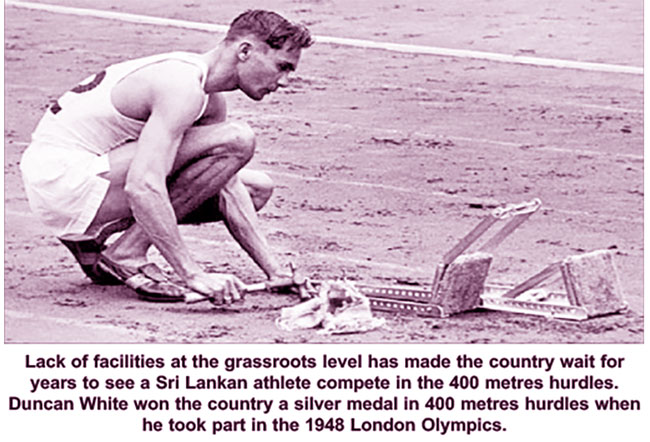
The 400 metres hurdles, a discipline in which the country won its first Olympic medal has lost its popularity from being probably the most popular track discipline in 1948 to be the least-interested athletics event among school children today. The lack of facilities and neglect by officials at Divisional and Zonal level is contributing to making the event less attractive and killing the interest of potential athletes who could one day win medals at the international level.  From lack of knowledge of coaches to train the technical event to lack of proper facilities (grounds), there could have been many other factors that had contributed to making the track discipline less appealing but there had been a number of athletes who have beaten the odds to win medals at the junior international level, proving that it is not a case of the dearth of talent.

After Duncan White won the country’s first medal at the 1948 London Olympics it took more than half a century for a Sri Lankan male even to earn an Olympic berth in that discipline. It also took more than five decades since Independence for a Sri Lankan male to win a 400 metres hurdles medal outside the South Asian region. In 2000 Harian Ratnayake won the Asian Athletics Championship silver and became the first Sri Lankan since Duncan White to take part in an Olympic 400 metres hurdles. Despite being the first Sri Lankan to run the distance under 50 seconds and winning silver at the Asian Championships, Ratnayake could not find a place in the semi-finals at the Sydney Olympics. Saudi Arabia’s Hadi Al-Somaily, Asia’s fastest that year went on to win a rare silver.

The 400 metres hurdle has been dominated by athletes from English speaking countries at the Olympics. While the competition among the English speaking countries has made the event faster than it had been a half-century ago, the standard of Sri Lanka’s 400 metres hurdles have remained stagnated.

When White finished second behind Leroy Cochran of the USA at the London Olympics he was just 0.07 seconds behind the winner who established a new Olympic record. The then world record was 50.6 seconds. During the last 73 years the world record has been improved by nearly four seconds. On the first of this month, the Norwegian champion Karsten Warholm broke the world record with a feat of 46.70 seconds (the record is subjected to World Athletics ratification).

The country’s national record of 49.44 seconds held by Ratnayake is more than two decades old now. Ratnayake, trained by S.M.G. Bandara and Asian Games medallist (relay) Asoka Jayasundara, trained by Sunil Gunawardena are the only athletes to have clocked sub 50 seconds in that discipline. The country’s top-level athletes today are much slower than the duo who won at the Asian level in their heyday.  At World Level more than 90 athletes clocked sub 50 seconds this year. Of them, 19 are from Asia. Sri Lanka’s fastest 400 metres hurdler this year is not even among the best 50 in Asia.

“Most of the current 400 metres hurdlers are athletes who had taken up the event after joining the Army. The motor abilities of an athlete have to be developed from a young age if he is to become a good hurdler. It takes years of training to become a good hurdler. Not many who take up hurdling at school level persevere,” says Asoka Jayasundara, the Asian Games medalist who trains several hurdlers.

The reason that many athletes do not take up 400 metres hurdles at school level could be attributed to the absence of facilities at the grass-root level. The vast majority of the country’s Divisional and Zonal schools athletics competitions are conducted on 200 metres tracks, which makes it impossible to conduct a proper 400 metres hurdles event. What the majority of organizers of Divisional meets do is to promote the few athletes who have applied for the event to the Zonal level. It is at the Divisional level that a young athlete first sees the event live. At a majority of Zonal meets too athletes competing in the 400 metres hurdles are given turns to run on a single set of hurdles. After finishing their turn, they wait around the timekeepers till all complete their turns to see who has produced the fastest time.

To be continued……….



Continue Reading
Advertisement
Click to comment

Leave a Reply

Your email address will not be published. Required fields are marked *

Latest News

West Indies, Sri Lanka and the two sides of pressure

Published

on

By

Deandra Dottin was brought to tears after being taken for runs at a critical juncture [Cricinfo]

If you want to know the kind of pressure West Indies have put themselves under at the 3036 T20 Women’s World Cup, watch Deandra Dottin during her second over against Scotland.

West Indies were defending 34 off the last three overs and Darcey Carter, albeit with an injury that was hampering her running, was on 50 and her sixth-wicket partnership with Ailsa Lister had grown to 45. Dottin was playing her 150th T20I and her match contribution was approaching negative territory. She scored 14 off 16 before being stumped in the midst of a middle-order strangle and her first over, which was the second of the innings, cost 13. With the spinners bowled out on a surface where they were more effective, Hayley Matthews had to turn to Dottin, who was her most experienced bowling hand.

With Lister on strike and pouncing on anything on off stump, Dottin’s plan was to cramp her for room. Her first delivery went down leg. As did her second. And her third. The first legitimate ball of the over was outside off and Lister ran one. Then Dottin overcompensated, went too far outside off and Carter swung and edged for four. Dottin dropped it shorter. Carter was beaten as she tried to pull. Dottin went even shorter and Carter cut for another four. Twelve runs came off the first four balls and Scotland’s requirement was cut to 23 off 15 balls and Dottin realised what she was doing.

Mid-over, Dottin broke down into an ugly cry. Tears poured from her as she scowled at the situation. Matthews and Chinelle Henry had to form a protective shield and coax her back from the brink. Whatever they said worked and Dottin fired in a yorker and another full ball that found the edge to close out the over well but the enormity of the situation had clearly affected her. What exactly was going on?

“It was just about the nerves that were going around. Being one of the leaders in the team, Hayley, myself, and a couple others just went and made her realise that she’s probably one of the best death bowlers we have in the team,” Henry said at the post-match press conference. “It was just about backing her skills, and she came out of that over pretty well. Deandra is one of those persons who is very emotional, a very passionate person who wears her heart on her sleeve. It’s just about trying to get her to remember that she is one of the best players we have to be out there at this moment. There were a lot of emotions going around at that time.”

That Matthews, once Dottin’s junior, and Henry, who was herself not fully fit after she sustained an injury in the warm-up match and then missed the first game, had to convince one of their most decorated players of her worth tells you as much as you need to know about West Indies’ insecurity.

It’s also worth remembering that Dottin has a history when it comes to hysterics. In 2017, when West Indies were bowled out for their second-lowest total of 48 by South Africa in the ODI World Cup in Leicester, Dottin also sobbed. Then, she was dismissed for a duck and conceded 23 off 3.2 overs, including the winning runs.

That tournament took place a year after West Indies were crowned T20 World Cup champions in 2016 but they were not even close to being in the running for the ODI cup. They finished sixth of the eight teams competing, and won only two of their seven matches. Since then, Dottin has tried to end her relationship with West Indies and retired in 2022, saying that “the current climate and team environment has been non-conducive to my ability to thrive and reignite my passion.” Two years later, she reversed that decision and said she was returning “enthusiastic about mentoring younger players and contributing to the overall development of women’s cricket in our region.”

“Because she cares so much, it breaks her when she can’t do what she wants for the team” Hayley Matthews on Deandra Dottin

She played the 2024 T20 World Cup, where West Indies reached the semi-final, and was their leading run-scorer at the event, so it may be a case of unfinished business that brought on the waterworks against Scotland. “Because she cares so much, it breaks her when she can’t do what she wants for the team,” Matthews told the post-match broadcast.

It’s fair to read that as a desperation to do well, and it seems to run through West Indies. After defeating defending champions New Zealand, thanks to a long-in-the-making career-best 90* from their most-capped T20I player, Shermaine Campbelle, they may have thought the hardest bit was over. But Scotland have recent history ofdumping West Indies out of tournaments and beat them in the ODI World Cup Qualifier last April. Losing to them would complicate matters, especially with matches against the hosts and before that Sri Lanka, who beat West Indies in a series in March, to come.

If you want to know what kind of pressure Sri Lanka have been able to absorb, watch the way Nilakshika Silva batted against New Zealand.

Sri Lanka had been downed by a massive 87 runs in the tournament opener by England. Their coach Jamie Siddons was so angry he could barely unclench his jaw to speak afterwards and chasing 151 against New Zealand, they slipped from 45 without loss in the powerplay to 55 for 4 in the ninth over. Their best batters were back in the dugout, or so we thought.

Nilakshika, who is 36 years old and had just one half-century to her name in 115 T20Is before this, should have been dismissed for 1 when she top-edged a sweep off Amelia Kerr. Inexplicably, New Zealand’s catching has been slippery throughout and the ball burst through Bree Illing’s hands at short fine. It took Nilakshika 12 balls before she found the boundary for the first time, off none other than New Zealand’s oldest hand on the day, Sophie Devine.

Sri Lanka needed 65 runs off 42 balls, with four wickets down and should have been favourites but on a seven-match losing streak at T20 World Cups, their odds were long. Nilashika didn’t care. She went after Devine again, this time in the field, when she sent Rosemary Mair towards Devine at deep midwicket, and over her for six. The Sri Lankan team sat huddled together, cheering every run as though it was the winning one. Chamari Athapaththu, the captain on whom the team was thought to revolve and who hit the innings’ only other maximum, sat alone, as though in meditation, watching.

She would not have enjoyed what she saw next. Nilakshika urged Kavisha Dilhari to try and take two runs off the last ball of the 15th over but Dilhari was ball-watching. She stayed at the non-striker’s end as Nilakshika joined her and then sacrificed herself so her senior partner could bat on. Sri Lanka needed 46 runs off 30 balls and the onus rested on Nilakshika and young wicket-keeper Kaushini Nuthyangana. The next over only yielded seven runs, a light drizzle enveloped the ground and maybe Athapaththu looked away. She didn’t have to.

Nilakshika’s excellent use of the crease and her ability to make room for herself brought three more boundaries, including a lap over short fine, a gorgeously timed cover drive and a sweep as she charged down to meet Melie Kerr’s last ball. Very few people would have known Nilakshika had that kind of big-match temperament in here but someone did: her bowling coach. “When Silva is fielding, she is mid-off, mid-off both sides, so she is running more than anyone else and she has done a lot of awesome work,” Chamila Gamage said afterwards. “Today, under pressure, it is a fantastic thing for us because we lost the first game and we needed to win this match, otherwise we can’t go to the semi-finals. I thought she batted really well under pressure.”

Nilkashika barely celebrated her fifty, which came with 14 runs still needed off 12 balls but let her emotions out when Nuthyangana smeared the winning runs over the on-side. She looked skywards several times while her team-mates hugged and fist-bumped and whooped on the side and even then, there seemed a restraint to her jubilation. Job done, more jobs to do, perhaps?

And that is what sets up the first match of Super Sunday as a West Indian side who are clearly feeling the heat take on a Sri Lankan team strutting around coolly. A place in the semi-final is on the cards for both. Victory for West Indies will see them take a massive step towards the final four but a Sri Lanka win keeps the group that many thought was a foregone conclusion before the tournament, tasty.

The crunch match between West Indies and Sri Lanka takes place in Bristol and starts at 10.30am.

[Cricinfo]

Continue Reading

Latest News

Lewis, Prendergast fifties in vain as Melie magic helps New Zealand win a thriller

Published

on

By

Melie Kerr's double-wicket over turned the game on its head [Cricinfo]

New Zealand had another poor day in the field and were nearly embarrassed by Ireland on a glorious sunny day in Southampton before the defending champions held their nerve and kept their semi-final chances alive with their first win of the tournament. It was far from a convincing day for New Zealand, who were reduced to 10 for 3 and 110 for 5 before the middle-order lifted them to 140. Ireland also kept New Zealand sweating for much of the 20 overs in the chase until the magic arm of Melie Kerr broke the century stand between Orla Prendergast and Gaby Lewis to bring the equation to 25 needed from 12.

Ireland needed 18 from eight balls once Lewis fell in the penultimate over, and the two new batters found it much tougher to nail the big shots. Louise Little and Leah Paul brought it down to 15 off the last over that was given to Suzie Bates, who was playing her first game of this World Cup, having replaced Sophie Devine, who fell sick just before the game. The lack of pace from Bates meant Paul and Little couldn’t find a boundary, and they fell short by four runs when they needed six off the last ball.

Now fourth in Group 2, New Zealand will know better than anyone that they will need far better performances to make the knockouts, as their last league game will be against England after they meet Scotland next.

At the helm for Ireland was Prendergast, who first dented New Zealand with her new-ball burst before her 45-ball half-century took Ireland agonisingly close, only three days after they gave England a scare too. New Zealand’s hero also turned out to be their allrounder Melie, who first pulled them out of a hole and picked two crucial wickets in the end.

New Zealand were in deep trouble early and lots had to do with Prendergast, who kept going for the top of middle stump and was rewarded twice. Isabella Gaze fell first when she missed a scoop on the first ball of the second over for just 1. That she fell the very next delivery after Georgia Plimmer had handed a catch straight to mid-off made the score 6 for 2.

Maddy Green had eaten up five dots and when she charged against Prendergast at the start of the third over, New Zealand had slipped to 10 for 3. Prendergast was, however, taken off after two overs that fetched her figures of 2 for 6 with eight dot balls. It was Melie who rescued them along with Brooke Halliday as the captain stepped out against the spinners regularly to rotate the strike and find boundaries while also scooping and cutting Arlene Kelly for back-to-back boundaries in the last over of the powerplay to lift the scoring rate.

Halliday was largely kept quiet at the start as Ireland bowled smartly to their fields. But Melie perished too, holing out to deep midwicket for 30 off 24 as the Ireland spinners took the pace off considerably to make hitting a lot tougher. While Halliday largely anchored, Isabella Sharp started to find the gaps more frequently as at last one boundary was hit from overs 10 to 13 to lift the run rate from under six to 6.61.

But Ireland fought back and dried up the boundaries for the next 35 balls while also removing the set batters. Halliday had just received some medical treatment and swept one straight to short fine leg for 34 in the 17th over before Sharp holed out to long-off for 36 off 28. Bates, batting at No. 7 for the first time in T20Is in her 19-year career, finally broke the boundary drought with a reverse lap and also ended the innings with a desperate six pulled from way outside off after exposing her stumps.

Left-arm quick Bree Illing gave New Zealand’s defence a fiery start with her pace close to 120kph and her height making things uncomfortable for Ireland’s top-order. She nailed an inswinging yorker to remove Amy Hunter for 2 before Prendergast and Lewis saw through her remaining three overs, which were bowled on the trot.

The rest of the attack didn’t look as threatening, which the duo of Prendergast and Lewis capitalised on, especially by stepping out and making room to find the gaps. Prendergast also got a life when a leaping Nensi Patel got a hand to a slice at point but only got fingertips. The pressure on New Zealand was visible as the runs kept coming and wickets eluded them by fine margins.

Lewis survived a loud lbw appeal on 25 off Melie in the ninth over and New Zealand lost a review as ball-tracking showed the ball was missing leg stump. Prendergast was given out lbw off Jess Kerr three overs later but a review saved her as ball-tracking again showed the ball going down leg. The duo picked a boundary each off Nensi in the next over to reduce the equation to 59 from 42. With only five bowlers at their disposal, the match was slipping out of New Zealand’s hands.

Melie had two overs left and she brought herself back for the 14th and Prendergast’s six off her on the leg side made it 50 from 36. That soon became 34 from 24 but Melie’s last attempt in the 18th over finally worked for New Zealand. She had Prendergast hole out to deep midwicket while Rebecca Stokell hit one to cover two balls later. The four-run over had turned the tables on Ireland. With 25 to get from 12, Lewis took charge as the set batter but she skied one to cover after a boundary and the match was now New Zealand’s to lose. Bates came on for the finishing touches with the ball too and only a streak of singles and doubles off her bowling found Ireland short.

SCORES:
New Zealand Women  140 for 6 in 20 overs  (Melie Kerr 30, Sharp 36, Brooke Halliday 34, Izzy Sharp 36, Suzie Bates 19*; Aaimee Maguire 1-32, Orla Prendergast 2-26, Arlene Kelly 1-25, Cara Murray 2-26) beat Ireland 136 for 4 in 20 overs (Orla Prendergast 59, Gaby Lewis 58; Rosemary Mair 1-31, Bree Illing 1-18,  Melie Kerr 2-23) by four runs

[Cricinfo]

Continue Reading

Sports

BCCI secretary hints at early start to IPL 2027

Published

on

By

Could IPL get an early start from next year onwards? (Cricbuzz)
BCCI secretary Devajit Saikia has hinted at the possibility of an early start to the IPL from next season onwards. Saikia stated that the BCCI and the IPL Governing Council are in discussions about starting the tournament sooner due to the extreme heat that the players and fans encounter as well as pre-monsoon showers that could disrupt games in the second half of May.

“This year, IPL started around March 29 [28], and it was over by May 31. Only thing which we are discussing is that during the fag end of the tournament after May 15… there is apprehension of having rainfall or pre-monsoon season starting,” Saikia told PTI.

“On the other hand, there is hot weather which is not very conducive either for the players or for the crowds. So therefore, there is a discussion going on in BCCI as well as in our IPL governing council regarding whether we can start the tournament a little bit earlier than the fag end of March.

Saikia went on to say that he’s looking at a window of March 10 to May 15 for the tournament.

“From next year, we will make an effort and I have already instructed our general manager (games development) [former India fast bowler Abey Kuruvilla] to look for the windows, whether we can start it by 10th of March and conclude it by 15th of May. So that there are no adverse weather conditions in the run-up to the playoffs and the finals of IPL 2027, which will be the 20th edition,” he said.

“I’m hearing a lot of complaints from the fans as well as from the players, because not all players are very well-equipped or well-acclimatised to play in such hot conditions,” he said. “So, to provide a pleasant atmosphere for the tournament, we want to close it by 15th of May. That is our first goal now, and that is the prime area of concern for the next year’s 20th edition of IPL, which will be a big event.”

Interestingly, the Border-Gavaskar series at home, comprising five Test matches, is scheduled to go on till March 3 if the fifth and final Test goes on for all five days. Also, England and Australia players will be occupied with the 150th Anniversary Test match, set to be played at Lord’s in London from March 11 to 15.

No league-stage expansion for now

Saikia also confirmed that expanding the league stage of the tournament cannot be done at the moment. Since 2022, when the IPL became a 10-team event, there have been 74 games in all – 70 league stage fixtures where teams play twice against a few teams and once against a few others, and four playoffs matches. There were expectations of the tournament expanding to 94 matches where every team plays twice against the other nine in the league, but that idea has been parked for now. IPL chairman Arun Dhumal had previously stated that discussions for such a possibility will be had after the 2027 season. .

“That is not feasible right at this moment because we have to consider many other factors regarding various players coming from various nations,” Saikia said. “With lot of difficulties we are getting this two months window. It will be very difficult to go beyond two months because other countries also have to play bilateral matches… So at this moment there is no discussion regarding increasing matches from 74 to 94. Not happening immediately.”

“In course of later years, I do not know what will be the position but right at this moment, I don’t see any possibility of increasing it from 74 to 94 [matches] because for that it is not only India that is to be considered but also the interest of other cricketing nations of the ICC especially players from Australia, England, New Zealand, South Africa, West Indies. We do not want to upset bilateral matches also and other multi-country tournaments,” Saikia opined.

“If you look at our domestic cricket, it is a robust system which is in place. We started sometime in the later part of August with Irani Trophy and all the matches, and it goes up to the Ranji Trophy final, which happens in the month of March. Already, we have about 7-8 months long period of domestic cricket. We have to squeeze in some of the matches, so that we finish our domestic cricket by 10th of March, so that we can start it [the IPL] immediately,” he added.

Continue Reading

Trending