
Features
Wage increase makes mockery of collective bargaining


by J. A. A. S. Ranasinghe
Productivity Specialist and Management Consultant.
This addendum to the topic is based on the incisive analysis of the plantation wages: Collective Bargaining or otherwise by Gotabaya Dasanayaka (GD) in The Island of 01st March 2021. The eminent labour legislation specialist, former Director General of the Employers Federation of Ceylon (EFC) has most undoubtedly hit the nail on the head drawing the attention of the readers to more sensitive aspects revolving round the importance of the time-tested collective bargaining systems prevailed in the determination of wages of the plantation workers for over three decades in particular as well as to the possible economic consequences, the new wage structure gives rise to the survival of the plantation industry in general.
Industrial Dispute Act No 43 of 1950 (ID Act)
The ID Act quite explicitly deals with the functions of the Commissioner of Labour (CL) under part 11 of the Act which says when an industrial dispute arose, it shall be the duty of the CL to refer such disputes for settlement by conciliation or by arbitration or by an Industrial Court including that of a District Court. It should be noted here that neither the Minister in charge of Labour nor the Commissioner of Labour (CL) nor the Deputy Commissioner of Labour (Industrial Relations) nor any other authorized person seems to have the gumption to abide by aforesaid conciliatory methods as envisaged in the ID Act, when the collective bargaining process of the plantation workers came to a deadlock a few weeks ago.
The most sensible course of action what the Minister or the CL should have done was to have recourse the dispute in question to a compulsory arbitration as per the provisions of the ID Act for a just and equitable award as articulated by GD. The reluctance on the part of the Minister to refer this sensitive issue to the compulsory arbitration is a moot point. Probably, he may have thought that the decision of the arbitration would not be favourable to the trade union demands. On the other hand, he may have thought that the reference to the arbitration is a time-consuming affair and the trade unions agitation is too severe to be ignored. However, it is crystal clear that the Minister had totally condemned the gist of the ID Act in toto by referring it to the Wages Board by circumventing all the bottlenecks in the pipeline for the first time in the history by creating a new precedent. It must be stated here that nowhere in the ID Act that an unfettered latitude is granted for the Minister to refer this labour dispute to the Wages Board. It is highly questionable as to why the Regional Plantation Companies did not challenge the Labour Minister’s arbitrary decision by way of a writ before the court and finally bore the brunt of the unconscious increase of the wages, which has far-reaching ramifications over the plantation industry and the smallholder sector.
Wages Board Ordinance (WBO)
Under section 8 of the WBO, the minister is empowered to establish Wages Board (WB) for any trade. It is a tripartite constituency representing the officials of the Labour Department, employers and employees of a particular trade. At present, there are 45 wages boards for different trades including that of plantation, agriculture and manufacturing industries and they receive minimum wages protection under this WBO. As regards the plantation sector, employees of rubber plantations 25 acres and above, coconut plantations 10 acres and above and tea plantations-no limit on acreage, are protected by the WBO. Though WB has been in existence for the last seven decades, the collective bargaining process initiated by the ID Act and the WBO functioned in tandem without interfering in each other’s territory.
As a matter of fact, collective bargaining process is more instrumental among the more organized sector where collective agreements are in force. By and large, the wage structure in the organized sector where collective bargaining operate is far superior to that of the establishments covered by the Wages Board. The minimum wages paid to employees covered by the WBO are conspicuously lower than the wages paid under the collective agreements. The Wages Boards are considered to be subsistence level wages as referred to above and in sectors where the trade unions are virtually non-existent. Hence, it is unprecedented that a matter which is subject to collective agreement was referred to wages board by the Minister of Labour in the annals of the labour movement of this country without realizing the repercussions that could arise. It is true that the plantation workers were covered by a Collective Agreement and periodically it has been renewed after collective bargaining. In a matter covered by Collective Agreement, if any dispute arose, the matter should have been referred to compulsory arbitration under the ID Act. However, in this instance, it is surprising that the issue was referred to the relevant wages board at the instance of the Minister of Labour.
Wage Impact on the industry
Mr. GD in his well-articulated article made a comparison between the wage structure of the different Wages Board in selected trades and the proposed daily minimum wage for the Tea and Rubber Growing and Manufacturing Trades and pointed out the huge disparity, if the proposed daily minimum wage of Rs. 1,000/= is paid across the board. Both the tea and rubber sectors are owned 70% by the smallholders, definitely the proposed increase will have a deleterious impact on the productivity of the tea and rubber sectors and the smallholders can ill-afford to bear the increased wage at this juncture. Right at the moment, a large number of rubber small holders in Kegalle, Kalutara and Ratnapura districts have abandoned their plots in the face of the exsisting wages and the dearth of labour. Right at the moment, Regional Plantation Companies (RPCs) make a desperate attempt to contain the high cost of production and there will be an inevitable impact-detrimental to the well-being of the industry, in the face of the enhanced wages approved by the Wages Board.
GD in his article had incorporated the minimum wages applicable to selected eight trades to pinpoint the irrational disparity of wages and I would go further to highlight the inadvisability of enhancing wages through the wages board mechanism.
The Collective Bargaining process stipulated in the ID Act provided a reasonable effective mechanism to maintain healthy industrial relations and a healthy industrial peace and harmony for the last 30 years. Moreover, the sustainability of the industry and the commercial viability on the basis of labour productivity, profitability and the efficiency of operations were some of the key prime-movers at the collective bargaining table, which both parties took cognizance of seriously. Every Dick, Tom and Harry knew quite well that the government made a solemn pledge at the Presidential Election as well as the last Parliamentary election that the daily wage of the estate workers would be enhanced to Rs. 1,000/= as per the election manifesto (Chapter 10 of the Vistas of Prosperity and Splendour). It is this pledge that the government had to initiate at the last Annual Budget at the instigation of the labour trade unions in the estate sector.
Obviously, there are many obstacles both statutory and bureaucratic in the implementation of this pledge. The Commissioner of Labour (CL) who was well versed in the sustainability of the estate sector and the procedural initiatives involved as per the ID Act and Collective Bargaining Process was seen as a stumbling block and he had to be booted out by installing a provincial bureaucratic who was absolutely unaware of the commercial viability of the plantation sector, which is associated with many operational and financial ills.
It must be stated here in fairness to the former Commissioners of Labour in the calibre of Mr. G.Weerakoon and Mr. Mahinda Madihahewa who had served the Labour Department with distinction adroitly and they did not succumb to the political pressure and had the capacity to appraise both sides when critical labour issues arose in fairness to both parties but they relied heavily on the sustainability of the industry on a more priority basis in solving labour disputes. The Government realized that the collective bargaining process outlined in the ID Act was an impediment to the smooth implementation of the proposed wage structure. So, the government insidiously shifted from the time-tested mechanism of collective bargaining process to Wages Board to expedite the process. According to the grapevine circulating in the Labour Secretariat that three strong party acolytes were brought in as nominated members of the Minister to the Wages Board in order to ensure the easy passage of wage increment of Rs. 1,000/=.
Future Trends of the Labour Movement.
From the pattern of the signals hitherto displayed by the government that came into power in 2019, it appears that every vibrant sector would be confronted with insurmountable labour agitations. Firstly, the industry has been agitating to do away with the obnoxious requirement of paying Rs, 200,000/= in case of terminations under the Employment of Termination Act. The employers pointed out over a decade of time that it was difficult to bring in foreign investment with such a legislation. The government did a U Turn by enhancing the payment of compensation to Rs. 400,000/= instead of scrapping this piece of legislation. Secondly, the amount of workmen compensation in the event of a death of an employee due to a fatal accident was increased almost double, placing more financial burden to the employers at the instigation of the trade unions. The third scenario was the manner in which it deviated from the time-tested collective bargaining mechanism and imposed unbearable financial constraints by way of enhanced wages to the employees of the plantation industry. The industry is unaware of any other ill-logical motives to be moved in the pipe-line against the well-being of the industry in the foreseeable future. What would happen if the rest of the Wages Boards request enhanced wages quoting the unprecedented mechanism adopted by the government and the resultant chaos would be inevitable. Unlike those days, the trade unions have become more aggressive with their political affiliations with the government and the civil society too have extended their support to trade unions to win over their demands, as can be seen from the Colombo Port ECT deal. There is obviously writing on the wall that the country would be inundated with heaps of labour unrest issues with the wrong signals given by the government.
Financial assistance to RPCs
It is factually correct that Regional Plantation Companies (RPCs) and smallholders were resisting the wage increase proposal on the ground that the financial resources do not permit them to incur this heavy expenditure. If this is the truth, nothing but the truth and the whole truth, the government has an inalienable duty to provide some financial assistance to RPCs by resorting to unorthodox avenues to alleviate its financial suffering even on short time basis. In this regard, Dr.Janaka Ratnasiri, a regular writer to The Island newspaper has made a pragmatic proposal in his feature dated 16th February 2021. He contends that export of tea is subject to a CESS levied at Rs. 10/- per Kg which works out to LKR 2.9 billion. Out of this, Rs. One billion is collected as tea promotion levy by Sri Lanka Tea Board from the exporters. Another 1% or 2.4 billion has to be paid to Brokers for conducting the auctions and carrying out quality control checks and certifying on samples received. These brokers comprising 8 Companies deserve it because they ensure that quality tea is exported. After paying taxes, the exporters are still left with a profit marginof about 65 billion annually. Dr. Janaka Ratnasiri argues that would be more prudent to share this profit among this plantation workers. Otherwise, it could be proportionately be distributed among the RPCs so that heavy financial implications arising out of this wage commitment could be mitigated.
Crises in the plantation industry
Consequent to the announcement of the new wage increase given to the plantation employees, there has not been any knee-jerk reaction from the plantation companies for the last one week. Their studious silence will have to be observed with much circumspection. Both the tea and rubber industries are on the verge of collapse owing to heavy financial implications and it is not clear as to how they absorb this unforeseen expenditure. It is certain that the Regional Plantation Companies (RPCs) would continue to incur heavy losses with this wage commitment. It could be reasonably assumed that the production and its quality will be the immediate casualties and this trend, if any, does not auger well for the sustainability of the plantation industry.
It would have been the ideal opportunity for the Labour Ministry to harp on productivity-based wage model as a bargaining tool, which the ministry has pathetically failed to convince, given the sizable salary package. The word “productivity” is anathema to trade unions in Sri Lanka including that of the plantation trade unions. The ramifications arising out of this wage increase are far-reaching in character and it is advisable for the Employers Federation of Ceylon to educate the members of its broader ill effects by way of a public seminar and convey its dissatisfaction to the government.
The biggest casualty in the aforesaid wage episode is the gradual demise of the collective bargaining process that led to Collective Agreements and plantation companies will have to think twice whether there is any rationale in entering into Collective Agreements by giving enhanced wages and other perks, if ill-conceived mechanisms are adopted by the government to give enhanced wages through Wages Boards by ignoring time-tested collective bargaining mechanism.
(The views contained in this article are the professional views of the writer and he could be contacted on athularanasinghe88@yahoo.com)

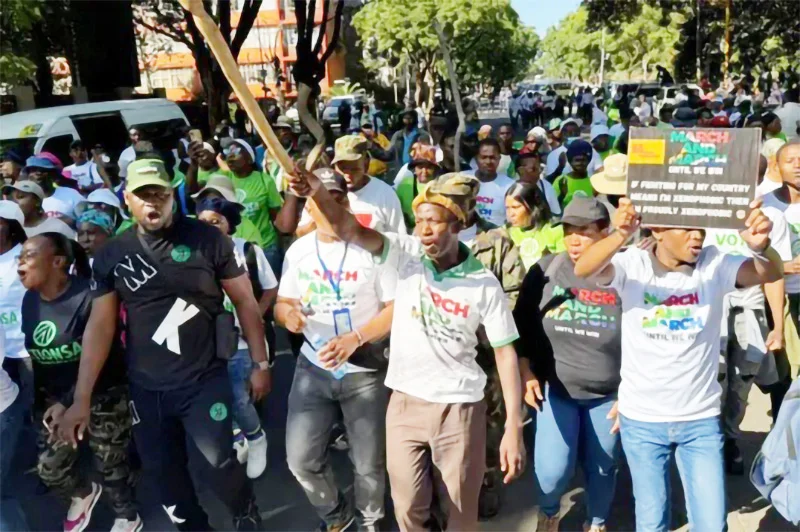
 The current outbreak of anti-immigrant protests in Durban, South Africa is bound to have taken many a subscriber to value-based politics or political idealism quite by surprise. After all, this is evidence that despite the historic accomplishments of nation-builders of the stature of the late President Nelson Mandela it cannot be taken for granted that identity politics, including racism in its worst forms, is no more in South Africa.
At the time of this writing details are scarce on the substantive root causes of the protests but it could very well be that economic grievances, particularly on the part of the majority community in South Africa, are contributing considerably to the disaffection. Shrinking employment and material prospects are likely to figure majorly among the factors igniting the unrest.
Fortunately, the local authorities in Durban are losing no time in calling for peaceful co-existence among the relevant communities and are pointing to the vital importance of stepping-up national integration processes. Apparently, immigrants in sizable numbers from neighbouring countries are present in Durban. However, international TV footage of the protests quoted some local authorities as saying that the majority of the immigrants in some centres that housed them were not illegal migrants and had the documents that entitle them to be in Durban.
In the Durban protests the world has fresh proof of the socially divisive consequences of the gathering globe-wide economic disaffection, touched off particularly by the continuing crisis in West Asia. Going ahead, the world would need to brace for increasing identity-based unrest of the kind it is just witnessing in South Africa.
Considering that the material lot of ordinary people everywhere could only aggravate progressively, with the US and Iran showing no signs of negotiating an end to their confrontation any time soon, it will be left to the more democratic and progressive sections of the world community to initiate positive measures collectively to bring a measure of relief to the discontented.
The swiftness with which such relief will be provided would depend crucially on the importance those sections taking up these undertakings attach to value-based politics as opposed to Realpolitik of power politics.
Going by these yardsticks, Italy could be considered to be moving in the right direction. Recently Italy came to the fore in initiating the collective named, ‘Rome Coalition for Food Security and Access to Fertilizer’, which has as one of its aims the swift provision of fertilizer to economically weak African countries.
In a recent statement Italian Minister of Foreign Affairs and International Cooperation, Antonio Tajani, said that a principal aim of the project was to ensure that the farmers of Africa gained easy access to fertilizer, considering that food security is a growing concern among some of Africa’s economically vulnerable countries.
The statement went on to mention that some 30 countries hailing from the Mediterranean region, the Middle East, the Balkans as well as the FAO had been invited to join the coalition. The venture is far-seeing in that food security is main among the reasons for social discontent which in turn could degenerate into endemic political turmoil and bloodshed. Separatist violence and geographical fragmentation of countries wouldn’t be too far behind these developments, as Africa itself has often proved.
It is hoped that more G7 countries would take the cue from Italy and do what they could to ease the hardships of economically distressed countries, particularly of the global South. In these efforts they would need to break rank with the US, which is today brutally indifferent to the consequences of its policy of making ‘America First’, come what may.
Going by current developments, the Trump administration seems to be blithely oblivious to the wider, deleterious effects of its policy course in West Asia. Besides rendering Iran militarily and otherwise impotent nothing else seems to matter to Washington, as regards West Asia. This is policy short-sightedness of an extreme kind. After all, right now West Asia could be said to be sitting on the proverbial powder keg.
On the other hand, Iran is not giving the world the impression that it is doing anything constructive to get out of the policy straitjacket that it wove for itself decades ago. Rather than enter into a policy of ‘live and let live’ in relation to Israel in particular and initiate a process of reconciliation with the latter, it has chosen to operate within policy parameters that continue to damn Israel. This has put Israel always on the ‘defensive’ so to speak and prevented the opening up of space for meaningful dialogue.
That said, Israel is obliged to explore the possibilities of entering into a negotiatory process with the Arab-Islamic world that could lead to a de-escalation of tensions and bloodshed. It cannot continue to look at its neighbours through lenses that distort them as archetypal enemies who should be ‘wiped off completely from the face of the earth.’
In other words, the need is urgent for Realpolitik to give way to value-based politicks. Italy is beginning to prove that the latter approach could be pursued with some success. May be the EU and the UK could throw their weight behind these initiatives as well and establish that international politics could be refashioned on the basis of humane, civilized norms. The UN would need to be fully supportive of these moves and prove an organizational nucleus of the operations that follow.
In fact the time is ripe for people of conscience to collectively stand up on the side of peace and say ‘No’ to war and violence. Organizations such as the ICRC, the WHO and Medicines Sans Frontiers have already taken up this call. Referring to the widespread destruction of health facilities and their dehumanizing results these organizations have said, among other things, that ‘This is not a failure of the law. It is a failure of political will.’
True, ‘failure of political will’ among those powers that matter accounts for the runaway, uncontrollable nature of war and destruction in contemporary times, but more fundamentally it is a failure of the human conscience. It could very well be that the phenomenal levels to which violence and war have been unleashed today have had the effect of deadening consciences. This is a matter for urgent study and wide discussion.

 I would describe Indunil Kaushalya Dissanayaka as innovative and creative, and she operates under the name of Cuteefly.
Indunil always comes up with something novel to celebrate special occasions, and she does it with candles … and that’s her profession.
She was in the spotlight when she created a happening scene, with candles, for Christmas, Sinhala and Tamil New Year, and Valentine’s Day.
As lanterns light up Sri Lanka for Vesak, the Colombo-based candle maker is quietly turning wax and wick into little pieces of the festival.

Candles reflecting Vesak themes
Her candles reflect Vesak themes – light, peace, remembrance, giving, etc., to enable you to fill your Vesak celebration with devotion and beauty.
Among her Vesak creations is a lotus-shaped soy candle, scented with sandalwood, lavender, etc., meant to burn during this Vesak Poya Day.

Indunil Kaushalya Dissanayaka: Customers
praise her for her creativity
These handcrafted Vesak candles are perfect for offering at the temple, she says.
What makes her creations so novel is that they come in different shapes, scents, themes, and all are handmade.
What’s more, her customers have heaped praise on her for her creativity.
According to Indunil, her creations are perfect as a thoughtful gift … to bring beauty, unity, and light into every moment.
Says Indunil: “Our beautifully handcrafted Unity candles are designed with premium detail and love, making them perfect for celebrations, gifts, and meaningful occasions.”
Cuteefly, says Indunil, is available online.
Readers could contact Indunil on 0778506066 for more details.
He Facebook Page is: Cuteefly.

Handmade with love

 Yes, dark spots do crop up on the skin, especially with sun exposure and, of course, as the skin ages.
However, these tips should be of immense benefit to those who are faced with dark spots.
* Lemon and Honey Glow Mask:
You will need 01 teaspoon lemon juice and 01 teaspoon honey.
Mix the lemon juice and honey well and then apply this mixture, only on the dark spots.
Leave for 10–15 minutes and then rinse with cool water.
Benefits:
Lemon helps brighten pigmentation.
Honey moisturises and heals skin.
Gives a natural glow.
* Aloe Vera Gel Treatment:
All you need is fresh aloe vera gel.
Apply the gel apply on dark spots, before going to bed.
Leave overnight and wash in the morning.
Benefits:
Reduces acne marks and pigmentation.
Soothes irritated skin.
Helps skin repair naturally.
* Turmeric and Yoghurt Paste:
You will need 01 teaspoon yoghurt and a pinch of turmeric
Mix the yoghurt and turmeric into a smooth paste and apply on affected areas.
Leave for 15 minutes and then wash gently with lukewarm water.
Benefits:
Turmeric brightens skin naturally.
Yoghurt removes dead skin cells.
Helps fade dark spots gradually.
Use these packs 02-03 times a week as results are generally seen over time.
You can also try this out: Mix a ripe papaya into a smooth paste and apply to the face, or directly on to the dark spots. Leave for 15-20 minutes and then wash with lukewarm water.

Advisory for strong winds and rough seas for the sea areas extending from Kankasanthurai to Chilaw via Mannar and from Galle to Pottuvil via Hambantota

West Indies to host Sri Lanka, New Zealand and Pakistan in 2026 home season

Hacking claims, mismatched answer-sheets: Controversies rock school exam in India

Iran says it targeted American base after fresh US strikes

Farmers Affected by the Nilwala Salinity Barrier paid Rs. 1.2 Billion in Compensation

State Vesak Festival held with the participation of the President

‘Dates have the highest sugar content to fight Coronavirus’

Sunday Island 27 December – Headlines

#SundayIsland 17th December – Headlines

Sunday Island – 28th March

Sunday Island Headlines – 21 March

Sunday Island – 21st February – Headlines
-

 Business7 days ago
Historic launch of CCWE Fashion Week & International Summit 2026
-

 News5 days ago
All-New GRAVITE launches at LKR 6.99 Mn
-

 Features5 days ago
The NPP’s pivot to the past
-

 News4 days ago
Police probe underway to ascertain links between criminals deported from UAE and local politicians
-

 News3 days ago
Easter Sunday carnage: Court told Maulana’s statement cannot be accepted without cross-examination
-

 Opinion7 days ago
The need to reform Buddhist ecclesiastical order
-

 Features5 days ago
End of Peacekeeping
-
 Opinion3 days ago
Undermining the democratic political framework