
Sports
Vishwa, Tharindu shine as Joseph Vaz record first win

Under 19 Cricket
by Reemus Fernando
Vishwa Rajapaksha and Tharindu Eshan bagged seven wickets each to lead St. Joseph Vaz’s College to an impressive 81 runs victory over Dharmasoka College in the Under 19 Division I Tier ‘B’ tournament match at Ambalangoda on Tuesday.
Rajapaksha set the stage for victory taking five wickets in the first innings to reduce the home team to 121 runs.
In their second innings the home team were dismissed for 125 runs as Rajapaksha and Eshan shared seven wickets between them.
It is the first victory in the tournament proper for the team from Wennappuwa.
Match Results
Joseph Vaz triumph at Ambalangoda
Scores:
St.Joseph Vaz’s
185 all out in 59.5 overs (Kavindu Premarathna 39, Kavith Fernando 33; Senura Sanoayuru 2/22, Jithira Sansika 2/23, Pathum Malitha 2/27, Senitha Halabage 2/41) and 142 all out in 40.4 overs (Isuru Jayasekara 29, Suhanda Fernando 23; Senitha Helambage 4/49, Jithira Sansika 3/36, Pathum Malitha 2/23)
Dharmasoka
121 all out in 45.5 overs (Senitha Halabage 31; Vishwa Rajapaksha 5/20, Tharindu Eshan 3/41) and 125 all out in 43.4 overs (Ishan Anurada 39, Pathum Malitha 25; Janith Fernando 3/23, Tharindu Eshan 4/42, Vishwa Rajapaksha 2/32)
First innings win for Sebs at Moratuwa
Scores:
Wesley
276 all out in 70.2 overs (Linal Subasinghe 42, Uvin Perera 86; Malintha Silva 7/59) and 243 all out in 55.4 overs (Lithum Sanjula 96; Manuja Chanthuka 4/77, Malintha Silva 2/54, Navod Fernando 3/53)
St. Sebastian’s
288 all out in 60.1 overs (Manuja Chanthuka 86, Malintha Silva 65; Sanithu Amarasinghe 4/76, Uvin Perera 4/44) and 94 for 3 in 15 overs (Ushen Silva 44n.o., Vimath Dinsara 29n.o.)
Bens in first innings win at Kotahena
Scores:
St. Benedict’s
224 all out in 67.2 overs (Sharujan Shanmuganathan 85, Mevan Dissanayake 28, Janindu Sanchila 28, Nilesh Perera 2/07, Yohan Aloka 2/28, Ameesha Fernando 2/43, Hasindu Perera 2/60) and 195 for 8 decl. in 55.5 overs (Sharujan Shanmuganathan 57, Steve Arshan 55; Ramith Bandara 3/06)
Maris Stella
173 all out in 54.5 overs (Shafni Deen 51; Nirwan Jayathilaka 3/39, Mevan Dissanayake 4/59) and 87 for 4 in 18 overs
Cambrians take first innings lead at Moratuwa
Scores:
St. Anne’s
112 all out in 29.5 overs (Kushan Subasinghe 31; Uneth Peiris 3/29, Rasindu Fernando 2/18, Achala Perera 4/33)
Prince of Wales
225 for 4 in 58 overs (Suwas Fernando 106n.o., Oshan de Silva 41)
Maliyadewa ahead at Kurunegala
Scores:
S. Thomas’
149 all out in 48.3 Overs (Thisen Eheliyagoda 41, Mahith Perera 33, Kavindu Dias 22; Dimantha Arusha 4/14, Dimath Abeysinghe 4/47)
Maliyadeva
153 for 5 in 50.4 overs (Chandupa Abeysinghe 50n.o, Gayana Weerasinghe 80;
Kavindu Dias 2/24)
Holy Cross in trouble at BRC
Scores:
Lumbini
227 all out in 60.4 overs (Shahan Kaushalya 32, Dinitha Prabhanka 28, Ashan Shanilka 27, Dumindu Sewmina 71n.o.; Akash Dewmina 4/42, Sithru Chamathka 4/13)
Holy Cross
34 for 5 in 19 overs (Shahan Kaushalya 2/10, Ushan Sathsara 2/05)






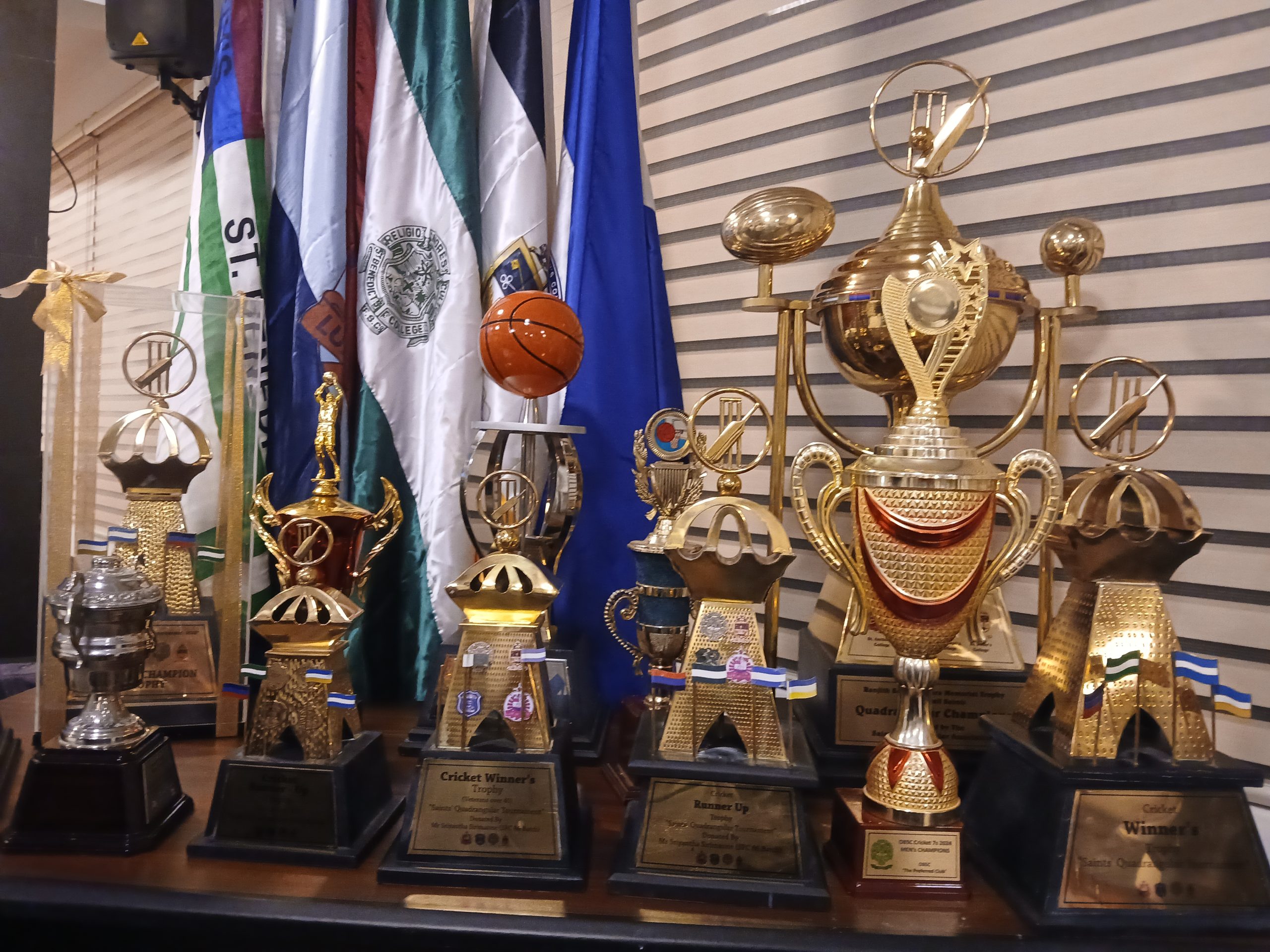
The much-anticipated 57th Annual Saints’ Quadrangular Tournament which brings together four of Sri Lanka’s leading Catholic schools, St. Anthony’s College, Kandy, St. Benedict’s College, Colombo 13, St.Joseph’s College, Colombo 10, and St. Peter’s College, Colombo 04, for a weekend of spirited competition, camaraderie and nostalgia is scheduled to take place this weekend (weather permitting).
This year’s tournament is being hosted by the St. Peter’s College Old Boys’ Union (SPCOBU) during its Centenary year, marking 100 years since the Union was founded in 1927. The Centenary celebrates a century of service to the College and the Peterite community, under the theme “Honouring the Past, Strengthening the Present, Inspiring the Peterite of Tomorrow.”
The origins of the ‘Saints Quadrangular Tournament’ trace back to 1963, during the Diamond Jubilee celebrations of St. Benedict’s College. An open invitation was extended to schools across the country for a cricket tournament, and coincidentally, only the above three premier Catholic institutions joined
Continuing its evolution, 7-a-side Rugby was introduced in 2014, transforming the Saints’ Quadrangular into a vibrant sports carnival that now features three major sports across four tournaments namely Cricket, over 40 Cricket, Basketball, and Rugby.
This year the organizing committee has opened the doors to four sister schools as well. Good Sheperd Convent Kandy, Good Shepherd Convent Colombo, St Bridget’s Convent and Holy Family Convent Bambalapitiya, are to play a six a side ladies’ softball cricket tournament and a ladies’ basketball tournament.
Each sport at the Quadrangular carries its own prestigious silverware:
The Quadrangular Trophy is awarded to the winners of the two Cricket tournaments.
The Very Rev. Fr. Joe E. Wickramasinghe Trophy is presented to the Basketball champions.
The Ranjith Samarasekera Challenge Trophy is awarded to the Overall winners of the tournament.

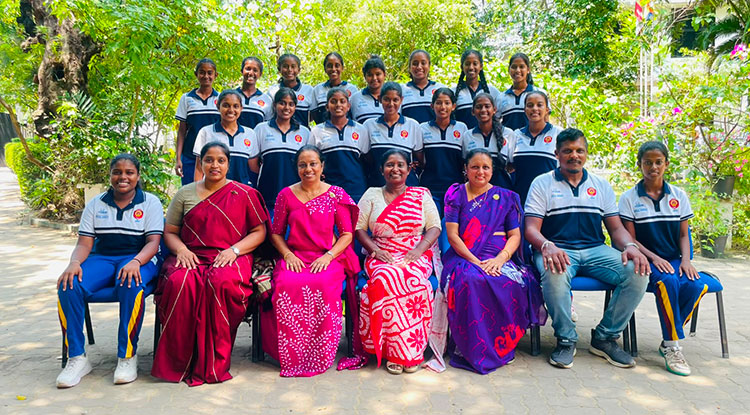
President’s Balika Nawala, won the girls’ hockey title at the All Island Schools Games, held recently at the Astro Turf, Reid Avenue. It was the second consecutive year the school had claimed the title.
Nethuli Dinethmi, who played a vital role in the team’s success, was named Best Player of the tournament.The victorious team is pictured here with the school’s officials, namely, H.P.M.P.D.Hasanthi Pathirathna, Principal, S.K.Tharsha Ranasinghe, Vice Principal, M.D.D. Aloka Dissanayake, Teacher in Charge of Sports, R.P.D. Dilrukshi, Teacher in Charge of Sports and Chathura Kalum Rupasinghe (Coach).
(Pic by Thushara Athapaththu)

by Rex Clementine
Sri Lanka were once pioneers in limited overs cricket, setting the bar so high that the rest of the world was left scrambling to catch up. And mind you, this was not confined to the 50 over format, where Sri Lanka tore up the coaching manuals, embraced an unconventional brand of cricket and took the world by storm.
Even in T20 cricket, despite not possessing an abundance of power hitters, Sri Lanka punched well above their weight.
Clever improvisation, fearless innovation and a willingness to back unorthodox talent helped them make the cricketing world eat humble pie. Fast forward to the present, however, and the picture is anything but rosy. Sri Lanka’s T20 cricket is in a sorry state, and there is no hiding the mountain of work ahead.
In Pakistan, their shortcomings have been laid bare, with the team repeatedly found wanting and left high and dry.
Successive administrations have tried every trick in the book to arrest the slide. Power hitting coaches have been brought in, psychologists engaged, players given unrestricted access to franchise leagues and emerging talent afforded regular exposure. Yet, for all these efforts, Sri Lanka’s players, particularly the batters, have struggled to raise the bar.
The series defeat to Pakistan was Sri Lanka’s fifth this year. Add to that the disappointments at the World Cup and the Asian Games and the picture becomes even more depressing. True, Sri Lanka returned from Japan with a bronze medal, but India provided a brutal reminder of the widening gulf between the haves and the have nots.
So, where do Sri Lanka go from here?
The Cricket Committee would do well to pick the brains of captains and coaches who have cracked the T20 code in recent years. There is no shame in learning from those who have mastered the format. The challenge is to identify a blueprint for su ccess and see how best those ideas can be adapted to Sri Lankan cricket.
Head coach Gary Kirsten himself has worked with successful franchises around the world. Perhaps he should be given a free hand to bring in specialist expertise if he believes that is what the team needs.
For all the disappointments in T20 cricket, fielding had remained one area where Sri Lanka could still hold their heads high. Alarmingly, even that department is beginning to unravel. The wheels appear to be coming off in a discipline that was once a hallmark of Sri Lankan cricket.
There were, however, a few encouraging signs in the final game against Pakistan. The manner in which Kusal Mendis went about his business was a breath of fresh air. The Sri Lankan captain struck at an impressive 181, combining clean hitting with the sort of innovation that has been conspicuously absent from the team’s batting.
Kamindu Mendis, too, showed signs of returning to form and Sri Lankan supporters will be hoping the pair can carry that momentum into the triangular ODI competition, also featuring England, which gets underway later this week.
Sri Lanka badly missed Pathum Nissanka, their highest ranked T20I batter at number nine in the ICC rankings. His absence robbed the batting line up of much needed quality and consistency. To compound matters, a troublesome hamstring has left his participation in the ODI leg uncertain as well.
The occasional flash of brilliance may offer some comfort, but it cannot disguise the larger malaise. Sri Lanka were once the trendsetters in limited overs cricket. Today, they are struggling to keep pace with the rest. Unless there is a serious rethink, the gap will only grow wider.

57th Annual Saints’ Quadrangular Tournament on Saturday and Sunday

Showers or thundershowers will occur at most parts of the island

Prison rules to be revised over monks’ attire

AC President recuses himself from hearing prison attire case pertaining to Gnanasara Thera

Court orders steps to obtain INTERPOL Red Notice against Basil

CID informs Fort Magistrate’s Court investigation into money laundering case against Namal completed

‘Dates have the highest sugar content to fight Coronavirus’

Sunday Island 27 December – Headlines

#SundayIsland 17th December – Headlines

Sunday Island – 28th March

Sunday Island Headlines – 21 March

Sunday Island – 21st February – Headlines
-

 News6 days ago
NDB fraud Rs 60mn more than reported
-

 News6 days ago
Removing monk’s robes matter for Sangha to decide: Mahanayake Theras
-

 News5 days ago
NPP govt. reminded of its responsibilities as US warship leaves Colombo
-

 News4 days ago
Sri Lanka escalates anti-graft drive with Shiranthi’s jailing
-
 Latest News6 days ago
Farhan, Sadaqat help Pakistan ace 183 chase to go 1-0 up
-
 News6 days ago
BHC, Colombo: “LTTE remains a proscribed org. in the UK”
-

 Latest News4 days ago
Farhan and Sadaqat help Pakistan seal series in style
-

 News4 days ago
Iranian ships stranded, Lanka fears US sanctions