
Opinion
Vidya Jyothi Gemunu Silva: The Ancient and Modern man


By Capt G.A.Fernando,
(RCyAF, Air Ceylon, Air Lanka, Singapore Airlines, and SriLankan Airlines)
In April, 1971, not long after the JVP Insurgency started, I was amongst a large crowd of young men, gathered at the Government Services Grounds, on Parsons Road, Colombo, jostling with each other, as we waited to volunteer our services to the Royal Ceylon Air Force (RCyAF).
While waiting for our names to be called, we heard an officer yell out, “Stand back all of you, except for this boy [he said pointing at me], or I am going to shoot!” The voice belonged to Squadron Leader Rex Fernando, Commanding Officer Designate of the Volunteer Air Force Reserve. Not surprisingly, his order and threat had the desired effect, and everyone promptly stood back to give him ‘breathing space’.
My name was the first to be called. The next was that of Gemunu Silva. As we were the first two, Gemunu and I had time to sit and get to know each other. His first question to me was, “Are you a pilot?” When I said yes, he said that he was a Mechanical Engineer at the State Engineering Corporation (SEC), and that he had a Student Pilot’s Licence, although it had been “destroyed” by his mother who didn’t want him to fly! Thus began a friendship between us which lasted over 50 years, until his untimely demise on 2nd July, 2021.
After recruitment, we went our separate ways. Gemunu to Diyatalawa, and I was posted to China Bay for flight and ground training. A few months later, we met again at Diyatalawa for our passing-out parade, and were subsequently posted, together, at China Bay.
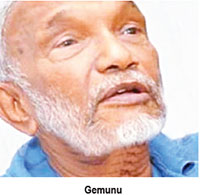 Many interesting hours were then spent at the Officers’ Mess bar, ‘shooting the breeze’ into the ‘wee small hours’ (unless I was scheduled to fly early the next day). Gemunu’s repertoire of both classical Sinhala and English songs, including some he’d learned during his ‘Varsity days, was incredible. He had a good singing voice, and his mannerisms were unique, too. Often, if he had a memory lapse, he would hit his hand on his receding forehead and exclaim, “Bloody curse!”
Gemunu was also widely read and could speak and hold the floor on any subject. I remember him telling me to hold on to my mechanical lever-motion wrist-watch because the new-fangled electronic digital watches, then in great demand, would soon be “a dime a dozen”.
Although not a qualified pilot as such, Gemunu’s passion for aviation burned strongly, so he never missed a chance to go flying with us. Even if it was to check the brakes of an aircraft that never left the ground! The process of speaking with the Air Traffic Control tower, starting up and taxiing out, would make his day.
In those days, TV had yet to arrive in Ceylon (as Sri Lanka then was), so, as movie buffs, we used our Air Force IDs to get us concessions at local cinemas. While in Colombo, on short breaks from China Bay, we would go from cinema to cinema, watching one movie after another, starting at the Savoy Cinema, Wellawatte, at 10.30 am, Majestic, in Bambalapitiya, for the 3.30 pm show, then the Liberty Cinema, at 6.30 pm, and finally the Empire (Slave Island) or Regal Cinema (Fort) for the late 9.30 pm show.
After I was demobilised and joined Air Ceylon, Gemunu continued to serve the RCyAF (which became the Sri Lanka Air Force, in 1972) as a Volunteer. But he and I kept in contact and ‘touched base’ off and on. He married his cousin and childhood sweetheart Swineetha. Because he was still with the Air Force, they had planned a ‘service wedding’. But, by the afternoon, before his wedding day, he still hadn’t engaged a band to play at the event. So, at the eleventh hour, I turned for assistance to Gamini ‘Gabo’ Peiris, drummer and leader of the popular band ‘Gabo and The Breakaways’, who in his ‘other job’ as a flight steward with Air Ceylon was by then a colleague of mine.
But when Gemunu and I arrived at Gabo’s home we learned that he and the band were ‘on holiday’. Wondering what to do next (I think I was more worried than Gemunu), while our bus was passing the Liberty cinema, Gemunu suggested that we should go watch a movie (which happened to be On a Clear Day You Can See Forever). Of course, by the time the movie ended, at 5.30 pm, we still hadn’t found a band to play at the next day’s wedding.
That was when I suddenly remembered my former neighbour and friend and Scout master from school, Nihal ‘Sam the Man’ Samarasinghe, another famous musician and bandleader in those days. Fortunately, after he made a few calls, Sam was able to find another upcoming band to play at short notice and thus saved Gemunu’s day. This episode was typical of Gemunu who took everything ‘on the bump’.
A few months later, the SLAF selected Gemunu Silva to study for an M.Sc. in Toulouse, the home of Airbus Industrie (as the company was then known) in the South of France. There he helped work out the algorithms for ‘fly-by-wire’ (FBW) aircraft. From what I’ve heard, it was a military project to which he was assigned, with the use of what was then the only hybrid computer in France. The research material thus gained was subsequently used in French fighter aircraft and, later still, the state-of-the-art Airbus A320 passenger airliner.
When Air Lanka was founded in 1979, Gemunu, now back in Sri Lanka, signed as one of the guarantors for my Boeing 707 training bond. Subsequently, I introduced him to the airline’s ‘flying Chairman’, Capt. S Rakkitha Wikramanayake, who was looking for aircraft maintenance engineers, but felt that Gemunu was “over-qualified”. To Gemunu’s credit, however, while in the SLAF he modified a fuel pump for the MiG-15 and 17 aircraft which prevented deterioration and fire in the engine after an inflight failure. He held the patent for that modification.
After Gemunu was finally ‘demobbed’ from the SLAF, he returned to the SEC where he would become the General Manager and, later still, Chairman (a post once held by the legendary engineer Dr. Deshabandu A.N.S. Kulasinghe). One of Gemunu’s many engineering accomplishments was changing the camber of the New Kelaniya Bridge, while traffic was on the move.
A long association with the Archaeological Department began when Gemunu Silva facilitated the use of a SLAF helicopter to place the crystal on the pinnacle of the Mihintale stupa which was being renovated by Dr Roland Silva, the Director of Archaeology, and his team.
Then the Temple of the Tooth Relic (Dalada Maligawa), in Kandy, began experiencing a problem. Monkeys, from the nearby Udawattakele Forest Reserve, used to play on the existing old roof and caused tiles to be shifted. When it rained, numerous leaks began, putting the Tooth Relic at risk. The solution was to build a canopy with gold-plated tiles, imported from Japan, over the existing temple roof. President Ranasinghe Premadasa’s ‘Sevana’ Foundation had promised to foot the bill in exchange for the honour of officially opening the finished project.
Amid objections to the modification from the Archaeological Department, the task was assigned to the SEC and Gemunu got involved. After the new canopy was built and the opening day drew near, it was discovered that the new structure was not steady and subject to swaying. One day, while wondering what to do about it, Gemunu discovered that there were a couple of holes, used as nests by resident pigeons, at the same level in the building adjacent to the golden roof. On investigation, he observed that there were metal beams inside the holes. So the canopy was duly welded to the beams, for additional support, and that stopped the swaying.
Then, there was the Maligawila Buddha Statue, in the Moneragala District. Carved out of limestone, with the head alone weighing some 50 tons, it was the tallest free-standing statue of its kind in Sri Lanka, and discovered in pieces in 1951 (presumably destroyed by treasure hunters). The project to restore it was abandoned by then SEC Chairman, Dr. Kulasinghe, in the mid-1970s. The challenge was subsequently taken up by Gemunu Silva in 1991, much to the satisfaction of President Premadasa.
Gemunu later mentioned that it was Dr Kulasinghe’s mentoring and guidance that gave him the confidence to embark on the project. And speaking of President Premadasa, when a colleague once asked Gemunu how he managed to get so close to the President, he replied that he didn’t get close to the President but the President got close to him!
When writing, or speaking of the late Gemunu Silva, it should not be forgotten that when the SLAF wanted to base their jet aircraft at the Sigiriya airport, and the Government followed up by proposing to build the next international airport there, Gemunu was involved with Dr Roland Silva, then Director General of the Central Cultural Fund, trying to stabilise the Rock, which was already chipping away, to prevent further damage from vibrations. So they appealed to President Chandrika Kumaratunga saying that jet operations at Sigiriya were not conducive to the future stability of the Sigiriya archaeological ‘treasure’. One option offered was to find another suitable site, so an RCyAF helicopter was assigned to the pair for two weeks in order to complete their survey. They found an ideal alternative within the Cultural Triangle on ‘crown land’ with no complications of land acquisition. But when a report was submitted, it never saw the light of day again!
In 1993, Gemunu became the youngest Vidya Jyothi awardee (for outstanding scientific and technological achievements) among greats like Geoffrey Bawa, Prof. E.O.E. Pereira, Prof. A.W. Mailvaganam, Sir Arthur C. Clarke, Dr. A.N.S. Kulasinghe and Dr. Ray Wijewardene. Gemunu remained the consultant engineer for the restoration of ancient stupas, such as the Jetavanarama, Abhayagiri, Mirisawetiya and Tissamaharama dagobas. Typical of the man’s ingenuity, all his mechanical restoration solutions were reversible.
After LTTE suicide bombers attacked the Dalada Maligawa, in 1998, Gemunu Silva participated in the repairs and renovation. He was also the Chairman of the Urban Development Authority (UDA) at one time. Gemunu worked at world heritage centres in Lumbini, Nepal and Bodh Gaya, India, and in 2013 he received the Engineering Heritage Award from the Institute of Engineers. This year Gemunu also became the first recipient of the Dr. Roland Silva Memorial Medal.
Gemunu always said that the best engineers were the ‘baases’ he worked with. As he (non-academically qualified but practically skilled senior workmen and artisans) told it, there was nothing a good chat and cup of plain tea and a cigarette couldn’t solve.
Of Gemunu, one could truly say he was “a man who walked with kings, and didn’t lose the common touch.”
To me, Gemunu was more a brother than a friend. I am glad that I was able to take him on a joy flight in a light aircraft about two years ago. Although his health was deteriorating, he was always in good spirits. The last time I spoke to him was to ask how the Ministry of Defence acquired the Akuregoda land on which the World War 2 Talangama transmitters were originally sited and then owned by the Department of Civil Aviation, only to be ‘handed over’ to the UDA.
Farewell my brother, may you achieve the supreme bliss of Nirvana!


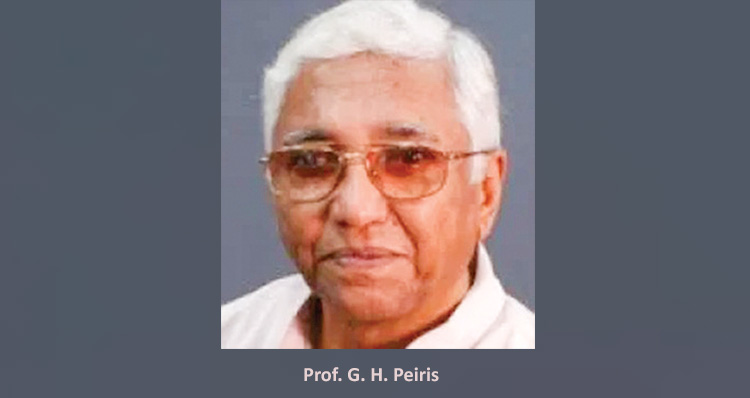
Prof. G. H. Peiris PhD, Emeritus Professor, University of Peradeniya, passed away on the 20th September 2026. His mortal remains were donated to the Anatomy Department, Faculty of Medicine, University of Peradeniya, according to his wishes. He was born on 30th January, 1938, in Junagaha, close to Negombo, and entered the University of Ceylon, at the age of 17 years. After obtaining a first class honours degree in Geography, the first to do so in the history of the University, he joined the staff of the Geography Department, Peradeniya University, and soon proceeded to Cambridge University to read for his doctorate.
Prof. Peiris excelled in academic work in teaching and research while serving the University for 43 long years. His research delved deeply into land reforms, economic and social change, irrigated agriculture, university education and ethnic conflict. He held visiting professorial appointments in Australia, Canada, the United States and Norway, and has undertaken sponsored study tours in the Philippines and the United States. His consultancy assignments include those conducted for the ILO, WHO and UNICEF. He has collaborated with scholars from India, Pakistan, Bangladesh, Nepal, Syria, the Netherlands and the United States in major research projects.
Based on his research, he debunked the homeland theory concocted by separatists.
Prof Peiris was appointed to the committee to draft a new constitution by the Gotabaya Rajapaksa government in 2020. He did not agree with the views of several members of the committee on the matter of federalism as a solution to the ethnic conflict. He held that the best solution would be devolution at the district level and consequently he submitted a dissenting report to the final draft constitution. In his extensive academic work and policy stances, such as his thesis Federalism and the ‘Federal Option’ for Sri Lanka, he argued that shifting from a unitary to a federal structure would not resolve ethnic tensions. Instead, he characterised federalism in the Sri Lankan context as an “absurdity,” given the island’s small geographic size.
He firmly contested the concept of a combined Northern and Eastern Province acting as a federal unit. He vocally opposed the “Traditional Tamil Homeland” hypothesis, arguing that merging these provinces, along ethnic lines, created severe risks to the country’s territorial integrity and ethnic harmony. Peiris maintained that supreme political power must be confined to the government.
After retirement, in 2003, Prof. Peiris authored and edited several major books focusing on socio-economic development, land policy, and ethnic conflict and these include; Sri Lanka: Challenges of the New Millennium (2006), Twilight of the Tigers: Peace Efforts and Power Struggles in Sri Lanka (2009), Political Conflict in South Asia (2013), Sri Lanka: Land Policy for Sustainable Development – To Strengthen the Struggle for Survival (2016/2017).
His book, in Sinhala, titled “Ganaduraka Sihivatana” (Memories of an Era of Darkness), a 307-page work, focuses heavily on the political history, ethnic conflicts, and peace efforts involving the Liberation Tigers of Tamil Eelam. In it, he draws from his extensive research career to provide a highly detailed critique of the LTTE’s secessionist campaigns, territorial claims, and the broader socio-political ramifications of the conflict in Sri Lanka.
Prof Peiris served as a member of the Council of the University of Peradeniya, from 2014 until he was appointed the Chancellor of the University in 2022, a post he held until 2025, when ill health forced him to step down. In the Council he consistently provided a mature viewpoint on many contentious issues and took up a balanced position that often helped the Council to arrive at an acceptable decision.
Prof. Peiris occupied the exalted seat of Chancellor of the University with much aplomb and dignity. It was so unfortunate that his tenure was cut short due to ill health.
He leaves his loving wife, Yasa, whom he had met in the University, a daughter, Indumathi, who is a Professor in Physiology in the Medical Faculty, Peradeniya, and a son, Manjula, who is a surgeon attached to the Department of Surgery, Faculty of Medicine Peradeniya. It gave him much happiness that his children and their spouses were all members of the academic staff of the University that he loved so much.
May he rest in peace!
Prof. N. A. de S. Amaratunga PhD, DSc, DLitt

An archetypal journey of life towards self-discovery
By Dr Siri Galhenage,
Psychiatrist [Retd]
The Odyssey is a narrative poem by Homer, the revered Greek poet of antiquity. Along with its forerunner, The Iliad, it is regarded as one of the foundational works of Western Literature. Both epics were transmitted for generations through the oral tradition by travelling bards before being committed to writing several centuries later. In 2026, it has received a major cinematic adaptation, and is currently being screened in theatres around the world. Written and directed by Christopher Nolan, the movie has a renowned ensemble cast including Matt Damon and Anne Hathaway, and is expected to top the charts this year.
The enduring interest in the Odyssey is reflected in its continuing reinterpretation across the arts and psychology. My interest in the epic is in the deeper meaning to the narrative – ‘the subterranean flow’ – which I have endeavoured to explore in light of the theoretical concepts developed by pioneer psychiatrists Sigmund Freud and Carl Jung, mainly the latter, while also appreciating the aesthetic dimensions of its cinematic presentation. My attempt, admittedly, is no road less travelled; yet each journey along it may reveal something new beneath the surface of the narrative!
Applicable Psychoanalytical Concepts
The psychoanalytical concepts developed by Freud and Jung concerning the structure and workings of the human mind are complex, but I shall restrict myself to outlining those aspects that are relevant to exploring the deeper meaning of the narrative in The Odyssey.
In psychoanalytical terms the human mind is divided into two domains – the conscious and the unconscious. Sigmund Freud’s structural model of the psyche was primarily applied to the individual. It consists of the ‘personal unconscious’, which harbours experiences that have been repressed or kept beneath the ‘conscious’ level.
In contrast, Carl Jung, Freud’s junior colleague, conceived the idea of a ‘collective unconscious’ as a deeper and a universal layer of the psyche shared by humanity as a whole. It contains innate patterns of psychological experience, which Jung called archetypes. An archetype may therefore be understood as an underlying psychic pattern or predisposition. In a narrative, such a pattern may appear in the form of a character, theme, image or symbol that becomes recognisable to consciousness. It is capable of presenting in different cultures and historical periods. What we encounter in a narrative, therefore, are archetypal manifestations rather than the archetype itself.
The Narrative
The Odyssey is a mythical tale; its setting and characters probably would have been familiar to the original Greek audience. A modern day audience, however, may find it ludicrous!
It is the story of Odysseus, King of Ithaca, and his struggle to return home after the victory at Troy, longing to be united with his wife, Penelope, and son, Telemachus. Meanwhile, in Ithaca, Penelope is besieged by a group of conceited suitors who pressure her to remarry, assuming that Odysseus is dead. Telemachus, now grown up, sets out in search of news of his father.
Odysseus embarks on a perilous journey across the Mediterranean Sea with his fellow soldiers, but his homeward voyage becomes a ten year ordeal as he encounters not only the forces of nature but also an array of hostile gods and mythical creatures.
The journey had a calamitous start with a raid on the Cicones at Ismarus where Odysseus loses many of his men. Soon afterwards, storms drive them to the land of the Lotus-Eaters, where some of his crew consume the intoxicating lotus and lose all desire to return home.
Odysseus rouses his men from their lethargy and moves on to confront the Cyclops, particularly the gigantic Polyphemus, son of the sea god Poseidon. Odysseus blinds Polyphemus who is blocking the cave they were trapped in, and escapes by clinging beneath a flock of sheep. It provokes the enduring wrath of Poseidon, god of the sea.
As the fleet sailed on, lost across the vast seas, Aeolus, keeper of the winds, gives Odysseus a bag of winds that might carry them home. While Odysseus sleeps, however, his suspicious crew opens the bag, believing it contains treasure. The released winds drive the ship away from their planned direction.
They next encounter the Laestrygonians, a race of gigantic cannibals who destroy most of the fleet. Odysseus escapes, but grimly continues his voyage.
He then reaches the island of Circe, where the powerful enchantress transforms some of his men into swine, who indulge in gluttony. Odysseus overcomes her spell, and Circe becomes his ally. At her direction, he consults the prophet Tiresias in the Underworld, who warns him about the continued hostility of Poseidon and advises him to refrain from harming the sacred cattle of the sun god Helios.
Returning to the sea, Odysseus encounters the Sirens, who use alluring sounds to lure sailors to their deaths. Forewarned by Circe, he orders his men to plug their ears with wax and bind him tightly to the mast so that he can hear their songs without steering the ship towards them.
He then navigates between Scylla, a six-headed sea monster, and Charybdis, a terrifying whirlpool. Choosing the lesser danger, he loses six of his men to Scylla. The incident becomes one of the most painful episodes of his journey.
With the surviving crew, Odysseus reaches the island of Thrinacia, where his starving men slaughter the sacred cattle of Helios, against the wishes of the prophet Tiresias, while he is asleep. In response to Helios’s demand, Zeus destroys their ship with a thunderbolt, killing all the men except Odysseus.
Odysseus is subsequently washed ashore on the island of Ogygia, where the nymph Calypso keeps him captive because she loves him. She commands the waves to wash him back to shore, each time he tries to make a raft and sail to sea. Odysseus turns down her offer to make him immortal if he remains with her. He longs to return home. At the command of Zeus, the God of the Heavens, Calypso eventually releases him, and Odysseus sets sail once more.
Angered by the release, Poseidon, the god of the seas, summons the winds and smashes Odysseus’s raft. Thrown overboard, an exhausted Odysseus manages to swim ashore in the land of the Phaeacians, a peaceful people living in relative isolation. With the help of Athena, the goddess of wisdom, he is brought before their king and queen. Moved by his story, they offer him hospitality and provide him with a ship, which finally carries him safely to Ithaca.
In Ithaca, Penelope has been besieged by numerous suitors, who have consumed his wealth and assumed that he was dead. With the help of Athena, he disguises himself as a beggar and secretly returns to his palace. Penelope meanwhile remains faithful to Odysseus, and has devised strategies to postpone remarriage. She announces that she will marry the man who can string Odysseus’s great bow and shoot an arrow through a series of axe-heads. None of the suitors succeeds. The disguised Odysseus effortlessly strings the bow and reveals his identity. With Telemachus and a few loyal servants, he kills the suitors and restores order to his household and reunites with Penelope.
Exploration of the ‘Subterranean Flow’ of the Narrative
Derived from the Greek root odussia, the word odyssey has entered the English language, meaning ‘long adventurous journey’ while, interestingly, some linguists argue that it is also linked to the word odyne meaning ‘pain and suffering, distress or consuming grief’.
The Odyssey can be understood as more than an adventure story. It is an archetype of the journey through life itself: departure, ordeal, wandering, self-discovery and return.
The narrative embodies three archetypal elements – a character [a hero], a theme [his journey] and a symbolic destination [home]
The character of Odysseus represents a pattern of struggle, confrontation with danger and transformation. He emerges as the archetypal ‘hero’, fighting the Trojan War to secure the release of Helen, who has been taken from her husband, Menelaus, the king of the allied nation of Sparta. Helen came to be known as ‘Helen of Troy’, an enduring archetypal image of feminine beauty. The war was brought to a dramatic conclusion by Odysseus’s ingenious stratagem: he and his men concealed themselves inside a giant wooden horse which was brought into Troy enabling them to launch a surprise attack. The ‘Trojan Horse’ has since become a lasting allegory for deception and cunning.
Odysseus is characterised as a ‘hero’, not only due to his military prowess, but also to the courage, resourcefulness and perseverance he displays throughout his archetypal journey home. Tested by forces both external and within, he endures suffering, confronts his limitations and undergoes a process of transformation before finding his way home.
He encounters storms, monsters, seductive enchantresses, intoxicating flora [lotuses: the ‘lotus eaters’ becoming an allegory for Indulgence in idle pleasure], enthralling music and the supernatural world – a realm divided between forces that protect, obstruct, tempt and test him. Yet his journey is not without errors of judgement or disagreement with his fellow crew members, and he must face the consequences of his actions, and most poignantly, the loss of his companions. His greatest challenge, however, is not merely survival, but the preservation of his identity and sense of purpose. He must resist the temptations that threaten to keep him from home, recognise the limits of his own pride and ingenuity, and ultimately learn the value of humility. The theme represents, in varying degree, a recurring pattern or journey of human experience, transformation and self-discovery, beyond its literary presentation.
Ithaca becomes not merely a geographical destination but an archetypal ‘home’, a symbol of selfhood, continuity and the restoration of order after chaos and suffering. One must not overlook the crucial role played by Penelope in preserving the home, enduring her own trials, sustaining the household and preserving its continuity against overwhelming odds.
In essence, the archetypal pattern beneath the narrative in Homer’s Odyssey is the human journey home – through danger, temptation, loss and transformation – towards identity, belonging and restoration.
Conclusion
A good piece of Art – literary or cinematic – much like Psychology, seeks to illuminate the complexities of human experience. In this regard, The Odyssey can be seen as a timeless metaphor for the human journey – the difficulties, hardships, setbacks and emotional challenges that people inevitably encounter throughout their lives: the trials and tribulations that may alter the course of a life. Such trials are not merely tests of character in the face of suffering but, more importantly, they may serve as opportunities for self-discovery, growth and transformation.
As Carl Jung, the renowned psychiatrist, postulated, much of this experience is rooted in the ‘collective unconscious’, a deeper layer of the psyche beneath conscious thought and individual experience. It is perhaps this deeper, often unspoken dimension of our shared humanity that enables The Odyssey to transcend its ancient origins and continue to resonate universally, across cultures and generations.
[sirigalhenage@gmail.com]

by Capt. (Ret) G.A.Fernando
‘Meritocracy’ is held to be an essential part of good governance in any organisation. The other two essential components are ‘pragmatism’ and ‘honesty as in Singapore’. Unfortunately, meritocracy is also subjective. Reportedly, in the early days of Air Ceylon, the first officer (co-pilot) would sometimes help to pack the operations manager’s bags before an impending trip, in order to gain ‘merit’ in the airline. Alternatively, the first officer considered for command may have been a ‘boozing buddy’ of the captain. In short, there was no system.
In Air Lanka all our managers, instructors and chief pilots were expatriates. Fairly or unfairly, a rumour had it that pilot promotions were decided at the whites-only Colombo Swimming Club. There were many instances when promotions were offered to someone of so-called ‘good standing’, or ‘a friend of the family’, in the eyes of airline management. Thus, some junior pilots were unfairly by-passed for no valid reason. Such was life in those days.
Consequently, in the mid-1980s the Pilots’ Guild declared that ‘enough was enough’, and after a quick survey of other airline practices, using data supplied by the International Federation of Air Line Pilots’ Associations (IFALPA), it was demanded of Air Lanka management that they too should establish a seniority list to ensure that no-one will be overlooked when it came to pilot promotions.
Essentially, a pilot would be given a ‘seniority number’ at the time of joining the airline. If the date of joining was the same for a batch of pilots, then the number of hours of experience at the time of joining in decreasing order would be the factor in determining individual pilots’ seniority within that batch. The lower the seniority number the greater the seniority of the pilot. That, and only that, would be the consideration. In other words, it was a pecking order of sorts. In case a pilot was bypassed due to some valid requirement, that pilot would be entitled to a good and acceptable reason, and then to a bypass allowance.
While accepting it on principle, no one in the Flight Operations department was willing to ‘bell the cat’ or buck the system.
Therefore, it fell upon the Pilots’ Guild, and specifically me as its secretary, to establish a draft copy of a seniority list, which was eventually accepted by the management of Air Lanka, for pilot promotions.
The pilot was to carry that number until his career with the airline ended. It also gave an opportunity for management to pick candidates out of sequence (for good reason), as the seniority will eventually be re-established. However, if the pilot left the airline for greener pastures and returned, he/she would have to join at the bottom of the list (as the most junior pilot).

Showers or thundershowers will occur at several places in the most part of the island after 1.00 p.m

Geneva takes up Sallay’s case and govt. ignores opportunity to answer accusations

Section of wartime KKS High Security Zone vacated to facilitate economic development in the area

Lawyer lodges complaint against Govt. Printer, Media Ministry Secy.

Sri Lankan troops in joint anti-terrorist exercise in Russia

Nine Indian poachers brought to KKS with their boat

‘Dates have the highest sugar content to fight Coronavirus’

Sunday Island 27 December – Headlines

#SundayIsland 17th December – Headlines

Sunday Island – 28th March

Sunday Island Headlines – 21 March

Sunday Island – 21st February – Headlines
-

 Latest News6 days ago
Gold winner Tharanga gets brand-new Honda Vezel from SLAAJ
-

 Features6 days ago
Why Sri Lanka needs an Inclusive Civic Nationalism – urgently
-

 News5 days ago
US-assisted ‘Ice’ detection: NPC to examine IGP’s move to transfer drug-busting team
-

 Features7 days ago
Thailand’s biggest new global star …
-

 News7 days ago
First cases taken up by SC after enactment of 22A dismissed
-

 Editorial4 days ago
Colombo Port drug bust: The plot thickens
-

 News6 days ago
Civil society activist accuses govt. of favouring Ven. Gnanasara
-

 Editorial7 days ago
Aftershocks of 22A