
Business
VAT hike in Sri Lanka: Who really pays the price?

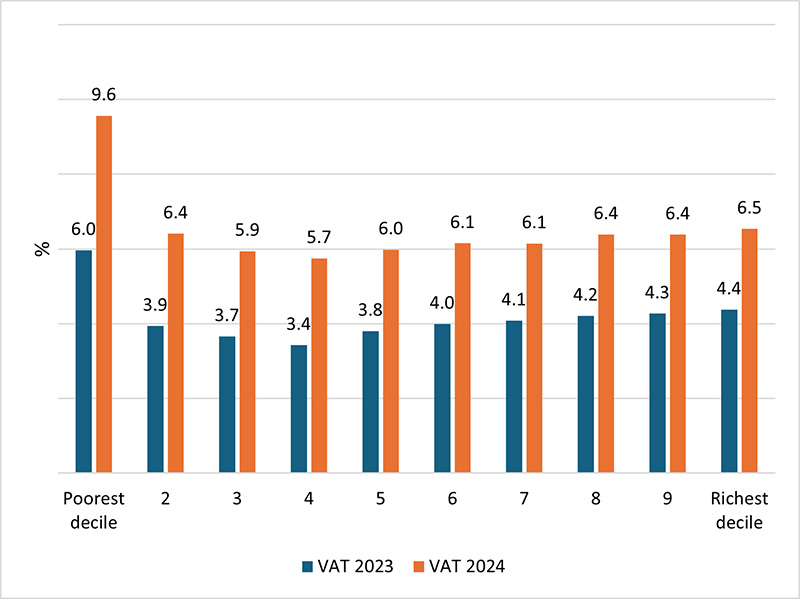
The recent VAT revisions have hit the poorest the hardest, whereas the bottom 10% of income group households now spend about 10% of their income on VAT.
The VAT burden has risen by approximately 50%, primarily due to theremoval of VAT exemptions on around 100 items. This blog offers potential solutions for easing the VAT burden in Sri Lanka.
Priyanka Jayawardena is a Research Economist at IPS with research interests in skills and education, demographics, health, and labour markets. Priyanka has around 15 years of research experience at IPS. She has worked as a consultant to international organisations including World Bank, ADB and UNICEF. She holds a BSc (Hons) specialised in Statistics and an MA in Economics, both from the University of Colombo. (Talk with Priyanka – priyanka@ips.lk)
By Priyanka Jayawardena
Earlier this year, Sri Lanka introduced major changes to the Value Added Tax (VAT) system. The VAT rate increased from 15% to 18%, and tax exemptions were removed for 97 items, including essential goods such as gas and stationery. While these revisions aimed to boost government revenue, they have also significantly increased the tax burden on low-income households, making life even more challenging for the most vulnerable during this ongoing crisis. This blog offers a comprehensive overview of the recent VAT revision and potential solutions for easing the VAT burden in Sri Lanka.
The Rise in VAT Burden
The VAT rate hike from 15% to 18% has translated into a 20% rise in VAT payments overall. A VAT simulation analysis based on Household Income and Expenditure Survey (HIES) 2019 data reveals that when combined with the removal of tax exemptions, the average VAT burden has increased by about 50%. However, this burden is not evenly distributed. The poorest 40% of households face an approximate 60% rise in VAT payments, while other income groups experience around a 50% increase.
Who Bears the Brunt of the VAT Revision?
The harshest impact of these VAT revisions has fallen on the lowest-income households. The bottom 10% of households now pay around 10% of their income as VAT, up from 6% under the previous VAT system (Figure 1). In comparison, other households spend about 6% of their income on VAT payments. This disproportionate impact is primarily due to the removal of tax exemptions on widely-use items, which are essential for all.

Indirect Taxes as a Share of Income
Source: Author’s calculations, based on HIES-2019 data from the DCS.
Removing VAT exemptions on 97 items out of the previously exempted 138 has made essential purchases more expensive. Low-income households typically allocate a greater portion of their budgets to essential items that were previously exempted from VAT but are now taxed. These include fuel, gas, telecommunication services, as well as various food products made from locally cultivated grains, locally produced coconut milk, and certain locally produced dairy products.
Comparing VAT with Other Indirect Taxes
VAT applies to a wide range of goods and services, affecting all consumers. However, its impact is regressive, taking a larger proportion of income from poorer households compared to richer ones (Figure 2). In contrast, excise taxes on products like alcohol and tobacco are less burdensome on lower-income groups. The top 20% of households contribute 43% of alcohol taxes and 44% of tobacco taxes, while the bottom 40% of households account for 19% of alcohol taxes and 14% of tobacco taxes. Additionally, VAT applies to basic commodities that everyone needs, whereas excise taxes apply to tobacco and alcohol, which are harmful products that contribute to non-communicable diseases (NCDs). In this sense, higher taxes on tobacco and alcohol act like an upfront investment in public health, helping to offset future healthcare costs.
What Can Be Done?
While the VAT hike was designed to stabilise Sri Lanka’s finances, it disproportionately affects vulnerable populations. This highlights the need for more balanced and fair fiscal policies. A more equitable approach would ensure that taxation doesn’t disproportionately affect those least able to afford it, preserving economic fairness during difficult times. Addressing the uneven impact of VAT requires exploring policy alternatives, such as reintroducing exemptions for essential goods if necessary. Increasing excise taxes on tobacco and alcohol is a favourable policy option. This could help create a more just system while reducing long-term healthcare expenses.


First Capital Holdings PLC, a subsidiary of JXG (Janashakthi Group) and a pioneering force in Sri Lanka’s investment bank landscape recorded a Total Comprehensive Income of Rs. 3.23Bn for the nine months ended 31 December 2025, compared to Rs. 4.53Bn in the corresponding period of the previous year. For the third quarter of 2025/26, the Group reported a Total Comprehensive Loss of Rs. 0.17Bn, after accounting for a dividend tax expense of Rs. 0.41Bn.
The Group’s Net Income before Operating Expenses for the nine months of 2025/26 amounted to Rs.6.33Bn compared to Rs. 7.69Bn reported in the corresponding period of the previous year. Trading income was primarily driven by the Primary Dealer and Corporate Dealing Securities divisions, reinforcing the Group’s positioning across fixed income and equity market segments.
The Primary Dealer division reported a Profit after Tax of Rs. 1.64Bn for the nine months ended 31 December 2025 (1st nine months of 2024/25 – Profit after Tax of Rs. 2.45Bn). The results include trading gains on the government securities portfolio of Rs. 1.66Bn and net interest income of Rs. 1.41Bn (1st nine months of 2024/25 – trading gains of Rs. 3.18Bn and net interest income of Rs. 1.31Bn), reflecting movements in yields and trading conditions during the period.
The Corporate Finance Advisory and Dealing Securities division recorded a Profit after Tax of Rs. 1.86Bn for the nine months ended 31 December 2025 (1st nine months of 2024/25 – Profit after Tax of Rs. 1.94Bn). The business unit reported total trading gains of Rs. 2.33Bn on its equity portfolio, compared to Rs. 2.23Bn in the corresponding period of the previous year, supported by market participation and portfolio positioning.
The Wealth Management division reported a Profit after Tax of Rs. 78.1Mn for the nine months ended 31 December 2025 (1st nine months of 2024/25 – Profit after Tax of Rs. 90.1Mn). Assets under Management stood at Rs. 96.4Bn as at 31 December 2025, compared to Rs. 115.9Bn as at 31 March 2025, reflecting market conditions and client portfolio adjustments.
The Stock Brokering division recorded a Profit after Tax of Rs. 166.3Mn for the nine months ended 31 December 2025, compared to Rs. 39.5Mn reported in the corresponding period of the previous year, supported by increased trading activities.
Commenting on the Group’s performance, Rajendra Theagarajah, Chairman of First Capital Holdings PLC, stated, “The operating environment during the period was shaped by shifts in interest rates, capital market activities, and fiscal adjustments. Against this backdrop, the Group’s performance reflects the structural strength of its capital markets platform and its ability to generate income across multiple market cycles while maintaining financial discipline.”
Dilshan Wirasekara, Managing Director / CEO of First Capital Holdings PLC, said, “Our priority during the period was to manage each business line with a clear focus on risk, liquidity and execution. Improved performance in stock brokering and consistent contributions from corporate finance reflect our ability to respond to market conditions while aligning capital deployment with client and market opportunities.”

Keells is set to usher a new chapter in customer experience with the relaunch of Keells Nexus with the introduction of its all-new loyalty app on 13th February. For 25 years, Keells Nexus has been at the heart of Sri Lankan retail, pioneering coalition loyalty and even introducing mobile-based loyalty as early as 2014. The loyalty program is building on this legacy, combining state-of-the-art technology with richer, more personalized rewards and seamless integration across the Keells ecosystem with an intuitive mobile experience.
Today, Keells Nexus stands at over 2 million registered members, a reflection of the trust customers place in Keells and the brand’s commitment to improving the quality of life for the nation. The launch further strengthens Keells’ long-standing focus on tech-enabled retail efficiency, following innovative retail experiences to customers such as self-checkout counters and retail technology that drives efficiency such as advanced inventory management systems.
The new app therefore is the next logical step in this journey, bringing together rewards, offers, and account visibility in one intuitive, streamlined interface. The new Keells Nexus app brings together all deals, savings and partner offers in one place, giving customers complete visibility and control. Members can track their points in real time, scan a QR code at checkout to earn rewards instantly, and enjoy a more personalised, more connected shopping experience.
“At the heart of Keells Nexus is a simple but powerful belief that life is better when we’re connected,” said Nilusha Fernando Head of Marketing, Keells Supermarkets & Senior Vice President, John Keells Group.
Business
IDL, Clouds by SOZO and the Rukmini Tissanayagam Trust partner with the HSBC Ceylon Literary & Arts Festival 2026


The HSBC Ceylon Literary & Arts Festival 2026, taking place from 13 to 15 February at Cinnamon Lakeside, Colombo, promises to be one of those rare cultural moments that linger long after the last session ends. It is a gathering not only of writers, artists and thinkers, but of ideas, shared, challenged and celebrated in spaces where curiosity feels welcome.
The HSBC Ceylon Literary & Arts Festival 2026 is supported by several organizations through non-promotional CSR initiatives, including Clouds by SOZO and the Rukmini Tissanayagam Trust. International Distillers Limited contributes in a strictly neutral CSR capacity, providing logistical and resource support for the event without any brand promotion or product visibility.
The Festival celebrates Sri Lanka’s creative voice by showcasing literature, arts, and cultural talent from across the country. All supporting organizations participate solely in a philanthropic and educational role, ensuring that the focus remains on artistic expression and community engagement.
The Rukmini Tissanayagam Trust brings to the Festival a deep and enduring commitment to nurturing literature and the arts as essential pillars of society. Its work is driven by the belief that creative spaces are not optional additions, but vital platforms that shape how communities think, feel and engage with the world around them.
Speaking on this collaboration, Indhu Selvaratnam, Director of SOZO Beverages and Trustee
of The Rukmini Tissanayagam Trust, stated, “The Rukmini Tissanayagam Trust is delighted to partner with the Ceylon Literary Festival for the second time. We are deeply committed to enriching Sri Lanka’s intellectual and cultural landscape and admire the festival’s evolution in embracing literature, art, music, and initiatives that nurture emerging local talent. These efforts align closely with the Trust’s mission to support creative expression, and we look forward to continuing our support as the festival strengthens Sri Lanka’s global cultural presence.”
Adding a complementary dimension to this partnership is Clouds by SOZO, Sri Lanka’s premium mountain spring water brand, whose ethos of purity, sustainability and thoughtful living aligns naturally with the spirit of the Festival. Sourced from a pristine spring in the Knuckles mountain range, Clouds represents a return to authenticity, an idea that resonates strongly within creative and cultural spaces.
Speaking on the partnership, Dushyantha De Silva, Founder of SOZO Beverages (Pvt) Ltd, said, “The arts invite us to slow down, to observe, and to think more deeply, and Clouds comes from that same place of intention. Supporting the HSBC Ceylon Literary & Arts Festival is about being part of a space where ideas flow freely and thoughtfully. It’s a privilege for us to align with a platform that values creativity, dialogue and conscious choices.”
The HSBC Ceylon Literary & Arts Festival 2026 offers something increasingly rare: three uninterrupted days of ideas. Of language and imagination. Of conversations that do not require a screen to feel alive. It is a reminder of the power of gathering, of listening, discovering and engaging with perspectives that challenge and inspire.
As February approaches, the hope is simple: that more people choose to attend, to listen, and to support Sri Lankan creativity in all its forms. Because when a country invests in its writers and artists, it is not merely celebrating talent, it is shaping how it remembers, how it questions, and how it evolves.

Landslide Early Warnings issued to the Districts of Kandy and Nuwara Eliya extended

Aryansh Sharma, Sohaib Khan power UAE to thrilling win over Canada

Royal Navy of Oman Vessel “SADH” departs island

Muzarabani, Bennett orchestrate famous Zimbabwe win

“We will not make decisions for rural level schools while sitting in Colombo” – PM

USA need to overturn history to beat Netherlands and stay alive

‘Dates have the highest sugar content to fight Coronavirus’

Sunday Island 27 December – Headlines

#SundayIsland 17th December – Headlines

Sunday Island – 28th March

Sunday Island Headlines – 21 March

Sunday Island – 21st February – Headlines
-

 Features6 days ago
My experience in turning around the Merchant Bank of Sri Lanka (MBSL) – Episode 3
-

 Business7 days ago
Zone24x7 enters 2026 with strong momentum, reinforcing its role as an enterprise AI and automation partner
-

 Business6 days ago
Remotely conducted Business Forum in Paris attracts reputed French companies
-

 Business6 days ago
Four runs, a thousand dreams: How a small-town school bowled its way into the record books
-
 Business6 days ago
ComBank and Hayleys Mobility redefine sustainable mobility with flexible leasing solutions
-
 Business3 days ago
Autodoc 360 relocates to reinforce commitment to premium auto care
-

 Midweek Review3 days ago
A question of national pride
-
 Business7 days ago
HNB recognized among Top 10 Best Employers of 2025 at the EFC National Best Employer Awards