
Editorial
Vanity, futility and public ire


Wednesday 7th February, 2024
The fifth session of the current Parliament is scheduled to commence today. There was absolutely no need for Parliament to be prorogued, last month. The Constitution provides for the prorogation of Parliament, but it should be done for good reason. In this country, the Heads of State prorogue Parliament, according to their whims and fancies.
President Ranil Wickremesinghe is reported to have decreed that the inauguration of the new parliamentary session today be devoid of traditional pomp and circumstance. He has only made a virtue of necessity. He has apparently sought to escape the opprobrium of the public, who are struggling to keep the wolf from the door. Nothing exasperates the people more than to see public funds being wasted on useless ceremonies. The incumbent government is notorious for reckless extravagance with people’s money.
The SJB is of the view that the latest prorogation of Parliament was intended to derail the probes conducted by parliamentary committees, most of which stand dissolved and will have to be reconstituted. This argument holds water. The possibility of the government planning to have some of its stooges appointed as the heads of those committees cannot be ruled out.
The silver lining of the dark cloud of tax increases is that the Sri Lankan public is now very concerned about wasteful government expenditure, the misappropriation of state funds, and corruption, which takes its toll on state revenue and hinders economic growth. They have learnt the hard way that there is no such thing as government money; the funds that a government is tasked with managing belong to the people, who have a right to know how their money is spent.
Wasteful expenditure continues unabated despite the current economic crisis. There is no dearth of official ceremonies. VIP junkets, domestic and foreign, cost taxpayers an arm and a leg. The government had better reduce its expenditure to a bare minimum at least for its own sake. The patience of the public, who are paying through the nose to maintain a bunch of unproductive, corrupt politicians is wearing thin. Unless the government mends its ways and frugally manages public funds instead of spending them to ensure that its leaders and their kith and king live the high life, it may face another popular uprising, which will be as destructive as the second wave of a tsunami. Let the state employees who strike work, demanding pay hikes during the country’s worst-ever economic crisis be warned that they are also testing the people’s patience.
Both the government and the Opposition ought to bear in mind that public faith in the national legislature is at a very low ebb. There are some decent men and women in the current Parliament, but protesters demand that all 225 MPs go home. This kind of public antipathy towards the legislature and elected representatives augurs ill for democracy; ultra-radical elements with a history of violence are busy tapping public anger to advance their sinister agendas.
Parliamentary sittings cost the public as much as Rs. 10 million a day, according to Chief Government Whip and Minister Prasanna Ranatunga. More often than not, they are inquorate or even stormy due to unruly behaviour of most MPs on both sides of the House. Worse, allegations abound that Bills are rushed through Parliament without amendments recommended by the Supreme Court being incorporated into them. The need for the members of the current Parliament to carry out their legislative duties and functions diligently and make a serious effort to arrest the erosion of public faith in the legislature cannot be overstated.

Wednesday 14th January, 2026
The police have warned of an escalation in online financial scams. There have been numerous complaints of such frauds, and fraudsters often offer online employment opportunities, investment schemes or other financial benefits, luring victims into transferring money to their accounts, the police have said.
The commonest online scams in Sri Lanka, according to cybersecurity warnings during the past two years, are deceptive loan schemes, phishing links, fake job offers, work-from-home frauds, love traps, pyramid schemes, investment and crypto frauds, lottery prize and shopping rackets, and duping people into sharing their banking details with unknown parties. Common precautions against these scams are said to include ignoring suspicious links, never sharing passwords or OTPs with others, and being sceptical of lottery wins and unsolicited employment or investment offers.
Scams are as old as the hills; they have proliferated during the past couple of decades due to the phenomenal expansion of social media. Humans have a penchant for trust and leaps of faith. One of the earliest known scams occurred in 300 BC, when two Greek sailors sank their cargo ship to cheat money lenders. Historians inform us that some members of the Praetorian Guard ‘sold’ the Roman Empire, of all things, after murdering their master. Sir Isaac Newton struggled to outwit forgers following his appointment as the Warden of the Royal Mint. A con-artist sold the Eiffel Tower to an unsuspecting buyer about 100 years ago. Such instances abound in world history.
Scams mushroom at all levels of society in this country, and it is not possible for the police and other state institutions to crack down on all of them. There’s said to be a sucker born every minute. The same is true of scammers. Most Sri Lankans do not heed warnings and invest money and even their nest eggs in fraudulent schemes only to regret. The scam victims, except those who invest their black money, deserve sympathy and help, and everything possible must be done to bring the scammers to justice. Various factors drive the ordinary people to take such risks and fall prey to scammers, one being low banking returns, but it is debatable whether taxpayers’ money should be used to compensate those who lose their clandestine investments.
Besides online scammers, loan sharks operating in the guise of microfinance companies have become a curse. They exploit the poor, especially those in the rural sector, with impunity. Many borrowers end up losing their belongings, including agricultural equipment put up as collateral. They have no one to turn to. On Monday (12), the Sectoral Oversight Committee on Economic Development and International Relations approved the proposed Microfinance and Credit Regulatory Authority Bill, subject to amendments. It is hoped that we are not going to witness another false dawn, and the laws this vital Bill seeks to make will help liberate the poor from the clutches of the microfinance Shylocks.
Perhaps, the biggest scams in this country are not in the financial sector but in politics, and they are taken for granted. Remember the much-advertised political promises that helped politicians hoodwink the public and savour power—‘rice from the moon’, ‘eight pounds of grain plus a righteous society’, ‘a country free from corruption and violence’, ‘a prosperous future’, ‘good governance’ and ‘a beautiful life’? The best way to deal with those who are responsible for such politico-social scams is to make election manifestos and campaign promises legally binding, and change the existing electoral system to introduce the recall mechanism so that it will be possible to unseat the crafty politicians who secure state power by making umpteen Machiavellian promises and betray people’s trust. But the question is whether the politicians who alone can make such laws will ever legislate for the politico-social scams in question to be brought to an end. We are reminded of a question Juvenal famously asked about two millennia ago: “Who guards the guards?”
Tuesday 13th January, 2026
What began as a debate on the government’s education reforms has descended into a dirty political war, with the propaganda brigades of both the JVP/NPP and the Opposition carrying out vilification campaigns against the key figures in the rival camps. Prime Minister Dr. Harini Amarasuriya, who is also the Minister of Education, has become a victim of a savage character assassination campaign, which no reasonable person will hesitate to condemn unreservedly. Shame on those who have stooped so low as to carry out personal attacks on her!
What has led to the current dispute in the education sector is basically the government’s intransigence. While claiming to be willing to consider dissenting views, it is all out to shove its reform package down the throats of other key stakeholders who unfortunately want the baby also thrown out with the bathwater, so to speak. A prerequisite for resolving the current conflict, which has the potential to cripple the education sector, is for both warring parties to soften their stands and negotiate.
President Anura Kumara Dissanayake is scheduled to meet the representatives of the trade unions representing teachers and principals shortly, we are told. One can only hope that two sides will move towards a rapprochement, which is the need of the hour.
The government ought to stop cherishing the delusion that its mandate is carte blanche for it to do as it pleases with no heed for dissent. It is only wishful thinking that the government will be able to ensure the implementation of its education reforms without the fullest cooperation of the frontline stakeholders—school teachers and principals.
Even the staunchest opponents of the education reforms at issue agree that the education system has to be reformed. What they are opposing tooth and nail is the manner in which the government has set about the task of introducing education reforms and its attempts to impose a fait accompli on other key stakeholders. The Opposition is not without a political agenda where its campaign against the education reforms is concerned; it will go to any extent to gain political mileage.
The government has erred by compressing the process of formulating education reforms into a year or so and proceeding at a pell-mell pace to implement them. Teachers’ and principals’ trade unions are of the view that some modules were prepared in just three months.
By rushing to reform the education sector, the government has provided the Opposition with a fresh rallying point and the latter is making the most of it. Various associations have sprung up overnight purportedly to ‘save free education’, and some Opposition politicians are planning to launch fasts against the education reforms.
A collective of Opposition parties held a protest in Matugama, the other day, claiming to safeguard free education. A group of NPP supporters staged a demonstration in the same township against the malicious propaganda attacks on Prime Minister Amarasuriya. They vehemently condemned the Opposition for insulting women. Their message must have struck a responsive chord with the public regardless what the Opposition politicians and their propaganda hitmen may say about them. Worryingly, the female JVP/NPP supporters have remained silent on scurrilous attacks the pro-government propagandists carry out on women in the Opposition; they have launched a vilification campaign against a young woman who spoke at a joint Opposition rally at Nugegoda recently. Politicians and propagandists in both the government and the Opposition must do unto others as they would have others do unto them.
Since all stakeholders agree that the education system needs reform, the government should put its controversial reform package on hold immediately and invite teachers, principals, the Opposition and others to a serious discussion.
The government would do well to refrain from crossing the Rubicon and be flexible enough to listen to the other stakeholders and make a course correction. It is hoped that the focus of the talks to be held between the government and the opponents of the education reforms will be on how to retain the baby while throwing away the bathwater.


Monday 12th January, 2026
Corruption has eaten into the vitals of Sri Lanka’s power and energy sectors to such an extent that one wonders whether ‘C’ in the initialisms of the Ceylon Electricity Board (CEB) and the Ceylon Petroleum Corporation (CPC) stands for ‘Corrupt’. Pressure is mounting on the government to cancel a questionable coal tender which is causing staggering losses to the state.
We reported on the coal scam at issue about three months ago, turning the spotlight on the fraudulent procurement of substandard coal. Following our report, the Opposition and the anti-corruption outfits did their own investigations and unearthed more information about the questionable deal. It has been revealed that the government extended the closing date for bidding and changed the eligibility criteria for the bidders in favour of a company of its choice. The company that won the tender has a history of supplying low-quality goods to Sathosa, and its owner and local agent are reportedly under a cloud. A complaint has been lodged with the Commission to Investigate Allegations of Bribery or Corruption (CIABOC) against Minister of Energy Kumara Jayakody over alleged misappropriation of state funds when he was in the Fertiliser Corporation. It is against this backdrop that the coal scam in question should be viewed.
The Opposition took up the issue of substandard coal imports, in Parliament, last week, accusing the NPP government of trying to cover up the scam. SLPP MP D.V. Chanaka told the House that only 107 metric tonnes of coal were usually required per hour to generate 300 megawatts of electricity but now 120 metric tonnes of newly imported coal had to be burnt to produce the same amount of power. About 13 extra tonnes of coal are required per hour due to the scam, according to Chanaka, who also said tests conducted at the Lakvijaya Coal Power Plant had revealed that the calorific value of the first two newly imported coal shipments ranged from 5,600 and 5,800 kilocalories per kilogram (kcal/kg). But under the coal tender guidelines, the minimum required calorific value was 5,900 kcal/kg. Energy Minister Kumar Jayakody is reported to have said the Lakvijaya laboratory is not an accredited facility, and therefore its test results are not acceptable; action will be taken when the test report from an accredited laboratory is received.
Curiously, the government has questioned the integrity of tests conducted by a Sri Lankan laboratory that has tested coal shipments all these years to ascertain their quality. How come the NPP government has suddenly refused to accept the accuracy of the tests conducted by this lab? Is it trying to go on testing the substandard coal until it gets the result it wants so that it can continue to import low-quality coal and help its members line their pockets? In fact, there is no need for any laboratory testing to prove that there is something terribly wrong with the coal procured under the current dispensation; that is clearly borne out by the fact that it takes 120 tonnes of newly imported coal to produce a particular amount of electricity previously generated with only 107 tonnes of standard of coal.
The NPP government seems to have taken a leaf out of the book of the previous administration, which became a metaphor for corruption. It too resorts to dilatory tactics and obfuscation to cover up scams. It has succeeded in diverting the public’s attention from the Ondansetron scam by claiming that more tests need to be conducted; the Opposition, the media, and civil society organisations have forgotten that pharmaceutical racket for all intents and purposes. It is using the same modus operandi in the case of the coal scam. Anti-corruption campaigners must remain intensely focused on all questionable deals and monitor the progress in investigations into them. It was their vigilance and relentless campaigning that led to the arrest and prosecution of Minister Keheliya Rambukwella and some panjandrums over the procurement of a fake cancer drug.
Given the sheer number of corrupt deals and shameful attempts to cover them up, under the incumbent government, which came to power, vowing to eliminate corruption and usher in good governance, one may say, with apologies to Immanuel Kant, out of such crooked wood as that which politicians and officials are made of, nothing straight can be fashioned.

Showery condition over the island is expected to reduce from tomorrow (15th)

USA’s Ali Khan claims having been ‘denied’ India visa ahead of T20 World Cup

At least 28 dead as crane collapses onto train in Thailand

Fair weather will prevail except for a few showers in the Uva, Eastern, Western and Central provinces and in Galle, Matara and Rathnapura districts

Trump cancels US-Iran meetings, urges protesters to take over institutions

Govt. bows to pressure, shelves Grade 6 reforms

‘Dates have the highest sugar content to fight Coronavirus’

Sunday Island 27 December – Headlines

#SundayIsland 17th December – Headlines

Sunday Island – 28th March

Sunday Island Headlines – 21 March

Sunday Island – 21st February – Headlines
-

 Business4 days ago
Dialog and UnionPay International Join Forces to Elevate Sri Lanka’s Digital Payment Landscape
-
 News4 days ago
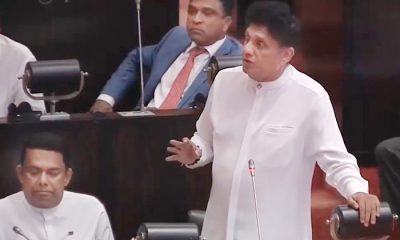
Sajith: Ashoka Chakra replaces Dharmachakra in Buddhism textbook
-

 Features4 days ago
The Paradox of Trump Power: Contested Authoritarian at Home, Uncontested Bully Abroad
-

 Features4 days ago
Subject:Whatever happened to (my) three million dollars?
-

 News3 days ago
Level I landslide early warnings issued to the Districts of Badulla, Kandy, Matale and Nuwara-Eliya extended
-

 News4 days ago
65 withdrawn cases re-filed by Govt, PM tells Parliament
-

 News3 days ago
National Communication Programme for Child Health Promotion (SBCC) has been launched. – PM
-

 Opinion6 days ago
The minstrel monk and Rafiki, the old mandrill in The Lion King – II