
News
US-based Overseas Sri Lankan Academic and Research Collaboration Network launched

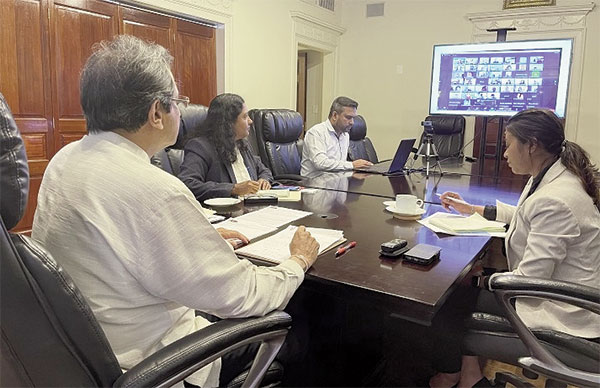
The Inaugural Meeting of the ‘US-Sri Lanka Academic and Research Collaboration Network’(USLARCN) was held virtually on 15 August 2021. The Network was launched by the Embassy of Sri Lanka in Washington D.C with a view to connecting with the academic community within the US, and leveraging their support towards Sri Lanka in academic collaboration, co-mentoring and facilitating access to US learning resources for Sri Lankan university students. This further expands the reach of the Pan US Overseas Sri Lankans (OSL)Network launched by the Embassy on 31 January 2021, with the broader aim of supporting OSL activities and leveraging their support towards Embassy efforts at realizing the interests of Sri Lanka in the US in political advocacy, economic empowerment, socio-cultural engagement, as well as in bringing unity within the SL community and reaching out to ‘Friends of Sri Lanka’.
Following the response received to a notice which was placed on the Embassy website and circulated among the OSL Network nearly two months ago, over 130 OSLs who expressed interest were clustered into 12 groups in the areas of Cultural Studies and Media; Business and Finance; Early Childhood Education; Team Science and Talent Development; Environmental Studies; Nutrition and Food Science; Chemistry, Physics; Engineering;, Computer Science and IT; Medical Sciences;, Social Sciences and Sri Lankan Studies.
Delivering the opening remarks, Ambassador of Sri Lanka to Washington D.C. Ravinatha Aryasinha commended the significant achievements of Sri Lankan academics in the US and the pride they bring to Sri Lanka. He emphasised the importance of bringing the US-based Sri Lanka origin academic community together, to both support the education system and students living in Sri Lanka, as well as to ensure that those involved at the academic and policy levels in the US had a more nuanced understanding of Sri Lanka, and of Sri Lankans in the US. Noting that up to the end of the Cold War, institutions such as the East-West Center in Hawaii and a few other US Universities had catered to this need, he said that today such a full understanding was imperative so that we respond not only to ‘events’ in each other’s countries but to the related dynamic ‘processes’ as a whole. Ambassador Aryasinha said that he had, during a visit to Hawaii in May 2021, discussed this aspect with both the East-West Center and Asia-Pacific Center for Security Studies (APCSS) so that a better appreciation of the full spectrum of multifaceted relations between Sri Lanka and the US can be better reflected in future collaboration. He hoped that the USLARCN will also take up the challenge to revive this tradition through their individual and collective endeavours.
Delivering the keynote address on the occasion, Emeritus Professor Wimal Dissanayake of the University of Hawaii and Leader of the Cultural Studies and Media Group, commended Ambassador Aryasinha for the new initiative under the Pan OSL Network, and recalled the different phases of US-SL Education Collaboration since the 1950s. He said that in the past there had been a steady stream of students, journalists, academics, policymakers and service personnel, who have attended long term degree programmes as well as seminars, and had benefitted from and contributed to the considerable cross fertilisation of views that took place, significantly around the East-West Center. However, he noted that “what you have today is a pale shadow of what it was 20 or 30 years ago, but still thanks to the efforts of the Ambassador, I think we are trying to revive it”. Noting that at present Sri Lankan scholars in this network are approximately 80% from the Natural Sciences, 15% from the Social Sciences and 5% from the Humanities, Professor Dissanayake recommended three conceptual criteria that could help future efforts; that it be inter-disciplinary in nature, that it focuses on knowledge exchange and knowledge utilization, and functions as a ‘Network’ with a structure but also flexibility.

The demand for obtaining higher-level services to diagnose diseases has been increasing within the public health system in Sri Lanka due to the growth of non-communicable diseases and
comprehensive services at all levels of care.
However, when obtaining reports from key equipment such as CT scanners, MRI scanners, DSA, cardiac catheterization units, and automated hematology and biochemistry analyzers, it has been observed that such patients have encountered immense difficulties due to a lack of equal opportunities for them.
Especially concerning the limited resources available for obtaining the respective reports in government hospitals, it has
been observed that there have been delays in clinical management due to such patients having to be on long waiting lists. Further, taking into consideration the financial limitations existing for purchasing such equipment and the complex procurement procedures that must be followed for the purchase and maintenance of such equipment, the need to resort to alternative methods for obtaining such reports has been identified.
Accordingly, the Cabinet of Ministers has approved the proposal presented by the Minister of Health and Mass Media to take necessary steps to obtain such services and equipment to diagnose relevant diseases, following the prescribed
procurement procedure under the suitable public-private partnership subject to a performance-based payment scheme.
Latest News
Cabinet approves implementation of National Strategic Action tion Plan to Combat and Prevent Trafficking in Human Beings – 2026- 2030

Sri Lanka has signed and ratified the United Nations Convention against Organized Crime (UNTOC) and the Palermo Protocol to Prevent, Suppress, and Combat Trafficking in Persons, especially against Women and Children, which is a treaty for the enforcement of its provisions.
Accordingly, the National Task Force on Trafficking in Persons was established in 2010 for the coordination of institutions that are interested and actively involved in the prevention of
trafficking in persons. The aforementioned task force has been operating in terms of the action plan prepared for a definite period, and the period of the final national strategic action plan for the period 2021-2025 has ended on 31-12-2025.
Therefore, having reviewed the progress of the aforementioned action plan. The national strategic action plan for the period 2026-2030 has been prepared with the consensus and knowledge of all relevant parties, consisting of four approaches:
protection, litigation (complaints), and partnership.
Accordingly, the Cabinet of Ministers has approved the proposal presented by the President, in his capacity as the Minister
of Defense, to implement the aforementioned national strategic action plan.

The situation report issued by the Disaster Management 1000hrs today [06th January 2026] confirms that 21,514 persons belonging to 6,592 family units who were displaced due to the floods and landslides are still at 225 safety centers.
Z total of 6,037 houses were destroyed while 108,476 houses were partially damaged due to floods and landslides.

Cabinet nod to obtain diagnostic reports under public-private partnership

Cabinet approves implementation of National Strategic Action tion Plan to Combat and Prevent Trafficking in Human Beings – 2026- 2030

21,514 persons remain at 225 safety centers as at 10AM today [06]

Landslide Early Warnings issued to the districts of Badulla, Kandy, Matale, Monaragala and Nuwara Eliya

Head and Smith centuries grind England in the SCG dirt

Cuba says 32 Cuban fighters killed in US raids on Venezuela

‘Dates have the highest sugar content to fight Coronavirus’

Sunday Island 27 December – Headlines

#SundayIsland 17th December – Headlines

Sunday Island – 28th March

Sunday Island Headlines – 21 March

Sunday Island – 21st February – Headlines
-

 News1 day ago
Private airline crew member nabbed with contraband gold
-

 News10 hours ago
Broad support emerges for Faiszer’s sweeping proposals on long- delayed divorce and personal law reforms
-

 News3 days ago
Health Minister sends letter of demand for one billion rupees in damages
-

 Opinion5 days ago
Remembering Douglas Devananda on New Year’s Day 2026
-
 News6 days ago
Leading the Nation’s Connectivity Recovery Amid Unprecedented Challenges
-
 Features1 day ago
Pharmaceuticals, deaths, and work ethics
-

 Latest News1 day ago
Curran, bowlers lead Desert Vipers to maiden ILT20 title
-

 News1 day ago
PM lays foundation stone for seven-storey Sadaham Mandiraya