
Life style
Upali: through the lens

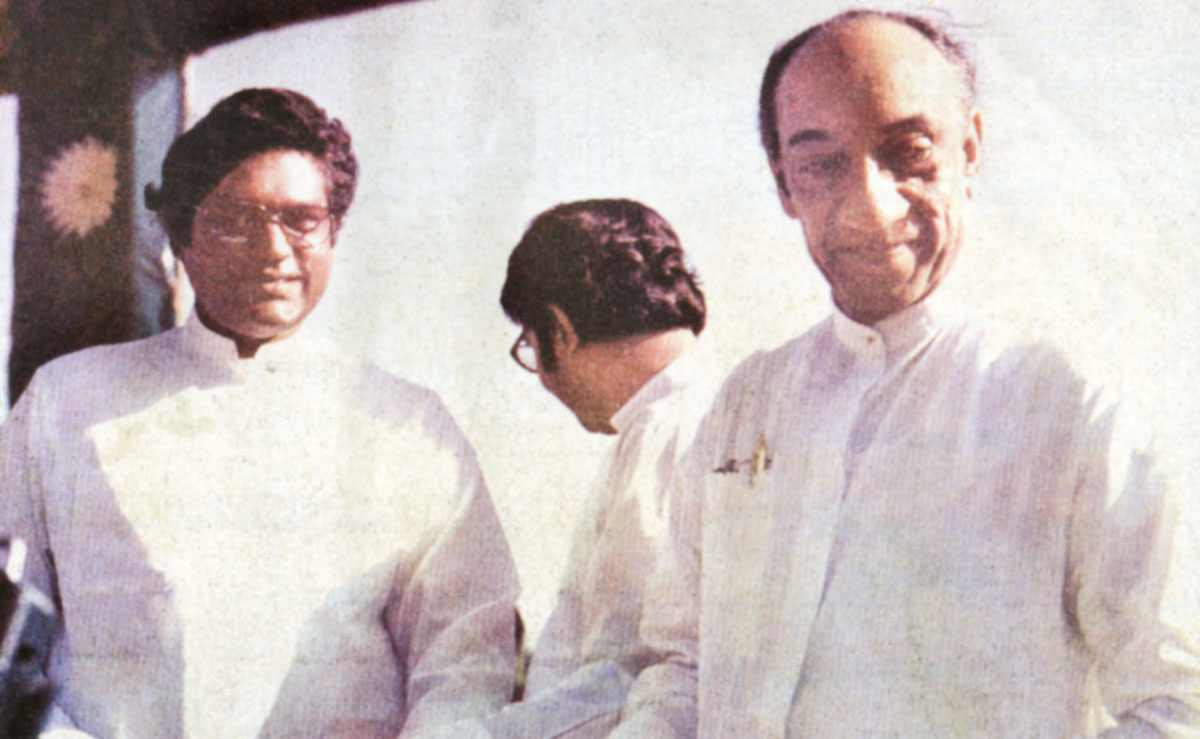
BY RANDIMA ATTYGALLE
Four decades and more on, the spectacle of Sri Lanka’s first home-grown business magnate of international repute- Upali Wijewardene’s life and mysterious disappearance just four days short of his 45th birthday, still holds us in its grip.
Marking 42 years since Upali disappeared on February 13, 1983, when he was returning home from Malaysia on his Lear Jet with five others on board, his beloved flagship ‘Sunday Island’ travels back in time with onetime photojournalist and today a senior professional and an entrepreneur himself, Prasanna Hennayake who was handpicked by Upali to enrich his newspapers and serve as his official photographer.
Hennayake who later went onto become the first Lankan photographer for Reuters and eventually served several Presidents of the country and political stalwarts as their official photographer, recaps the unforgettable memories of his one-time boss who was dubbed ‘the quintessential entrepreneur of Asia’ and whose only unrealized dream at the time of his tragic exit was to become the President of Sri Lanka.
It was October 26, 1981. The Ceylon Daily News’ front page was decorated with a photograph of Queen Elizabeth waving at the crowds from the balcony of the British Council in Colombo under the banner ‘Goodbye, Queen Elizabeth’. The Queen, who was on her second visit to the island was making her last visit to the British Council just a day before her departure and crowds had thronged to get a glimpse of the royal.
Soon to be a young father of 24, Prasanna Hennayake who had been a staff photographer for Lake House newspapers only for one year, was picked as one of the two photographers to cover the Royal visit. “This was the time when colour photography was just making it to our newspapers. While I was assigned to take black and white photographs of the Royal visit, my photo editor was to take colour photos. However, I was given just one colour film with instructions to capture any good shots if they were worthy of the reel,” recollects Hennayake.
The life-changing photograph
The young photojournalist who was following the Queen and her entourage around the island was to cover her last visit to the British Council. While the other press photographers were following the royal in a frenzy to the British Council, young Hennayake kept his vigil outside the building. “Given the customary royal practice of waving from Buckingham Palace, I had a gut feeling that the Queen would eventually turn up on the building’s balcony and I was right.” With an adrenaline rush, Hennayake wasted no time in using the colour film he was given to freeze the moment of Queen waiving at the crowds below.
The following day his photograph appeared as the lead photo of all Lake House newspapers and Hennayake was at his desk in the morning as usual. He was suddenly alerted by his then editor at the Daily News, Manik de Silva that someone was on the phone asking for him. “When I answered it was none other than Upali Wijewardene who complimented me on the Queen’s photo which he had noticed in the papers that day and inviting me to join his newly launched The Island and Sunday Divaina newspapers.”
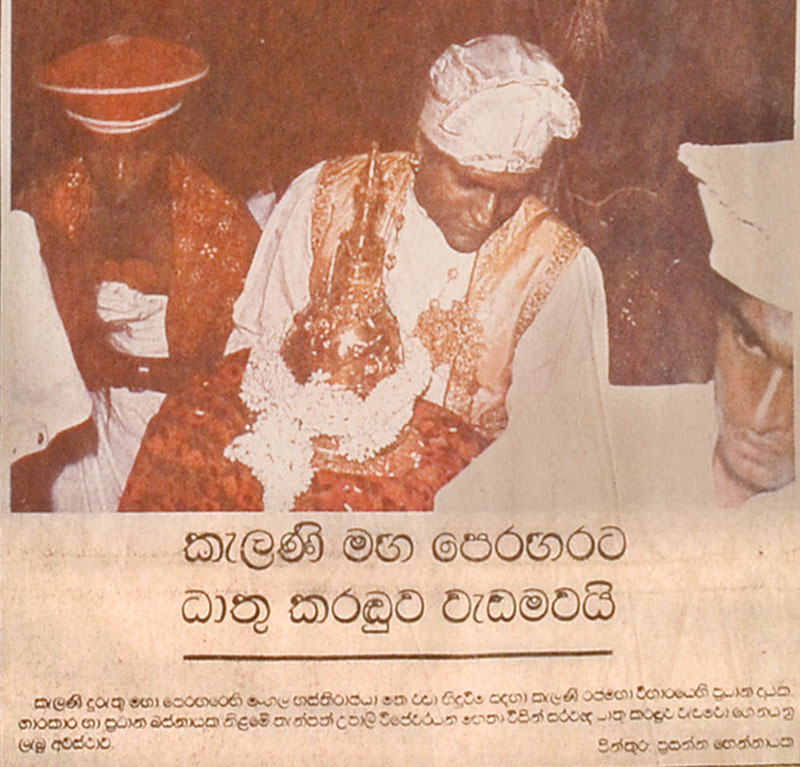
Upali as the Chief Basanayake Nilame of Kelani Raha Maha Vihara
Hennayake who was drawing a modest monthly salary of Rs. 450 was dumbstruck when Upali offered him Rs. 2,500 and urged him to come and meet him at his offices the following week. “With my first child on the way and struggling to make ends meet, it was an offer too good to lose,” he looks back, sharing with me the photo taken 44 years ago which changed his destiny. Hennayake who photographed the Queen bidding goodbye, ironically had to bid goodbye to his Lake House colleagues in less than a week.
A handsome six-footer greets
On November 2, 1981 when Hennayake was ushered into the Chairman’s office at the Upali Group’s offices at Bloemendhal Road, a strikingly handsome six-footer with chiseled features greeted him. “His was a face that any camera would love,” recounts Hennayake who was mesmerized by the charisma of the towering personality Upali was. “He knew exactly what he wanted and despite being an entrepreneur of international fame at that point, Mr. Wijewardene never threw his weight around. He looked after his staff well and was essentially a warm man.”
Hennanyake who joined the Upali Group only a few weeks after The Island and Sunday Divaina had been launched, proactively contributed to it and other sister publications which followed. He fondly remembers his then Chief of Photography Rienzie Wijeratne. He recounts the Spectrum series for the Island and the picture story series based on Dr. Ediriweera Sarachchandra’s dramas done for Divaina among his other contributions.
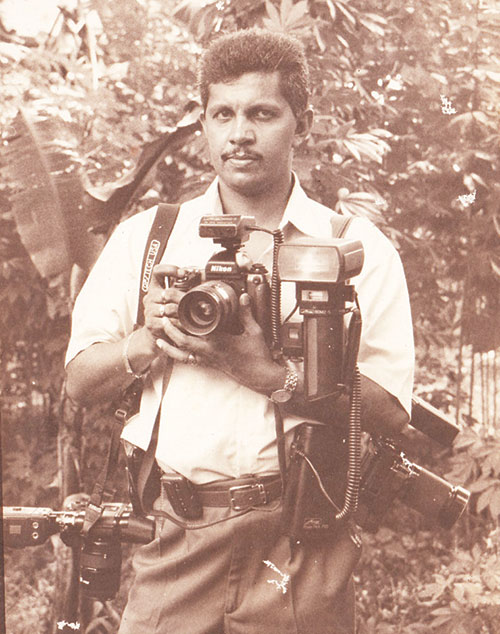
Young Prasanna as a photojournalist
Radical publisher
The newspapers his founder went on to launch snubbing the feasibility reports that suggested the venture will not be viable in an already saturated market, was a hit within a few weeks. “He hired the cream of people- be it journalists, administrators or otherwise and turned tables with his newly launched newspapers. The Island and Divaina soon earned the reputation of ‘informal universities’ as such was the rich content they carried. He was innovative with his publishing business just as much as he was with his other business pursuits. He also brooked no interference from people and was radical in everything he did. The best example was when the Sri Lankan rebel team toured in South Africa, all newspapers boycotted reporting on it except the Island,” recollects Hennayake who was fortunate to have covered Sri Lanka’s first Test match played in 1982 at the Colombo Oval Grounds for the Island.
Global Lankan
Commenting on Upali who was described by Matt Miller (Insight, May 1981) as ‘Sri Lanka’s most free-wheeling industrialist’ and ‘commodities wizard’, Hennayake remarks: “what Upali Wijewardene envisioned was global recognition for the ‘Made in Sri Lanka’ label. Just as much as he prided in Upali products which made international presence, he encouraged other local businesses to come up and think big. Once when I was accompanying Mr. Wijewardene on his helicopter to his maternal ancestral place Kamburupitiya, he told me that it is only once you give back the money you’ve earned from this country to the people of this country that it will truly progress.”
Hennayake quotes Ariyasiri Vithanage who once compered Upali’s political meetings in Kamburupitiya: ‘the loud speakers installed for this meeting, the radios the villagers listen to, the very first television receiver we saw, the car in which were driven today- all bear the ‘Upali’ brand. His vision to usher Sri Lanka to the next century is best mirrored through these products.’ Hennayake laments that Sri Lanka lost this golden opportunity with his untimely exit. “Had Upali lived, we would be living in a different Sri Lanka now. In his own words he was ‘probably the culmination of the country’ youth aspirations’ and we wouldn’t have seen this brain drain.”
Man of speed
Working closely with Upali in his projects concerning the Greater Colombo Economic Commission (GCEC) which he set up and of which he became the first Director General, enabled the then young photographer closer insights to this maverick. Upali’s leadership style, his ‘can-do’ attitude, photographic memory, aptitude for quick problem-solving and his tremendous energy continue to inspire the successful entrepreneur that Hennayake is today. Upali’s daring sense of adventure, wit and impish sense of humour still holds his one-time recruit in wonderment.
“He was bold and feared nobody, the very reason which earned him several political enemies,” reflects Hennayake who became an indispensable member of Upali’s political campaign which he called his ‘Third-20-year plan’ and as Matt Miller would once write: ‘Upali’s current passion for politics is matched only by his passion for racehorses.’

Prasanna Hennayake
Photographing Upali as the Chief Basnayake Nilame of the Kelani Raja Maha Vihara when he placed the casket of relics on magul hasthiya to the collective resonance of the bystanders’ sadu-sadu was a phenomenal experience says Hennayake. “He was stunning and had an electrifying effect on people. Watching him parade in the annual Duruthu Perahera was simply a sight to behold,” says Hennayake who had no inkling that it would be the last time he would see his beloved boss alive, as he snapped his photos at the Duruthu Perahera in January 1983.
Recollecting that fateful day when Sri Lanka’s much-loved tycoon simply vanished with no trace, Hennayake says: “it was like a scene from a movie, so surreal. None of us could accept the disappearance. It took months for the news to sink in. Even several years after Mr. Wijewardene’s disappearance when I used to visit Malaysia, many over there who called him the ‘Cocoa-King’ used to believe that he was still alive somewhere. Such was his charisma.” He also recollects the heart-rending first year remembrance rites of his boss at the Kelani Vihara in 1984 which he was assigned to cover.
A legend of our times
In a digital era where Artificial Intelligence seems to be the norm, the innovation and creativity of a man such as Upali’s, become even more valid, reflects Hennayake. “Today we see youngsters becoming slaves to technology, they are becoming increasingly dependent on artificial intelligence. With his innovation and inherent skill, from a small confectionary manufacturer, Upali expanded his company to one of Asia’s largest and most diverse manufacturing concerns. What is even more amusing is the fact that he achieved all of it and showed the world what the Sri Lankan entrepreneurship was capable of, in an era where global connectivity was minimal.”
What happened to Upali Wijewardene who captured the imagination of an entire nation, is yet unanswered. The veteran journalist Ajith Samaranayake once wrote: ‘Upali Wijewardene fascinated people in life and now that he is no longer to be found, lost somewhere in the vast ethereal emptiness, he has become a legend and a cult which continues to enthrall the people…Like Icarus who flew but went too close to the sun so that his wings melted, the strange and fascinating destiny of Upali Wijewardene, Sri Lanka’s first tycoon who also chose the sun as his symbol, will always be a glorious legend of our times…’
Photo credit: Prasanna Hennayake


In a country where creative pursuits are often treated as indulgences rather than vocations, Saman Halloluwa’s journey stands apart — carved patiently through brushstrokes, framed through a camera lens, and articulated through the written word. Painter, wildlife and nature photographer, and independent environmental journalist, Halloluwa inhabits a rare space where art, ecology and social responsibility converge.
His relationship with art began not in galleries or exhibitions, but in a classroom. From his school days, drawing was not simply a subject but an instinct — a language through which he learned to observe, interpret and respond to the world around him. Under the guidance of two dedicated mentors, Ariyaratne Guru Mahathaya and Gunathilaka Guru Mahathaya, he honed both skill and discipline. Those early lessons laid the foundation for a lifelong engagement with visual storytelling.

“His work navigates between traditional Sinhala artistic sensibilities, abstract compositions and expansive landscapes.”
 That commitment eventually materialised in two solo art exhibitions. The first, held in 2012, marked his formal entry into Sri Lanka’s art scene. The second, staged in Colombo in 2024, was a more mature statement — both in content and confidence. Featuring nearly fifty paintings, the exhibition drew an encouraging public response and reaffirmed his place as an artist with a distinct visual voice.
His work navigates between traditional Sinhala artistic sensibilities, abstract compositions and expansive landscapes. There is restraint in his use of form and colour, and an underlying dialogue between memory and space. Yet, despite positive reception, Halloluwa speaks candidly about the structural challenges faced by artists in Sri Lanka. Recognition remains limited; fair valuation even rarer.
“This is not merely an artistic issue,” he observes. “It is a social and economic problem.”
In Sri Lanka, art is often viewed through the lens of affordability rather than artistic merit. Many approach a painting by first calculating the contents of their wallet, not the value of the idea or labour behind it. In contrast, he notes, art in Europe and many other regions is treated as cultural capital — an investment in identity, history and thought. Until this mindset shifts, local artists will continue to struggle for sustainability.
The decisive push toward wildlife photography came from Professor Pujitha Wickramasinghe, a close friend who recognised both Halloluwa’s observational skills and his affinity with nature. From there, the journey deepened under the mentorship of senior wildlife photographer Ravindra Siriwardena.
Both mentors, he insists, deserve acknowledgment not merely as teachers but as ethical compasses. In a field increasingly driven by competition and spectacle, such grounding is invaluable.
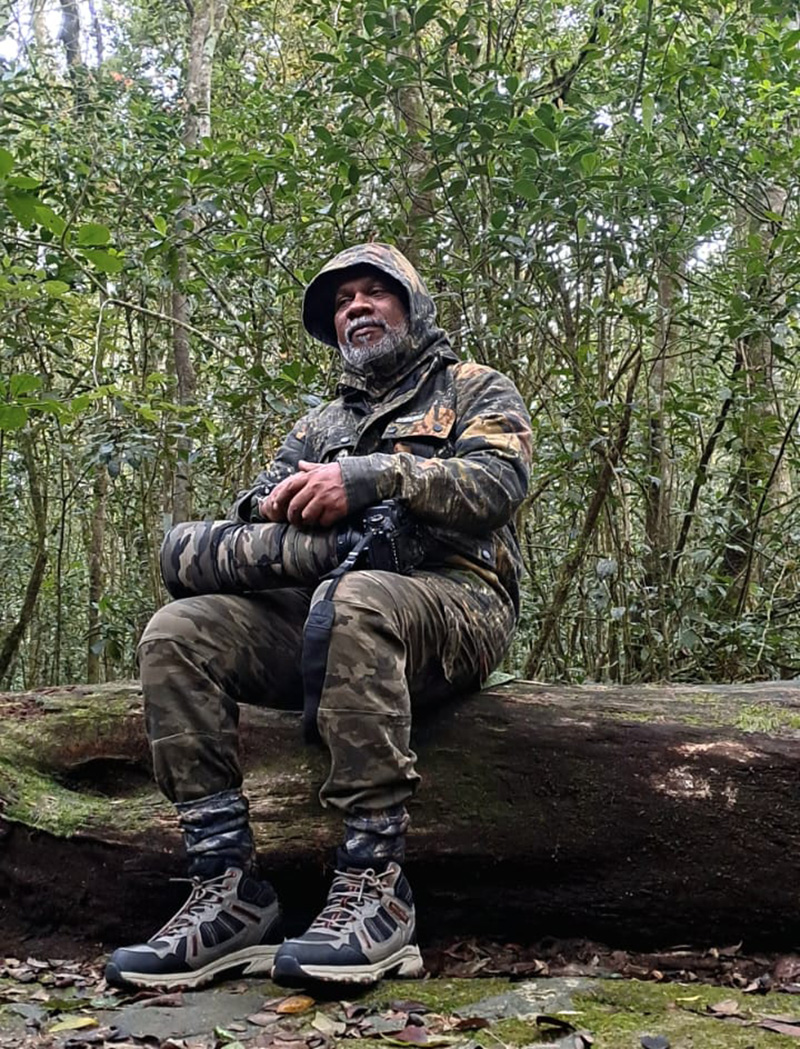
Saman Halloluwa
Wildlife photography, Halloluwa argues, is among the most demanding visual disciplines. It cannot be improvised or rushed. “This is an art that demands restraint,” he says.
Among all subjects, elephants hold a special place in his work. Photographing elephants is not merely about proximity or scale, but about understanding behaviour. Observing social patterns, movement, mood and interaction transforms elephant photography into a constantly evolving challenge. It is precisely this complexity that draws him repeatedly to them.
Halloluwa is cautiously optimistic about the current surge of interest in wildlife photography among Sri Lankan youth. Opportunities have expanded, with local and international competitions, exhibitions and platforms becoming more accessible. However, he issues a clear warning: passion alone is not enough
Sri Lanka, he believes, is uniquely positioned in the global nature photography landscape. Few countries offer such concentrated biodiversity within a compact geographical area. This privilege, however, carries responsibility. Nature photography should not merely aestheticise wildlife, but foster respect, aware ness and conservation.
Parallel to his visual work runs another equally significant pursuit — environmental journalism. For the past seven to eight years, Halloluwa has worked as an independent environmental journalist, giving voice to ecological issues often sidelined in mainstream discourse. His entry into the field was guided by Thusara Gunaratne, whose encouragement he acknowledges with gratitude.
An old boy of D.S. Senanayake College, Colombo, Halloluwa holds a Diploma in Writing and Journalism from the University of Sri Jayewardenepura and has completed journalism studies at the Sri Lanka Press Institute. He is currently pursuing an Advanced Certificate in Wildlife Management and Conservation at the Open University of Sri Lanka — a testament to his belief that learning must remain continuous, especially in a rapidly changing ecological landscape.
Outside his professional life, he enjoys cricket, rugby and badminton. Yet even leisure intersects with responsibility. He is a founding member and former president of the D.S. Senanayake College Old Boys’ Wildlife Forum, an active member of Wild Tuskers Sri Lanka, and a contributor to several independent environmental and wildlife volunteer organisations. In an era dominated by speed, spectacle and short attention spans, Saman Halloluwa’s journey unfolds differently. It is deliberate, reflective and rooted in values. Through art, he captures memory and form. Through photography, he frames life beyond human control. Through journalism, he asks uncomfortable but necessary questions.
“What I do, what I love” is not fashion here.
It is conviction — patiently lived, quietly asserted, and urgently needed in a country still learning how to value its artists, its environment and its truth.
By Ifham Nizam ✍️

Ramani Fernando Sunsilk Hair and Beauty Academy
Ramani Fernando Sunsilk Hair and Beauty Academy marked their graduation of their latest cohort of aspiring hair professionals in a ceremony held at Kingsbury Hotel.

Senaka de Silva, creative force behind Ramani’s shows
For over two decades, the Ramani Fernando Sunsilk Hair and Beauty Academy has stood as a beacon of excellence in beauty education in Sri Lanka. Founded by industry icon Ramani Fernando, the Academy has built a reputation for producing highly skilled professionals who go on to make their mark in salons, both locally and internationally. As the newly minted graduates step out into the world, they carry forward not just certificates, but also the promise of creative authority and personal empowerment.
The chief guest for the occasion was Rosy Senanayake, a long-standing supporter of the Academy’s mission. Addressing the graduates her message echoed her enduring belief that the beauty industry is not merely about aesthetic but about. confidence, self-worth and future leaders.
Over months of rigorous training, these young professionals honed their skills in cutting colouring, styling and contemporary artistry readying themselves to set trends rather than follow them.
Each graduate walked the stage with confidence, their dedication signalling a promising future for Sri Lanka’s beauty and fashion industry! With this new generation of stylists preparing to raise the standard of professional hairstyling.
Ramani Fernando, addressing the audience reflected on the academy’s mission to cultivate not only skills but vision and confidence in every student.
She urged the graduates to embrace continuous learning to take risks with creativity .The world of beauty is ever evolving, stay curious, stay bold and never underestimate the power of your talent, she added emphasising the importance of confidence, discipline and passion in carving a successful career in shaping the future of style.
These graduates are stepping into a world of endless possibilities. They are future of the country, who will carry a forward legacy of creativity. Behind every successful graduate at Sun silk Hair Academy stands a team dedicated to excellence. While Ramani Fernando serves as a visionary Principal and it is Lucky Lenagala, her trusted person who ensures that the academy runs seemingly.
From overseeing training sessions to guiding students, through hands on practice, Lucky plays a pivotal role in shaping the next generation of hairstylists.
Kumara de Silva, who has been the official compere Ramani’s, Hair graduation ceremony, from inception has brought energy, poise and professionalism. The Sunsilk Hair Academy is a celebration of talent and mentor ship for the graduates stepping confidentially into the next chapter of their careers, ready to make their mark on Sri Lanka beauty landscape

A moment of pride Ramani with chief guest Rosy Senanayake

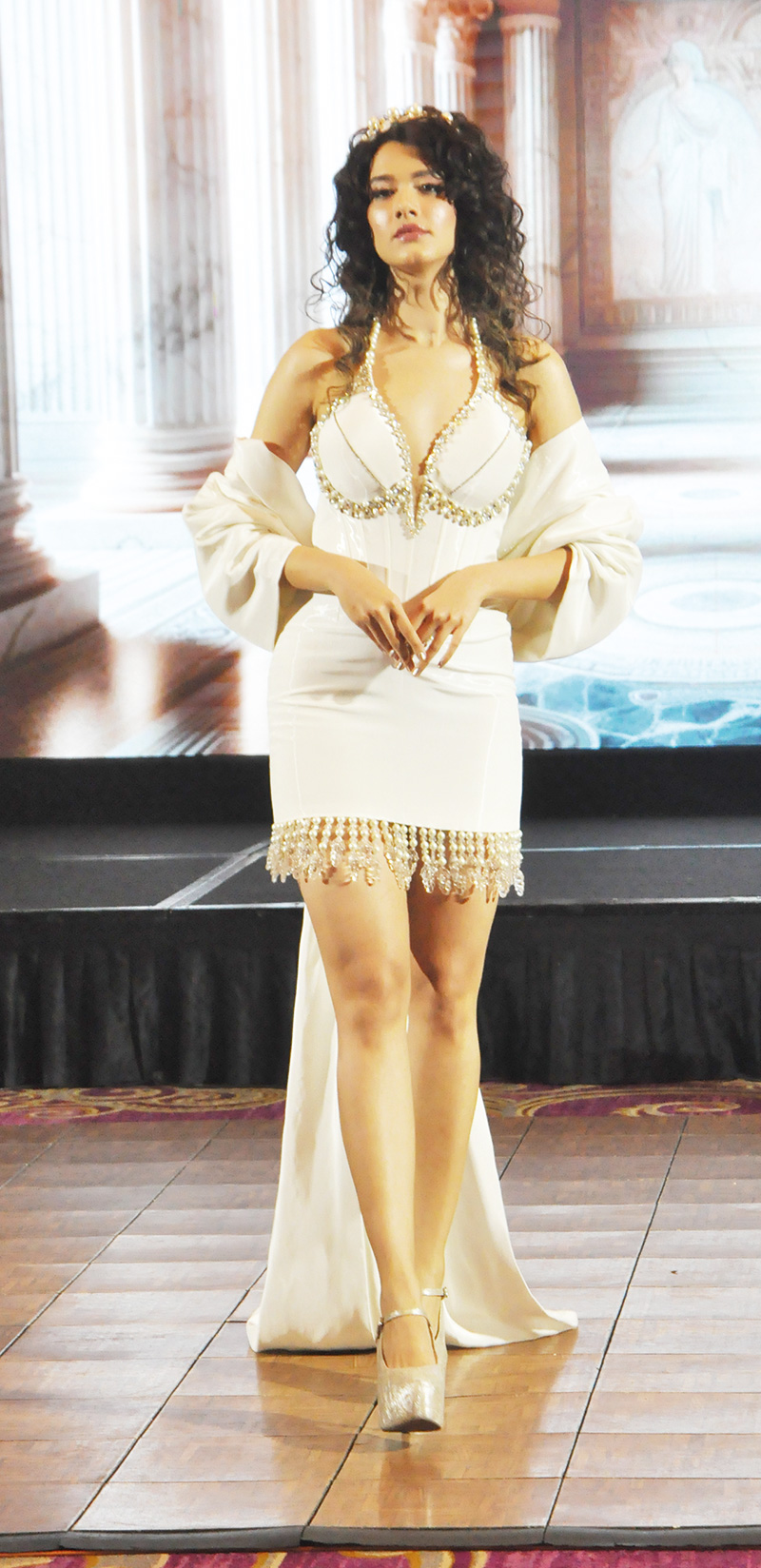
Statement in style

Gliding in romance and sophistication
Pix by Thushara Attapathu
By Zanita Careem ✍️

During this season, Romesh Atapattu’s Capello Salon buzzes with a unique energy – a blend of festive excitement and elegance. Clients arrive with visions of holiday parties, office soirees, seeking looks that capture both glamour and individuality. The salon itself mirrors this celebrity mood. Warm lights, tasteful festive décor create an atmosphere where beauty and confidence flourish.
Romesh Atapattu himself curates the festive décor, infusing the space with his signature sense of style. His personal eye ensures that the décor complements the salon’s modern interiors.
As Colombo slips effortlessly into its most glamorous time of year, the Christmas season brings with it more than twinkling lights and celebrity soirees – it signals a transformation season at salons across the city. Capello salons are no exception.
At the heart of this festive beauty movement is Romesh Atapattu of Capello salons, a name synonymous with refined hair artistry, modern elegance and personalised style.
Christmas is about confidence and celebration. Romesh believes ‘People want to look their best without losing who they are”. Our role is to enhance, not overpower. This philosophy is evident in the salon’s seasonal approach.
Beyond trends, what sets Atapattu apart is the attention to individuality. Each consultation is treated as a creative collaboration – face shape, lifestyle, hair texture and personal style all play a role in creating the best for Romesh.
Stepping into Romesh’s salon during the Christmas season is an experience in itself. The space hums with festive energy while maintaining an atmosphere of calm sophistication.
The décor embraces the Christmas spirit with understated elegance. Tastefully adorned décor, beautiful Xmas tree, soft gold and ivory tones, and gentle hints of red are woven seamlessly into the salon’s contemporary design.
His staff, known for their warmth and professionalism also plays a key role in shaping the salon’s atmosphere—friendly, stylish and always welcoming. The Capello staff combine skill and creativity to deliver results that have a lasting impression.
Beyond trends, what sets Romesh Atapattu apart is the attention to individuality. Each consultation is treated as a creative collaboration – face shape, lifestyle, hair texture and personal style all play a role.
He is a professional who blends technical mastery with a deeply personal approach to style. His dedicated team of skilled professionals, operate with quiet confidence ensuring styles that create an atmosphere of trust, turning every appointment into a personalised and memorable experience.
(ZC) ✍️
Pic by Rohan Herath

Showers predicted in several provinces today (29th December)

Delay in govt. response to UK sanctions on ex-military chiefs, and others causes concern

Sri Lanka outlines seven key vectors of international cooperation at Moscow forum

Sri Lanka third most preferred destination for Indians

Ondansetron controversy: Health Minister explores interim measures to address growing concerns

Post-Ditwah tourism: Govt. to retain UK interest in SL as key destination

‘Dates have the highest sugar content to fight Coronavirus’

Sunday Island 27 December – Headlines

#SundayIsland 17th December – Headlines

Sunday Island – 28th March

Sunday Island Headlines – 21 March

Sunday Island – 21st February – Headlines
-

 News6 days ago
Members of Lankan Community in Washington D.C. donates to ‘Rebuilding Sri Lanka’ Flood Relief Fund
-

 News4 days ago
British MP calls on Foreign Secretary to expand sanction package against ‘Sri Lankan war criminals’
-

 Features6 days ago
General education reforms: What about language and ethnicity?
-
 News6 days ago
Suspension of Indian drug part of cover-up by NMRA: Academy of Health Professionals
-
 Sports4 days ago
Chief selector’s remarks disappointing says Mickey Arthur
-
 News3 days ago
Street vendors banned from Kandy City
-

 Editorial6 days ago
A very sad day for the rule of law
-

 News6 days ago
US Ambassador to Sri Lanka among 29 career diplomats recalled