
News
UNP’s preferential votes not counted as it failed to secure any parliamentary seats


by Suresh Perera
As the UNP failed to secure any parliamentary seats at the August 5 election, the preferential votes of its candidates were not counted, a senior Election Commission (EC) official said.
Asked why Ranil Wickremesinghe’s preferences were not released, EC Chairman Mahinda Deshapriya said there was no need to count preferential votes of candidates of political parties which had had not secured any seats in Parliament.
“Why count them when no representatives had been elected?”, he asked.
The UNP suffered a crushing defeat, and it was the first time that the oldest party in Sri Lanka’s political landscape failed to secure a single seat in a parliamentary election.
“The UNP was reduced to rubble”, a political observer commented.
The embattled party led by Wickremesinghe was able to secure only 249,435 votes (2.15%) as against the SLPP’s hefty 6,853,690 (59.09%) and the SJB’s 2,771,980 (23.90%) at the polls.
The UNP, which was routed even in its one time stronghold of Colombo, was entitled only to a single National List seat. There was no word on who would be nominated by the party but speculation was rife that either veteran UNP stalwart John Amaratunga or Prof. Ashu Marasinghe may be asked to step in.
The ignominious defeat suffered by the UNP also saw the exit of the party’s leader Ranil Wickremesinghe, a seasoned politician, who was first elected as a Member of Parliament for Biyagama in 1977.
After taking over the party leadership in November 1994, he served as the Prime Minister three times. The last time he served as premier was when Maithripala Sirisena was elected President in 2015.
“The UNP has been decimated”, political analysts said, referring to the dismal performance of the party, which had to grapple with a leadership crisis leading to the formation of the Samagi Jana Balavegaya (SJB), an offshoot headed by the UNP’s one-time deputy, Sajith Premadasa.



The Suraksha Student Insurance Program has been initiated with the primary objective of the creation of the necessary environment for the students who encounter various obstacles due to various health issues to overcome barriers and continue their education without any interruption.
The students studying in government schools, government approved private schools, Pirivenas and Assisted special schools are eligible to obtain the benefits under this program.
The Cabinet of Ministers, decided to grant their approval for the resolution furnished by the Prime Minister, in her capacity as the Minister of Education, Higher Education, and Vocational Education, to revise and implement the currently enforced agreement regarding the aforementioned Suraksha Student Insurance Program between the Ministry of Education, Higher Education, and Vocational Education and Sri Lanka Insurance Corporation for the period from 01-09-2026 to 31-08-2027,
with the inclusion of the following new benefits as well.
• Providing the opportunity to claim benefits up to Rs. 75,000/- for repairing hearing accessories and for the service charges incurred thereof.
• Providing the opportunity to claim benefits up to Rs.20,000/-for the students who are taking medicines in long term for the diseases such as for chronic kidney diseases and Chronic
Inflammatory Arthritis.
• Providing the opportunity to claim benefits up to Rs.20,000/- for the expenses incurred for the tests Malignancy Screening Test for Skin Cancer, Post-transplant Lymphoproliferative Disorder (PTLD), Screening Test for Osteoporosis, Screening Test for Hepatitis B, Hepatitis C, and HIV.
• Revising ‘Cancer Treatment’ under the critical illness category to ‘Cancer Treatment and related Testing’, and covering expenses incurred for major surgeries required for hip, shoulder, and knee joint replacements due to sudden accidents, as well as PET Scans, under the critical illness category.
• Providing the opportunity to claim an amount of Rs. 100,000/- under the accidental category for student fatalities occurring due to sudden accidents during activities organized by institutions under the Ministry of Education, Higher Education, and Vocational Education, and conducted under the supervision of educational authorities (such as educational terms/excursions and sports meets, etc.) either within or outside the school.
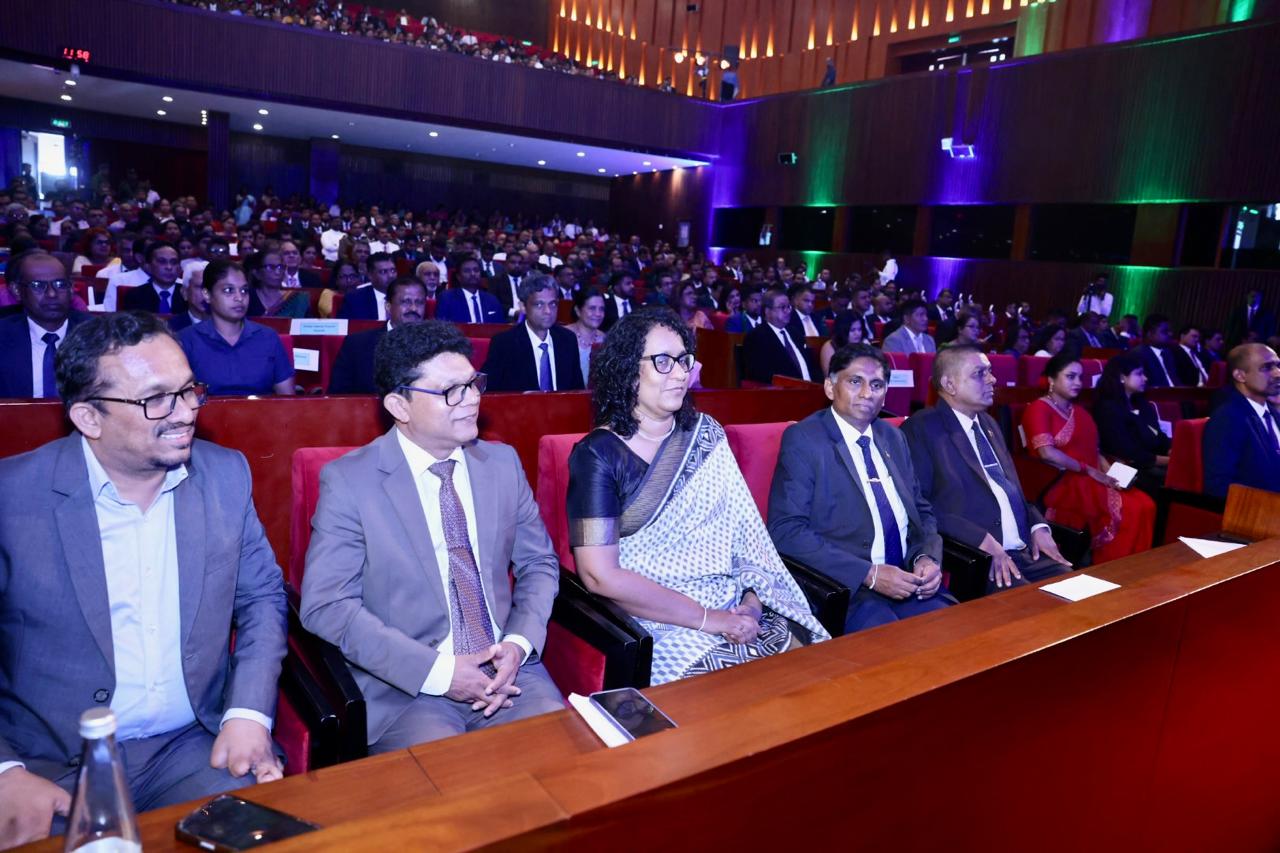
Prime Minister Dr. Harini Amarasuriya stated that the Government was deeply saddened by the unfortunate death of the Tusker Kavanthissa, a national treasure who sustained severe injuries from gunshot wounds. She emphasised that environmental laws would be strictly enforced against those responsible for environmental crimes, without discrimination or favouritism.
The Prime Minister made these remarks while addressing the Presidential Environmental Awards 2026, organised for the 11th time by the Central Environmental Authority under the Ministry of Environment, at the Bandaranaike Memorial International Conference Hall (BMICH) in Colombo on Monday (19 October).
A total of 195 awards, comprising Gold, Silver, Bronze and Merit Awards, were presented to institutions recognised for their sustainable management of natural resources. The Prime Minister participated in presenting the Gold Awards.
Addressing the occasion, the Prime Minister stated:
“A country’s prosperity is measured not only by its economic indicators. Clean air, safe drinking water and a healthy ecosystem are equally essential to ensuring a better quality of life for its people.
The Clean Sri Lanka programme, launched with this objective, is not merely about cleaning roads. It is a national transformation aimed at reducing waste, ensuring proper waste management and changing the way we think about and treating the environment.
We cannot allow tragedies such as the one that befell Tusker Kavanthissa to happen again. Environmental laws must not be influenced by a person’s position, wealth or connections. The law will be enforced equally against everyone. Everything from the issuance of licences to the approval of projects must be carried out on the basis of scientific evidence and with complete transparency.
Development achieved at the expense of environmental destruction can never be considered sustainable development. Wildlife officers and veterinary teams made significant efforts to save the Tusker Kavanthissa. However, the Tusker could not be saved due to the severity of its injuries and the resulting infections.
The Government is deeply saddened by this loss. In order to prevent similar incidents in the future, we will further strengthen veterinary care for wildlife and veterinary education. The Government has already taken a number of practical measures to address the long-standing human-elephant conflict.
Accordingly, 113 forest areas have been designated as reserves, bringing 71,900 hectares (approximately 180,000 acres) under protection. In addition, three elephant corridors are being established to facilitate the free movement of elephants, alongside a dedicated reserve for elephant management.
In order to strengthen the field operations of the Department of Wildlife Conservation, 100 pickup vehicles, 185 motorcycles and nine tractors have been provided. Furthermore, 3,500 elephant fence assistants and 5,000 members of the Civil Security Department have been deployed to maintain elephant fences.
Steps have also been taken to amend the National Environmental Act after 26 years. More than 1,600 new officers are being recruited to the Ministry of Environment.
Environmental conservation must not be treated as a temporary project. It must become an essential component of government policy and the daily lives of every citizen. It is vital to support small and medium-sized enterprises in adopting green technologies, promoting practical environmental skills through school and university education, and fostering environmental responsibility through religious institutions. We seek the support and cooperation of the entire public to ensure that we leave behind a safe, beautiful and clean country for future generations.
The event was attended by Minister of Environment Dhammika Patabendi; Minister of Industry and Entrepreneurship Development Sunil Handunnetti; Deputy Minister of Environment Anton Jayakody; Secretary to the Ministry of Environment K. R. Uduwawala; Chairman of the Central Environmental Authority, Professor Tilak Hewawasam; and a large gathering of government officials, foreign representatives and award recipients.
Prime Minister’s Media Division

President Anura Kumara Dissanayake today (20) paid his last respects to the remains of Most Venerable Kappetiyagoda Siri Wimala Thera, Anunayake of the Sri Lanka Ramanna Maha Nikaya and Chief Incumbent of the Rajopawanaramaya Temple in Gatambe, Kandy, who passed away.
The President visited the Rajopawanaramaya Temple in Gatambe, Kandy, where the remains of the Thera are lying, and paid his last respects. He subsequently expressed his deepest condolences to the Maha Sangha and the temple’s Dayaka Sabha, who are mourning the passing of the Thera.
Central Province Governor and Consultant Physician Dr Harsha Suranga Fernando, Kandy District Secretary Indika Udawatta and several others were present.
President’s Media Division (PMD)

Implementation of Suraksha Student Insurance Program for the Year 2026/2027

Environmental laws will be enforced equally against everyone

President pays last respects to Most Venerable Kappetiyagoda Siri Wimala Thera

Shafali receives demerit point for breaching Level 1 of ICC code of conduct

Heavy showers about 100 mm are likely at some places in the Northern, North-central, Central, Eastern, North-western and Uva provinces

Molineux, Dunkley enter WPL 2027 auction with top base price of INR 50 lakh

‘Dates have the highest sugar content to fight Coronavirus’

Sunday Island 27 December – Headlines

#SundayIsland 17th December – Headlines

Sunday Island – 28th March

Sunday Island Headlines – 21 March

Sunday Island – 21st February – Headlines
-

 Features3 days ago
Kotahena:A Small Enclave, An Extraordinary Legacy
-

 News7 days ago
Sri Lanka, India caught in US-Iran ship crisis
-
 News4 days ago
Asgiri Mahanayake calls for immediate release of Gnanasara Thera
-

 Latest News7 days ago
Missiles intercepted near Riyadh after Saudi coalition hits Yemen fuel depot
-

 Latest News7 days ago
Kusal Mendis’ unbeaten 87 hands Sri Lanka consolation win
-

 News2 days ago
Record 1,600 students take Russian Classical Ballet examination in Sri Lanka
-
 News6 days ago
AC President recuses himself from hearing prison attire case pertaining to Gnanasara Thera
-

 Latest News7 days ago
Heavy showers above 100 mm are likely at some places in the Western, Sabaragamuwa, Southern, Central, and North-western provinces and in Anuradhapura district.