
Business
Unprecedented geo-politics & geo – economics at play: History, strategem and positioning of Sri Lanka


Just a year ago, probably nobody in the world would have believed that a military or crisis in Middle-East could have such a cataclysmic impact on the global economy. Of course, understandably, even to this day Oil remains a potent geo-political and geo-economic tool or weapon, decades after the energy crisis of the 1970s. Interestingly, both the energy and oil crises of 1973 and 1979, Iran did play a pivotal role. In 1973, even though Iran was only a non-Arab member of OPEC, it did not pro-actively participate in the crisis but under the Shah, Mohommed Reza Pahlavi, played a seminal role in massively increasing the price of oil leading to a full-blown crisis.
Oil crisis of 1970s and thereafter:
The genesis of the 1973 oil crisis was the surprise military attack on Israel by a coalition of Arab States led by Egypt and Syria on 6th October 1973, the holiest day of the Jewish calendar known as Yom Kippur. Precisely, 50 years later on 7th October, 2023, the day of Yom Kippar, Palestinian militant group, Hamas, attacked Israel leading to the still unresolved Gaza War. At that time many political thinkers and pundits thought that the global attention would, seismically, shift from Ukraine invasion by Russia to Israel-Palestine conflict. Yes, it did but yet the Ukraine conflict still continue as certain Western countries were assisting Ukraine militarily, despite completion of the fourth year of invasion on 22 February 2026. It might be ironical as well as fortuitous for any discerning geo-political observer that Oct. 7 happens to be the birthday of Valdimir Putin of Russia. The oil crisis of 1979 was of course the Iranian Revolution followed by Iran-Iraq conflict. The price of oil did surge significantly leading major economies including US to a recession.
The world witnessed oil spikes in July 2008, at the height of the economic and financial crisis precipitating the Brent Crude to reach all time high of USD 147. Then followed “Arab Springs” in 2012 as well as Iran exploiting the situation. In this context, Iran was both a “victim” of sanctions and “contributor” to the crisis with threats to close the Strait of Harmuz leading to creation of an “Iran Premium” on Oil by an additional USD 15 per barrel. This led oil to reach over USD 125 by April 2012. Then, of course, Ukraine-Russia conflict experienced oil reaching USD 120 in June 2022, when the world, mostly developing countries such as Sri Lanka, were recuperating from annihilatory COVID. Amongst others, it was of no surprise that Sri Lanka experienced one of the worst political upheavals leading to defaulting of sovereign debt. This episode of 2022 in Sri Lanka was only a “spark” of decades of dereliction and negligence of much needed political & economic reforms by successive Governments and political apparatuses. As noted Nobel Laureat in Economics, Edward Prescott, stated quote “You need a real crisis before you to have reforms” unquote.
Today, the Brent Crude and West Texas Intermediate (WTI) Oil are hovering around USD 110 and if the crisis continues, it would surge to well over USD 150 to 200. The 12 member and 11 plus member OPEC produce approximately 65 million barrels per day (bpd), according to Energy Information Administration (EIA). Even after over five decades, still oil rich or endowed nations/nation could weaponize oil, particularly, in the region of Middle East. The Straits of Hormuz is widely considered as most pivotal maritime oil chokepoint as the primary artery of around 20% of global energy.
Seminal nature of oil and gas to the global economy:
The strategic geographic location of Iran is most unique, to say the least, as it borders three continents i.e. Asia, Africa and Europe, thus reflecting the global volatility of the aforesaid conflict on a global basis. In 1970s during the oil crisis, the world used and consumed over 60% of total energy consisting of oil & gas. Today, as a percentage, it has declined to about 30%, yet the consumption quantity is approximately twice as in 1970s. For record, the total oil production is around 100 million bpd plus or minus and US consumes 20% or 21 million and China 16 million bpd, India 5.5 million bpd and followed by Japan, Saudi Arabia, Brazil, Russia and South Korea respectively. Sri Lanka, supposedly, consumes around 100,000 bpd. In simple math, USD 10 movement means a difference of USD 30 million a month or USD 360 million a year.
It is quite baffling and obfuscating to any perspicacious mind or political analyst that since energy or oil & gas is often been described as, the lubricant which makes the world move, could be effortlessly and deftly weaponized, thus making the energy reliant and depended nations, such as Sri Lanka, strangulate or suffocate not only economically but politically as well. Many developed nations wished and also executed processes to minimize the dependency on Oil and Gas in 1980s but yet the negative impingement reverberate across the world from Sydney, Stockholm to Santiago. The fact of the matter was most countries, literally and metaphorically, depended on oil and gas, primarily other than seeking other energy alternatives. If nation states extract from solar & wind, they could be economically independent as no nation or region could weaponize the Sun or Wind.
Positioning and efficacious posturing of the Government of Sri Lanka:
The Government of Sri Lanka, addressing, extending, balancing and managing the situation particularly given the sinking of a vessel of Iran and extending humanitarian assistance with great efficacy and commendation from the international community. Needless to state the US is the largest economy with 25% of global GDP and the largest export market of Sri Lanka, amongst other economic, political, diplomatic and military endowments. The Middle Eastern countries too are indispensable given over 1.2 million Sri Lankan migrants are employed, It is imperative for Sri Lanka not to align, explicitly, or make any statement other than an immediate resolution of hostilities or conduct diplomatic discussions and negotiations leading to cessation of violence, amongst others. Sri Lanka has established and earned this status since 1956 during the Suez crisis and 1962 India-China dispute, amongst others.
In conclusion, it is encouraging that the Government and Central Bank have lucidly articulated that the foreign reserves were over USD 7 billion and enunciated the length of time that the current stock of oil and gas would be sufficient for the economy and populace for the foreseeable future. These factual sentiments are central and requisite to educate and enlighten the populace of the country in the midst of an imminent crisis. As 16th US President, Abraham Lincoln stated during the height of the Civil War in 1860s, quote “I am a firm believer in the people. If given the truth, they can be depended upon to meet any national crisis. The great point is to bring them the real facts”. Unquote.
Writer is a former career Ambassador, Professor and Examiner of International Economics with specialization on Geo-economics and Geo-politics, Board Member, and Strategic Advisor. He earned the MBA from San Francisco State/University of California, PhD from Indian Institute of Technology (IIT) Delhi and is a Senior Fellow at Harvard. He could be reached on mendissaj24@gmail.com
By Prof. A. Saj U. Mendis


By Sanath Nanayakkare
On Baseline Road in Colombo, Barista Coffee recently opened its 100th outlet. For a modern café culture spreading across shopping centers, office districts, and provincial towns, this milestone is a major commercial success. It shows a thriving urban service sector and a growing class of lifestyle consumers who use coffee shops as places to work, socialise, and meet.
This is a curious new picture emerging from Sri Lanka’s post-crisis economic recovery: the coffee cup is getting bigger, even as the household tea cup tells a very different story.
Yet, looking past the espresso machines, a different reality unfolds in the country’s kitchens.
International financial institutions note that while Sri Lanka’s macro-economy is recovering, household welfare and employment remain below pre-crisis levels. Poverty rates sit at roughly double what they were in 2019, and food prices doubled over a three-year span, forcing families to cut back on essentials.
This creates a striking local paradox, especially given Sri Lanka’s proud heritage as a global tea producer. While the world pays top dollar for Ceylon Tea, local market studies and industry reports have long pointed out an unfortunate disparity: many ordinary families find high-quality tea too expensive, often settling for lower-grade alternatives at home.
The growth of a 100-outlet coffee network does not mean prosperity has spread evenly across the island. Instead, it proves that there is a specific, well-resourced segment of consumers with the purchasing power to sustain a premium lifestyle economy, even as many other households carefully calculate the cost of everyday groceries.
Barista’s 100th store is not a bad-news story; it is a testament to acute entrepreneurial grit, shifting consumer behavior, and the vital revival of the nation’s urban service sectors. But it serves as an uncompromising reminder that macroeconomic stabilisation is not synonymous with household recovery.
As Colombo’s coffee culture looks toward its next hundred outlets, the true pulse of the nation’s economic health will not be measured by the espresso machines humming in sleek urban hubs, but by the quiet arithmetic happening in millions of kitchens beyond its doors – where the fundamental question remains whether a family can comfortably afford a better cup of Ceylon Tea.

Aitken Spence Hotel Holdings PLC announced that its maiden listed, rated, unsecured, senior
redeemable debenture issue was oversubscribed on its opening day, 15th September 2026.
The Company sought to raise Rs. 3 billion through an initial issuance of 30 million debentures at Rs.
100 each, with an option to issue a further 20 million debentures in the event of oversubscription of the initial issue, increasing the total issue size to Rs. 5 billion.
The Company said it had received applications for more than 50 million debentures, the full amount on offer, prompting the issue to close at 4:30 p.m. on the opening day (15).
The basis of allotment will be announced to the Colombo Stock Exchange as per regulatory requirements in due course.
By Ifham Nizam
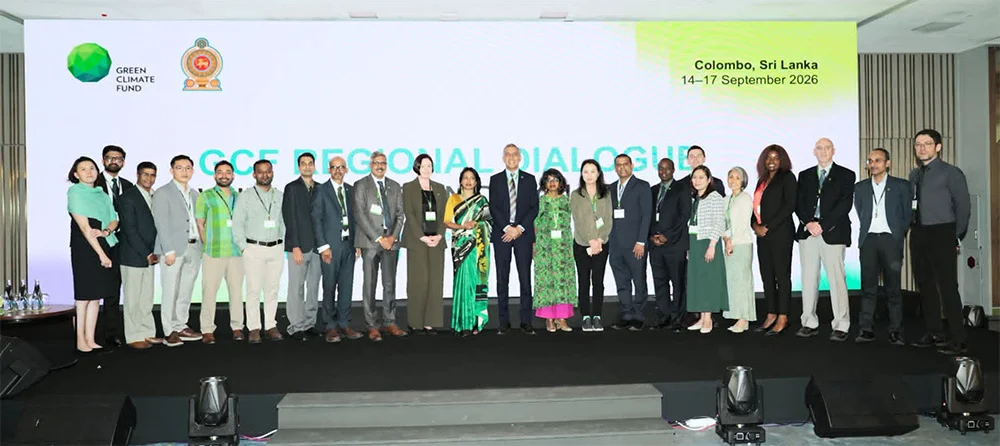
The widening gap between climate commitments and actual projects on the ground has come under the spotlight in Colombo, with the Green Climate Fund (GCF) calling for a decisive shift from pledges and plans towards implementation, investment and measurable climate impact across Asia.
Some 150 climate leaders, government representatives and development partners from East and South Asia have gathered in Colombo for the GCF’s Regional Dialogue, as developing economies across the region seek greater access to climate finance to strengthen resilience, accelerate clean investment and protect vulnerable communities from intensifying climate impacts.
The dialogue has also given Sri Lanka an important platform to highlight the financing challenge confronting a climate-vulnerable economy seeking to strengthen resilience while rebuilding economic capacity.
Opening the dialogue, Environment Minister Dr. Dammika Patabendi called for moving ‘from pledges to projects, from plans to implementation, and from ambition to impact,’ stressing that transformative climate action would require stronger partnerships, increased climate finance and greater support for adaptation.
His message carries particular significance for Sri Lanka, where climate-related disasters increasingly threaten agriculture, water resources, infrastructure, livelihoods and economic activity.
For a country with limited fiscal space, financing climate resilience entirely through domestic resources remains a major challenge. International climate finance therefore has the potential to become an important source of investment for projects designed not only to reduce emissions but also to protect communities and economic assets from increasingly severe climate shocks.
The Colombo dialogue provides an opportunity for Sri Lanka to strengthen its engagement with the GCF and other development partners while highlighting the need to convert national climate priorities into credible, investment-ready projects.
The GCF said its portfolio across Asia and the Pacific currently comprises 129 projects in 36 countries, supported by USD 5.8 billion in GCF financing. It has also approved USD 163 million in Readiness support to help countries strengthen their institutional capacity and ability to access climate finance.
These figures underline the growing scale of climate investment in the region, but they also highlight the importance of countries developing strong project pipelines capable of converting available finance into implementation.
For Sri Lanka, this is likely to be one of the most important dimensions of the current climate-finance discussion.
Projects aimed at strengthening climate-resilient agriculture, water management, disaster-risk reduction, renewable energy, resilient infrastructure and ecosystem protection require significant upfront investment.
Access to concessional and climate-focused international finance could help reduce the burden on public finances while enabling projects with long-term economic and environmental returns.
The need for adaptation finance was reinforced by the opening of the Colombo dialogue, which began with a moment of remembrance for those affected by last month’s glacial flood disaster in Nepal.
For Sri Lanka, a more country-responsive climate-finance system could be particularly valuable at a time when investment needs are high but public resources remain constrained.
As the GCF begins its third replenishment, the real measure of the next phase will therefore be whether climate finance can move faster from international commitments to national projects—and ultimately from project documents to tangible results on the ground.

River home to 500 crocodiles chosen as Olympic rowing venue

Steps will be taken to implement a new National Youth Policy in Sri Lanka in the first quarter of 2027 – PM

Pakistan survive Thailand scare to make Asian Games semi-finals

Bangladesh through to semi-final after washout against China

Showers in most parts of the island today (17)

US embassy won’t comment on IGP’s probe into joint drug raid

‘Dates have the highest sugar content to fight Coronavirus’

Sunday Island 27 December – Headlines

#SundayIsland 17th December – Headlines

Sunday Island – 28th March

Sunday Island Headlines – 21 March

Sunday Island – 21st February – Headlines
-

 Sports6 days ago
DDS set to lose Test captaincy
-

 News6 days ago
Sri Lanka faces new grid challenge as rooftop solar surges: former CEB GM
-

 Latest News6 days ago
Shafali, Deepti power India into sixth T20 Asia Cup final
-

 Latest News6 days ago
Sri Lanka thwart Fatima Sana challenge to secure Asia Cup final spot
-

 News4 days ago
Gnanasara Thero absconding after SC ruling
-

 News5 days ago
Ammunition cache found in old Kandy bungalow
-

 Editorial6 days ago
A flight of fancy
-

 News5 days ago
Green Climate Fund (GCF) Regional Dialogue for East and South Asia will be held from 14 to 17 September 2026 at Cinnamon Life at City of Dreams Hotel, Colombo