
News
UNP confident of forming next Government “Gota will have to work with us”

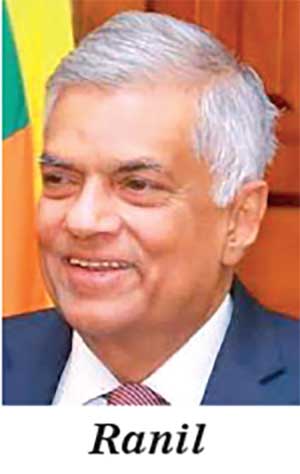
by Zacki Jabbar
Former Prime Minister and UNP leader Ranil Wickremesinghe, stressing he has “no deals with anybody” said he is confident of forming a UNP government following the upcoming parliamentary election “This election will prove to be one of the most vital in the country’s recent past,” he declared.
Amidst a hectic polls campaign, the UNP leader spoke to The Sunday Island , outlining his future plans and vision for the country.
Q – The UNP has promised a monthly Rs.10,000 for the recently unemployed due to the Coronavirus Pandemic and a further monthly Rs. 10,000 for families affected by a future lockdown. How many beneficiaries are you looking at and how soon would you implement the project, if elected to power?
A – Families will have to be helped if there is a future lockdown. We have presented our proposals and will negotiate with the IMF and others to get USD 6 billion. I think we can do the initial work within six months. In any case USD 850 million is due as a share of our quota.
Once we start, long term bankable bonds of 25 to 50 years can be issued. This is what the UK and USA did during World War two. But its important that we restructure the economy and attract investments so that the loans can be repaid within 50 years.
In parallel, we can start identifying those who have been displaced due to the Coronavirus. There will many applicants, but the minimum we can do is to look after the people who are out of employment now.
Q – How many beneficiaries are your looking at?
A – About a million. But we can go beyond that, if there is a mass exodus from the Middle East.
Q – Do you think the government would sign the MCC agreement with the USA after the election?
A – The agreement has been finalized. The government should without dilly-dallying any further, tell the people before the polls as to what the exact position is. It should also clarify if it was trying to mortgage Surakumpath worth USD 4,500 million with the U.S government and get a loan of USD 1000 million against it.
Q – What is the reason for the breakdown in relations with Japan?
A – The government owes an explanation on this as well. JICA has suspended assistance. Relations with Japan are strained. Wrong actions of the government have resulted in one of our oldest financial lenders losing confidence in Sri Lanka. We will revive this relationship through our strong and pro-active foreign policies.
Q – How do you think the UNP will perform at the general election ?
A – We are the largest party. It all depends on how many come to vote. No party is sure about that. If there is no fear of the Coronavirus, more people will go to the polling booths. We hope more people vote. The higher the percentage, the better for the UNP. The people who voted for Gotabaya are now fed up due to the problems they are facing on all fronts.
Q – Is there a possibility of the UNP and its breakaway faction linking up after the election ?
A – UNP is UNP. We have decided to go on our own. We have to re-establish the UNP brand. So we will go as the UNP. The Sri Lankan identity is associated with the UNP. We are the major party, the others came later.
Q – How do you view President Gotabaya Rajapaksa trying to run the country with Special Task Forces packed with former military officers?
A – Its not good for the country. There is no need for such extreme measures when there is a Cabinet of Ministers and a Parliament.
Q – The SJB says it would take over your party headquarters – Srikotha after August 5 ?
A – If anyone tries to use force they would be reported to the Welikada Police. What would become of the country, if everyone resorted to violence to acquire what did not belong to them.
Q – The UNP promised to abolish the Executive Presidency and Proportional Representation System. But your 2015 government didn’t do it?
A – Now it can be done only after the term of the current President, but the PR system can be scrapped if all parties agree.
Q – Who do you think was responsible for the recent demolition of the Assembly Hall of King Buvanekabahu ll in Kurunegala?
A – The problem is that there is a huge attempt to save the culprits. It has become a joke. It is those who shouted the loudest about preserving historical sites who are now unable to ensure law and order. The complaint states that the Mayor had approved of the RDA bulldozing the Assembly Hall. The police has to find out the truth. There are many questions that need to be answered . Did the Mayor inform the Archaeology Department and did it grant approval. But there should be no room to scuttle the investigations.
Q – Can you predict the result of the General Election ?
A – We are confident of forming the next government.
Q – With the support of other parties ?
A – I have not struck deals with any party or individual. We want to strengthen the UNP. We will form the next government.
Q – If the UNP wins, it will have to work with President Gotabaya Rajapaksa ?
A – No, he will have to work with us. Under the current Constitution the Cabinet of Ministers and Parliament have more powers than the President. He will have to consult us.
Outlining his economic revival plan, Wickremesinghe said that a UNP-led government would set out the basis to build a competitive platform similar to the Japanese model.
“We will strengthen competitive enterprises and promote new age industries and services. This will create the necessary foundation for us to develop a strong economy that could repay the loans. We will immediately provide relief to the people by improving their financial situation, safeguard jobs and income. The UNP has track record of raising the required finances through developing international relations.”
He said : the UNP will work towards strengthening the 19th Amendment to the Constitution and the various Independent Commissions that have empowered the public service including the judiciary and police and placed shackles on political interference. The recent practice of delegating functions of the Police to the military should stop forthwith and the military given its rightful role.
Economic mismanagement by the Gotabaya Rajapaksa government was the main cause for the suffering people were undergoing and not the Coronavirus pandemic. Leading figures in the government were pulling in different directions in an effort to cover the economic mess created in a short period of just eight months and have tried to avoid dealing with this crisis by hiding behind the COVID-19 pandemic.
The people were facing many problems in their homes due to the economic downturn. With the onset of the financial crisis there is a shortage of jobs and many had reduced or no income at all. Daily wage earners and even businessmen and women higher up in the economic scale are feeling the pressures exerted by the financial collapse.
The people are facing reduced or an absence of any income. From the daily wage earners to the large businessmen and women, the pressures exerted by the financial collapse is being felt. It is important that we recognize that the cause for this economic collapse cannot be attributed entirely to the health issues in the country. It has been the short-sighted economic management by the government that has resulted in this precipitating state of the economy.
It is the home economy that forms the foundation of our day to day lives. The price increases that we have witnessed at every level of consumer goods, starting from the basic needs to the luxury appliances, has clearly demonstrated that the home economic situation is no longer manageable. People around the country are facing difficulties in providing three square meals a day for their families.
Businesses are unable meet the necessary monthly salary payments for their employees. The government chose to slash the allowances of the State Sector Employees who were then deprived of the festival advances that have been previously provided to them yearly. Allowances of private sector employees have been reduced and most businesses are finding it difficult to meet the salary bills.
The Industrial sector is grinding to a halt. The recently imposed import restrictions have taken many businesses to the verge of collapse. The self-employment sector is in danger. The incomes of those who are engaged in agriculture as well as other sectors of our economy are also declining. Many of the key export markets have been lost. The country’s foreign revenue sources are disappearing fast and the economy is facing a grave danger of falling down an abyss. The retrogressive aspect of this crisis is the unbearable increase in the cost of living that has resulted in a large number of families in the country facing financial difficulties. The country as a whole is recording a decline in the per capita GDP. It has been predicted that over one million will be jobless by 2021.
The level of unemployment is expected to sky-rocket with a drop in Middle East employment. Sri Lanka’s foreign reserves are also depleting. Printing Rs. 450 billion is no solution to the crisis. We are falling from the frying pan to the fire. We must overcome this crisis and disentangle ourselves from the existing chaos created by this government. There are no short solutions to the problems that we face.
The UNP has on numerous occasions highlighted the importance of implementing a long term comprehensive economic programme that will cover all aspects of the economy. This is the only approach that can overcome this crisis. We have called upon the government to announce such a programme, but it is unable to formulate a strategy, because it lacks a viable economic vision. The government has already demonstrated in this short period that it lacks the capability to face the external economic challenges and build a strong national economy.
As a nation we are now faced with the gravest economic crisis since independence and it is only the UNP that has the vision, the plan and the capability to address the present crisis. We have a proven track-record time and again undoing economic mismanagement and reviving our economy. In 1977, 2001, 2015 and again in 2019 after the Easter Sunday attacks, it was the UNP that led the country’s economic recovery.

News
AgriConnect Sri Lanka’ to be launched on 30 October to Modernise the Agricultural Sector Through Digitalisation

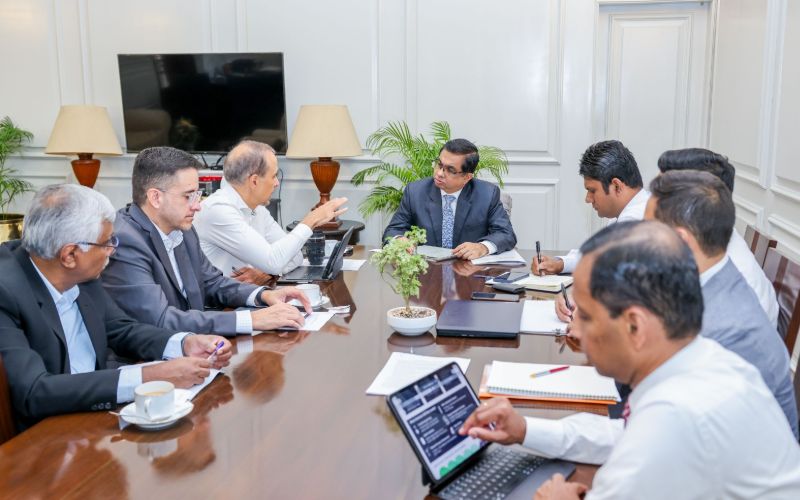
A discussion on the official launch of the ‘AgriConnect Sri Lanka’ programme was held at the Presidential Secretariat on Tuesday (13) morning between Secretary to the President Dr. Nandika Sanath Kumanayake and a delegation led by Gevorg Sargsyan, World Bank Group Manager for Sri Lanka and the Maldives.
The discussion focused on the official launch of the ‘AgriConnect Sri Lanka’ programme, scheduled to take place on 30 October at TRACE Expert City.
The World Bank delegation provided a comprehensive briefing on the programme and emphasised that Sri Lanka is set to become the first country in South Asia to join this global initiative of the World Bank Group, marking a significant milestone.
Victor Anthonypillai, Senior Country Officer of the International Finance Corporation (IFC), Tomas Ricardo Rosada Villamar Practice Manager at the World Bank, Felipe F. Dizon, Senior Economist and Athula Senaratne, Senior Agriculture Specialist, also attended the meeting. The Presidential Secretariat was represented by Senior Assistant Secretary to the President Dr Danushka Perera and Assistant Secretary to the President R. A. Ruwanpathirana.
President’s Media Division (PMD)

Appointment of committee eyewash, says UNP
The government is considering changes to prison regulations pertaining to the treatment of Buddhist monks serving jail terms, including their right to wear monastic robes when taken outside prison.
Justice and National Integration Minister Harshana Nanayakkara announced the proposed changes yesterday (14) following the submission of an interim report by a committee appointed to review the rules and procedures governing prisons.
The report was handed over to Secretary to the President Dr Nandika Sanath Kumanayake at the Presidential Secretariat.
One of the key recommendations is to amend Prison Standing Order 356 by introducing a new provision, 356(A). The proposed revision would require prison authorities to consult the Department of Buddhist Affairs on the removal of a monk’s robes upon admission to prison. The Commissioner of Prisons would be allowed 10 days to notify the department and take the necessary steps.
A separate amendment to Departmental Order 550 would allow Buddhist monks to wear their robes whenever they are taken outside prison, unless their respective Nikaya formally requests that the privilege be withdrawn.
The committee has also recommended extending similar arrangements, with suitable modifications, to members of other religious clergy who are imprisoned.
The proposals follow concerns raised over the treatment of Ven. Galagoda Aththe Gnanasara Thera after he was taken into custody. President Anura Kumara Dissanayake subsequently held discussions with representatives of the three main Buddhist Nikayas and appointed the committee to examine the existing legal framework.
Nanayakkara said the interim report had been forwarded to the Acting Commissioner General of Prisons, along with instructions to revise the relevant standing orders in accordance with its recommendations.
The proposed amendments have yet to be confirmed as formally implemented.
Meanwhile, the UNP yesterday criticised the government’s decision to appoint a committee to make recommendations on the attire to be worn by imprisoned Buddhist monks and other religious leaders when taken outside prison, describing the move as unnecessary.
In a statement issued yesterday (14), the UNP said the procedures governing the matter were already clearly set out in the Department of Prisons’ Standing Orders, making the appointment of a separate committee unwarranted.
The party cited remarks by Professor G.L. Peiris, Convenor of the Janathawadi Joint Opposition, who had described the committee’s appointment as a
“complete eyewash” and questioned the need for such a move.
Referring to Standing Order 550 of the Prisons Department, the UNP said convicted prisoners appearing before court for legal proceedings should not be required to wear prison uniforms.
It further stated that the regulations allowed prisoners to wear civilian clothing consistent with what they wore before imprisonment, including attire appropriate to their cultural and religious backgrounds.
The UNP accused the government of unnecessarily prolonging the issue by appointing a committee, despite the existence of regulations governing prisoners’ attire.
The party also called on the government to seek forgiveness from the Mahanayake Thera and the Sangha Council of the Kotte Sri Kalyani Samagri Dharma Maha Sangha Sabha of the Siyam Maha Nikaya over the decision concerning the religious attire of Ven. Galagoda Aththe Gnanasara Thera.
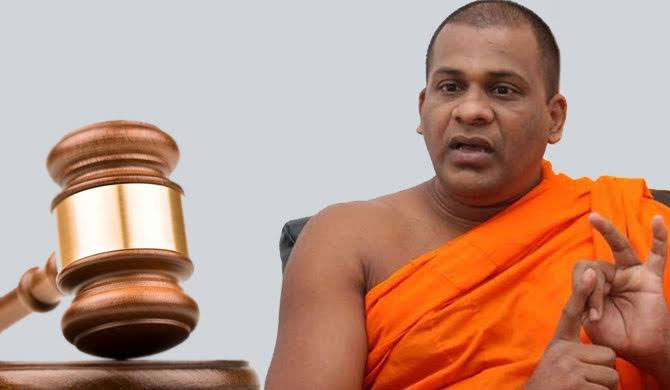
Court of Appeal President Justice Rohantha Abeysuriya yesterday withdrew from the bench hearing petitions challenging the decision by prison authorities to require Ven. Galagoda Aththe Gnanasara Thera to wear prison attire following his imprisonment.
The decision was announced when the petitions seeking to invalidate the prison authorities’ decision were taken up for consideration on October 14.
Following his withdrawal, a three-judge bench was appointed to hear the petitions.
The petitions relate to the prison authorities’ decision to require Gnanasara Thera to wear prison attire after he was taken into custody to serve the remainder of his sentence for contempt of court.
In September this year, the Supreme Court annulled the presidential pardon granted to Gnanasara Thera by former President Maithripala Sirisena in May 2019.
Following the ruling, the Court of Appeal directed the Commissioner General of Prisons to take the necessary steps to enforce the remainder of the monk’s prison sentence.
Gnanasara Thera had originally been sentenced to six years’ imprisonment for contempt of court but had served only around nine months before receiving the presidential pardon in 2019.

AgriConnect Sri Lanka’ to be launched on 30 October to Modernise the Agricultural Sector Through Digitalisation

57th Annual Saints’ Quadrangular Tournament on Saturday and Sunday

Showers or thundershowers will occur at most parts of the island

Prison rules to be revised over monks’ attire

AC President recuses himself from hearing prison attire case pertaining to Gnanasara Thera

Court orders steps to obtain INTERPOL Red Notice against Basil

‘Dates have the highest sugar content to fight Coronavirus’

Sunday Island 27 December – Headlines

#SundayIsland 17th December – Headlines

Sunday Island – 28th March

Sunday Island Headlines – 21 March

Sunday Island – 21st February – Headlines
-

 News7 days ago
NDB fraud Rs 60mn more than reported
-

 News7 days ago
Removing monk’s robes matter for Sangha to decide: Mahanayake Theras
-

 News5 days ago
Sri Lanka escalates anti-graft drive with Shiranthi’s jailing
-

 News6 days ago
NPP govt. reminded of its responsibilities as US warship leaves Colombo
-

 Latest News6 days ago
Farhan, Sadaqat help Pakistan ace 183 chase to go 1-0 up
-

 News7 days ago
BHC, Colombo: “LTTE remains a proscribed org. in the UK”
-

 Latest News4 days ago
Farhan and Sadaqat help Pakistan seal series in style
-

 News5 days ago
Iranian ships stranded, Lanka fears US sanctions