
News
UNHRC urges Sri Lanka to pursue urgent reforms and accountability after upcoming elections


Following the upcoming elections, the newly-elected government should – as a matter of urgency – pursue an inclusive national vision for Sri Lanka that addresses the root causes of the conflict and undertakes fundamental constitutional and institutional reforms needed to strengthen democracy and devolution of political authority and advance accountability and reconciliation, the Advance unedited version of ‘Situation of human rights in Sri Lanka – Comprehensive report of the United Nations High Commissioner for Human Rights,’ issued yesterday (22) by the United Nations Human Rights Council (UNHRC) has said.
Conclusions and recommendations of the report are as follows: “As Sri Lanka approaches Presidential and Parliamentary elections, it has an opportunity to recommit to the transformational changes demanded by the broad cross-section of Sri Lankans who protested in 2022. The Government has a responsibility – prior, during and after the election period – to fully protect and respect the rights to freedom of expression, association and peaceful assembly, including by refraining from the use of unnecessary or excessive force against protestors, to take measures to prevent and tackle divisive and discriminatory rhetoric and practices, based on religious, gender or other grounds, and prevent election-related and other human rights violations and abuses.
“The High Commissioner is mindful of the deep impacts the economic crisis and debt burden are having on all Sri Lankans, particularly the poorest and those in other situations of vulnerability. This economic stress is exacerbated for Sri Lanka and many other developing countries by the prevailing global economic situation and international financial architecture. He urges that decisions on economic policy and fiscal consolidation be guided by Sri Lanka’s international human rights obligations, including by ensuring adequate social protection. Sri Lanka’s external creditors should provide the Government with the fiscal space needed to realise economic, social and cultural rights and to ensure austerity measures do not undermine Sri Lanka’s ability to fulfil its human rights obligations.
“Emerging trends observed during the reporting period, including a continuing lack of respect for fundamental freedoms as evidenced by new regressive laws, erosion of democratic checks and balances, instances of threats, intimidation and violence against victims, civil society actors and journalists and resurfacing of serious human rights violations of the past, are of deep concern.
“Failure of the Sri Lankan State to specifically recognize victims’ suffering, to acknowledge the military and other security forces’ role in the commission of gross human rights violations, and to address violations committed in the past and present, has been a key obstacle to the rule of law, democracy, and good governance. Many of the structures and some of the members of the State apparatus credibly implicated in the grave crimes and human rights violations remain in place, preventing meaningful progress in terms of accountability and perpetuating human rights violations. As noted in the report to the 51st Human Rights Council session, entrenched impunity has also been manifested in the corruption and abuse of power that contributed to the economic crisis and drove the popular protests in 2022.
“Following the elections, the newly elected Government should – as a matter of urgency – pursue an inclusive national vision for Sri Lanka that addresses the root causes of the conflict and undertakes fundamental constitutional and institutional reforms needed to strengthen democracy and devolution of political authority and advance accountability and reconciliation.
“Fundamental changes are needed for advancing accountability, reconciliation, and preventing future human rights violations and the abuse of power. This includes implementing significant security sector reforms, which should involve vetting to remove those implicated in serious violations and establishing an operational and judicial framework ensuring strict compliance with human rights standards. The Government should undertake the constitutional, legal and institutional reforms necessary to comply with the country’s international human rights obligations, prevent the recurrence of grave violations and strengthen democratic and devolved systems of governance. OHCHR continues to stand ready to assist Sri Lanka on this path.
“The Human Rights Council and individual UN Member States should continue to fill the accountability gap in Sri Lanka by supporting and using the full potential of OHCHR’s strengthened capacity to undertake accountability-related work under Human Rights Council resolutions 46/1 and 51/1, and contributing to creating necessary conditions and political will for undertaking meaningful accountability and reconciliation efforts in the country.
“The following recommendations to the Government build upon the High Commissioner’s recommendations in his previous reports.
(a) Actively promote an inclusive, pluralistic vision for Sri Lanka, based on non-discrimination and protection of human rights for all, including by preventing and condemning speech and action of religious actors that incite discrimination, hatred and violence against women and minority communities;
(b) Ensure the right to political participation through free and fair elections at all levels of government;
(c) Create an enabling environment for transitional justice by implementing confidence-building measures, such as releasing military-held lands, stopping new land seizures in the north and east, releasing all long-term detainees under the PTA, and decriminalizing and supporting victim’s memorialization initiatives;
(d) Remove from power and refrain from appointing or promoting credibly alleged perpetrators of human rights violations to high-level positions in the Government, the security sector, or diplomatic postings, as well as any institution, especially those established to achieve transitional justice and accountability;
(e) Immediately impose a moratorium on the Prevention of Terrorism Act and ensure that any replacement legislation is consistent with international human rights law and the benchmarks previously laid out by UN human rights experts for counter-terrorism legislation;
(f) Repeal or amend existing laws or proposed laws that unduly restrict the rights to freedom of opinion and expression, association, and peaceful assembly, including the Online Safety Act, ICCPR Act, draft NGO Bill, and proposed amendment to Telecommunications Act;
(g) Publicly issue unequivocal instructions to all branches of the military, intelligence and police forces that arbitrary arrests, extrajudicial killings, torture, sexual violence and other human rights violations are prohibited and will be systematically investigated and punished;
(h) Establish as a matter of urgency an independent prosecutorial authority, separate from the AG’s function, to assess relevant information and make independent prosecutorial decisions, including in relation to the cases of human rights violations and violations of international humanitarian law committed in previous decades;
(i) Avoid the involvement of military in law enforcement, commercial and civil affairs and significantly reduce military presence in the Northern and Eastern Provinces;
(j) Order all security agencies and intelligence to immediately end all forms of surveillance and harassment of and reprisals against human rights defenders, journalists, victims of human rights violations and their families, especially women;
(k) Assess and mitigate the impact of austerity measures on the standard of living of disadvantaged and marginalized individuals and groups; and take all appropriate measures to protect that core content of rights under the International Covenant on Economic, Social and Cultural Rights, especially for those individuals and groups;
(l) Assess the negative impact of corruption on the enjoyment of human rights and ensure the adoption of anti-corruption measures aligns with human rights obligations;
(m) Ensure social protection measures reach disadvantaged and marginalized individuals and groups, including by increasing fiscal allocation for social security;
(n) Adjudicate land disputes in ways that are transparent, consultative, impartial and non-discriminatory, and ensure interfaith dialogue about the erection of religious sites;
(o) Stop the ‘Yukthiya’ operations, and release all individual detained under this operation; provide community-based treatment, rehabilitation and harm reduction support to people with drug dependency; and develop and implement a human rights and public health centred drug policy in line with the International Guidelines on Human Rights and Drug Policy; and
(p) Recognize the competence of the Committee on Enforced Disappearance to receive and consider communications under article 31 of the International Convention for the Protection of All Persons from Enforced Disappearance and accede to the Rome Statute of the ICC.
“The High Commissioner recommends that the Human Rights Council and Member States, as applicable:
(a) Cooperate in investigating and prosecuting alleged perpetrators of international crimes committed by all parties in Sri Lanka through judicial proceedings in national jurisdictions, including under accepted principles of extraterritorial or universal jurisdiction, through relevant international networks and mutual legal assistance processes, and in cooperation with survivors, families, and their representatives;
(b) Consider using other international legal options to advance accountability in Sri Lanka;
(c) Explore, as part of a wider range of accountability measures and consistent with international law, further targeted sanctions such as asset freezes and travel bans against individuals credibly alleged to have perpetrated gross international human rights violations or serious humanitarian law violations;
(d) Review asylum measures with respect to Sri Lankan nationals to protect those facing reprisals and refrain from any refoulement in cases that present a real risk of torture or other serious human rights violations; and
(e) Support OHCHR to continue its monitoring and reporting and its strengthened work on accountability for human rights violations and related crimes in Sri Lanka.”



More than 1,600 students sat this year’s Russian Classical Ballet Examination, the largest number ever to take part in the examination in Sri Lanka. Exams were held in Colombo from 5, to 18, October and in Galle on 10 October.
Students aged four and above came from across the island, including Colombo, Galle, Gampaha, Negombo, Matara, Kelaniya, Panadura, Wattala, Kiribathgoda, Ratnapura, Kandy, Kurunegala, Bandarawela and Badulla. They are taught by 15 dedicated teachers trained in the Vaganova method, the renowned Russian system of classical ballet training.
They were examined by Dr. Oxana Karnovich of the Moscow State Academy of Choreography, a distinguished academic and curator.
The Russian School of Ballet and Dancing was established in 2001 by Michael Ustinov, Buddhapriya Ramanayake and Mrs Chandi Aluvihare, with Mrs Galina Pleshakova as its founding instructor. Today the School is led by Director Madam Maria Popova, Counsellor of the Embassy of the Russian Federation in Sri Lanka.

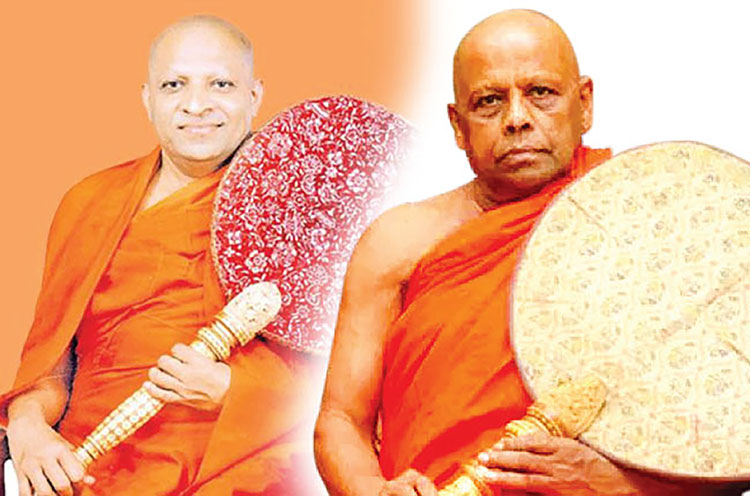
MONETABRIEF– Sri Lanka’s two most senior Buddhist chapters, Malwatte and Asgiriya, demanded special concessions for monks serving prison sentences, following the disrobing of convicted monk Ven. Galagodaatte Gnanasara in line with established procedures.
The chief prelate of the Asgiriya chapter, Most Venerable Warakagoda Sri Gnanarathana, told Prisons Commissioner Senaka Palletenna that Ven. Gnanasara, who is serving a six-year sentence for contempt of court, must be released immediately.
Prison authorities have no power to release or pardon convicts, but Palletenna told the monk in Kandy on Friday that he would convey his request to the relevant government authorities.
“There is no point in talking about this and that… The entire country has been shaken (??????? ) . He must be released,” the Asgiriya chief prelate said.
The Malwatte chief prelate, Most Venerable Thibbatuwawe Sri Siddhartha Sumangala, appeared to accept the court verdict against Ven. Gnanasara, but asked the prisons chief whether a separate section could be established for convicted monks.
Palletenna noted that a special ward for the clergy already existed at Welikada Prison.
At least 63 convicted Buddhist monks are currently incarcerated within Sri Lanka’s criminal justice system.
Meanwhile, a group of 34 Buddhist monks named in a Colombo Fort Magistrate’s Court order to vacate the vicinity of the Presidential Secretariat ended their protest and dispersed after lunch on Friday.The monks are demanding an unconditional pardon for Ven. Gnanasara, who has previously been imprisoned, making him a reconvicted prisoner.
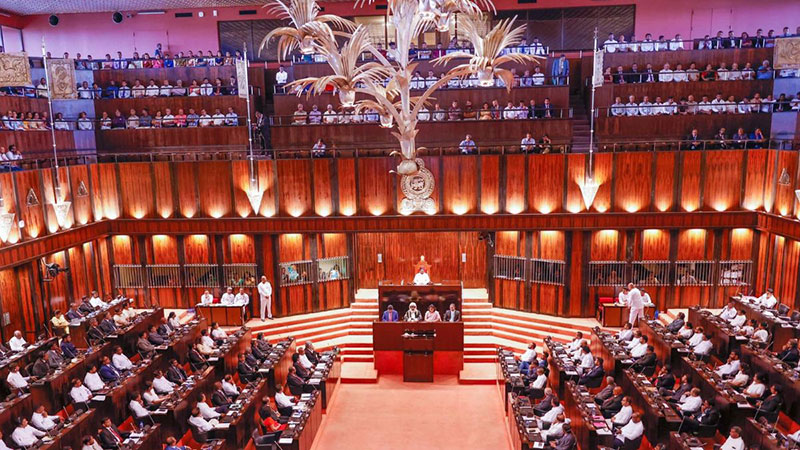
The debate on the no-confidence motion against Speaker Dr. Jagath Wickramaratne, submitted by the Samagi Jana Balawegaya (SJB), has been postponed indefinitely pending the Attorney General’s opinion on certain technical issues in the motion.
Government representatives raised the matter at a meeting of the Committee on Parliamentary Business, pointing out that several provisions of the motion required clarification and that the Attorney General’s advice should be obtained.
As obtaining the opinion would take time, the debate could not be scheduled for the next parliamentary week, parliamentary sources said.
Chief Opposition Whip Gayantha Karunatilaka said a date for the debate would be decided after the Attorney General’s advice was received.
Meanwhile, Parliament is scheduled to meet from October 20 to 23, Secretary General of Parliament Kushani Rohanadeera announced.
The parliamentary business for the week was finalised at a meeting of the Committee on Parliamentary Business held on Friday (16) under the chairmanship of Deputy Speaker Dr. Rizvie Salih.
On each sitting day, the period from 9.30 a.m. to 10 a.m. will be allocated for parliamentary business under Items 1 to 6 of Standing Order 22. Questions for Oral Answers will be taken up from 10 a.m. to 11 a.m., followed by questions under Standing Order 27(2) from 11 a.m. to 11.30 a.m.
On Tuesday, October 20, an Opposition-sponsored Adjournment Motion will be debated from 11.30 a.m. to 5.30 p.m.
On Wednesday, October 21, a resolution under the Public Debt Management Act and a Supplementary Estimate will be taken up for debate and approval from 11.30 a.m. to 5 p.m. The annual reports of five statutory institutions will subsequently be presented for approval without debate, while questions at the Adjournment Time will be taken up from 5 p.m. to 5.30 p.m.
On Thursday, October 22, the Second Reading debates on two Bills to amend the Poisons, Opium and Dangerous Drugs Ordinance (Bills Nos. 79 and 80) will be held from 11.30 a.m. to 5 p.m.
The annual reports of five statutory institutions will then be taken up for approval without debate, followed by an Opposition-sponsored Adjournment Motion from 5 p.m. to 5.30 p.m.
On Friday, October 23, the Second Reading debate on the Elimination of Rabies and Registration of Dogs Bill will be held from 11.30 a.m. to 5 p.m. A Government-sponsored Adjournment Motion will be debated during the final half-hour of the sitting.

Pakistan quicks seal win after Salman Agha ton sets tone

Record 1,600 students take Russian Classical Ballet examination in Sri Lanka

Half a million people join protests in France, but some turn violent

Deadly fire breaks out at Canada military base

Showers or thundershowers will occur in most parts of the island after 1.00 p.m.

Buddhist hierarchy demands prison perks for monk convicts

‘Dates have the highest sugar content to fight Coronavirus’

Sunday Island 27 December – Headlines

#SundayIsland 17th December – Headlines

Sunday Island – 28th March

Sunday Island Headlines – 21 March

Sunday Island – 21st February – Headlines
-

 Latest News6 days ago
Nissanka’s return headlines Sri Lanka’s Test squad against Pakistan
-

 Latest News7 days ago
Farhan and Sadaqat help Pakistan seal series in style
-

 Features7 days ago
Intake 16: 45 years of duty and honour
-

 News7 days ago
Malwathu Chapter issues statement on talks with President over Gnanasara Thera’s robes
-

 News7 days ago
CP alleges NPP has taken the blame for illegal US sanctions on Iranian vessels
-

 News5 days ago
Sri Lanka, India caught in US-Iran ship crisis
-

 Opinion7 days ago
How long can Sri Lanka remain silent on its demographic crisis?
-

 Latest News5 days ago
Kusal Mendis’ unbeaten 87 hands Sri Lanka consolation win