
News
UNESCO Recognition Highlights Kitul Craft — But Sinharaja’s Traditional Producers Struggle to Survive

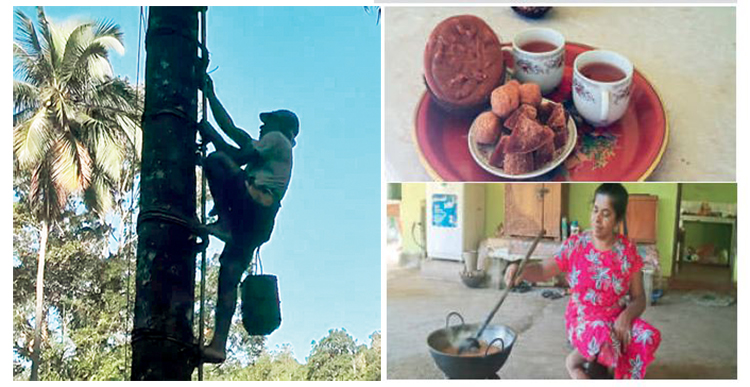
For generations, rural communities across several provinces of Sri Lanka have quietly sustained one of the island’s most distinctive traditional industries: the tapping of the kitul palm (Caryota urens). In December last year, that centuries-old knowledge received global recognition when UNESCO inscribed Sri Lanka’s traditional kitul sap extraction technique—commonly known as tapping or cutting—on the Representative List of the Intangible Cultural Heritage of Humanity.
The announcement was made on December 11, 2025, at the 20th session of the Intergovernmental Committee for the Safeguarding of the Intangible Cultural Heritage, held in New Delhi. For practitioners of the craft, particularly those living on the fringes of the Sinharaja World Heritage Forest, the recognition was a moment of pride. Yet, on the ground, many say the future of the industry remains uncertain.
In villages scattered across the country, kitul production continues to be either a primary livelihood or an important supplementary income. It is not a trade that can be learnt overnight. Kitul tapping is an inherited skill, passed down through generations, demanding experience, physical endurance and a steady nerve. Among Sinharaja-adjacent communities, the craft is also steeped in spiritual belief. The first jaggery produced from a freshly tapped kitul flower is traditionally offered to God Saman, the guardian deity believed to protect the forest and its people.
Renowned for its deep, earthy sweetness, kitul jaggery and treacle mask the dangers behind their production. Falls from towering palms have resulted in serious injuries and even fatalities over the years. Yet, life in these villages remains marked by an unassuming generosity. Visitors are welcomed with a cup of strong tea and homemade kitul jaggery, while those partial to kitul toddy are readily offered a glass, sometimes accompanied by a pinch of salt. Guests rarely leave empty-handed; a bottle of treacle or a block of jaggery is gifted with quiet pride.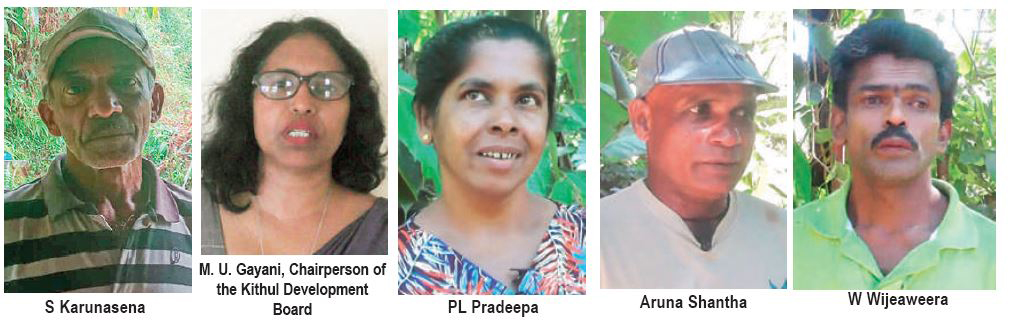
The process itself is slow and exacting. Once a kitul flower is cut, the sap does not gush forth but drips, drop by drop, into a container suspended below. This sap, known locally as telijja, is later heated and reduced to produce treacle and jaggery.
In Pitakale village, near the Sinharaja Forest Reserve, families engaged in the traditional industry spoke candidly of the pressures they face. Foremost among them is the proliferation of sugar-based jaggery and treacle, falsely marketed as kitul products. Sold cheaply—often online and sometimes under the Sinharaja name—these imitations, producers say, have severely undermined demand for genuine kithul products.
Wildlife interference, particularly from monkeys and giant squirrels, has added to their difficulties, while the lack of basic equipment has discouraged younger generations from entering the trade. Many producers also lament that despite repeated assurances by successive governments to develop kithul villages and support the industry, tangible assistance has been limited.
“In the past, almost every family here was involved in kithul production,” said W. Wijewira (51), a traditional producer from the Sinharaja area. “Today, it is deeply disappointing to see people who have nothing to do with kithul tapping use the Sinharaja name to sell sugar-based jaggery and treacle. Because those products are cheaper, our genuine kithul jaggery remains unsold. Consumers assume it is the same. If proper equipment and a clear government programme are introduced, we can supply high-quality kithul products to the market.”
Echoing the concern, P. L. Pradeepa (51) said her family’s generational livelihood was now under threat. “My husband taps the trees and I prepare the jaggery and treacle. But sugar-based products have flooded the market. We cannot afford proper tools and rely on old, damaged equipment. Without support, the younger generation is moving away from this work. Once the elders are gone, the kithul industry here will vanish.”
S. Karunaratne (63) pointed to the absence of a structured development plan. “Sugar-based jaggery has collapsed the market. If this industry is properly developed, it can earn foreign exchange for the country. What we need are basic tools—vessels to boil the sap and proper containers. Government intervention is essential.”
For Aruna Shantha (56), the issue is both economic and cultural. “We supply pure kithul products for almsgivings, weddings and religious ceremonies. But fake products labelled as Sinharaja kithul are sold at low prices, reducing demand for ours. Wildlife damage is another serious problem. A dedicated market for genuine producers would benefit both consumers and us.”
Responding to these concerns, M. U. Gayani, Chairperson of the Kithul Development Board, acknowledged gaps in market access. She said that while producers make high-quality treacle, poor packaging limits their reach, allowing middlemen to dominate. “The solution lies in collective production centres with proper equipment and standardised packaging. This would enable producers to access better markets directly. Measures to reduce wildlife damage have also been introduced, alongside awareness programmes,” she said.
Despite UNESCO recognition, traditional kithul producers in the Sinharaja region say they continue to battle a host of challenges. Without urgent state intervention, structured development initiatives and dedicated markets for authentic products, they warn that this newly celebrated heritage may quietly fade away—leaving behind little more than a name on an international list.
Text and Pix by Upendra Priyankara Jathungama


Bus fares have been increased by 12.19% with effect from midnight today [23rd March 2026].
The minimum fare will be increased from Rs 27 to Rs 30 while the maximum fare of Rs2159/- will be increased to 2422/-
Latest News
Public will not be served as Computer system failure at Department of Registration of Persons

The Acting Commissioner General of Registration of Persons has announced that due to an unexpected failure of the computer system of the Department of Registration of Persons, all services, including the one day service will not be held on Tuesday (24th March) at the Head Office and all Provincial offices.

Latest News
Heat Index at Caution Level in the Western, Sabaragamuwa, Southern and North-western provinces and in Anuradhapura, Mannar and Vavuniya districts
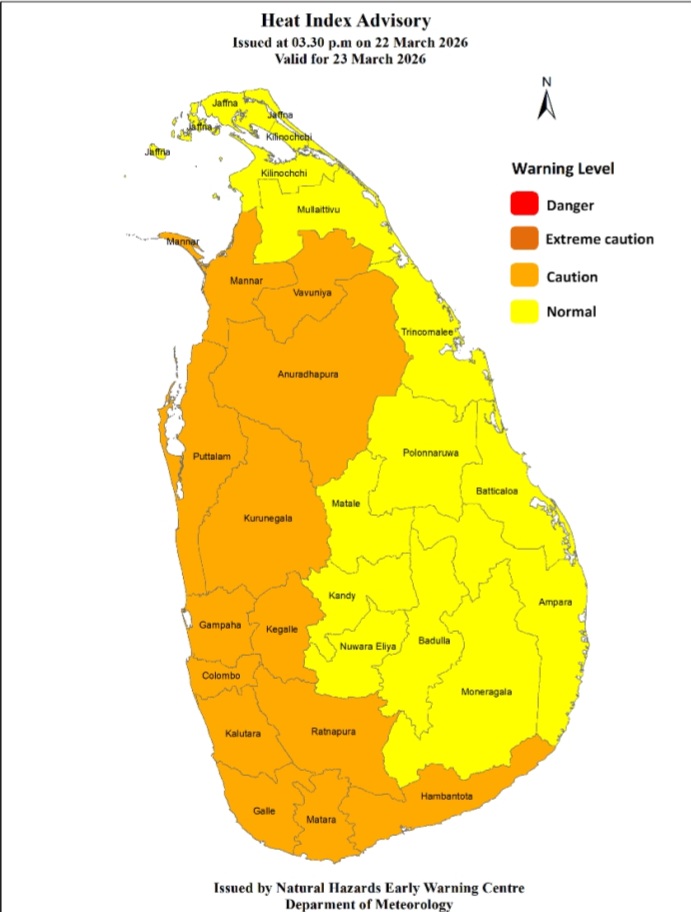
Warm Weather Advisory
Issued by the Natural Hazards Early Warning Centre of the Department of Meteorology
at 3.30 p.m. on 22 March 2026, valid for 23 March 2026.
The Heat index, the temperature felt on human body is likely to increase up to ‘Caution level’ at some places in the Western, Sabaragamuwa, Southern and North-western provinces and in
Anuradhapura, Mannar and Vavuniya districts.
The Heat Index Forecast is calculated by using relative humidity and maximum temperature and this is the condition that is felt on your body. This is not the forecast of maximum temperature. It is generated by the Department of Meteorology for the next day period and prepared by using global numerical weather prediction model data.

Effect of the heat index on human body is mentioned in the above table and it is prepared on the advice of the Ministry of Health and Indigenous Medical Services.
ACTION REQUIRED
Job sites: Stay hydrated and takes breaks in the shade as often as possible.
Indoors: Check up on the elderly and the sick.
Vehicles: Never leave children unattended.
Outdoors: Limit strenuous outdoor activities, find shade and stay hydrated.
Dress: Wear lightweight and white or light-colored clothing.
Note:
In addition, please refer to advisories issued by the Disaster Preparedness & Response Division, Ministry of Health in this regard as well. For further clarifications please contact 011-7446491.

Two killed when Air Canada jet hits fire truck at NYC’s LaGuardia Airport

Bus fares increased by 12.19% from midnight today [23]
Public will not be served as Computer system failure at Department of Registration of Persons

Trump says he is postponing strikes on Iran power plants after ‘productive’ talks on ending war

Asia stocks slide as US and Iran threaten to escalate war

Heat Index at Caution Level in the Western, Sabaragamuwa, Southern and North-western provinces and in Anuradhapura, Mannar and Vavuniya districts

‘Dates have the highest sugar content to fight Coronavirus’

Sunday Island 27 December – Headlines

#SundayIsland 17th December – Headlines

Sunday Island – 28th March

Sunday Island Headlines – 21 March

Sunday Island – 21st February – Headlines
-

 News6 days ago
CIABOC questions Ex-President GR on house for CJ’s maid
-

 News7 days ago
Sri Lankan marine scientist Asha de Vos honoured at UNGA opening
-

 News7 days ago
Australian HC debunks misleading travel risk claims for Sri Lanka
-

 News5 days ago
Bailey Bridge inaugurated at Chilaw
-

 News5 days ago
Pay hike demand: CEB workers climb down from 40 % to 15–20%
-

 News4 days ago
CIABOC tells court Kapila gave Rs 60 mn to MR and Rs. 20 mn to Priyankara
-

 Editorial6 days ago
Couple QR-based quota with odd-even rationing
-

 News3 days ago
Colombo, Oslo steps up efforts to strengthen bilateral cooperation in key environmental priority areas