
News
UN warns 345 million people face starvation worldwide


The United Nations food chief has warned the world is facing “a global emergency of unprecedented magnitude” with up to 345 million people marching towards starvation – and 70 million pushed closer to starvation by the war in Ukraine.David Beasley, Executive Director of the UN World Food Programme, told the UN Security Council on Thursday the 345 million people facing acute food insecurity in the 82 countries where the agency operates is more than twice the number of acutely food insecure people before the COVID-19 pandemic hit in 2020.
He said it is incredibly troubling that 50 million of those people in 45 countries are suffering from very acute malnutrition and are “knocking on famine’s door”.
“What was a wave of hunger is now a tsunami of hunger,” he said, pointing to rising conflict, the pandemic’s economic ripple effects, climate change, rising fuel prices and Russia’s invasion of Ukraine.
Since Russia invaded its neighbour on February 24, Beasley said, soaring food, fuel and fertiliser costs have driven 70 million people closer to starvation.Despite an agreement in July, allowing Ukrainian grain to be shipped from three Black Sea ports, blockaded by Russia, and continuing efforts to get Russian fertiliser back to global markets, “there is a real and dangerous risk of multiple famines this year”, he said.
“And in 2023, the current food price crisis could develop into a food availability crisis if we don’t act.”
‘All hands on deck’
The Security Council was focusing on conflict-induced food insecurity and the risk of famine in Ethiopia, northeastern Nigeria, South Sudan and Yemen. But Beasley and UN humanitarian chief Martin Griffiths also warned about the food crisis in Somalia, which they both recently visited, and Griffiths also put Afghanistan high on the list.
“Famine will happen in Somalia. Be sure it won’t be the only place either,” Griffiths said.
He cited recent assessments that identified “hundreds of thousands of people facing catastrophic levels of hunger” – meaning they are at the worst famine level.
Beasley recalled his warning to the council in April 2020 “that we were then facing famine, starvation of biblical proportions”. He said then the world “stepped up with funding and tremendous response, and we averted catastrophe”.
“We are on the edge once again, even worse, and we must do all that we can – all hands on deck with every fibre of our bodies,” he said. “The hungry people of the world are counting on us and … we must not let them down.”
Effects of conflict and violence
Griffiths said the widespread and increasing food insecurity is a result of the direct and indirect effect of conflict and violence that kills and injures civilians, forces families to flee the land they depend on for income and food, and leads to economic decline and rising prices for food they cannot afford.After more than seven years of war In Yemen, he said, “some 19 million people – six out of 10 – are acutely food insecure, an estimated 160,000 people are facing catastrophe, and 538,000 children are severely malnourished”.
Beasley said the Ukraine war is stoking inflation in Yemen, which is 90 percent reliant on food imports. The World Food Programme hopes to provide aid to about 18 million people, but its costs have risen 30 percent this year to $2.6bn.As a result, it has been forced to cut back so Yemenis this month are getting only two-thirds of their previous rations, he said.
Beasley said South Sudan faces “its highest rate of acute hunger since its independence in 2011” from Sudan. He said 7.7 million people, more than 60 percent of the population, are “facing critical or worse levels of food insecurity”.
Without a political solution to escalating violence and substantial spending on aid, “many people in South Sudan will die”, he warned.‘Exhausted families over the edge’ In northern Ethiopia’s Tigray, Afar and Amhara regions, more than 13 million people need life-saving food, Griffiths said. He pointed to a survey in Tigray in June that found 89 percent of people food insecure, “more than half of them severely so”.
Beasley said a truce in March enabled WFP and its partners to reach almost five million people in the Tigray area, but resumed fighting in recent weeks “threatens to push many hungry, exhausted families over the edge”.
In northeast Nigeria, the UN projects that 4.1 million people are facing high levels of food insecurity, including 588,000 who faced emergency levels between June and August, Griffiths said. Almost half of those people could not be reached because of insecurity, and the UN fears “some people may already be at the level of catastrophe and already dying”.
Griffiths urged the Security Council to “leave no stone unturned” in trying to end these conflicts, and to step up financing for humanitarian operations, saying UN appeals in those four countries are all “well below half of the required funding”. – Al Jazeera


Ms Sajeewani Dilka Lakmali Karunannayake was sworn in as a Judge of the Court of Appeal before President Anura Kumara Dissanayake at the Presidential Secretariat this afternoon (03).
She previously served as an Additional Solicitor General at the Attorney General’s Department.
The appointment has been made to fill a vacancy on the Court of Appeal.
Secretary to the President Dr Nandika Sanath Kumanayake was also present on the occasion.
(President’s Media Division)
Latest News
Sun directly overhead Madampe, Thorayaya, Thotagamuwa, Rattota and Kalavanchikudy about 12.09 noon today (03)


The sun is going to be directly over the latitudes of Sri Lanka from 28th of August to 07th of September due to its apparent southward relative motion.
The nearest places of Sri Lanka over which the sun is overhead today (03) are Madampe, Thorayaya, Thotagamuwa, Rattota and
Kalavanchikudy about 12.09 noon.

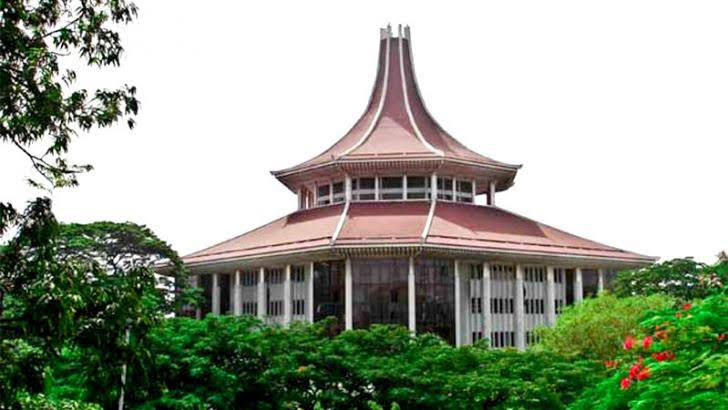
Attorney-at-Law Sugandhika Fernando, on behalf of the Vinivida Foundation, petitioned the Supreme Court yesterday (02), seeking a full bench, excluding Chief Justice Preethi Padman Surasena, to hear the petitions challenging the 22nd Amendment Bill. She also requested that the hearing be suspended immediately until the matter was fully heard and determined.
Among the respondents are Chief Justice Surasena, the first respondent, and Attorney General Parinda Ranasinghe. Justices Yasantha Kodagoda, Shiran Gooneratne, Achala Wengappuli and Priyantha Fernando have also been named as respondents.
The petitioner has sought to have quashed the decision of the first respondent to appoint a five-member bench, which she alleged was made in violation of the norms of public law. She also sought a bench comprising all Supreme Court judges, excluding those cited as respondents, to hear the special determination applications on the 22nd Amendment.
The petitioner further contended that Chief Justice Surasena, who is due to retire on December 1, 2026, would be the main beneficiary of the 22nd Amendment.
The hearing of the petitions continued for a second day yesterday (02) before a five-member Supreme Court bench comprising Chief Justice Preethi Padman Surasena and Justices Achala Wengappuli, Arjuna Obeyesekere, Sampath Abeykoon and Gihan Kulatunga.
The hearing, which commenced on Tuesday morning, continued for nearly 12 hours, until 10:30 p.m.
Solicitor General Viraj Dayaratne, appearing for the Attorney General, submitted yesterday that the Government had presented the 22nd Amendment Bill to the Constitution and the Judicature (Amendment) Bill with the objective of expanding and streamlining the country’s judicial system.
After the Solicitor General’s submissions concluded, counsel representing the petitioners requested an opportunity to respond to the Solicitor General and the intervening petitioners. However, the Chief Justice declined to allow the petitioners’ counsel to make further oral submissions, concluded the determination hearing and directed them to file written submissions instead.

New Court of Appeal Judge Sajeewani Dilka Lakmali Sworn In

India to host inaugural Women’s Champions Trophy in February

Sun directly overhead Madampe, Thorayaya, Thotagamuwa, Rattota and Kalavanchikudy about 12.09 noon today (03)

Afternoon thundershowers in the Northern, North-central, Eastern and Uva provinces in next few days, starting from today (03).

22A: SC urged to suspend hearing, appoint full bench

Govt. seeks NATO assistance

‘Dates have the highest sugar content to fight Coronavirus’

Sunday Island 27 December – Headlines

#SundayIsland 17th December – Headlines

Sunday Island – 28th March

Sunday Island Headlines – 21 March

Sunday Island – 21st February – Headlines
-

 News7 days ago
Eight politicians in drug kingpin probe
-

 Features5 days ago
“Wrap Me Up in My Blazer”— A Gentlemanly Bradby Reminiscence
-
 Business7 days ago
Sri Lanka opens up: A new season of direct connectivity
-

 Features4 days ago
When Sri Lankan stories find their own voice
-

 Features7 days ago
Redefining ageing in Sri Lanka
-

 Editorial7 days ago
The toxic legacy of two lakes
-
 Business7 days ago
Jaffna Teaching Hospital secures lifeline water supply via ADB-funded Thalaiyadi sea water desalination plant
-

 Features5 days ago
JVP/NPP government as seen from outside by Lionel Bopage now domiciled in Australia