
News
UN Regional Director launches SL’s first Country Gender Equality Profile during official visit


UN Women Regional Director for Asia and the Pacific, Christine Arab, concluded a two-day official visit to Sri Lanka (25–26 March), emphasising that closing gender gaps in labour force participation, access to economic opportunities and decision-making are critical to the country’s inclusive recovery. She also launched the Sri Lanka Country Gender Equality Profile (CGEP), a comprehensive analysis designed to inform evidence-based policymaking and strategic investments.
The CGEP notes that despite achieving high human development levels and ranking first in South Asia by 2022, Sri Lanka has continued to regress on gender equality markers, falling sharply from 16th place in the Global Gender Gap Index in 2010 to 130th by 2025 – a decline of over 100 places in just 15 years.
The publication features detailed gender statistics on women’s economic and political participation, education, health and morbidity, poverty and social protection, safety and security, as well as the gendered impacts of climate change and disasters. It also includes analysis of the country’s legal and institutional frameworks, acknowledging positive judicial and administrative reforms, while observing that persistent and layered inequalities and discriminatory social norms continue to undermine the rights of many women across the country. The profile concludes with recommendations for gender-transformative governance.
During her visit, Arab held a high-level discussion with the Minister of Women and Child Affairs, Saroja Savithri Paulraj, focusing on strengthening collaboration on policy reform, women’s economic empowerment, and efforts to end violence against women and girls.
“Gender equality is fundamental to Sri Lanka’s inclusive recovery and long-term resilience,” said Arab. “Data, strong institutions and meaningful partnerships are essential to ensuring that women and girls can fully contribute to and benefit from the country’s development.”
She also met with the High Commissioners of Australia and Canada, and their teams, and with the Embassy of Japan in Sri Lanka to reinforce partnerships supporting inclusive development and women’s leadership. Arab met members of Sri Lanka’s National Commission on Women (NCW) underscoring the importance of community-driven change and women’s voices in shaping policy.
Engagement with civil society organizations was another key component of the visit. Speaking during the discussion, Samitha Sugathimala, Programme Director, Foundation for Innovative Social Development (FISD), emphasized that “the shrinking space for civil society remains a critical challenge, particularly for organizations working on gender equality and social justice. In such contexts, collective action among civil society actors is not just important but essential to resist pushback, amplify marginalized voices and sustain community-driven change.”
In all her engagements, Arab reiterated the importance of strengthening institutions, investing in data and fostering multi-stakeholder partnerships to accelerate progress on gender equality.
The keynote address by Dr. Radhika Coomaraswamy, former United Nations Under-Secretary-General and Special Representative of the Secretary-General for Children and Armed Conflict, and former Chairperson of the Human Rights Commission of Sri Lanka, provided an in-depth analysis of the state of gender equality in Sri Lanka. It grounded these priorities in the country’s lived realities and highlighted persistent structural challenges.
A panel discussion, moderated by Arab, brought together current and former members of independent commissions to collectively explore the structural and institutional barriers that continue to impede progress, examine gaps in accountability and rights protection, and identify priority reforms required to drive meaningful, gender responsive governance in the final stretch towards 2030.
Panelist Dr. Padma Gunaratne, Member, NCW (2025–present) and Consultant Neurologist, stated that “Sri Lanka stands at a critical moment to strengthen its gender governance architecture. In this regard, it is essential to ensure that the National Commission on Women is both independent and well-resourced, while also clarifying and reinforcing the mandates of key institutions.”
Arab also appeared in an exclusive national television interview on Face to Face, where she highlighted the economic and social imperative of advancing women’s empowerment, noting that “investing in women is not only a matter of rights, but a driver of economic growth and sustainable development for Sri Lanka.”
UN Women remains committed to working alongside the Government of Sri Lanka, development partners and civil society to advance policies and programmes that promote equal rights, leadership opportunities, and economic participation for women and girls across the country.



The International Solar Alliance (ISA) is undertaking a high-level mission to Sri Lanka from 6 to 9 April 2026, led by Director General Ashish Khanna, to advance the operationalisation of the ISA–Sri Lanka Country Partnership Strategy (CPS) and accelerate the country’s solar deployment agenda.
The text of ISA statement: “The mission focuses on four key outcomes: formal endorsement of the CPS, signing of a Memorandum of Understanding to establish a Solar Technology Application Resource Centre (STAR-C) at the University of Moratuwa, high-level bilateral engagements with government and development partners focusing on initial support on digital tool for streamlining approval process, support on integration of battery storage and policy and regulatory reforms, along with a dedicated Floating Solar Workshop to advance project readiness.
Sri Lanka’s energy sector is undergoing a structural transition. Installed solar capacity has crossed 1 GW, with a pipeline of over 4 GW identified under the Renewable Energy Project Development Plan (REPDP 2025–2030). Accelerated solar deployment is expected to deliver nearly 75% of national emissions reductions under NDC 3.0 (2026–2035), while reducing fiscal exposure to imported fossil fuels especially under the current global scenario, making timely implementation a national priority.
The ISA–Sri Lanka Country Partnership Framework (CPF), signed at the Asia Pacific Regional Committee Meeting 2025 in Colombo in the presence of Prime Minister Harini Amarasuriya, laid the foundation for long-term collaboration. Building on this, the CPS, developed through extensive technical consultations, including ISA’s technical mission in November 2025, translates Sri Lanka’s REPDP targets and climate commitments into a results-oriented, multi-year implementation roadmap spanning policy reform, project development, capacity building, and investment facilitation.
Underscoring the significance of the mission, Minister of Energy Kumara Jayakody said: “Sri Lanka’s energy transition is well underway, and ISA has been a key partner in this journey. The CPS provides clarity across the solar value chain from policy and regulation to project development, capacity building, and investment mobilisation. This mission is delivering tangible outcomes, including CPS endorsement, alignment on our National Solar Energy Roadmap, BESS priorities, and digital approval processes, while advancing catalytic finance pathways.”
Highlighting ISA’s approach, Director General, ISA Ashish Khanna stated: “The ISA–Sri Lanka partnership is anchored in Sri Lanka’s vision of 4 GW of Renewable Energy by 2030, where the current high global prices of fossil fuels demand acceleration of electrification of economy through renewable energy as part of energy security for Sri Lanka. ISA brings global technical expertise, partnership on institutional strengthening, and use of catalytic tools for accelerating private financing. The STAR-C at the University of Moratuwa is a landmark initiative that will strengthen domestic research, testing, and skills for creation of jobs along with solar deployment at scale. Together with the CPS and the growing project pipeline under REPDP 2025–2030, this mission marks a decisive shift from ambition to implementation.”
The three-day mission includes engagements with the Ministry of Energy, utilities, regulators, and development partners, including the Asian Development Bank and the World Bank, to advance project pipelines, financing pathways, and institutional coordination.

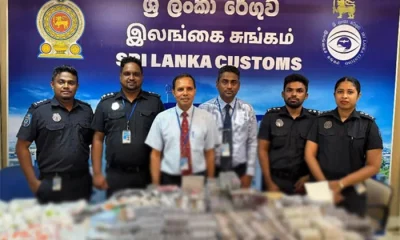
Customs officers yesterday (07) thwarted an attempt made by four persons, including a woman, to smuggle in a consignment of medicines worth about Rs. 10 mn via the Bandaranaike International Airport.
They were arrested while leaving the airport through the green channel.
The suspects, all residents of Colombo, arrived from Bangalore, India.
Customs officers found a stock of medicines, including injections, tablets, capsules, and ointments, concealed in eight suitcases carried by the suspects, officials said.
Investigations revealed that the medicines had not been declared to Customs and were brought into the country without the required approvals from the Ministry of Health and the National Medicines Regulatory Authority (NMRA).

Andre Fernando, recently assumed duties as the Chairman of the Sri Lanka Logistics and Freight Forwarders Association (SLFFA).
A well known corporate leader, Fernando, who previously served as Vice Chairman of SLFFA, brings more than three decades of experience in the logistics and supply chain industry to his new role.
Fernando said that it is with great honour and a deep sense of responsibility that he assumes duties as Chairman of the Sri Lanka Logistics and Freight Forwarders Association. He is grateful for the confidence placed in him by the members and looks forward to serving the Association and the wider logistics community during this important phase of growth and transformation of the industry.
He noted that Sri Lanka’s logistics and freight forwarding sector plays a critical role in facilitating international trade and supporting the national economy. Fernando emphasised the importance of strengthening industry capabilities, embracing technological innovation, and maintaining high professional standards to ensure global competitiveness.
The global logistics sector is currently experiencing rapid transformation driven by digitalization, technological innovation, and evolving supply chain demands. As such, the new Chairman highlighted the importance of adopting modern logistics technologies, enhancing operational efficiency, and investing in industry talent to ensure Sri Lanka remains competitive in the global trade environment.

ISA operationalises country partnership strategy through high-level Sri Lanka mission

Coal-blackened moralists

The university bought AI, now it’s buying back the pencil

University admission crisis: Academics must lead the way

Rs. 10 mn worth of smuggled medicine detected at BIA

Major investment push in Sri Lanka’s solar economy

‘Dates have the highest sugar content to fight Coronavirus’

Sunday Island 27 December – Headlines

#SundayIsland 17th December – Headlines

Sunday Island – 28th March

Sunday Island Headlines – 21 March

Sunday Island – 21st February – Headlines
-

 Features3 days ago
Ranjith Siyambalapitiya turns custodian of a rare living collection
-

 News6 days ago
2025 GCE AL: 62% qualify for Uni entrance; results of 111 suspended
-

 News3 days ago
Global ‘Walk for Peace’ to be held in Lanka
-
 Editorial6 days ago
Search for Easter Sunday terror mastermind
-
 Opinion5 days ago
Hidden truth of Sri Lanka’s debt story: The untold narrative behind the report
-

 Opinion6 days ago
Is there hope for Palestine?
-

 Features5 days ago
The Ramadan War
-

 Features3 days ago
Beyond the Blue Skies: A Tribute to Captain Elmo Jayawardena