
News
‘UK suppressed wartime HC dispatches unfavorable to Western strategy at UNHRC’


… 20-year UN ban on examination of accusations travesty of justice: ex-CJBy Shamindra Ferdinando
Former Chief Justice Sarath Nanda Silva (1999-2009), on Thursday (18), alleged that the British government had suppressed diplomatic cables sent by its wartime Defence Attaché Lt. Colonel Anthony Gash from the British High Commission, Colombo, because they ran counter to the claims made by the western bloc as regards Sri Lanka at the Geneva-based United Nations Human Rights Council (UNHRC).
Appearing on ‘Get Real’ on Derana 24×7, anchored by Johnney Mahieash, the 41st CJ explained the British, in spite of being a member of the UNHRC in addition to spearheading the Core Group, had no option but to suppress credible information as part of the overall strategy to sustain the campaign against Sri Lanka.
The UNHRC consists of 47 countries divided into five zones with the UK categorised along with Austria, Denmark, France, Germany, Italy, the Netherlands (Western Europe and other States). A vote on the Core Group’s resolution, backed by the US, is expected early next week at the end of the 46th session of the UNHRC on March 23. The session commenced on Feb 22.
Displaying a set of highly censored British diplomatic cables that dealt with the situation on the Vanni front in 2009 (January-May) made available by Lord Naseby, who obtained them following a protracted legal procedure, the former CJ expressed shock and dismay at the British choosing to suppress information provided by a person who enjoyed diplomatic status.
Silva said Lt. Colonel Gash had been stationed in Colombo during that period to provide information sought by the British pertaining to the conflict. Having perused the documents and examined the context in which they were written, the former CJ asserted that the Gash papers gave an accurate picture.
In an exclusive interview with The Island, in Sept 2019, Lord Naseby said that he struggled for nearly three years to secure the dispatches from the UK government after making the first formal request in Nov 2014.
Responding to another query posed by Mahieash, the former CJ questioned the rationale in the UK depriving a House of Lords member material relevant to an issue the UK government was deeply concerned about. The outspoken former CJ explained that for the British the dispatches from Colombo couldn’t have posed any security concerns though their disclosure was certainly detrimental to their Geneva agenda.
Referring to Gash dispatches again, former CJ Silva said that in spite of blackening sections of the reports from Colombo, the person assigned the task carelessly left some crucial words intact one could comprehend what had been censored.
Lord Naseby told The Island that he personally handed over sets of Gash reports to the then President Maithripala Sirisena’s administration as well as the Joint Opposition (now SLPP) in 2017. The Conservative Party politician regretted the disclosure of the vital material hadn’t been properly utilized by Sri Lanka. Lord Naseby revealed the existence of the Gash papers on Oct 12, 2017 in the House of Lords.
Comparing the LTTE with the Irish Republican Army, the former CJ pointed out the wartime British Defence Attaché’s comment on the LTTE employing foreign mercenaries to mount air attacks in Colombo and the Katunayake airbase, where Sri Lanka’s precious fighter squadrons were based at. The former CJ referred to specific reference to the LTTE targeting the Israeli supplied Kfir aircraft based at Katunayake at a crucial time of the war against the LTTE. Reference was also made to the LTTE having seven airstrips in the northern theatre of operations and its failure to use a fourth aircraft in its arsenal in the absence of a mercenary.
Sri Lanka brought the war to a successful conclusion in May 2009.
The former CJ said that another reason for the British to suppress Gash papers was that the British official officially assigned the task of keeping London informed of the developments here, presented a picture of the Sri Lankan military quite opposite to what they propagated. In the wake of Gash/Lord Naseby disclosure, the UN Panel of Experts (PoE) report based on unsubstantiated allegations was in tatters, the former CJ said.
The PoE issued its report on March 31, 2011.
The former CJ said that British diplomatic dispatches on the basis of UN reports explained how the LTTE deployed forcibly recruited ‘unwilling recruits’ in its desperate counter offensives as the fighting entered the final phase.
The former CJ stressed that the British should have disclosed all available information to ensure a free and fair inquiry. Sarath Nanda Silva was responding to the British declaration in February this year that they didn’t furnish Gash reports to the UNHRC nor did the Geneva body asked for them.
The former CJ alleged that the British were pursuing a politically motivated agenda. In the wake of his interview with Derana 24×7, The Island sought the former CJ’s opinion on measures that could be taken to ascertain the truth as regards the primary allegation namely the killing of 40,000 civilians (PoE, paragraph 137). The UK led Core Group which includes Germany and Canada could call for dispatches from Defence Advisors/Defence Attaches from other countries having diplomatic missions in Colombo. They could easily verify the Gash reports by comparing them with dispatches from other missions, the former CJ said, pointing out that the UN and ICRC, too, could furnish their reports.
The former CJ said that the British government actions had in fact embarrassed the ordinary people who believed in their supposed sense of justice and fair play.
The former CJ said that he was appalled by the PoE placed the number of dead at 40,000 in spite of UN report that dealt with the situation therein from August 2008 to May 13, 2009 having asserted only 7,721 perished on the Vanni front (both civilians and combatants/paragraph 134). He also pointed out the PoE declaration the unsubstantiated accusations that led to Geneva actions couldn’t be examined till 2031 (paragraph 23) revealed that due attention hadn’t been given to the high profile anti-Sri Lanka project. The PoE/UN prohibited the examination of accusations for a period of 20 years from 2011. Pointing out the discrepancy in varying figures quoted by interested parties, the former CJ said that wartime US Defence Advisor Lt. Col. Lawrence Smith’s revelation at the 2011 Colombo Defence Seminar could be utilized along with Gash reports to carefully re-examine the accusations.
The US official denied alleged war crimes, including battlefield executions, the former CJ said, pointing out that the US denial was made just a couple of months after the release of PoE report widely called the Darusman report. In fact, Geneva should have asked member states and other countries especially the US and India to provide their defence advisors’ dispatches to help its investigations. The Tamil Diaspora demanding justice never asked for those reports because all knew what would happen to politically motivated Geneva actions if the reports reached the public.
The former CJ also referred to a Wikileaks revelation that ICRC told the US in 2009 Sri Lanka military could have finished off the LTTE if the civilian factor was not taken into consideration. The bottom line is that the case against Sri Lanka had been exposed by the officials of the same countries, the former CJ said, urging the government to take a fresh look at all available information/evidence.
The former CJ told Derana 24/7 that cases shouldn’t be won by suppressing information/evidence. The former CJ further pointed out how a section of the media in early 2007 revealed the UN suppressing the LTTE detaining two UN Tamil employees for helping civilians to escape to the government controlled area. The UN acknowledged that New York was not briefed of the developments here, the former CJ said, urging those shedding crocodile tears to revisit Sri Lanka accountability issue.


Latest News
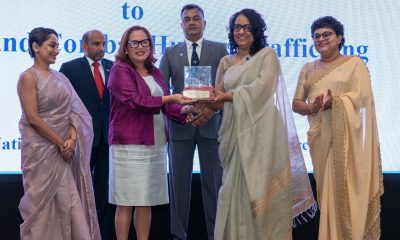
The National Strategic Action Plan to monitor and combat human trafficking (2026-2030) officially launched


The Prime Minister Dr. Harini Amarasuriya participated in the official launch of the National Strategic Action Plan to monitor and combat human trafficking (2026-2030) held on 28th of January at the Cinnamon Life Hotel, Colombo. The event was jointly organized by the Ministry of Defence, National Anti Human Trafficking Task Force ( NAHTTF), International Organization for Migration (IOM).
This five-year Action Plan was unveiled under the leadership of the Ministry of Defence, in its capacity as Chair of the NAHTTF and with the technical support from the International Organization for Migration (IOM). The National Strategic Action Plan 2026-2030 establishes a unified national framework to prevent human trafficking, protect and assist victims, strengthen law enforcement responses, and enhance accountability.
Addressing the event, the Prime Minister reaffirmed the Government’s commitment to strengthening national efforts to prevent and address human trafficking and stated that the Action Plan must transcend its symbolic launch into concrete, coordinated, and sustained implementation.
The Prime Minister also noted that the launch of the National Strategic Action Plan is timely, as it operationalizes the four internationally recognized pillars of the anti-trafficking framework namely prevention, protection, prosecution, and partnership.
The Prime Minister further stated,
“Caring for trafficking survivors in Sri Lanka requires a holistic, gender-sensitive, and survivor-centered approach that addresses both immediate protection and long-term recovery. This includes safe shelter, medical care, and trauma-informed psychological support, with particular attention to women and girls who experience more severe and gendered forms of violence, alongside legal assistance, economic empowerment, and skills development to prevent re-trafficking.
Human trafficking is a structural and social challenge that requires sustained, multi-sectoral action. Ministries and government agencies must embed anti-trafficking priorities into their core strategies and day-to-day operations, ensuring institutional integration and professional accountability”.
The event was attended by Parinda Ranasinghe Jnr, PC, Attorney General of the Democratic Socialist Republic of Sri Lanka, the Secretary to the Ministry of Defence and Chair of the NAHTTF, Air Vice Marshal Sampath Thuyacontha; and Kristin Parco, IOM Chief of Mission in Sri Lanka and Maldives. Members of the NAHTTF representing 23 key government entities, along with representatives of the diplomatic community, United Nations entities and Civil Society Organizations (CSOs).
(Prime Minister’s Media Division)

The International Monetary Fund (IMF) has declared that the Extended Fund Facility (EFF) wouldn’t be amended in view of the impact of Cyclone Ditwah.
The IMF delegation, at the end of its visit to Sri Lanka, informed President Anura Kumara Dissanayake of its decision during a meeting at the Presidential Secretariat yesterday (28). The IMF delegation included Director of the Asia and Pacific Department Krishna Srinivasan, Deputy Director for Asia and the Pacific Sanjaya Panth, Mission Chief Evan Papageorgiou, and Resident Representative Martha Woldemichael.
The 48-month arrangement, approved on 20 March, 2023, during Ranil Wickremesinghe’s tenure as the President, is for SDR 2.286 billion (approximately US$3 billion). In terms of the agreement, repayment of debt has to be resumed in 2028. Sri Lanka unilaterally suspended debt repayment in April 2022.
Close on the heels of Cyclone Ditwah, the main Opposition party, the Samagi Jana Balawegaya (SJB), repeatedly pressed the government to request the IMF to amend the agreement.
The Presidential Media Division ( PMD) quoted the IMF delegation as having said that the strong fiscal discipline maintained by the government over the past year had been a key factor in addressing the challenges caused by Cyclone Ditwah. They said that the government’s ability to present a supplementary estimate of Rs. 500 billion was made possible by a surplus in the Treasury.
The Government of Sri Lanka was represented by Minister of Labour and Deputy Minister of Economic Development Dr. Anil Jayantha Fernando, Secretary to the Ministry of Finance Dr. Harshana Suriyapperuma, Governor of the Central Bank Dr. Nandalal Weerasinghe, Senior Economic Adviser to the President Duminda Hulangamuwa, along with several others.
Sri Lanka’s economy has “stabilised decisively” under its International Monetary Fund (IMF)-supported programme, with growth rebounding, tax revenues doubling, and inflation sharply declining, a senior IMF official said in Colombo yesterday.
Dr. Krishna Srinivasan, Director of the IMF’s Asia and Pacific Department, delivered the assessment during a public lecture on the IMF Regional Economic Outlook: Asia and Pacific, held at the Central Bank of Sri Lanka. He was joined by Dr. Thomas Helbling, the Department’s Country Director.
Both officials commended the Asia-Pacific (APAC) region’s overall economic resilience in the face of global challenges and advocated for deeper trade and supply chain integration to mitigate vulnerabilities in international trade.
Presenting a country-focused analysis, Dr. Srinivasan outlined how Sri Lanka has performed against the five key pillars of the IMF programme:
Revenue-based fiscal consolidation, supported by tax reforms and strengthened social safety nets.
Restoring debt sustainability through fiscal adjustment and debt restructuring.
Maintaining price stability and rebuilding foreign exchange reserves.
Safeguarding external stability.
Combating corruption via a comprehensive anti-corruption reform agenda.
“Sri Lanka has come out of the crisis stabilising its economy across three dimensions,” Dr. Srinivasan stated referring to Sri Lanka’s Growth, Revenue, and Inflation. He highlighted that growth “bounced back decisively,” turning positive within six months of the programme and recently averaging about 5 percent annually.
On fiscal performance, he noted a “significant turnaround.” Tax revenue has doubled from a critically low 7.3 percent of GDP to 14.8 percent in 2025.
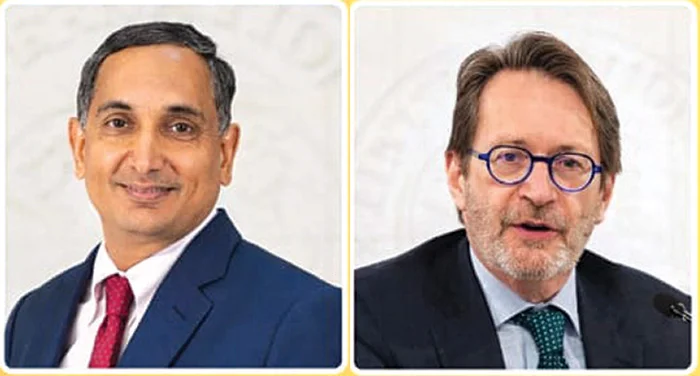
Dr. Krishna Srinivasan / Dr. Thomas Helbling
Furthermore, inflation has dropped “in a very convincing manner” from approximately 70 percent to the current 2-3 percent range. “One would hope that in the next few quarters, it will reach the Central Bank’s target of 5 percent,” he added.
“Overall, the IMF programme for Sri Lanka has delivered on many of its objectives,” Dr. Srinivasan concluded. “There is still a long way to go in terms of securing strong, sustained, balanced growth, but the program is off to a very good start. All of you, the authorities, and the people of Sri Lanka need to be congratulated for the progress made so far,” he said.
In his regional remarks, Dr. Srinivasan projected that Artificial Intelligence (AI) will be a key driver of the Asian economy. He suggested that technology companies in the region would be “better served by the capital markets than from conventional banks,” pointing to a need for evolved financial ecosystems to support innovation.
The lecture underscored the IMF’s constructive outlook for Asia’s continued resilience, while emphasising structural reforms and regional cooperation as vital for future stability and growth.
By Sanath Nanayakkare

Rathnayake in Sri Lanka squad for England T20Is; Thushara, Kamindu left out

U19 World Cup: Peake ton fires Australia into the semis

The National Strategic Action Plan to monitor and combat human trafficking (2026-2030) officially launched

Seifert, Santner headline New Zealand’s massive win despite Dube’s 15-ball fifty

Dry weather will prevail inmost parts of the island.

No changes to IMF agreement despite Cyclone Ditwah impact

‘Dates have the highest sugar content to fight Coronavirus’

Sunday Island 27 December – Headlines

#SundayIsland 17th December – Headlines

Sunday Island – 28th March

Sunday Island Headlines – 21 March

Sunday Island – 21st February – Headlines
-
 Business3 days ago
ComBank, UnionPay launch SplendorPlus Card for travelers to China
-
 Business4 days ago
ComBank advances ForwardTogether agenda with event on sustainable business transformation
-
 Opinion4 days ago
Conference “Microfinance and Credit Regulatory Authority Bill: Neither Here, Nor There”
-

 Opinion6 days ago
A puppet show?
-
 Opinion3 days ago
Luck knocks at your door every day
-
 Business5 days ago
Dialog Brings the ICC Men’s T20 Cricket World Cup 2026 Closer to Sri Lankans
-
 Features6 days ago
‘Building Blocks’ of early childhood education: Some reflections
-
 News4 days ago
Rising climate risks and poverty in focus at CEPA policy panel tomorrow at Open University