
News
UK sanctions on war-winning military: NJC slams govt. over its lukewarm response

The National Joint Committee (NJC) has strongly condemned what it called the NPP government’s weak response to the sanctions imposed on retired senior military officers and former LTTE Ampara-Batticaloa leader.
The following is the text of statement issued by Lt Col. (retd.) Anil Amarasekera, on behalf of the NJC:
“On 24th of March 2025 UK Foreign Commonwealth & Development Office in a press release titled “UK sanctions for Human Rights Violations and Abuses during the Sri Lanka Civil War” stated that the UK Government has imposed sanctions on four individuals, three of them are former military commanders of the Sri Lanka Armed Forces. The National Joint Committee cannot understand how the government of the United Kingdom came to the conclusion that there was a civil war in Sri Lanka when the security forces in Sri Lanka only conducted a humanitarian confrontation against the LTTE that was considered by the American FBI as the most ruthless terrorist organisation in the world. The Sinhalese were not at war with the Tamils; in fact a majority of the Tamils lived and continue to live peacefully with the Sinhalese in the south of Sri Lanka.
In a mild and weak response the Foreign Ministry of Sri Lanka says that such unilateral actions by countries do not assist but serve to complicate the national reconciliation process underway in Sri Lanka. The Foreign Ministry of Sri Lanka should have informed the UK Government that there was no civil war in Sri Lanka and that Sri Lanka had a non–international armed conflict for over three decades in which the armed forces of the government had a confrontation with the LTTE, an armed terrorist organisation. The Foreign Ministry of Sri Lanka should have also informed the United Kingdom government that the aim of the LTTE, for three decades, was to divide the country and establish a separate state of Eelam by overthrowing governments that the people elected democratically to rule the country and that the LTTE was finally defeated by the government armed forces of Sri Lanka in 2009.
The Sri Lankan diaspora in several western countries that support the division of Sri Lanka are influencing politicians in these western countries to impose sanctions for alleged war crimes against security forces heroes that defeated the separatists. The government that won the conflict against LTTE terrorists, as well as all the other governments elected by the people, subsequently, failed to inform the UNHCR and the international community adequately regarding this non-international armed conflict in which LTTE terrorists were even recruiting child soldiers. The UK government has, up-to-date, failed to take effective action against Adela Balasingham who was responsible for training child soldiers. The armed forces sacrificed so much blood, sweat, tears and toil, sometimes even their very life and limb to save the Tamil people who were held as a human shield by the LTTE. As a result of defeating the LTTE the armed forces were able to protect and preserve the unity and territorial integrity of their nation for posterity.
The 2nd Mandate of the Maxwell Paranagama Presidential Commission of Inquiry that was completed in August 2015 secured the services of several leading internationally renowned legal and military experts, like Sir Desmond de Silva Q.C., Professor David Crane, Sir Geoffrey Nice Q.C. and Major General John Holmes, the former Commander of the SAS, to assist the Commission on international humanitarian law, international human rights law, customary international law and the laws of armed conflict generally. It remains a mystery as to why this comprehensive report that negated all allegations made by the so called Panel of Experts (PoE) was not taken into consideration when the final version of the HRC Report was released to the public on 16th of September 2015. Foreign Minister Mangala Samaraweera of the Sirisena-Wickremesinghe government instead of making use of the available material in the 2nd Mandate of the Maxwell Paranagama Presidential Commission of Inquiry to clear the Security Forces of alleged war crime charges, co-sponsored the UNHRC Resolution 30/1 on 1st October 2015 and assisted the Western Powers to implement their neo-colonial strategy probably to please the Western Powers that made the 2015 regime change possible in Sri Lanka.
In October 2017 Lord Naseby informed the House of Lords that there was no basis for the PoE claim of 40,000 civilian deaths in the Vanni based on British wartime dispatches from Colombo sent by Colonel Gash from January to May 2009. He reiterated during the Queen’s Speech in the House of Lords in January 2020 that around 6000 Tamil civilians were killed and that quarter of them would have been LTTE combatants. He also said that reports of Colonel Gash made it clear that the Sri Lanka Army behaved admirably and looked after the civilians. He further said that the Sri Lanka Army would not have brought 295,000 Tamil civilians safely across the lines if they wanted to knock them off. Why the Sirisena-Wickremesinghe government fail to make use of the revelations made by Lord Naseby and request the help of the British government to establish the truth by releasing the entire set of dispatches sent by Colonel Gash to clear the Sri Lanka Security Forces of war crimes allegations is beyond comprehension.
In June 2011 at the first defence seminar held after the end of the Eelam war the US Defence Advisor in Colombo Lt Col. Lawrence Smith questioned the very basis of allegations including the execution of surrendering LTTE terrorists directed at the Sri Lanka Army. Both the Army and the then External Affairs Ministry pathetically failed to take notice that there couldn’t have been a better defence for Sri Lanka than a top US representative publicly denouncing false propaganda directed at Sri Lanka. The ICRC head of operations for South Asia Jacque de Maio during a confidential conversation on 9th July 2009 with the US Ambassador Clint Williamson, based in Geneva, had said that the Army was determined not to let the LTTE escape from the shrinking territory even though this meant that civilians being kept hostage by the LTTE were at an increasing risk and as a result there were serious widespread violations of international humanitarian law but that it did not amount to genocide and that he could cite examples of where the Army had stopped shelling when the ICRC informed them it was killing civilians. He had further said that the Army actually could have won the military battle faster with higher civilian casualties, yet that it chose a slower approach which led to a greater number of Sri Lanka Army deaths. Based on this information Ambassador Clint Williamson had sent a cable to the US State Department on 15th July 2009 clearing the Sri Lanka Army of crimes against humanity.”





Suspect also wanted for child abuse: Extradition process underway
Among seven persons arrested in the United Kingdom for people smuggling is a Sri Lankan wanted by French authorities for the rape of a child.
UK’s National Crime Agency said that it collaborated with police and international partners in INTERPOL’s largest-ever operation targeting people smuggling and human trafficking.
Operation Liberterra III was led by the NCA’s Joint International Crime Centre (JICC) and targeted offenders wanted for a range of crimes who had entered the UK illegally.
Officers from the National Extradition Unit at the JICC made five arrests across London, Bedfordshire, Merseyside and Greater Manchester.
Those arrested included:
A 30-year-old Sri Lankan man arrested in Liverpool and wanted in France for the rape of a child
A 38-year-old Iraqi man wanted for rape in Germany arrested in Greater Manchester
A 29-year-old Egyptian man wanted for murder in France arrested in Bedfordshire
A 41-year-old Syrian man arrested in Greater Manchester and wanted in Germany for organising illegal small boat crossings
A 30-year-old Bulgarian man arrested in London for human trafficking and wanted in France
Greater Manchester Police teams also made two arrests across the county during the operation which was held between 10 and 21 November last year.
A 23-year-old Ukrainian man wanted in Germany for sexual exploitation
A 31-year-old Romanian man wanted in Romania for sexual exploitation
Extradition proceedings are underway for all seven suspects.
The NCA website quoted its Deputy Director of International Rick Jones as having said: “This global operation is a prime example of our commitment to working closely and effectively with international partners to tackle people smuggling and human trafficking.
“We were proud to host the European Co-ordination Unit and used a range of our specialist capabilities to gather and disseminate intelligence to law enforcement agencies across the world, and to enable our officers to identify, locate and detain offenders wanted overseas.
“As a result, seven suspects wanted in connection to serious offences have been removed from our communities and extradition proceedings are ongoing to ensure they face justice.”
Globally, 3,744 suspects were arrested including 1,800 for human trafficking and migrant smuggling offences.
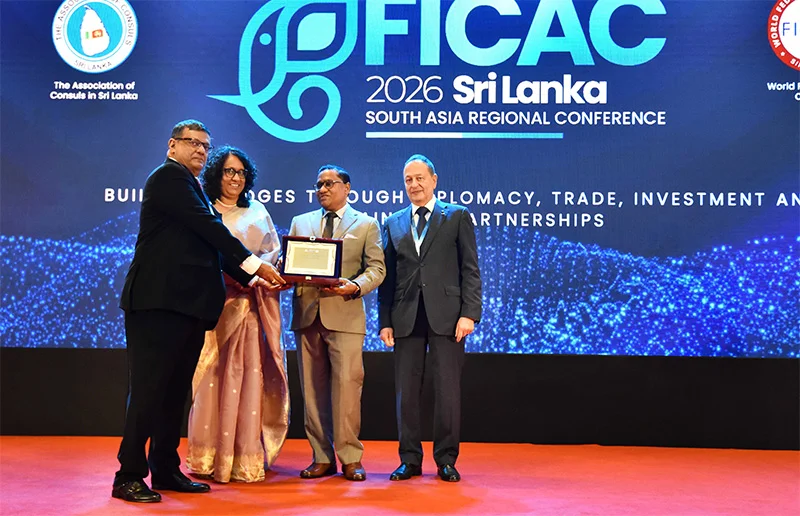
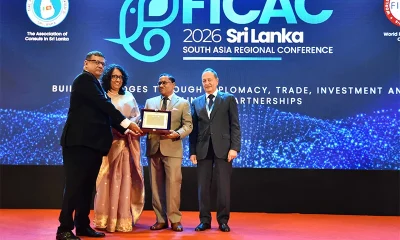
Addressing a gathering of the world’s consular community, Foreign Minister Vijitha Herath issued a pointed, diplomatic request yesterday for the enhanced protection of Sri Lankan citizens abroad, a message delivered against the backdrop of a recent alleged assault on Sri Lankan fishermen by the Indian Coast Guard.
The occasion was the inauguration of the FICAC 2026 South Asia Regional Conference, hosted by The Association of Consuls in Sri Lanka together with the World Federation of Consuls (FICAC) at Cinnamon Life.
Minister Herath, while outlining Sri Lanka’s foreign policy of “non-alignment, strategic autonomy, and constructive engagement,” directly tasked the honorary consul community with a critical role. “I request the honorary consul community to maintain a continued and enhanced focus on safeguarding the rights and welfare of Sri Lankan nationals in respective jurisdictions,” he stated.
The appeal carries significant weight following recent media reports which detailed claims by a group of fishermen from Wennappuwa that they were assaulted by uniformed Indian Coastal Guards. The incident, alleged to have occurred partly in Sri Lankan territorial waters, resulted in hospitalisations and has been referred to the Foreign Affairs Ministry and Navy for investigation. Minister Herath’s carefully calibrated statement before the international audience underscored the government’s proactive but diplomatic approach to citizen welfare overseas.
Prime Minister Harini Amarasuriya, who also addressed the inaugural session, framed Sri Lanka as a nation on a resurgent path. She thanked FICAC for selecting Sri Lanka, noting the choice reinforces the country’s returning credibility under President AKD’s administration.
“Fiscal management is in good control with contained inflation and increased reserve levels and global confidence is returning as the country is moving towards stability, expanded economic activity and inclusive growth,” the Prime Minister stated. She also acknowledged the severe challenge posed by climate change, citing Cyclone Ditwah, and thanked the international community for its support during the disaster, which helped quickly revive the tourism sector.
Both leaders positioned the consular network as indispensable partners in Sri Lanka’s recovery and global re-engagement. Minister Herath emphasised their role in bridging “governments, businesses and communities,” while the Prime Minister stated such forums help reconsolidate the support of global actors.”
The three-day FICAC conference brings together consular officials from across South Asia, focusing on their unique role in facilitating diplomacy, trade, and legal cooperation outside traditional embassy channels.
By Sanath Nanayakkare
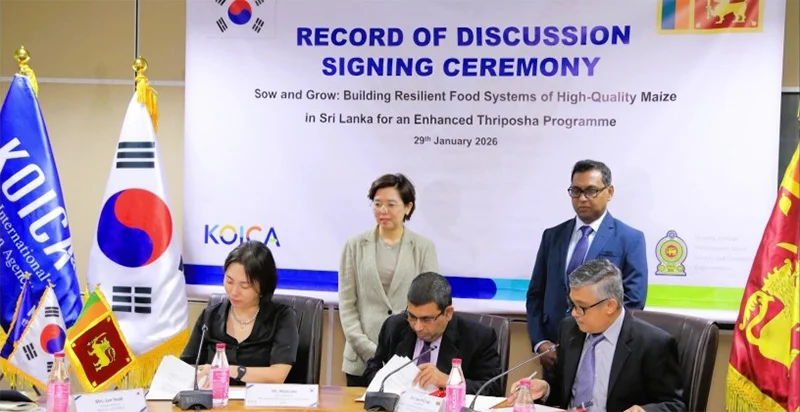
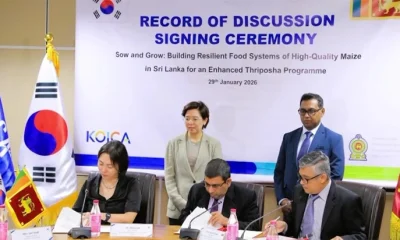
The Korea International Cooperation Agency (KOICA) has reached agreement with Sri Lanka to strengthen the country’s Thriposha nutrition programme through climate-resilient, locally sourced food systems.
According to the Korean Embassy here the agreement formalised a USD 10 million partnership that would enhance domestic production of high-quality maize, reduce reliance on imports, and reinforce the sustainability of Sri Lanka’s flagship nutrition intervention for children and mothers. The agreement in this regard reflected the shared commitment of the Republic of Korea and Sri Lanka to advancing inclusive, resilient, and sustainable development outcomes, the Embassy stated.
The agreement was signed in the presence of the Ambassador of the Republic of Korea to Sri Lanka Ms. Miyon Lee, the Minister of Rural Development, Social Security and Community Empowerment Dr. Upali Pannilage, Country Representative, World Food Programme (WFP) Philip Ward, and senior representatives from the Ministry of Agriculture, Ministry of Health, Ministry of Trade, Sri Lanka Thriposha Limited, demonstrating the commitment by all relevant stakeholders of this unique project.

Crown Princess’s son arrested for alleged assault before rape trial in Norway

Shower will occur in the Northern, North-central, Eastern and Uva provinces and in Nuwara-Eliya and Matale districts

Interpol crackdown: Sri Lankan man among seven arrested in UK for human smuggling

Sri Lanka calls on global consular corps to protect nationals amid fishermen incident

Korean boost for Thriposha programme: Partnership worth USD 10 mn

Development Officers’ Association steps up protest campaign

‘Dates have the highest sugar content to fight Coronavirus’

Sunday Island 27 December – Headlines

#SundayIsland 17th December – Headlines

Sunday Island – 28th March

Sunday Island Headlines – 21 March

Sunday Island – 21st February – Headlines
-
 Opinion4 days ago
Sri Lanka, the Stars,and statesmen
-
 Business5 days ago
Climate risks, poverty, and recovery financing in focus at CEPA policy panel
-

 Business3 days ago
Hayleys Mobility ushering in a new era of premium sustainable mobility
-
 Business3 days ago
Advice Lab unveils new 13,000+ sqft office, marking major expansion in financial services BPO to Australia
-
 Business3 days ago
Arpico NextGen Mattress gains recognition for innovation
-
 Business2 days ago
Altair issues over 100+ title deeds post ownership change
-

 Business2 days ago
Sri Lanka opens first country pavilion at London exhibition
-

 Editorial3 days ago
Govt. provoking TUs