
News
Udaya warns of longer power cuts as situation deteriorates further

‘Electricity deficit growing due to continuing drop in hydro-power generation
By Shamindra Ferdinando
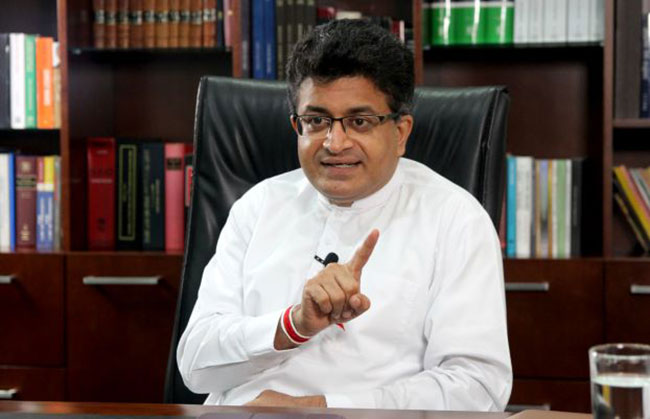
Energy Minister Udaya Gammanpila says the country is paying a very heavy price for failing to enhance electricity generation capacity since 2014.
Attorney-at-law Gammanpila, who is also the leader of Pivithuru Hela Urumaya (PHU) stresses ongoing unannounced power cuts are likely to be a regular feature due to what he called ‘system imbalance’ caused by sufficient power to meet the regular requirement.
The outspoken lawmaker warned that the duration of power cuts would be further extended sooner when the supply and demand gap widened.
Responding to another query, the Colombo District MP said that the CEB had no option but to switch off selected sections to avoid countrywide disruption of electricity. Whatever various interested parties say, power cuts were necessary and couldn’t be avoided, Minister Gammanpila said.
Minister Gammanpila said that he recently suggested a daily 90 minute power cut as there was no other option. Acknowledging that his proposal hadn’t received the required attention, Minister Gammanpila said that the situation would continue to deteriorate until all stakeholders reach a consensus on the issue.
According to the Minister, those who had been in authority since 2014 couldn’t absolve themselves of the responsibility for the current crisis.
Asked whether the failure on the part of the political leadership and those who had been at the CEB’s helm as well as trade unions was deliberate, Minister Gammanpila declined to comment. The minister pointed out that all stakeholders should examine the full picture if the country was to address the issue at hand properly. It would be a serious mistake to believe that the issue could be addressed by operating thermal power stations alone, MP Gammanpila said. Those who propagated the lie that the entire power requirement could be met through thermal power generation obviously didn’t understand the contribution made by hydro-power generation, the PHU leader said.
Had there been a proper strategy, the government could have initiated tender procedures to secure electricity from private operators to meet the shortfall. However, in the absence of such a strategy, emergency power purchases could be quite costlier at a time the cash-strapped government was experiencing a financial crisis. Perhaps there should be a genuine dialogue involving all stakeholders at least now, Minister Gammanpila said, asserting the energy situation was in a dicey situation. “Do we have a realistic view of the developing situation,” Minister Gammanpila asked, underscoring the importance of reaching a consensus among all stakeholders.
Appreciating India providing USD 500 mn through a new Line of Credit for the purchase of Indian oil products in addition to extending foreign exchange support of over USD 900 million to Sri Lanka, Minister Gammanpila emphasized the fuel supply remained at a critical stage. “There is no point in denying that fact. We are struggling, really struggling with no permanent solution in sight. That is the undeniable truth. Perhaps, the government should take the public into confidence. The public should be told of the exact situation and urged to bear up difficulties.”
Minister Gammanpila said that the situation could further deteriorate.
The energy Minister said that Sri Lanka was also grateful to China for providing a six-month loan facility to procure oil products. That would come to an end at the end of February, Minister Gammanpila said, adding that one more diesel shipment was scheduled to take place in terms of this agreement.
The Minister admitted that their negotiations with several other countries to procure fuel at concessionary terms hadn’t been successful. “We shouldn’t expect other countries to respond or come to our rescue the way India and China do,” Minister Gammanpila said.
The PHU leader dismissed Opposition criticism. Perhaps, those who had been in power in the 2015-2019 period should explain their failure to enhance power generation to meet the annual increase in the requirement. According to him, Sri Lanka needs to increase power supply by six percent annually.


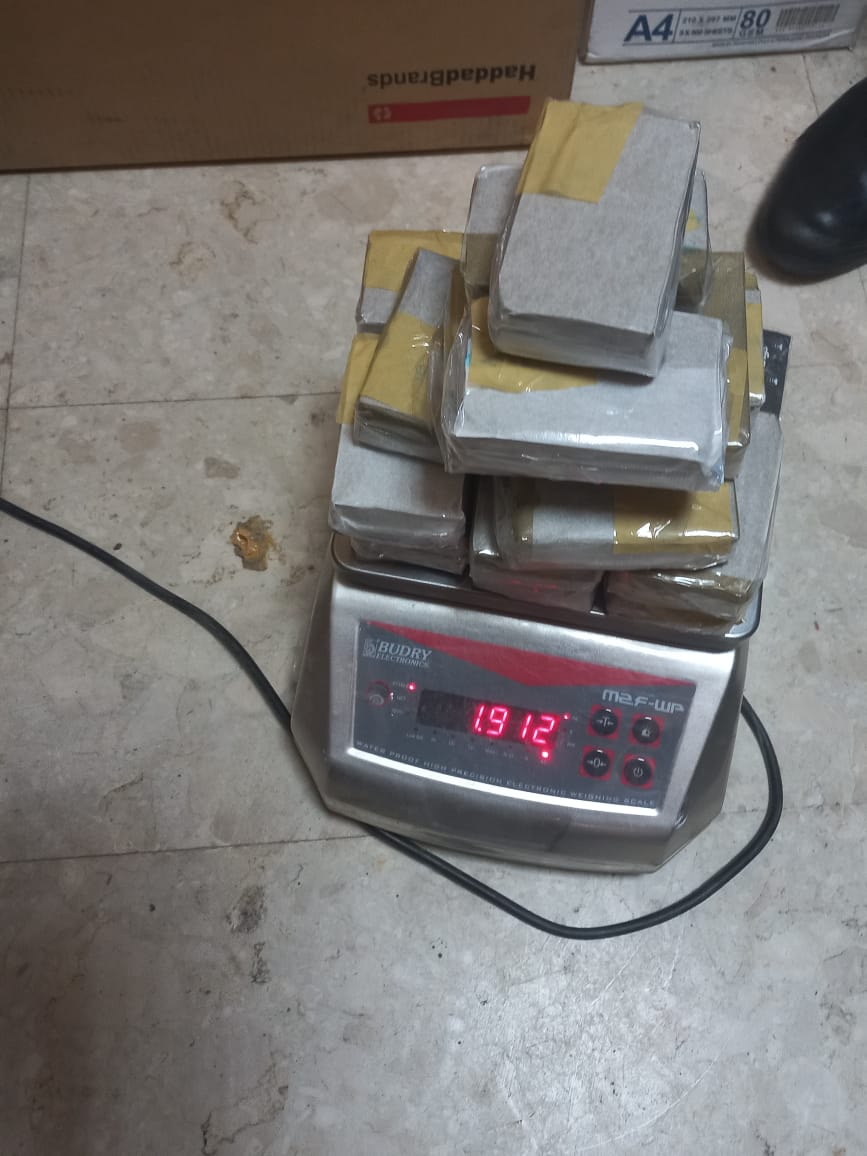
Three Sri Lankan male passengers who arrived from Muscat by flight no. OV 437 on Saturday (24) have been arrested by officers attached to the NCU at BIA as they were found to be carrying 12,306 grams of Cannabis class narcotics (suspected as Hashish & Kush) valued at 123 million rupees.
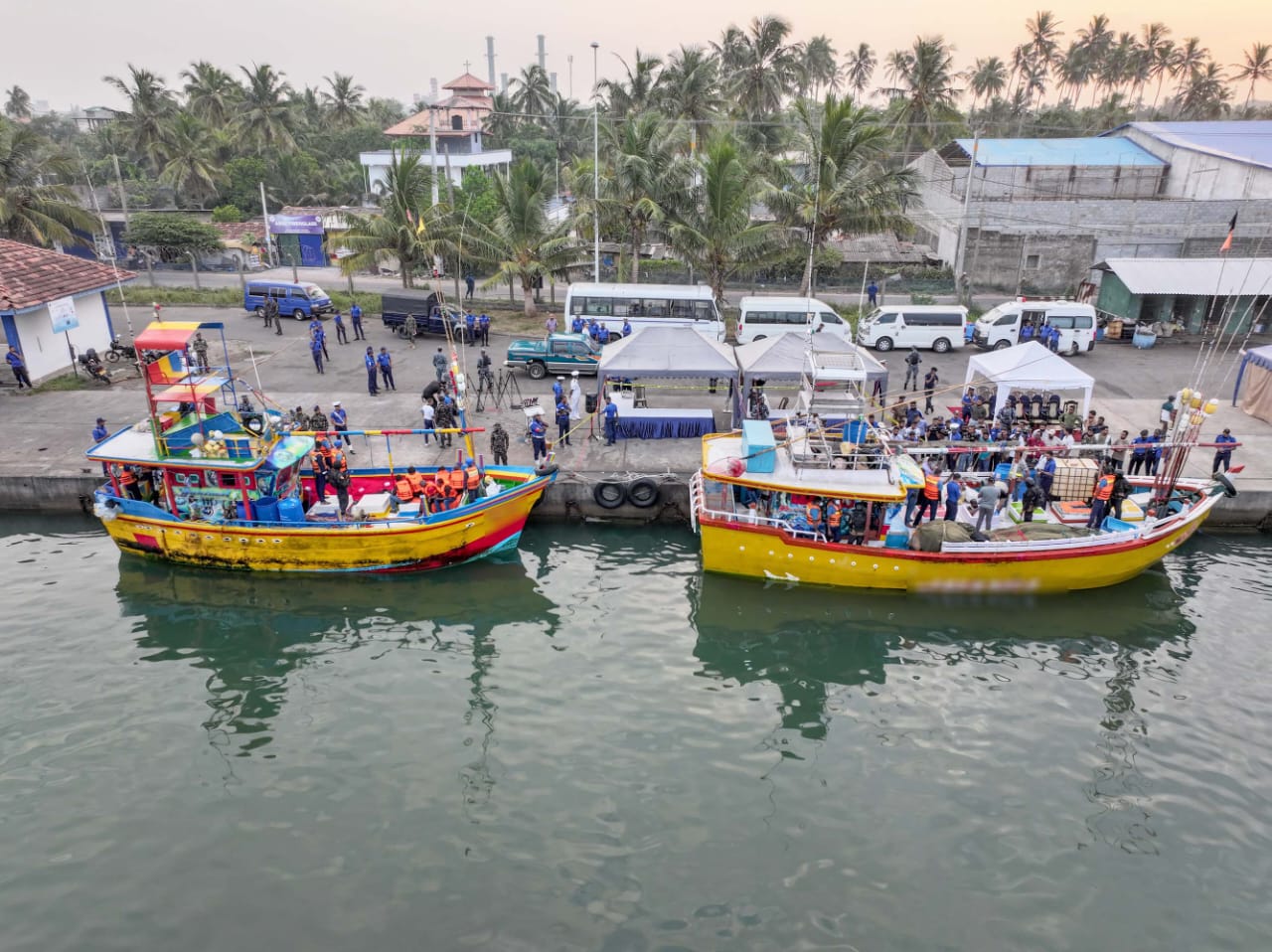
Building on its success in seizing major narcotic stocks in 2025, the Navy continued to support the “A Nation United” National Mission in 2026. In continuation of these efforts, during an
operation conducted on the high seas south of Sri Lanka, the Navy apprehended eleven (11) suspects aboard two local multi-day fishing trawlers suspected of drug smuggling.
Based on shared information, by the Sri Lanka Navy and Police, this special operation was conducted off the southern coast, deploying the Navy‟s Offshore Patrol Vessels. The operation
resulted in the interception of a multi-day fishing trawler suspected of smuggling narcotics, and the apprehension of five (05) suspects on board.
During further operations in the same area, naval units seized another multi-day fishing trawler (01), along with communication equipment and six (06) additional suspects, also believed to be involved in drug smuggling.
This morning (25 Jan 26), the two intercepted fishing trawlers, along with fourteen (14) sacks laden with suspected narcotics and the suspects, were brought to the Dikovita Fisheries Harbour.
An expert examination by the Police Narcotic Bureau confirmed that the fourteen (14) sacks contained more than 184 kilograms of heroin and over 112 kilograms of ‘Ice’ (crystal methamphetamine).
The Deputy Minister of Defence, Major General (Retd) Aruna Jayasekara, the Commander of the Navy, Vice Admiral Kanchana Banagoda, and the Inspector General of Police, Priyantha Weerasuriya, inspected the narcotics at the Dikovita harbour.
The Deputy Minister of Defence said that the current administration has initiated several projects for national development. As a flagship initiative, under the directives and guidance of the President, and under the supervision of the
Ministry of Defence, well-coordinated anti-narcotic raids have been launched.
This effort, part of “A Nation United” National Mission, involves the tri-forces, police, and all intelligence agencies working together under a coordinated plan to ensure that drug smugglers have no opportunity to bring narcotics into the country, he opined. He further stated that despite the national disaster situation, the state machinery, including the tri-forces, the police, and the public at large, remains united in rebuilding the nation, no room will be left for drug trafficking, which poses a severe threat to national security and public safety. Those
who engage in or support drug trafficking, under the cover of fishing activities, will find no escape, he added.
The Deputy Minister also reaffirmed that the tri-forces, police, and all law enforcement agencies are fully committed to their duty of suppressing this menace.
The Deputy Minister of Defence reported that, throughout 2025, a series of highly successful operations were conducted leading to numerous arrests. This was achieved through close coordination and mutual cooperation among the tri-services, the police, the Special Task Force, Police Narcotics Bureau, local law enforcement and international agencies. He noted that this
same spirit of cooperation and commitment has continued into 2026, resulting in the seizure of a large stockpile of drugs.
On behalf of the Honourable President, he extended gratitude to all who contributed to these efforts, specifically acknowledging the Commander of the Navy, the Inspector General of Police, the Police Narcotic Bureau, and the crews of the Navy’s Offshore
Patrol Vessels.
Moreover, the Deputy Minister declared that drug smuggling has become a national crisis, fueled by youth involvement and social crime. With borders secured under the “Nation United” National Mission, he warned traffickers to cease operations and urged users to abandon the destructive habit.
The Deputy Minister urged the public to report suspected drug smugglers to law enforcement via the hotlines 1818 or 1997 and also commended the role of media institutions and journalists in raising public awareness about the dangers of narcotics through responsible reporting.
Meanwhile, the two (02) multi-day fishing trawlers, along with a haul of narcotics, eleven (11) suspects, and communication equipment, were handed over to the Police Narcotic Bureau for
further investigation and legal proceedings.

Engineers at the Ceylon Electricity Board have drawn a clear red line over the government’s plan to gazette the appointed date for restructuring the utility, warning that trade union action will follow if the move is pushed through without addressing their core demands, the Sunday Island learns.
The powerful Ceylon Electricity Board Engineers’ Union (CEBEU) says preparations are already under way for industrial action, most likely after the appointed date gazette is published, should the Minister proceed without resolving outstanding issues raised repeatedly by engineers.
“If the appointed date is gazetted without addressing our demands, we will have no option but to take trade union action,” a senior electrical engineer told The Island, stressing that the warning should be taken seriously.
CEBEU sources say the engineers’ demands are aimed at preventing a structural and financial crisis in the electricity sector, rather than blocking reform. They insist that unbundling the CEB without first putting in place firm safeguards would expose the sector to instability and consumers to higher costs.
The engineers’ key demands include: legally binding financial safeguards to ensure the proposed Electricity Generation Company is viable from inception; protection against the transfer of legacy liabilities, extraordinary costs, or inefficiencies to new entities or electricity consumers; enforceable accountability for management and policy decisions that inflate system costs; genuine, structured consultation with technical professionals before irreversible decisions are taken; and a halt to gazetting the appointed date until these safeguards are formally incorporated.
Engineers warn that rushing the appointed date would lock existing weaknesses into the new structure, making them harder—and more expensive—to fix later. “Once the appointed date is gazetted, there is no rewind button,” a senior engineer said. “If the foundation is flawed, the entire structure will suffer.”
Meanwhile, according to energy analyst, Dr. Vidhura Ralapanwe, electricity sector reforms must be grounded in technical and financial reality, not driven by administrative timelines.
He has cautioned that implementing structural changes without correcting underlying governance and cost issues risks destabilising the sector and undermining public confidence.
CEBEU officials reject claims that the union is resisting reform. They say engineers are being sidelined in decision-making while being held responsible for system performance. “We are accountable for keeping the system running, but our professional warnings are being ignored,” one engineer said. “That is not reform; it is reckless governance.”
With the Minister yet to gazette the appointed date, tensions within the power sector are rising sharply.
Engineers say the government now faces a stark choice: engage with professionals and fix the problems first—or brace for confrontation in a sector where disruption will have coutrywide consequences.
By Ifham Nizam ✍️

Three arrested with narcotics valued at Rs123 million at BIA

Navy intercepts 02 narcotics-laden trawlers with 11 suspects in southern seas

U19 World Cup: Japan defeat Tanzania by nine wickets

U19 World Cup: Ambrish’s four-fer powers India to third straight win

Josh Hoey breaks world 800m short track record with 1:42.50 in Boston

Trump threatens Canada with 100% tariffs if it ‘makes a deal with China’

‘Dates have the highest sugar content to fight Coronavirus’

Sunday Island 27 December – Headlines

#SundayIsland 17th December – Headlines

Sunday Island – 28th March

Sunday Island Headlines – 21 March

Sunday Island – 21st February – Headlines
-

 Features7 days ago
Extended mind thesis:A Buddhist perspective
-

 Opinion6 days ago
American rulers’ hatred for Venezuela and its leaders
-
 Business13 hours ago
ComBank advances ForwardTogether agenda with event on sustainable business transformation
-
 Business4 days ago
CORALL Conservation Trust Fund – a historic first for SL
-
 Opinion4 days ago
Remembering Cedric, who helped neutralise LTTE terrorism
-

 Opinion3 days ago
A puppet show?
-

 Opinion6 days ago
History of St. Sebastian’s National Shrine Kandana
-

 Features5 days ago
The middle-class money trap: Why looking rich keeps Sri Lankans poor