
Latest News
U-19 World Cup: Henil, Kundu secure India’s first win


Five-time champions India began their 2026 Men’s Under-19 World Cup campaign with a six wicket win (via DLS) over United States of America, but not without a brief scare.
When right-arm quick Henil Patel’s five-wicket haul skittled USA for 107, it looked like it would be an easy win for India. However, in a rain-affected chase, India lost three wickets – including those of captain Ayush Mhatre and Vaibhav Sooryavanshi – inside the first six overs. But Abhigyan Kundu, who hit a double-century in the Under-19 Asia Cup in the lead up to the World Cup, played an assured knock to seal the deal.
Henil, who draws inspiration from Dale Steyn, struck in his first over in the first innings, with Amrinder Gill the first to fall to his extra bounce as he edged one to second slip. USA opener Sahil Garg and wicketkeeper Arjun Mahesh then put up a resistance, even if runs were hard to come by. They added 28 runs in 45 deliveries before Garg sent Deepesh Devendran’s short ball straight to deep third.
Two overs later, Henil had his second when USA captain Utkarsh Srivastava shouldered arms but couldn’t get his bat out of the way, dragging the ball onto the stumps. This was the first of two double-wicket overs for Henil, as he had the set Mahesh slicing to deep third too.
Spin was introduced in the 16th over and the decision paid off as Amogh Arepally chipped left-arm spinner Khilan Patel to cover. However, Adnit Jhamb and Nitish Sudini looked settled against the spin and put on USA’s highest partnership – 30 in 8.5 overs.
Sudini tried some big shots, but was beaten by the spin, however the pair rotated strike nicely. With the spinners failing to create an opening, Mhatre went back to pace and RS Ambrish got the breakthrough with a length ball that took Jhamb’s outside edge.
A brilliant piece of fielding then sent Adit Kappa back. He hit a ball to cover’s right and took off for the single, but Vihaan Malhotra – a livewire in the field – dived and made a good stop. He then nailed a direct hit at the non-striker’s end.
With just three wickets in hand, Sudini then upped the tempo but Henil ended a 25-run stand by bouncing out Sabrish Prasad. Next ball, Henil cleaned up No. 10 Rishabh Shimpi and found himself on a hat-trick. But he never got another crack as Sudini tried to take on Vaibhav Sooryavanshi’s part-time bowling and picked out long-off, leaving India 108 to chase.
India’s start to the chase was scratchy. First, the players had to walk off for a short rain delay before the first ball of the chase. When they returned, Mhatre cut the first ball straight to point where Gill put down a straight-forward chance. Sooryavanshi then miscued a shot down the ground, but managed to clear mid-off.
It looked like the nerves had calmed when Mhatre hit two gorgeous boundaries off left-armer Shimpi. But Ritvik Appidi, denied in the first over, wasn’t going to be denied again. On the second ball of his second over, Sooryavanshi charged down but was cramped for room and dragged the ball onto his stumps. One over later, the players went off due to lightning nearby and the delay was extended by a spell of rain that left behind a wet outfield.
There was more trouble for India once play resumed after a two-hour delay. Appidi troubled No. 3 Vedant Trivedi throughout the over and on the last ball, Trivedi hit a crisp cut straight to Gill, who held on this time.
With another drizzle around and perhaps feeling the need to up the tempo, Mhatre went on the attack next over. He got a top edge off a pull for four off Shimpi but when he went to hook another short ball, Gill took a good catch running in from deep fine leg. Gill slipped as he ran in, but maintained his composure to complete the catch.
In walked Kundu and immediately stamped his authority with a sublime drive through cover point for four. Malhotra got off the mark first ball with a back-foot punch through covers and in the next over, Kundu hit back-to-back on-drives off Shimpi.
Kundu hit another smooth drive through point before a mix-up almost cost Malhotra’s wicket when he tapped one in front of point and took off for a single. But Malhotra didn’t last long as Srivastava drew the outside edge and Garg grabbed the chance at slip.
Kundu and Kanishk Chouhan ensured there were no more hiccups for India. In the 18th over, Kundu lofted Kappa down the ground for four to bring the target within one hit. He then finished the game with a six over long-on to finish unbeaten on a 41-ball 42.
Brief scores:
India Under 19s 99 for 4 (Abigiyan Kundu 42*; Ritvik Appidi 2-24) beat USA Under 19s 107 (Nitish Sudini 36; Henil Patel 5-16) by six wickets (via DLS)
[Cricinfo]

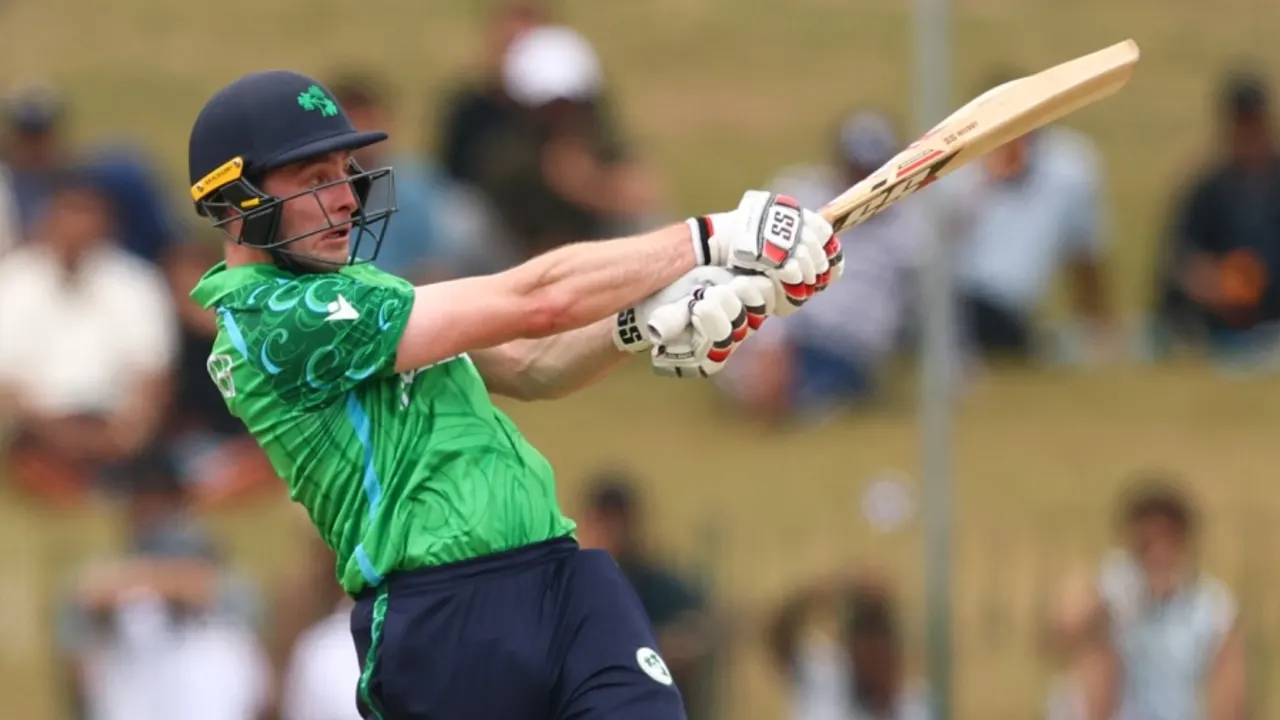
Ireland muscled the highest score of the 2026 T20 World Cup en route to a dominating win over Oman in Group C to keep their Super Eights hopes alive, at least mathematically.
Lorcan Tucker, standing in for the injured Paul Stirling, muscled 94 not out as Ireland walloped 235 for 5. They hammered eight sixes in the last three overs alone – more than Oman had in the tournament until then – and the last five overs produced 93 runs.
In response, Oman were bowled out for 139 with two overs left unused, the innings characterised by a rush of wickets following an early turbocharge from 44-year-old Aamir Kaleem, who muscled 50 off 29 balls.
Playing his first game of the competition, left-arm spinner Shakeel Ahmed struck thrice in the powerplay to leave Ireland in trouble at 45 for 3 after five overs. Each of the three wickets had a different skill at play: Tim Tector was dismissed with an arm-ball, Ross Adair was beaten in flight as he skied one to mid-off, and Harry Tector was bowled, done in by dip and turn.
There was more trouble for Ireland as Kaleem, also a left-arm spinner, struck to remove Curtis Campher in the eighth over. Two balls later, he should have had Tucker on 18, but for a missed stumping by Vinayak Shukla. Deceived in flight, Tucker seemed to have been stumped down leg, but third umpire Ahsan Raza deemed Shukla to have broken the bails with the hand in which he didn’t have the ball. Replays, though, seemed to indicate both gloves were in contact with each other. Had it been given, Ireland would have been 65 for 5.
For the first 14 overs, Oman’s mantra was pace off. And that meant Tucker had to adjust to a slow surface. Out went the agricultural heaves, out came the scoops and paddles. Tucker and Gareth Delany raised their half-century stand off just 33 deliveries, with Tucker getting to his half-century first with a ferocious sweep behind square off Kaleem. This was only the second half-century by an Irish captain, after Andy Balbirnie, in a men’s T20 World Cup.
With their spin options exhausted by 14 overs, Oman turned to their seam options in a bid to restrict Ireland. This is when Delany chose to leave his imprint on the game, muscling Jiten Ramanandi for two sixes off his first two deliveries in an 18-run over. Then he went after Faisal Shah, flat-batting a six off a slower-length ball to raise a 28-ball half-century. That was to be the start of the carnage that saw Ireland muscle 93 off the last five overs.
Tucker began the 18th over on 60 and ended it on 86 as he took apart Mohammad Nadeem with three sixes and two fours. Suddenly, a first century by an Irish batter at a men’s T20 World Cup loomed, but George Dockrell’s cameo – 35 not out off nine – provided the perfect finish. Ireland had smashed an incredible 156 off their last ten overs.
Jatinder Singh fell for his third low score, while Ashish Odedara, playing his first game, was run out taking a casual stroll. After two ordinary outings, Kaleem showed what he is capable of in a sensational powerplay take-down, reminiscent of his half-century against India at last year’s Asia Cup. When he got to a half-century, off just 28 deliveries, he became the oldest half-centurion in men’s T20 World Cup history. At 97 for 2 in the 11th over, Oman were well on track.
Then from 107 for 3, they slumped to 108 for 5 before Josh Little, the left-arm seamer, picked up the wickets of Ramanandi and Nadeem Khan to inflict further damage. By then, it looked increasingly likely Oman wouldn’t even bat their overs. And they didn’t, the margin of defeat of 96 runs, much bigger than it seemed when Kaleem set them up in the first half.
Brief scores:
Ireland 235 for 5 in 20 overs (Ross Adair 14, Harry Tector 14, Lorcan Tucker 94*, Curtis Campher 12, Gareth Delany 56, George Dockrell 35*; Shakeel 3-33) beat Oman 139 in 18 overs (Aamir Kaleem 50, Hammad Mirza 46, Sufiyan Mehmood 10; Mathew Humphreys 2-27, Barry McCarthy 2-32, Josh Little 3-16, George Dockrell 1-06) by 96 runs
[Cricinfo]

Two days out from a will-they-won’t-they India vs Pakistan contest, the weather in Colombo has largely been clear. But the Sri Lanka Department of Meteorology has warned of a low-pressure system developing in the Bay of Bengal, which indicates a high risk of rain that could disrupt the marquee World Cup game on Sunday evening.
The weather forecast for Sunday in the Khettarama area of Colombo, where the R Premadasa Stadium is located, shows warm and humid conditions to start the day, with temperatures peaking around 30° to 31°C. However, scattered thunderstorms are predicted throughout the afternoon, with a 50-70% chance of rain.
With the game set to begin at 7pm local time, some models suggest heavy thundershowers in the hours before the scheduled start, which might lead to a delayed toss, or a shortened game. While clouds are expected to linger, some forecasts indicate a slight clearing trend after 8pm, though isolated showers remain possible through the night.
The Premadasa, however, features a sophisticated drainage system and specialised ground staff protocols designed to handle Colombo’s tropical downpours. And unlike many international venues that only cover the pitch, the Premadasa has enough covers to protect the entire playing area. This prevents the outfield from soaking up water in the first place.
The staff also manually push water from one cover to the next until it reaches the perimeter drains. This method is often faster and more effective than using mechanical super soppers. Under standard conditions, the ground typically becomes fit for play within 45 to 60 minutes after heavy rain stops.
There’s also some rain expected the day before, on Saturday, which could disrupt India’s scheduled training session at the ground.
The weather in Colombo has otherwise been largely dry, making any rain unseasonal for this time of the year. So far, none of the matches in Sri Lanka of this T20 World Cup has been impacted by inclement weather, even though there have been a few close calls – such as Sri Lanka’s match against Oman, where rain was predicted but fell hours after the match ended.
Both India and Pakistan, meanwhile, currently have four points each after playing two games. But India are ahead in Group A due to a superior net run rate of 3.050 to Pakistan’s 0.932. If rain in Colombo forces a washout, both sides will get one point each as there is no reserve day for group-stage matches.
[Cricinfo]
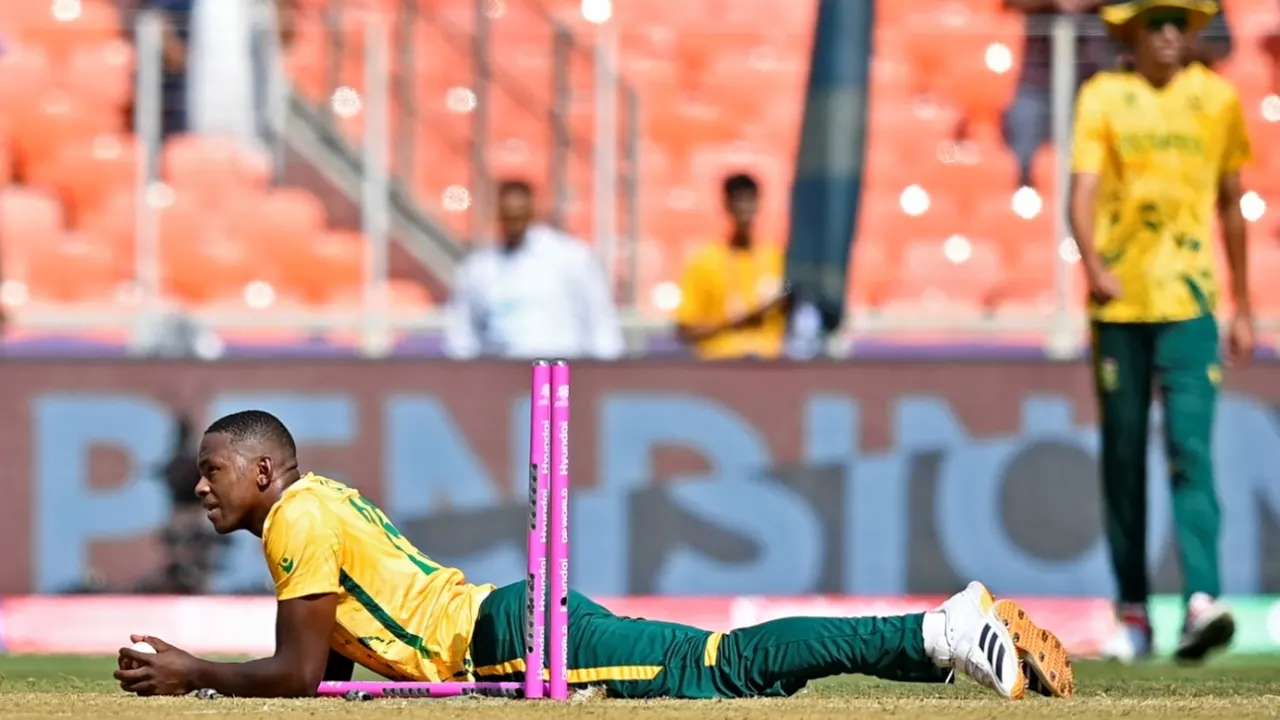
Wednesday afternoon’s all-time classic in Ahmedabad was a game of inches. A couple of inches this way or that, and Saturday night’s game, at the same venue, could have had a whole lot more riding on it.
But as things stand, New Zealand and South Africa look set for safe passage out of Group D and into the Super Eights, leaving Afghanistan bemoaning fate and small margins, and praying for miracles from UAE and Canada – or is probably unlikely to cut it.
There’s no mystery about which of the Super Eights groups New Zealand and South Africa will end up in either. Pre-tournament seedings already decided that.
So this game, which could have been one of the tastiest clashes of the tournament, pitting two title contenders and featuring several tactical sub-plots, doesn’t really have much riding on it at all.
It could still turn out to be one of the games of the tournament, of course, because that can happen when you put two T20 teams of elite power and skill on the field together. But the title of this section, big picture? There isn’t much of it at all.
He is one of South Africa’s greatest cricketers of all time, but is Kagiso Rabada under some pressure to hold his place in their first XI in T20Is? He has the pace and skills to operate in any phase, but he has had an indifferent time in T20Is of late. Rabada averages 34.55 with the ball since 2025, with an economy rate of 9.82. But in his defence, he has only played nine T20Is in this time, thanks to injury and workload management. The chaotic 20th over against Afghanistan, during which Rabada overstepped twice, shouldn’t put his spot in danger. But he’ll want to pick himself up and remind the world of the impact he can make at his best.
Rachin Ravindra looks like he could be the archetypal modern-day T20 No. 3, but his international record in the format is… not good, with a strike rate of 135.19, an average of 19.09, and just three half-centuries in 40 innings. All that doesn’t take away from Ravindra’s potential – which he has shown in flashes in recent weeks, in a pair of cameos against India – and he could make a big difference on Saturday if he and his fellow left-handers in New Zealand’s line-up could get stuck into Keshav Maharaj’s left-arm spin.
New Zealand played the same XI against both Afghanistan and UAE, and they seem unlikely to make any changes unless a used pitch prompts them to pick an extra spinner in Ish Sodhi.
New Zealand (probable): Tim Seifert (wk), Finn Allen, Rachin Ravindra, Glenn Phillips, Daryl Mitchell, Mark Chapman, Mitchell Santner (capt), James Neesham, Matt Henry, Lockie Ferguson, Jacob Duffy
South Africa replaced seam-bowling allrounder Corbin Bosch with spin-bowling allrounder George Linde when they played Afghanistan. They might, however, worry about having two left-arm fingerspinners in Linde and Maharaj against a New Zealand side with four left-hand batters in their likely top eight. Bosch, therefore, could come back in.
South Africa (probable): Aiden Markram (capt), Quinton de Kock (wk), Ryan Rickelton, Dewald Brevis, David Miller, Tristan Stubbs, Marco Jansen, Corbin Bosch/George Linde, Kagiso Rabada, Keshav Maharaj, Lungi Ngidi
[Cricinfo]

Tucker 94* headlines Ireland’s thrashing of Oman

High risk of rain in marquee India vs Pakistan T20 World Cup game in Colombo

New Zealand and South Africa look ahead to Super Eights in low-pressure contest

Teacher recruitment examinations will be conducted in accordance with the relevant court decisions – PM

Low-pressure area is likely to form over the southeastern Bay of Bengal around 15th February

Kolkata the stage as England, Scotland resume auld rivalry

‘Dates have the highest sugar content to fight Coronavirus’

Sunday Island 27 December – Headlines

#SundayIsland 17th December – Headlines

Sunday Island – 28th March

Sunday Island Headlines – 21 March

Sunday Island – 21st February – Headlines
-

 Features6 days ago
My experience in turning around the Merchant Bank of Sri Lanka (MBSL) – Episode 3
-

 Business6 days ago
Remotely conducted Business Forum in Paris attracts reputed French companies
-
 Business6 days ago
Four runs, a thousand dreams: How a small-town school bowled its way into the record books
-

 Business6 days ago
ComBank and Hayleys Mobility redefine sustainable mobility with flexible leasing solutions
-

 Business3 days ago
Autodoc 360 relocates to reinforce commitment to premium auto care
-

 Midweek Review3 days ago
A question of national pride
-
 Opinion2 days ago
Will computers ever be intelligent?
-

 Midweek Review3 days ago
Theatre and Anthropocentrism in the age of Climate Emergency