
Features
Two well-known Sinhala classical poems translated into English

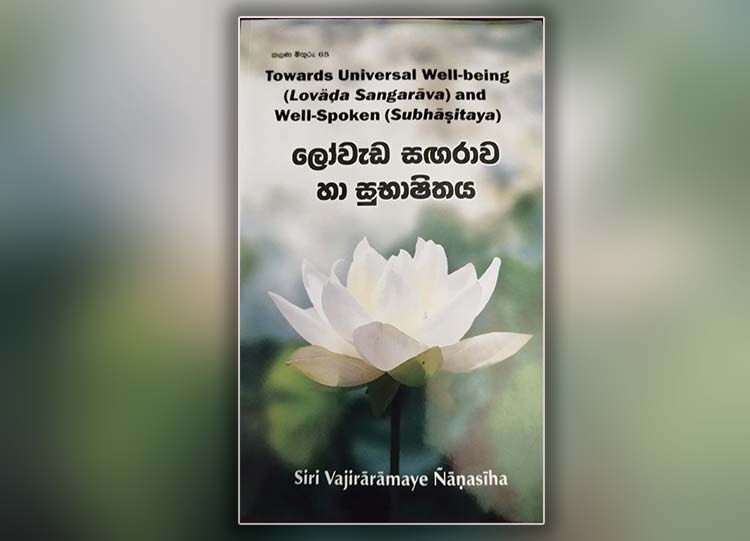
 The poems, termed didactic – Lovada Sangarava and Subhasitaya – have been translated as Towards Universal Well-being and Well Spoken respectively, and published as a second edition by the Buddhist Publication Society Kandy, in 2023 (Buddhist era 2567). The translator is Ven Siri Vajiraramaye Nanasiha Thera. The very clear print text runs through 90 pages with the verses from the ancient text in Sinhala letters and the translation in bold English script, well-spaced and easy on the reading eye.
Embarrassed, I admit, I am not familiar with the two great classics of our Sinhala literature but have been reading them, along with easy-to-understand English translations, in the book I feel privileged to write about.
Unlike many Buddhists I did not study these two sets of poems as a school goer when classics are usually ‘done’ in classes and greatly appreciated. I was in a Christian missionary school when the medium of instruction and language of conversation was English. In three years of Kindergarten and then Standards Two to Five, we sang hymns and had Bible stories narrated. In Forms 1 and 2 we started on the Bible but then CWW Kannangara’s education reforms were introduced and we Buddhists, Hindus and Muslims had time-tabled periods of ‘moral teaching’; while the others had Christianity classes. Also, Sinhala texts that swayed towards Buddhism were not included in such school curricula. We certainly missed out on classics such as Lovada Sangarava and Subhasitaya. Thus my gratitude to Ven Nanasiha for gifting me copy of his excellent translation, with the verses in Sinhala too.
Authorship of the two Sinhala Classics
The 140 verses of the Lovada Sangarava were written by Ven Vidagama Maitreya Maha Thera, during the reign of Parakramabahu VI of the Kotte period (1410-1468 CE). The meaning of the title of the poems is Compendium (of Poems) for Universal Well-being. As Ven Nanasiha points out in his Introduction, these poems were not for the erudite but for those who were not able to read and understand books on Buddhism in Pali. “The purpose was to wean them from unwholesome deeds and to urge them to do wholesome actions that would be beneficial to them in their lives here and hereafter, … also to evoke deep saddha or confidence in the Buddha, Dhamma and Sangha.” I well remember at my grandmother’s ancestral home a learned old man would sit and chant from Buddhist texts of an evening, while family and servants and nearby villagers listened intently. Remember how Silindu was deeply affected by such a recitation while on pilgrimage to Kataragama in Leonard Wolfe’s Village in the Jungle. It was a custom for a guru to chant aloud suttas etc when illiteracy was common.
The Subhasitaya, the translator says, may be rendered as “The Well Spoken” in English. Its 100 verses were composed by Alagiyawanna Mukavetti (1552-circa 1625), who was a scholar of repute and versatile in Pali, Sanskrit, and Tamil too. In his verses, (the exact date of writing not being known exactly), he reacts against conversion and asks why persons forsake the sublime religion – Buddhism. However he converted to Roman Catholism and was known as Alagiyavanna Mohottala and served under the Portuguese. “The Subhasitaya deals with matters relatively more worldly, … good worthy men (sudana) and low, unworthy men (dudana). They are compared and the consequences of associating with them described in detail.”
The term didactic is used to classify these two ancient collections. Its definition: “intended to teach, particularly in having moral instructions as an ulterior motive” proves the point made in classifying the two collections as didactic, more so the first collection.
Ven. Nanasiha writes in his Introduction to the first collection of verses: “The message is to make the best use of being born a human… They echo the last exhortation of the Buddha to all his disciples. The world is fragile. Exert heedlessly and put an end to those conditions that make one continue in the cycle of birth, decay and death; i.e. samsara.”
How the translation and publication happened
It started in 1993. Ven Nansiha, then civil servant Deshabandu Olcott Gunasekera, was invited by the SL Broadcasting Corporation to translate into English the verses of Lovada Sangarava and to read them after each verse in the original Sinhala was sung by a female guest artiste. This was in March. A couple of months later he was invited by SLBC to do the same with Subhasitaya.
He consulted his sisters – Sudharma Pandita and Sujata Dias – both highly qualified educationists whom he says were lodestars in his life. To his surprise he found Sujata had translated the classic and she handed him a hand-written manuscript which he used as the base of his translation, making much easier his task. He thus shares the magnitude of this translation with his second sister and others he consulted. Very fortuitously, in a conversation with the Most Ven Tirukunamale Ananda Mahanayake Thera, he mentioned his translations for SLBC. To continue the fortuitousness, the Mahanayake Thera queried; “Why don’t you get them printed?” With donations received, the printing was done by Ruwan Paharuva Press in 2017.
That was the first edition. The second, six years later, which I write about, was somewhat due to comments received by his sister Sudharma from Sahityarathna Dr Lakshmi de Silva, of the Department of English at Kelaniya University and also a renowned translator, critic, writer and winner of many awards. She went through the English translation meticulously and edited. Most Ven Tirikunamale Ananda Mahanayake Thera himself undertook to edit and proof read the Sinhala verses.
“My wish was to ensure that the second edition reaches a wider circle.” Consequent to discussion with the Mahanayake Thera, The Buddhist Publication Society, Kandy, was selected as publisher. As a layman, Ven Nansiha had close contact with this Society inaugurated in 1957 under the supervision of Ven Nyanaponika Maha Thera; at one time having Bhikkhu Bodhi as its editor. BPS accepted the book readily for publication. And thus the benefit to so very many of us having in one slim volume the verses of these two classics of more than 500 years vintage in Sinhala and English.
Ven Nanasiha mentions in his introduction to the volume I write about, that the verses are currently relevant, both to individuals and societies. He thinks particularly of Sri Lankan children living in foreign countries who could and should read our classical writings. His publication is particularly suited in content matter and style to young minds. Conscious as we all are of the present day political situation in this country, in the context of corruption, other evils and elections taking place, what he says in the sentence I quote from his Introduction cannot be over-emphasised. “These verses are good measures to evaluate good governance even in the 21st century.”
When I wrote to Ven Siri Vajiraramaye Nanasiha Thera for permission to make more people aware of his latest publication, he replied: “As the translations are an end product that is not completely mine but edited by an erudite person of very high calibre and commended by a Venerable Mahanayake, I wish the book is popularized among Dhamma School students so they are motivated or enthused to live upright lives, … How is it possible to make those gems of words and wise ideas contribute to a better world order? How make these classics a part of modern society? If you can contribute towards that popularization of the two classics, I shall be happy and contented that something has been achieved for the greater good of humanity.”
As columnist, I can only hope people will read this article and have themselves and their younger family members read the book. It is available on sale priced Rs 375/-, at outlets of BPS in Colombo – one of which is the bookshop in the Sri Sambuddhatva Jayanthi Mandiraya along Havelock Rd. I can assure you BPS is excellent in its posting of books when ordered from its Kandy headquarters.




by Kapila Chinthaka Premarathne
Head of the Department of Agricultural Systems and a Senior Lecturer in Agricultural Economics at the Faculty of Agriculture,
Rajarata University of Sri Lanka
Beyond the Graduate Unemployment Number
Sri Lanka’s economic recovery has improved macroeconomic stability, but youth unemployment remains a significant labour-market concern. Around 43% of Sri Lankan youth aged 15–24 with postsecondary education are unemployed, the highest among the Asian economies compared in the IMF analysis, compared with about 36% in Bangladesh and 13.2% in Thailand. This reflects a problem of skills mismatches and the difficulty of connecting higher education with changing labour-market demand. The concern goes beyond unemployment itself. Sri Lanka has invested heavily in educating its younger population, yet the conventional labour market is not creating enough opportunities to convert these qualifications into income. Many young people possess degrees, technical knowledge and growing digital familiarity, but remain outside formal employment because suitable jobs may not exist in the right place, at the right time or under conditions compatible with their circumstances. This makes it necessary to think beyond traditional employment models and explore new ways of connecting Sri Lanka’s educated youth with economic opportunities.
This is where Sri Lanka needs to reconsider how it understands employment
Employment has traditionally been viewed through the employer–employee relationship, with qualifications leading to a formal job and regular salary. While this model remains important, digital platforms are creating new ways to generate income, allowing individuals to work for multiple clients across geographical boundaries without permanent employment. Sri Lanka therefore needs to look beyond simply creating conventional jobs and consider whether it is building the conditions for its educated population to participate in the growing global market for digital services.
The Opportunity of the Gig Economy
The gig economy extends far beyond ride-hailing and delivery services. Digital platforms increasingly connect skilled individuals with opportunities in software development, design, accounting, data analysis, digital marketing, translation, online education, research and consultancy. This is particularly relevant to Sri Lanka, where a highly educated population faces a relatively limited domestic market for specialised skills. Digital platforms can overcome geographical constraints by connecting Sri Lankan workers directly with international clients.
As highlighted in my previous LSE South Asia article on women and the gig economy, such work should not replace formal employment but can create additional income opportunities when supported by appropriate skills, digital infrastructure, training and institutional support. A skilled person in Anuradhapura, Jaffna, Batticaloa or Monaragala could potentially serve clients in London, Melbourne or Dubai without first relocating to Colombo. This makes the gig economy relevant not only to employment but also to Sri Lanka’s emerging digital services-export strategy.
A Digitally Familiar Generation
Sri Lanka’s younger generation is growing up with smartphones, social media, online learning, digital applications and digital financial services, giving them a level of digital familiarity that previous generations did not have. However, digital familiarity does not automatically translate into digital employability. The challenge is to transform everyday digital use into productive skills such as data analysis, artificial intelligence, software development, digital marketing, financial analysis and online professional services.
Sri Lanka therefore needs to move young people from being consumers of digital services to producers of digital value. Universities, vocational institutions and training providers can play an important role in converting existing digital familiarity into marketable skills that connect young people with both domestic and international opportunities. This is increasingly important as technological change and AI reshape labour markets and intensify the need for skills that match emerging forms of work.
The Gender Dimension
The gig economy may be particularly relevant to women, who often face barriers to conventional employment arising from childcare, eldercare, mobility, social expectations and rigid working arrangements. For mothers and women living outside major urban centres, fixed working hours and daily commuting can make formal employment difficult even when suitable jobs exist.
Digital gig work can provide greater flexibility, allowing women to undertake professional assignments from home or their communities and potentially serve international clients without relocating. As discussed in my earlier LSE South Asia article, this opportunity is most meaningful when supported by digital infrastructure, skills training, virtual work hubs, mentorship and appropriate institutional support. However, flexibility should expand women’s economic choices rather than simply add paid work to existing unpaid household responsibilities.
Pressure on Labour-Market Opportunity
The value of a job cannot be judged by salary alone, as commuting, working hours and household responsibilities can significantly affect its real economic value. Flexible digital work can potentially reduce some of these costs by allowing people to work from home or nearby digital hubs and participate in employment on a part-time or project basis. While gig work cannot solve all household pressures, a more flexible organisation of work can create additional employment opportunities while helping households manage their limited time and resources more effectively.
A Possible Third Option Between Unemployment and Migration
Sri Lanka’s migration and brain-drain concerns highlight the need to explore employment opportunities beyond the domestic labour market. While overseas migration will remain an important individual and economic choice, digital work can provide another pathway by allowing skilled Sri Lankans to serve international clients without physically leaving the country. Software developers, designers, analysts, researchers, translators and consultants can potentially earn from global markets while remaining in Sri Lanka. Digital gig work cannot eliminate migration or reverse brain drain, but it can create an additional option between domestic unemployment and physical migration—working for the world while remaining in Sri Lanka.
Recognising and Making Digital Work Reputable
A major institutional gap is that conventional systems are designed around salaried employment, while a freelancer may earn from multiple clients without a single employer or salary certificate. This can make legitimate digital workers difficult to recognise when they seek loans, leasing, insurance or business finance. Sri Lanka could address this through a voluntary digital-worker or independent-professional registration mechanism, providing a recognised economic identity based on qualifications, verified skills, platform activity and documented income, without creating unnecessary bureaucracy.
Such recognition should also make digital income bankable. Banks could assess verified platform earnings, bank transactions, contracts, invoices, tax records, savings and repayment history alongside conventional employment documents. A standardised digital income statement could further help workers demonstrate their financial capacity. The key shift is from asking “Who is your employer?” to asking “Can your income be verified and is it sufficiently stable?”. This would allow successful digital workers to build financial credibility and use their earnings to access credit, acquire assets and develop their own businesses.
Digital Payments Are Part of the Labour Market
Access to reliable international payment systems is essential if Sri Lankans are to participate effectively in the global digital economy. Recent developments in PayPal’s local banking arrangements, including its partnerships with Sampath Bank and Commercial Bank, indicate progress in this direction. However, the broader priority should be a regulated and efficient digital-payment ecosystem that allows workers to receive international earnings, transfer them to Sri Lankan bank accounts, document their income and meet relevant financial and tax requirements with minimal friction. International payment infrastructure is therefore not simply a technology issue; it is an essential component of Sri Lanka’s emerging services-export economy.
Building Infrastructure Outside Colombo
Digital familiarity alone is insufficient without reliable internet, electricity, computers, software and suitable working environments, particularly in rural and underserved areas. To ensure that the gig economy supports regional development rather than becoming another Colombo-centred opportunity, Sri Lanka could establish regional digital-work hubs through universities, vocational institutions, libraries and public-private partnerships. These hubs could provide connectivity, equipment, training, mentoring and assistance with platform registration and international payments. If graduates must migrate to Colombo simply to access such infrastructure, the geographical advantage of digital work is significantly reduced.
From Freelancer to Entrepreneur
Gig work should not be viewed as an end in itself. A person may begin with small online assignments, develop regular clients and professional credibility, and eventually establish a small digital enterprise. This creates a potential pathway from graduate to freelancer, professional service provider and entrepreneur, allowing individuals to create markets around their own skills rather than waiting for conventional vacancies. Universities can support this transition by teaching students not only subject knowledge but also portfolio development, market identification, client communication, digital platforms and contract management. A degree demonstrates educational attainment, while a professional portfolio demonstrates what a graduate can offer to the market.
Facilitation Must Be Matched by Protection
Promoting the gig economy without appropriate safeguards could simply transfer employment risks from institutions to individuals. Digital workers may face uncertain incomes, weak bargaining power and limited social protection. Sri Lanka should therefore facilitate digital work while also ensuring opportunities for independent workers to build savings, access insurance and participate in portable social-protection mechanisms. Flexibility should create greater economic choice without compromising long-term financial security, particularly for women.
A regional Example from India: Think Globally and act Locally
India provides a useful regional example of how the gig economy can be approached as a policy issue rather than simply as informal or temporary work. NITI Aayog has estimated the size and future employment potential of India’s gig and platform economy and has developed recommendations covering employment generation, skills, financial inclusion and social protection. More importantly, India has begun creating institutional mechanisms around these workers. Its e-Shram portal provides a national database of unorganised workers, including gig and platform workers, creating a recognised identity through which workers can potentially access employment, skills development and social-security services. India has also explored platform-led skills development through skill certificates, skill passports and on-the-job training, while NITI Aayog has proposed cash-flow-based lending models that could allow platform workers to demonstrate creditworthiness through their earnings rather than conventional employment or collateral.
Social protection has also entered the policy framework. India’s Code on Social Security, 2020 formally recognises gig and platform workers and provides a basis for schemes covering areas such as accident insurance, health, maternity, disability and old-age protection. India is still developing and refining these arrangements, and Sri Lanka need not replicate the Indian model.
However, the experience demonstrates an important policy lesson: the gig economy can be supported through a system that identifies workers, develops their skills, makes their income more visible to financial institutions and extends appropriate social protection. Sri Lanka could develop its own simpler framework suited to its smaller economy, beginning with recognising digital workers and building the institutional conditions that allow their skills and earnings to become part of the formal economy.
Rethinking Employment and the Next Opportunity
The 43 percent figure for educated young Sri Lankans should encourage a wider discussion about the changing nature of work. Sri Lanka will continue to need conventional employment through firms, industries, farms, professional organisations and public institutions, but the changing labour market also requires new opportunities to connect educated Sri Lankans with global digital markets. The gig economy can provide an additional pathway to increase female labour-force participation, reduce the pressure for migration and brain drain, and connect Sri Lankan skills with markets beyond geographical boundaries.
This does not require a complicated bureaucracy. It requires recognising legitimate digital workers, facilitating access to international platforms and payment systems, allowing verified digital income to support credit assessment, developing portable social protection, and strengthening digital infrastructure and skills beyond major urban centres. Better data on digital workers would also help policymakers develop evidence-based interventions.
The future of work is therefore not only about creating more jobs, but about creating more ways for Sri Lankans to work, earn and build livelihoods while continuing to live and contribute in Sri Lanka. The gig economy should be recognised as part of an emerging digital labour market and services-export economy, where workers can build professional identities, earn internationally, access finance and eventually develop their own enterprises.

by Dr Upul Wijayawardhana
We are living in an era of astonishingly rapid scientific advancement. From the time Apple launched the ‘iPhone’ in January 2007, the first targeting the mass market, smartphones have taken over the world, making them indispensable. According to the latest statistics, there are around 8.1 billion mobile phones with 7.4 billion active smartphones, for the world population of 8.25 billion. Except for a tiny minority of the very poor, most people have at least one smartphone.
We are now entering the era of Artificial Intelligence (AI) and smart robots. Recently, a ‘Chinese’ robot ran 100 metres faster than Usain Bolt! Though Alan Turing proposed the idea of ‘Thinking Machines’ way back in 1950, the real AI boom commenced with the release of the generative AI chatbot, ChatGPT, by OpenAI in November 2020. Number of technology firms in the US as well as in China have joined the race, China catching up very fast, quite unexpectedly. There is a frenzy at the moment, raising expectations, as the imminent floating of these companies is likely to value the two leaders, OpenAI and Anthropic, trillion dollars each!
However, trouble is brewing in the AI field. On top of the concerns raised by environmentalists regarding the huge power drain by AI centres, there are recent reports of some AI models hacking independently into other systems, without human input. Worse still, a senior researcher at Anthropic, who has previously worked for OpenAI as well, resigned in early September on ethical grounds stating that the way the two companies are fast-tracking AI poses an existential threat to humanity. Surprisingly, instead of a rebuttal the head of Anthropic supported his view, soon joined by three more heads of leading AI developers. Whilst they agreed on slowing progress, President Trump has claimed that slowing is totally unnecessary as long as a super intelligent President like himself is at the helm! There does not seem to be an end to Trump’s grandiosity! He was joined by Tony Blair. In contrast, King Charles held a summit with representatives of all AI developers to find a way AI could be developed without a threat to humanity. That is how wise leaders act!
Less sophisticated AI tools are already in widespread use and installed in computers, laptops and smartphones. Some of us are using these automatically. However, the more advanced AI tools like ChatGPT can change even reality. For instance, AI can generate videos hardly distinguishable from real ones. What you enjoy watching on YouTube may be just the creations of AI! Some people use AI to write articles; only a few of them admit that they do so. Very soon we may be reading stories AI creates and listening to music, courtesy of AI. Technology seems to be fast becoming the new religion? Or, will the existential threat move us more towards religion?
Religion, perhaps, is as old as humanity itself; various belief systems evolving and disappearing coupled with the fortunes of the associated civilizations. Just like AI, religion is also a creation of the human mind which our ancestors did to explain many phenomena which appeared, at that time, to be supernatural. Starting with Animism, perceiving the divine in the natural world around, humans went on to Polytheism, believing in many gods like in Hinduism, culminating in the concept of Monotheism.
World’s oldest religion, Hinduism, still in wide practice, is devoid of a founder or a single text. The earliest scriptures, Rigveda, is considered to be around 3,500 years old but archaeologists have discovered symbols of importance to Hinduism as far back as 7,000 BCE. Though it is considered to be Polytheistic, it can be argued that it was the precursor of Monotheism, the concept of a creator God, as Brahma was the creator in the triad, Trimurti, Vishnu being the preserver and Shiva being the destroyer. It seems to be a sensible balancing act; create, destroy and repair with improvements.
It is pretty obvious that as science expands, the importance of religion contracts but it is hardly likely religions would be totally redundant. We have no choice as to which family we are born to and that invariably determines what your religion would be, if any. Religion is the first brainwashing a child encounters and most remain in the same faith, often trying to defend even the indefensible, but some change through conviction or conversion due to one of many reasons. Further, religious rituals have social values and religious practices often come to one’s solace at times of distress. Therefore, many will continue with the religion they were born to but with declining enthusiasm, at times. However, some religions seem to be facing problems like falling attendances in places of worship. With education and tech savviness expanding, one would expect the youth to be less enthusiastic about religion but the converse is true in some religions, some youth becoming very militant unfortunately.
While most religions make you subservient to a supernatural power, the Buddha was wise and bold enough to remove those shackles. He proclaimed that one’s destiny is in one’s own hands. However, many Buddhists appear to attach greater significance to rituals than to practising the Dhamma.
Buddhism as a religion may become less relevant as the frontiers of science expands but the Buddha Dhamma, especially Abhidhamma and Vipassana, would receive increasing recognition, the Buddha remaining an authority on consciousness and the mind.
Scientific progress should be for the betterment of society but AI developers are taking huge risks, taking massive loans threatening the world economy, for one aim: profit! Some do not seem to care even if their actions pose an existential threat to humanity.
Perhaps, if the Four Sublime Attitudes (Sathara Brahma Vihara) expounded by the Buddha; loving kindness (Metta), compassion (Karuna), empathetic joy (Muditha) and equanimity (Upekkha) are adopted as universal values, the world would become a safer place to live in, with or without AI.

Tales of Mystery and Suspense 21
by Prof. Rajiva Wijesinha
Another book that is part of a series, today—one that is fun without the brooding concentration on criminality in different forms that marks the Rebus novels. This one about the Thursday Murder Club, is a romp as its two predecessors were interspersed with deaths and what might be deaths.
The Bullet that Missed
begins with a meeting with the presenter of ‘South East Tonight’, a programme about the area, in which Coopers Chase is situated. The meeting is held because the club has decided to look into the murder of the producer’s assistant, Bethany Waites, whose car was found at the bottom of a cliff ten years ago. There was blood in it, but the body was never found.
Or, rather, the book begins with an account of Bethany Waites deciding, on the night she vanished, to meet someone in connection with a case of massive fraud that she had been investigating, after sending the producer, Mike Waghorn, a message that she had found new evidence though he had no idea what it was. The night she died, she sent him another message: “I don’t say this often enough, but thank you.”
CCTV cameras showed her leaving her place, but then the vehicle vanished, before being sighted near the cliff, with two people in it. Investigation of the fraud had led to the imprisonment of a woman, Heather Garbutt, though it proved impossible to pin anything on Jack Mason, the mastermind for whom she had worked.
The Club conducts investigations on several fronts, including through Connie Johnson, the drug dealer they had helped imprison in the earlier book. The psychiatrist Ibrahim, the most respectable member of the Club, interviews her in an attempt to get her to find out more from Heather, who is in the same prison as she. They also investigate the CCTV record of the night Bethany vanished, and deduce that she went to an apartment block and exited from its other side, and that is why she was not seen leaving the town. But some time had elapsed between her being seen in the town and then on the cliff.
Meanwhile, Elizabeth has been kidnapped, along with her husband, and taken to a house in Staffordshire, where she is told by a man called the Viking that she must kill a former KGB agent now in London, who has a profitable career in money laundering. The Viking tells her he will inform Viktor that she was responsible for stealing the diamonds, the story of which is told in the previous Murder Club Mystery, and Viktor will then kill her.
Elizabeth, who has an affair with Viktor, knows he will not kill her, but when the Viking says he will also send Viktor a picture of Joyce, she decides she must act, and goes to see Viktor, and fires when she gets him in the bathroom. But, of course, she fired into the ceiling, and Viktor is then taken to Coopers Chase, to stay with Joyce until they have dealt with the Viking. And Viktor then enjoys the camaraderie of the retirement home so much that he wonders whether he too should settle there.
Elizabeth does trace the Viking, or rather her husband does, for he has noticed rare books on the shelves in his library, and an antiquarian book dealer friend managed to find out who bought them. But before they could confront him, he comes to Coopers Chase, for he has seen the bullet hole in the bathroom of Viktor’s flat and realized he was fooled.
But he cannot bring himself to kill Joyce straight away, and she knocks him out with a drug in a cup of tea. When he meets Viktor, they both decide to fall in with the plans of the Club.
Before this, Heather has been found dead in her cell, with a note saying that ‘they’ were going to kill her, and only Connie could help. Before that she had admitted that she was frightened to name the man behind the fraud. Jack Mason said the same, after Ron had won his confidence. The Club had deduced by then that the body was buried in the garden of Heather’s house which Jack had bought, after she had been jailed, and digging reveals a gun and money, but no body. Jack tells them that the mastermind had said that Bethany was buried with a bullet with his DNA on it.
The Club is now working with the Chief Constable of Kent, Andrew Everton, who writes thrillers himself, but in the form of e-books. He is in search of a publisher, and delighted when Mike Waghorn puts him on his programme, as is Donna, who is substituted at the last minute for Chris.
The Club finds out whom Bethany visited in the apartment block—Mike’s assistant Pauline, who tells them later what she and Bethany had been doing. But this is after the man behind the fraud has been unmasked up in the house in Staffordshire, where he was trying to hire the Viking and Viktor to find the money that he had stashed away, using accounts that he could no longer trace. He has also confessed to murdering Bethany, hoping this will persuade the two money launderers to help him, but it turns out that he did not do this. Nor did he kill Heather, the incriminating note having been placed in her room by Connie, who decided that Heather’s suicide should be treated as murder so that the person who had been blackmailing her should be found out.
It was Jack Mason’s murder that was brought home to the crook. It turns out that Bethany, her appearance altered by Pauline, has vanished, to a new life in Dubai, where she has taken control of the missing millions. She has gone there because the threat, she received through the bullet she was looking at in the preamble, was to Mike and she wanted him out of danger.
Yet another whimsical conclusion to a whimsical book with enough loose ends left hanging for another sequel.

Lalit Rajbanshi, Kushal Bhurtel set up Nepal’s opening win

‘Vision’ Programme Marks Two Years

Costa Rica minister fired for unapproved meeting with Trump in US

At least 41 die as boat capsizes in DRC’s Lake Tanganyika

Showers will occur at times in the Western, Sabaragamuwa, Southern, Central and North-western provinces

Sajith vows to scrap 22A under future govt.

‘Dates have the highest sugar content to fight Coronavirus’

Sunday Island 27 December – Headlines

#SundayIsland 17th December – Headlines

Sunday Island – 28th March

Sunday Island Headlines – 21 March

Sunday Island – 21st February – Headlines
-

 News7 days ago
Shanakiyan urges urgent action over reported death sentence for Lankan in Saudi Arabia
-

 News6 days ago
Namal Rajapaksa Buddhist gambit fails, bail denied
-

 Features6 days ago
Why the spelling Sri Lankan names in English vary
-

 Features6 days ago
Three bands, a new identity: Sri Lankan wolf snake recognised as distinct species
-

 Business6 days ago
SLIIT holds largest-ever convocation
-

 News6 days ago
Vehicle prices drop by up to Rs. 1 mn, says importers’ body
-

 News6 days ago
Govt monitors reported Saudi death sentence – Foreign Ministry
-

 Business6 days ago
All-new Bolero MaXX Pik-Up unveiled in Lanka