
Features
Twenty-five years of private sector-led renewable energy development

by Dr Tilak Siyambalapitiya
A policy change in 1995 to allow private investments in electricity generation into the grid, a standard agreement and a standard price for electricity produced, enabled such investments to pick-up faster than in other countries. The first mini-hydro power project with entirely private sector funding and private ownership commenced operations in May 1996.
The agreement and the price
Dubbed the “most investor friendly agreement in the world”, Sri Lanka’s renewable energy developers were offered, since 1996, a non-negotiable 15-year agreement (20-years for projects signed after 2008). The agreement says, literally, “I will buy all your electricity produced for the next 15 years, any day any time; I will not penalize you for delays in your project or for not producing electricity at all or producing less electricity than you promised; I will not ask you to start or stop your power plant”. There is no other agreement in the business world 25 years ago or now, where such agreements are offered to a seller.
Then the price. The agreement carries a price, which too is not negotiable. It says: “I will pay you a price that reflects the fuel saved in major power plants; in case fuel prices go down, I will not drop the price below 90% of the price when you signed; if the fuel prices go up, I will keep on increasing the prices without any limit”.
I shall buy all your all your product at the following price for 20 years. If you do not produce too, even when I need it badly, I will only greet you with a smile !
Government procurements have to be on competitive basis. This policy of competition was further reinforced by the Electricity Act 2009, required to be implemented by the Public Utilities Commission (PUCSL). The legal validity of such renewable energy agreements and price offers, that make a mockery of rules of “competition”, has been debated in many quarters over the past 25 years.
Has it been good ?
Well, yes and no, depending on whom you speak to and your convictions. To the credit of the program, Sri Lanka’s renewable energy development accelerated after 1996. These are smaller power plants using hydropower, wind, wood and more recently, waste. If the government attempted to develop them through a state entity, excessive overheads and inefficiency would most likely creep-in. There would have been a politically appointed Chairman and a fleet of vehicles going up and down, to run a tiny minihydro.
On the other hand, had the state rigidly controlled what is developed and where, renewable energy projects developed would have been more efficient, well-engineered and certainly more environment friendly. Stories are many, where a private mini-hydro project agreed with the Central Environmental Authority to release water for downstream users, but later blocked it 100%. As the saying goes, “Sri Lanka’s streams and rivers are now flowing in tubes”, but we are proud about a vibrant renewable energy industry !
Renewable energy from such smaller private investments reached 1% of total in year 2000 and 4% by 2006. Buoyed by another policy change in 2007 that offered a contract for 20 years and an even more attractive prices, renewable energy from small power plants raced toward a 10% policy target for 2015. It reached the target indeed, with 11% of electricity produced in 2015 from the combined production in 147 minihydros, 15 wind and 3 each of grown biomass, wood waste and solar parks. Unlike many countries who make headlines by stating their renewable energy contribution in megawatt, Sri Lanka’s targets and achievement are stated in kilowatthour, honestly reflecting the true benefits to save fuel and to reduce emissions.
Continuing its race for development, by 2020 (provisional figures) electricity produced from smaller private renewable energy power plants reached 12%. Adding major hydros, the energy share from all renewable energy was 37% by 2020, a share unmatched by all countries and expatriate Sri Lankans that preach Sri Lanka on how to develop renewable energy.
Has the price been good to the investor?
The policy of paying renewable energy projects signed over 1996-2016 was to pay the value of fuel saved in the grid, calculated and published in advance every year. Agreements signed after 2007 enjoy an even more attractive pricing formula: a technology-specific, cost-reflective price. That means minihydros are paid a price to make that a profitable investment; wind power is paid to make that technology, a profitable investment.
Once signed, price paid does not change. If costs go up or down after signing, or bank interest rates go up or down, the price remains the same. Fortunately for all who signed in 2008-2009 or later, equipment costs and bank interest rates both have been on a downward trend. Projects that borrowed at 18% in 2018 possibly borrowed at 8% this year, but still enjoy the price paid calculated at 18% interest. By way of equipment costs, solar power has seen the deepest reduction in costs. More on that later.
What was the benefit to the public?
Why did the government offer such attractive rates and terms to private investors? Sri Lanka did not throw Rs 10 at renewable energy investors and say “do it if you can”. The key principle in the pricing policy was: price paid makes investments profitable (not just profitable but excessively profitable). The agreement still remains the “most investor friendly agreement” in the world.
In other words, the public of this country, through their electricity bills and through taxes, have paid for the investments, bank interest, and profits (above market rates), to make privately-owned renewable energy an excessively profitable venture. Other benefits of renewable energy need not be repeated here; they are all well known. So what is the benefit to the public who fully paid (and continue to pay) for these investments, of which the ownership is private?
It should be the longer-term benefit of cheaper renewable energy. That’s why the 2008 announcement on the revised policy said as follows: “Renewable energy, which is a natural resource, belongs to the State. Developers are provided with a high tariff to cover their expenses and to earn reasonable profits for an adequately long period (in this case the first fifteen years). Thereafter, the benefit of the resource should flow to the electricity customers, while continuing to provide an operating fee to the small power producers and full recovery of maintenance costs”.
The closest example is the CEB-owned fleet of hydropower plants, which are bigger. The familiar ones are Laxapana, Kotmale and Victoria, among a total of 15 power plants. The public of the country paid for those too, starting from 1950. How? Through electricity bills (because loans and government investments were apportioned between CEB and Mahaweli Authority), taxes and benefits foregone. The major hydros today produce at a cost of Rs 3.35 per unit of electricity. True, that except for Upper Kotmale, all are 20 years or more of age. The fleet of minihydros, too, as they mature into their contracts, after 15 years of good profits to investors, should deliver benefits to electricity customers. That’s why the 2008 announcement said: Therefore, once the developers’ costs and profits are paid, it is inevitable that in the long-term, renewable energy should flow into the national grid at prices significantly lower than the cost of thermal energy.
However, information published indicates that the principles on which small power producers were enabled in 1996 and then enhanced in 2008, are indeed being followed. CEB produces electricity from mature hydros at Rs 3.35 per unit (PUCSL assessment 2019). The price for mature hydropower in the private sector was Rs 5.38 per unit (CEB publication 2019), precisely following the principle of fairness: good profits to investor for 15 years, benefits to electricity customer in the longer term.
As more and more minihydros mature, later wind, biomass and solar projects mature, we should be seeing finally, that ALL renewables produce electricity at prices very significantly lower than all the alternatives. Renewables replace thermal power and we should be paid the same price, will not be an argument, now or then, or in the future. “My power plant is not so good, it does not have water, is not an argument”, because no one defined where to build the minihydro; the investor selected it.
The argument that private renewables can produce below the price of oil, gas or coal does not hold, then, now or in the future. Renewables were allowed because fossil fuels were expensive and bad. The price of fossil fuels comprise royalties, production and delivery costs. If one needs a comparison, royalties for renewables have to be paid to the “republic” (the treasury) and production costs paid by electricity customers. Since royalties are not charged for renewables, both CEB and private, then renewable energy prices should be compared only with production costs. The investment has already been fully paid by the republic.
I conclude with a quotation from the 2008 announcement: “Small power producers opting not to migrate to the new agreement by 30th April 2008, will be offered the tier 3 tariff announced for the relevant technology in the year in which the existing agreement expires, after its full tenure of 15 years is completed”. That means, retiring minihydros should be offered prices in the range of Rs 6 per unit.
It is yet to be seen whether the PUCSL and consumer rights groups are willing to fully and comprehensively understand the issue, step-in, and ensure that “renewable energy belongs to the republic”, as stated in the Sri Lanka Sustainable Energy Authority Act 2007.
The country’s streams are now flowing in tubes, but do benefits flow to the public who have fully paid the investors with profits?


by Prof. C. A. Saliya
 Over the past four weeks, this column has taken you to a casino floor on the Colombo waterfront, a card game under an awning, a trading app glowing in a teenager’s bedroom, and a racecourse where the numbers on the board are quietly rigged in the house’s favour before the horses even reach the starting gate. Four completely different worlds. Four completely different sets of laws governing them. And, underneath every single one, the exact same machine.
It’s worth stating that machine plainly, one final time, because it’s the thread that has run through this entire series: every form of gambling we’ve examined has a built-in mathematical edge that belongs to the operator, not the player. Every one of them puts real effort into making that edge feel invisible, by calling itself a sport, a tradition, an investment, or simply harmless fun. And every one of them has a shadow version, an informal or offshore tier, that exists specifically to serve the customers the legal, licensed version either can’t reach or won’t touch.
Once you see that pattern, you can’t really unsee it. A casino’s house edge, a bookmaker’s overround, a trading platform’s spread, and the quiet certainty that whoever’s running the neighbourhood’s illegal numbers game isn’t doing it as a charity, they’re all the same idea, wearing different clothes.
Sri Lanka’s moment of choice
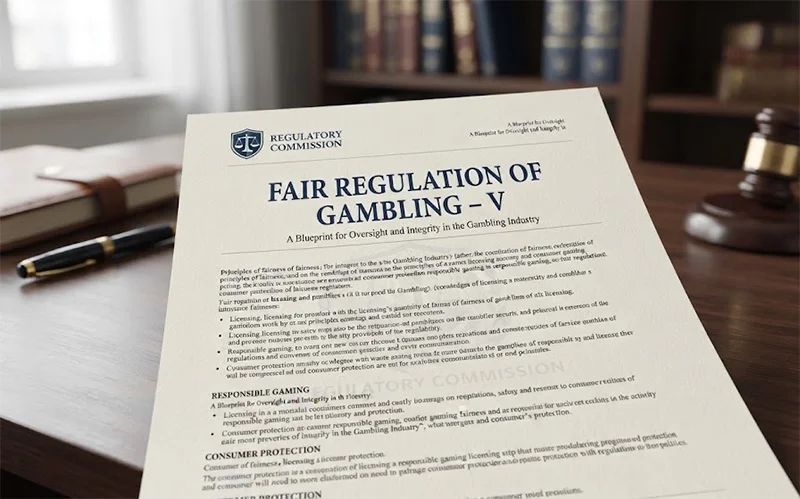
Which brings us to the reason this series exists right now, rather than five years ago or five years from now: Sri Lanka is in the middle of the biggest overhaul of its gambling laws in more than a century. A new Bill, gazetted under President Anura Kumara Dissanayake, would scrap three separate, ageing pieces of legislation, the ordinances covering horse racing, general gambling, and casinos, the oldest dating back to 1889, and replace them with a single Gambling Regulatory Authority responsible for the entire industry, from a Colombo casino table to an online betting app.
That’s a genuinely significant moment, and it deserves to be judged fairly, against the three failures we’ve traced through this series rather than against vague hopes or fears. So, let’s do that, one at a time.
Does it close the gap between licensed gambling and everyone else’s gambling? Almost certainly not, and, as we argued in Part 2, it probably shouldn’t try. A modern regulator built to license casinos and tax betting operators has no realistic way of prosecuting a card game at a funeral house. That gap between “gambling the wealthy do” and “gambling everyone else does” is older than the Republic itself, and one new law was never going to close it. The more honest question for policymakers isn’t how to stamp out Buruwa, it’s whether the country should keep spending any enforcement energy at all pretending it might, when that energy could go toward the tier of the industry that actually causes measurable financial harm.
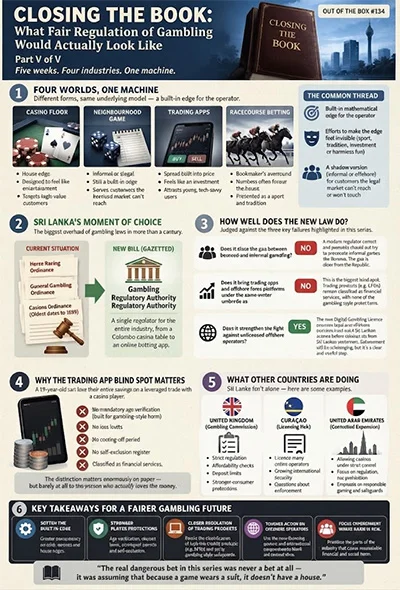 Does it bring trading apps and offshore forex platforms under the same protective umbrella as gambling? No, and this is the new law’s single biggest blind spot, exactly as we laid out in Part 3. A 19-year-old can lose their entire savings to a leveraged CFD trade with none of the protections that would apply if they’d lost the same money at a licensed casino table: no mandatory age verification built for gambling-style harm, no loss limits, no cooling-off period, no self-exclusion register. The new Gambling Regulatory Authority, as currently designed, has no jurisdiction over any of it, because these products are still classified as financial services rather than gambling, a distinction that matters enormously on paper and barely at all to the person who actually loses the money.
Does it strengthen the fight against unlicensed offshore operators? Here, genuine credit is due. The new law’s Digital Gambling License, requiring both local and offshore online operators to hold a Sri Lankan licence before taking bets from Sri Lankan customers, is a real and overdue step, arguably the single most useful thing in the entire Bill. Whether it can actually be enforced against operators sitting on servers in another country, outside Sri Lankan jurisdiction, is a separate and much harder question. But as a statement of intent, it’s the clearest sign yet that the government understands where the real money, and the real modern risk, has moved to.
What the rest of the world is trying
Sri Lanka isn’t figuring any of this out alone, and it’s worth glancing at how others are handling the same puzzle. Britain’s Gambling Commission is one of the world’s most established regulators, and it is currently under real political pressure over gambling advertising and whether operators do enough to check that customers can actually afford their losses, a reminder that even a mature, well-resourced regulator never really finishes the job. Curaçao, a small Caribbean territory, built its reputation on issuing gambling licences fast and cheap, which sounds appealing until you realise it’s also a cautionary tale about what happens when a “race to the bottom” on licensing standards leaves consumers with almost no real protection at all. And the United Arab Emirates offers the opposite lesson: a country that spent decades as one of the strictest gambling-ban states in the world, now in the process of building a licensed casino and betting industry from scratch, precisely because its leaders concluded that a controlled, visible industry was easier to manage, and tax, than an invisible one they could never fully suppress anyway.
Sri Lanka’s new law sits somewhere between those examples: more ambitious than Curaçao’s light-touch approach, less mature than Britain’s decades-old framework, and facing the same fundamental question the UAE has just decided for itself, is it better to chase an activity underground, or bring it into the light where it can at least be taxed, measured, and, where necessary, restrained?
What no law can fix
It’s worth being honest about the limits of regulation, too, because this series has tried throughout not to oversell what any single law can achieve. No Gambling Regulatory Authority, however well designed, is going to stop a family playing Buruwa at a funeral house, and it probably shouldn’t try to. Some forms of gambling are so deeply woven into ordinary social life that treating them as a policing problem wastes effort that would be far better spent where the actual harm is concentrated: online, on trading apps, at unlicensed operators reaching people through their phones at two in the morning, far from any awning or family gathering.
A closing word, not a closing bet
If there’s one thing worth taking away from five weeks of this column, it isn’t a tip for the next race, or a warning to delete your trading app, though there’s a case for both. It’s simply this: understanding how the house edge works, in a casino, at a card table, on a trading screen, or at the bookmaker’s window, doesn’t make you better at winning. Nothing does, reliably, over the long run; that’s what “house edge” means. What it does is make you a harder person to fool, which, in an industry built almost entirely on making its edge feel invisible, might be the only real advantage a player ever gets.
The most dangerous bet in this entire series was never really a bet at all. It was assuming that because a game wears a suit, or a silk shirt, or a family blessing, it doesn’t have a house. It always does. The only real choice any of us has is whether we walk in with our eyes open.
This concludes our five-part Out of the Box series on the business of gambling. If you or someone you know is struggling with gambling-related harm, please seek support from a qualified counsellor or helpline in your area.
(Prof. C. A. Saliya, is a charted accountant, academic, researcher and former banker. He is the author of SAMAJA GAVESHAKAYA and Springer Publication DOING SOCIAL RESEARCH. He can be contacted at saliya.ca@gmail.com. The views expressed in this article are his own and do not necessarily represent those of the organisations with which he is affiliated.)

 by Sasanka Perera
(The writer is on X as @sasmester)
The frenzied online actions of thousands of Sri Lankans responding to the Canadian actress, Maitreyi Ramakrishnan, calling herself an Eelam Tamil and opting not to identify herself with Sri Lanka has gone viral. Many of these were ‘Sinhalas’ from the country and the diaspora. An equal number of people spoke in support of the actress too, most being diasporic and local Tamils. Much of the latter was driven by a sense of online-Eelam nationalism. The liberal-woke types from Lanka claimed the Canadian actress as our own despite Ramakrishnan having made it very clear she does not want to be identified as such. The first two of these expressions are clear examples of ways in which nationalism should not manifest, usually as a divisive and exclusionary force. The liberal third expression is simply silly, irrelevant and sad. This said, I have never considered nationalism as useless or dangerous if it can be intelligently and inclusively fashioned to serve the nation. This is very different from my friends in the Sri Lankan Left, who have generally rejected all forms of nationalism.
However, one must be mindful that across the globe nationalism has long walked a dangerous tightrope. Too often, its supporters in different countries have defined the nation through an exclusionary lens, drawing narrow circles around who ‘truly’ belongs and pushing minority communities to the periphery. Two very dangerous ongoing manifestations are epitomised by the virulent US and Israeli nationalisms espoused by Donald Trump and Benjamin Netanyahu. Consequences of their toxic rhetoric have gone beyond their national borders to impact the entire world. In Sri Lanka, this global malaise has found a localised anchoring as exemplified by the online explosion of competing ethnic nationalisms referred to at the beginning of this essay.
For decades, dominant political narratives have cast nationalism mostly in majoritarian and ethno-cultural and religious terms, overtly or subtly privileging the Sinhala identity. In doing so, this version has mostly alienated Tamil, Muslim, Burgher, and other communities, transforming a concept that should have ideally unified the people of the nation into a wedge that drives them apart. These other communities also have on their own come up with similarly competitive, exclusionary and at times, virulent forms of ethnoreligious natalisms.
But this is not how Sri Lankan nationalism emerged, at least among the elites, in the early years prior to independence. It was far more inclusive and inclusionary than we can fathom today. Compounding the present exclusionary trend is a more cynical phenomenon. That is the weaponization of identity by woefully unethical political interests. In the hands of many political parties and at present, among the fractured and irrelevant political opposition, nationalism in Sri Lanka has been reduced to crude, emotional rhetoric. Or to put it more clearly, it has been turned into a tool of convenience hauled out during election cycles or in times of existential political crisis to secure votes and support through divisive and chauvinistic mobilization. This phenomenon is clearly visible among Sinhala, Tamil and Muslim-dominated political parties.
This brand of nationalism is both offensive and counterproductive, even though many nationalisms in the world today work precisely like this. Such a negative, virulent and exclusionary nationalism only offers hollow slogans while failing to address the fundamental socio-economic realities and existential crises reaching across international borders that ordinary citizens must face regardless of whether they speak Sinhala or Tamil. It thrives on stoking fear rather than building state capacity or national pride.
To break this cycle, Sri Lanka must self-consciously move toward an inclusive civic nationalism. In my mind, this reimagined identity must necessarily encompass all Sri Lankans across ethnic, linguistic, and religious boundaries. This is the kind of nationalism that did exist among the elites prior to independence and also reemerged decisively during the public protests of the aragalaya. But I am unsure of its continuity, although it is clear the present government has not offered any ammunition to build a divisive and exclusionary nationalism within the country as in the past. Such inclusive civic nationalism however, does not manifest in the government’s dealings with other nations where the more dominant streak is an unfathomable sense of servility.
Crucially, this new civic nationalism must operate purely on behalf of the sovereign state and its national interest, refusing to use ethnicity or religion as filters for patriotism. It should also be a driver for our national interest when dealing with other countries –– big or small. When a citizen contributes to the economy, pays taxes, or defends the rule of law, their right to the nation is absolute. True nationalism respects diversity not as a concession, but as the very bedrock of the nation’s strength.
An inclusive nationalism, however, is not merely a domestic moral imperative; it is a geopolitical necessity as well. In an era where small nations are increasingly caught in the crosshairs of great power competition, Sri Lanka cannot afford to be internally fractured.
We have seen ample evidence of how external pressures can sideline our interests — whether through lopsided economic leverage, geopolitical arm-twisting, or diplomatic overreach by regional and global powers like India and China. Particularly this international dimension of nationalism has not seriously been discussed in Sri Lanka and it is hardly an integral part in our negotiations with other nations.
There has been continuous diplomatic pressure and policy lobbying, driven by long-term Indian security and political interests, to construct a physical road and rail link along with power and energy connections between India and Sri Lanka. While Indian proponents and their many Sri Lankan cohorts pitch this purely through an economic lens of trade and tourism, many Sri Lankans view it with deep apprehension. But this apprehension is hardly articulated in any sensible way in any sensible forum including in national politics. It is almost a whisper, albeit a widespread one. Beyond environmental vulnerabilities in the fragile Palk Strait ecosystem, there is a legitimate fear that an open land corridor would strip away Sri Lanka’s natural island strategic defence as well as its identity itself. It risks opening up the country to asymmetric socio-political pressures more than it endures at present, potential demographic and migration imbalances, and tighter economic subjugation by its massive neighbor, effectively transforming Sri Lanka into an easily accessible periphery of the Indian mainland. Besides, a physical link is not an absolute necessity for connectivity.
The Chinese situation is no different. Over the past two decades, aggressive infrastructure financing by Chinese state-owned banks have led Sri Lanka into high-cost commercial debt, culminating in the 2022 economic collapse and the infamous 99-year lease of the Hambantota Port to a Chinese joint venture. This highlights how a weak, fragmented state can be reduced to the role of a pawn in a ‘debt-trap’ or broader Indo-Pacific great power rivalry. When national leaders prioritise short-term political survival or personal patronage networks and wealth accumulation over national interest, critical sovereign assets are compromised, turning parts of Sri Lankan territory into strategic flashpoints for foreign powers. This has already happened in Sri Lanka.
An inclusive Sri Lankan nationalism ensures that decisions on sovereignty and borders as well as the value of national economic assets are evaluated from the standpoint of all citizens and only in the national interest –– not forced through by a locally powerful government with a compliant international relations outlook susceptible to external lobbying. A unified nation can objectively weigh economic connectivity against strategic vulnerability without internal or regional factions weaponizing the issue for sectarian advantage.
In my mind, an inclusive, civic nationalism establishes a firm, non-negotiable doctrine: no foreign power, whether Eastern or Western, regional or global, is permitted to compromise Sri Lanka’s territorial integrity or economic sovereignty. It ensures the country’s national interest and long-term survival are carefully aligned to the economic independence of the nation, ensuring that future governments maintain transparency, resist predatory lending, and treat national assets as sacred public trusts rather than bargaining chips. This does not mean the closure of opportunities for overseas investments. Rather, it means those investments would be based on transparency, on equal grounds and with equal benefits based on similar rules and conditions as those operational in the very countries we deal with.
When a nation is internally divided along ethnic and religious lines or is submissive in the way it deals with the world, it is inherently weak, vulnerable to external manipulation, and ill-equipped to negotiate fiercely.
A unified, inclusive Sri Lanka, backed by a nationalism rooted in collective strength and an inclusive sense of national pride rather than narrow exclusion, can stand its ground. Only then can we speak with one voice to defend our sovereignty, protect our economic assets, and chart an independent course in the Indian Ocean and the world.
by Jehan Perera
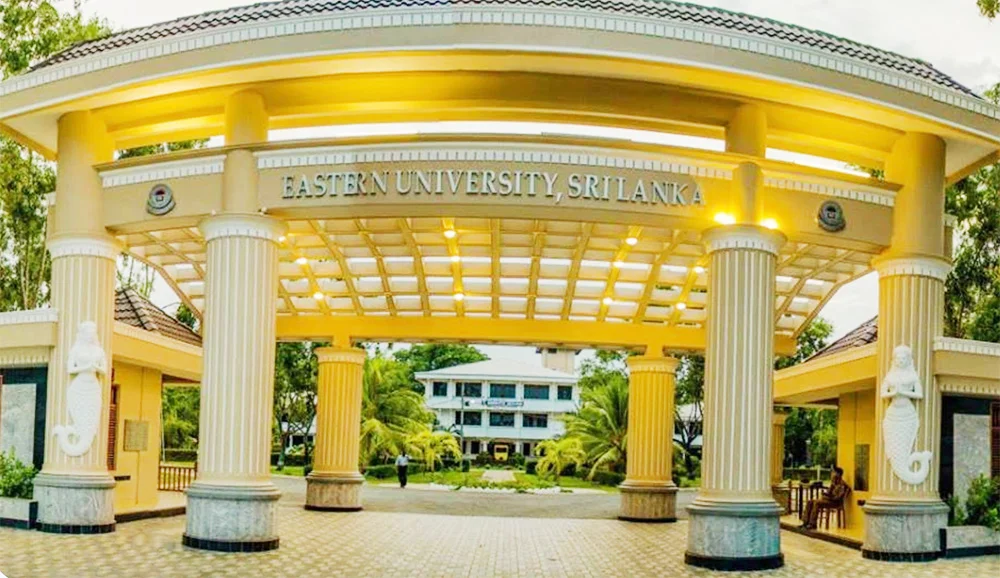
There is an important change in the way peace is being understood in Sri Lanka. The notion that peacebuilding is not simply the responsibility of governments, politicians and peace organisations, but is also a responsibility of educational institutions, appears to be permeating the consciousness of at least a section of the academic community. This was visible on International Peace Day at an event held at Eastern University by the Faculty of Health-Care Sciences. The event was unusual not least because the medical and nursing faculty of the university had decided that peacebuilding was relevant to its academic and professional responsibilities.
Peacebuilding has too often been treated as something undertaken after conflict, when the fighting has stopped and the immediate task is to rebuild relationships between communities. But peace cannot be sustained by governments and peace organisations alone. If it is to become long lasting, the values and practices of peace have to become part of the institutions through which a society educates its younger generations. Universities and other educational institutions are therefore important to peacebuilding. They are among the places where the foundations of a culture of peace can either be built or neglected.
The experience of the Faculty of Health-Care Sciences at Eastern University provides a practical example of what this can mean. Led by its Dean, Prof Thillainathan Sathaananthan, the faculty organised an event which went beyond the ordinary academic scope of a medical faculty. University academics are experts in writing project proposals and applying for research grants. On this occasion, the members of the Faculty of Health-Care Sciences used those skills to apply for a UNESCO grant that they won to conduct an International Peace Day event. The significance lies less in the Rs 200,000 grant than in the decision to use the university’s institutional capacity and resources to invest in peacebuilding. The event at Eastern University needs to be understood as more than a successful university programme. It represents a possible paradigm shift in peace thinking.
Institutional Commitment
The Peace Day event obtained the support of the university administration, including Vice Chancellor Prof P Peratheepan, and reached out to secondary schools in the vicinity to mobilise their attendance. The event itself was meticulously organised. There were cultural items including traditional and modern dance and song in the three languages, performed by combinations of solo, duet and multiple singers, dancers and actors drawn in part from nearby secondary schools. There was a panel discussion by senior academics on the general theme of peacebuilding and how to prepare for it. A discussion among the students followed, where each student spoke on behalf of a religion that was not theirs. This is significant because peacebuilding cannot remain an idea discussed by specialists at conferences. It has to become part of the way institutions educate and prepare people for life in a plural society.
The Faculty of Health-Care Sciences at Eastern University has provided a model through its Peace Medicine course modules that were introduced to the curricular as a compulsory core course over 10 years ago. Two senior academics, Dr Kuveriel Eliyas Karunakaran and Dr Thillainathan Sathaananthan, have written a book on “Peace Medicine- A Health Care Concern” that was published five years ago. Its Peace Medicine Module integrates principles of medical ethics, compassion, equity, social justice and community engagement into health education and practice. In his introduction, former Vice Chancellor of Eastern University, Prof T Jayasingam noted “This book is an introduction to a theme which had already been operating in the Faculty of Health Care Sciences as a course.”
Doctors, nurses and health workers know better than anyone the harm that war and violence does. They are the people who treat the wounds and trauma that violence leaves behind. In a hospital, a patient is not asked what their religion or ethnicity is before they are treated. Health care is one of the places where peace is practised every day. The Faculty has therefore found a way of connecting its professional responsibilities with the wider social responsibility of peacebuilding. The question is whether this experience can be replicated throughout the country, at universities and at other educational institutions, so that peacebuilding becomes part of the consciousness of education itself. If that happens on a sufficient scale, it can begin to generate a culture of peace that becomes increasingly difficult to reverse.
Local Action
The Eastern University event corresponded closely to the United Nations theme for this year’s International Day of Peace, “Invest in Peace – For Everyone, Everywhere, Every Day”, which honours the “everyday architects of peace”, people driving local action, laying the groundwork for stability and building lasting peace from the ground up. The emphasis on investment is important. An investment means that something is put in: time, courage and resources. There is no more violent conflict in Sri Lanka today. But the absence of war does not automatically produce a culture of peace. The factors that fed the country’s conflict have not disappeared from the world. Racism, corruption and the violation of laws and human rights are the raw materials of conflict. So too are unresolved grievances, discrimination and the failure to recognise the suffering of others.
A country that does not deal with its past does not escape it. The past can return in the next generation. This is why the experience of Eastern University needs to be replicated countrywide, both at universities and at other educational institutions. The objective should not be to turn every academic discipline into peace studies. Rather, peacebuilding needs to become part of the consciousness of education itself. Eastern University shows that a medical faculty can develop Peace Medicine. A law faculty can examine the relationship between justice, rights and peace. Faculties of education can prepare teachers to work in diverse communities, while the humanities and social sciences can examine the different narratives through which communities understand their histories. Every institution can find its own way of making peacebuilding relevant to what it teaches.
Sri Lanka has had many declarations, pledges and programmes in the past. What matters is whether these produce changes in behaviour and institutional practice. Peacebuilding requires confronting difficult issues rather than avoiding them. It requires respect for different identities, but also engagement across those identities. It requires dealing with grievances in the present while also addressing unresolved issues from the past. It requires truth, accountability, reparations and guarantees of non-recurrence. It requires people to learn that the rights of another community do not diminish their own rights. The International Peace Day event at Eastern University was evidence of a change in the way at least some academics in a part of the country deeply affected by war are thinking about their responsibilities. Peace needs to be invested in and the most important investment will be in the minds of those who will inherit the future.

What happened on diverted Flydubai flight from Dubai to Tel Aviv?

“Vishishta Seva Vibhushana” medals presented under President’s patronage

Hindu Priests Seek State Intervention for Sivarasa Anojan

“A Nation United” National Steering Committee meets under President’s Chairmanship

PM declares open 2nd Day of National AI Expo 2026

Waste management and recycling to receive priority in the 2027 Budget – PM

‘Dates have the highest sugar content to fight Coronavirus’

Sunday Island 27 December – Headlines

#SundayIsland 17th December – Headlines

Sunday Island – 28th March

Sunday Island Headlines – 21 March

Sunday Island – 21st February – Headlines
-

 Latest News7 days ago
Showers above 100 mm are likely at some places in the Western, Sabaragamuwa, Central and North-western provinces and in Galle and Matara Districts
-

 Editorial7 days ago
Crimes punished and unpunished
-

 Features6 days ago
Beyond traditional jobs: Why Sri Lanka needs to facilitate the gig economy
-

 Editorial5 days ago
Birth of a bad law
-

 News3 days ago
Police remove Thileepan statue in Jaffna
-
 Latest News6 days ago
Kusal, Wellalage star as Sri Lanka defend 322 in Headingley thriller
-

 News5 days ago
TIN mandatory for key transactions from Nov. 1
-

 News7 days ago
IMF: Sri Lanka on course for 2027 market return