
News
Turkish terror group’s links to Easter Sunday carnage under investigation

By Shamindra Ferdinando
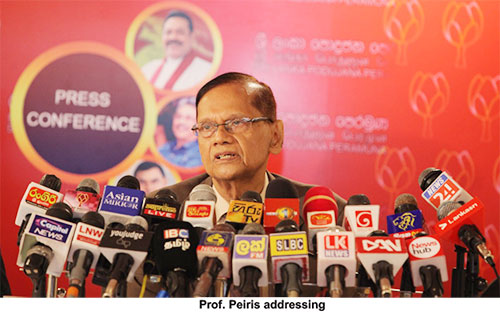
President Gotabaya Rajapaksa, in terms of the Presidential Commission of Inquiry (PCoI) report on the 2019 Easter Sunday carnage has issued specific instructions to the Police/Criminal Investigation Department (CID) and other relevant authorities to expedite investigations, SLPP Chairman Prof. G.L. Peiris said yesterday.
Addressing the regular SLPP briefing at the Waters Edge, Prof. Peiris, who is also the Education Minister said that President Gotabaya Rajapaksa intervened on behalf of the government whereas the Attorney General proceeded with own actions.
Prof. Peiris said that the entire set of PCoI volumes was handed over to the AG recently to enable him to proceed. The SLPP Chairman emphasized the pivotal importance in taking tangible measures to secure the arrest of those suspects living abroad.
Prof. Peiris said that as part of the overall investigations law enforcement authorities had been instructed to probe the alleged FETO (Fetullah Terrorist Organization aka the Gulen movement) links to the Easter Sunday carnage. Prof. Peiris explained that the proscribed Turkish organization had provided funding to some persons named in the report and a thorough inquiry was called into foreign involvement in the attacks.
The PCoI revealed that the previous government had turned a blind eye to information provided by Turkey regarding FETO activities in Sri Lanka. FETO leader Gulen has secured US protection.
Reiterating the government’s commitment to bring Easter Sunday perpetrators before court, Prof Peiris revealed the arrest of 99 persons in connection with the attacks and also efforts to secure the extradition of 35 others. However, the Minister didn’t explain the status of the extradition process pertaining to those 35 living overseas.
Prof Peiris said that the 36 separate investigations into various aspects of the Easter Sunday attacks had been completed. The police were directed to hand over the relevant files without delay, the minister said.
Appreciating the services rendered by the PCoI, Minister Peiris said that specific information hitherto not available were now with authorities and quite useful in the investigations.
The former top law academic also discussed the Wanathavilluwa detection made by the CID in the run up to the Easter Sunday attacks. Making reference to three wounded persons in custody, Prof. Peiris said that the police were directed to conduct thorough investigations into their alleged involvement.
Archbishop of Colombo Malclom Cardinal Ranjith moved Court of Appeal regarding the recovery of swords and daggers in the wake of the Easter Sunday attacks. The SLPP spokesperson said that President Gotabaya Rajapaksa issued specific instructions as regards the detection of some 1,440 swords and daggers. The academic explained the judiciary addressing the Easter Sunday issues while President Gotabaya Rajapaksa issued directives to expedite the overall process.
Prof. Peiris censured the previous government over allowing extremist elements a free hand. The minister pointed out how foreign preachers were allowed in without any scrutiny. Dismissing Opposition and civil society criticism of planned prohibition of burqa, Prof Peiris emphasized the right and the responsibility on the part of the government to take tangible measures to neutralize the threat.
Blaming the previous government for issuing visa on arrival to dangerous foreign elements, Prof Peiris explained how irresponsible and foolish conduct of the previous administration created an environment for extremists to destroy Buddha statues at Mawanella. If the government of the day properly inquired into Mawanella incidents, including the attempt to kill the then Minister Kabir Hashim’s coordinating secretary, the Easter Sunday carnage could have been averted, the minister said.
Minister Peiris also questioned the rationale in one-time Western Province Governor Azath Salley’s declaration that his community wouldn’t care about laws of the country and would abide by Muslims law. The minister said that no one would be able to take such a stand under any circumstances.
Commenting on PCoI recommendations and findings, Prof. Peiris said that 54 persons living abroad were categorized as wanted in connection with the Easter Sunday investigations. Of them, 50 had been already extradited and were under investigations whereas actions were being taken to bring down the remaining four in foreign custody.
Minister Peiris said that the government would soon request Australia to inquire into some persons who had been arrested in Qatar in Oct 2020 and subsequently sent Down Under.
According to Minister Peiris, the PCoI called for the establishment of a separate unit at the AG’s Department to handle terrorism cases, bring in amendments or introduce new laws in parliament as regards foreign funding matters, extradition and money laundering et al, setting up a National Intelligence Organization by way of a parliamentary act, restrictions on setting up of private organizations by lawmakers and special court to hear Easter Sunday case and any other case related to it.

Latest News
The National Strategic Action Plan to monitor and combat human trafficking (2026-2030) officially launched


The Prime Minister Dr. Harini Amarasuriya participated in the official launch of the National Strategic Action Plan to monitor and combat human trafficking (2026-2030) held on 28th of January at the Cinnamon Life Hotel, Colombo. The event was jointly organized by the Ministry of Defence, National Anti Human Trafficking Task Force ( NAHTTF), International Organization for Migration (IOM).
This five-year Action Plan was unveiled under the leadership of the Ministry of Defence, in its capacity as Chair of the NAHTTF and with the technical support from the International Organization for Migration (IOM). The National Strategic Action Plan 2026-2030 establishes a unified national framework to prevent human trafficking, protect and assist victims, strengthen law enforcement responses, and enhance accountability.
Addressing the event, the Prime Minister reaffirmed the Government’s commitment to strengthening national efforts to prevent and address human trafficking and stated that the Action Plan must transcend its symbolic launch into concrete, coordinated, and sustained implementation.
The Prime Minister also noted that the launch of the National Strategic Action Plan is timely, as it operationalizes the four internationally recognized pillars of the anti-trafficking framework namely prevention, protection, prosecution, and partnership.
The Prime Minister further stated,
“Caring for trafficking survivors in Sri Lanka requires a holistic, gender-sensitive, and survivor-centered approach that addresses both immediate protection and long-term recovery. This includes safe shelter, medical care, and trauma-informed psychological support, with particular attention to women and girls who experience more severe and gendered forms of violence, alongside legal assistance, economic empowerment, and skills development to prevent re-trafficking.
Human trafficking is a structural and social challenge that requires sustained, multi-sectoral action. Ministries and government agencies must embed anti-trafficking priorities into their core strategies and day-to-day operations, ensuring institutional integration and professional accountability”.
The event was attended by Parinda Ranasinghe Jnr, PC, Attorney General of the Democratic Socialist Republic of Sri Lanka, the Secretary to the Ministry of Defence and Chair of the NAHTTF, Air Vice Marshal Sampath Thuyacontha; and Kristin Parco, IOM Chief of Mission in Sri Lanka and Maldives. Members of the NAHTTF representing 23 key government entities, along with representatives of the diplomatic community, United Nations entities and Civil Society Organizations (CSOs).
(Prime Minister’s Media Division)

The International Monetary Fund (IMF) has declared that the Extended Fund Facility (EFF) wouldn’t be amended in view of the impact of Cyclone Ditwah.
The IMF delegation, at the end of its visit to Sri Lanka, informed President Anura Kumara Dissanayake of its decision during a meeting at the Presidential Secretariat yesterday (28). The IMF delegation included Director of the Asia and Pacific Department Krishna Srinivasan, Deputy Director for Asia and the Pacific Sanjaya Panth, Mission Chief Evan Papageorgiou, and Resident Representative Martha Woldemichael.
The 48-month arrangement, approved on 20 March, 2023, during Ranil Wickremesinghe’s tenure as the President, is for SDR 2.286 billion (approximately US$3 billion). In terms of the agreement, repayment of debt has to be resumed in 2028. Sri Lanka unilaterally suspended debt repayment in April 2022.
Close on the heels of Cyclone Ditwah, the main Opposition party, the Samagi Jana Balawegaya (SJB), repeatedly pressed the government to request the IMF to amend the agreement.
The Presidential Media Division ( PMD) quoted the IMF delegation as having said that the strong fiscal discipline maintained by the government over the past year had been a key factor in addressing the challenges caused by Cyclone Ditwah. They said that the government’s ability to present a supplementary estimate of Rs. 500 billion was made possible by a surplus in the Treasury.
The Government of Sri Lanka was represented by Minister of Labour and Deputy Minister of Economic Development Dr. Anil Jayantha Fernando, Secretary to the Ministry of Finance Dr. Harshana Suriyapperuma, Governor of the Central Bank Dr. Nandalal Weerasinghe, Senior Economic Adviser to the President Duminda Hulangamuwa, along with several others.
Sri Lanka’s economy has “stabilised decisively” under its International Monetary Fund (IMF)-supported programme, with growth rebounding, tax revenues doubling, and inflation sharply declining, a senior IMF official said in Colombo yesterday.
Dr. Krishna Srinivasan, Director of the IMF’s Asia and Pacific Department, delivered the assessment during a public lecture on the IMF Regional Economic Outlook: Asia and Pacific, held at the Central Bank of Sri Lanka. He was joined by Dr. Thomas Helbling, the Department’s Country Director.
Both officials commended the Asia-Pacific (APAC) region’s overall economic resilience in the face of global challenges and advocated for deeper trade and supply chain integration to mitigate vulnerabilities in international trade.
Presenting a country-focused analysis, Dr. Srinivasan outlined how Sri Lanka has performed against the five key pillars of the IMF programme:
Revenue-based fiscal consolidation, supported by tax reforms and strengthened social safety nets.
Restoring debt sustainability through fiscal adjustment and debt restructuring.
Maintaining price stability and rebuilding foreign exchange reserves.
Safeguarding external stability.
Combating corruption via a comprehensive anti-corruption reform agenda.
“Sri Lanka has come out of the crisis stabilising its economy across three dimensions,” Dr. Srinivasan stated referring to Sri Lanka’s Growth, Revenue, and Inflation. He highlighted that growth “bounced back decisively,” turning positive within six months of the programme and recently averaging about 5 percent annually.
On fiscal performance, he noted a “significant turnaround.” Tax revenue has doubled from a critically low 7.3 percent of GDP to 14.8 percent in 2025.

Dr. Krishna Srinivasan / Dr. Thomas Helbling
Furthermore, inflation has dropped “in a very convincing manner” from approximately 70 percent to the current 2-3 percent range. “One would hope that in the next few quarters, it will reach the Central Bank’s target of 5 percent,” he added.
“Overall, the IMF programme for Sri Lanka has delivered on many of its objectives,” Dr. Srinivasan concluded. “There is still a long way to go in terms of securing strong, sustained, balanced growth, but the program is off to a very good start. All of you, the authorities, and the people of Sri Lanka need to be congratulated for the progress made so far,” he said.
In his regional remarks, Dr. Srinivasan projected that Artificial Intelligence (AI) will be a key driver of the Asian economy. He suggested that technology companies in the region would be “better served by the capital markets than from conventional banks,” pointing to a need for evolved financial ecosystems to support innovation.
The lecture underscored the IMF’s constructive outlook for Asia’s continued resilience, while emphasising structural reforms and regional cooperation as vital for future stability and growth.
By Sanath Nanayakkare

Rathnayake in Sri Lanka squad for England T20Is; Thushara, Kamindu left out

U19 World Cup: Peake ton fires Australia into the semis

The National Strategic Action Plan to monitor and combat human trafficking (2026-2030) officially launched

Seifert, Santner headline New Zealand’s massive win despite Dube’s 15-ball fifty

Dry weather will prevail inmost parts of the island.

No changes to IMF agreement despite Cyclone Ditwah impact

‘Dates have the highest sugar content to fight Coronavirus’

Sunday Island 27 December – Headlines

#SundayIsland 17th December – Headlines

Sunday Island – 28th March

Sunday Island Headlines – 21 March

Sunday Island – 21st February – Headlines
-
 Business3 days ago
ComBank, UnionPay launch SplendorPlus Card for travelers to China
-
 Business4 days ago
ComBank advances ForwardTogether agenda with event on sustainable business transformation
-
 Opinion4 days ago
Conference “Microfinance and Credit Regulatory Authority Bill: Neither Here, Nor There”
-

 Opinion6 days ago
A puppet show?
-

 Opinion3 days ago
Luck knocks at your door every day
-
 Business5 days ago
Dialog Brings the ICC Men’s T20 Cricket World Cup 2026 Closer to Sri Lankans
-

 Features6 days ago
‘Building Blocks’ of early childhood education: Some reflections
-

 News4 days ago
Rising climate risks and poverty in focus at CEPA policy panel tomorrow at Open University