
Latest News
Trump’s global tariffs ‘victory’ may come at a high price

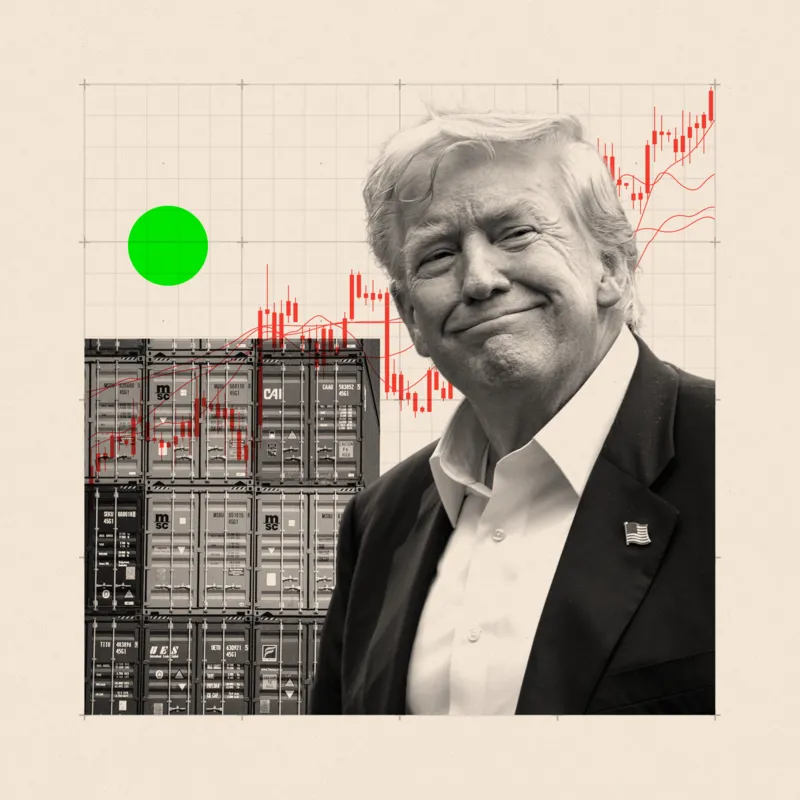
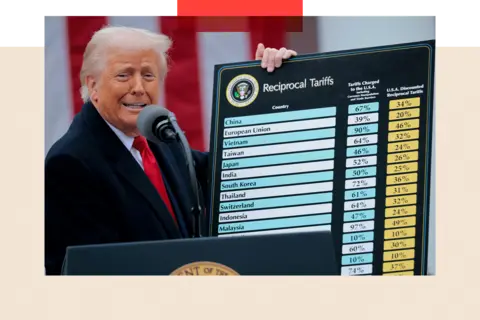
In April Donald Trump stunned the world by announcing sweeping new import tariffs – only to put most on hold amid the resulting global financial panic.
Four months later, the US president is touting what he claims are a series of victories, having unveiled a handful of deals with trading partners and unilaterally imposed tariffs on others, all without the kind of massive disruptions to the financial markets that his spring attempt triggered.
At least, so far.
Having worked to reorder America’s place in the global economy, Trump is now promising that the US will reap the benefits of new revenue, rekindle domestic manufacturing, and generate hundreds of billions of dollars in foreign investment and purchases.
Whether that turns out to be the case – and whether these actions will have negative consequences – is still very much in doubt.
What is clear so far, however, is that a tide that was gently turning on free trade, even ahead of Trump’s second term, has become a wave crashing across the globe. And while it is reshaping the economic landscape, it hasn’t left the kind of wreckage in its wake that some might have predicted – though of course there is often a lag before impact is fully seen.
What’s more, for many countries, this has all served as a wake up call – a need to remain alive to fresh alliances.
And so, whilst the short term result might be – as Trump sees it – a victory, the impact on his overarching goals is far less certain. As are the long-term repercussions, which could well pan out rather differently for Trump – or the America he leaves behind after his current term.
For all the wrong reasons, 1 August had been ringed on international policymakers’ calendars. Agree new trading terms with the US by then, they’d been warned – or face potentially ruinous tariffs.
While White House trade adviser Peter Navarro predicted “90 deals in 90 days” and Trump offered an optimistic outlook on reaching agreements, the deadline always appeared to be a tall order. And it was.
By the time the end of July rolled around, Trump had only announced about a dozen trade deals – some no more than a page or two long, without the kind of detailed provisions standard in past negotiations.
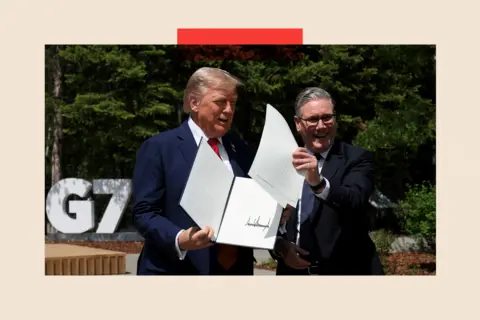
The UK was first off the blocks, perhaps inevitably. Trump’s biggest bugbear is, after all, America’s trade deficit, and trade is in broad balance when it comes to the UK.
While the baseline 10% applied to most British goods may initially have raised eyebrows, it provided a hint of what was to follow – and in the end came as a relief compared to the 15% rate applied to other trading partners such as the EU and Japan, with whom the US has larger deficits; $240bn and $70bn respectively last year alone.
And even those agreements came with strings attached. Those countries that weren’t able to commit to, say, buying more American goods, often faced higher tariffs.
South Korea, Cambodia, Pakistan – as the list grew, and tariff letters were fired off elsewhere, the bulk of American imports are now covered by either an agreement or a presidential decree concluded with a curt “thank you for your attention to this matter”.
Capacity to ‘damage’ the global economy
Much has been revealed as a result of this.
First, the good news. The wrangling of the last few months means the most painful of tariffs, and recession warnings, have been dodged.
The worst fears – in terms of tariff levels and potential economic fallout (for the US and elsewhere) – have not been realised.
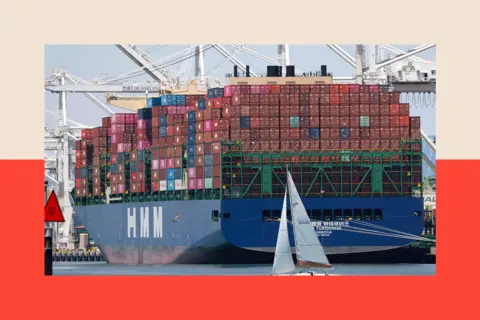
Second, the agreement of tariff terms, however unpalatable, reduced much of the uncertainty (itself wielded by Trump as a powerful economic weapon) for better – and for worse.
For better, in the sense that businesses are able to make plans, investment and hiring decisions that had been paused may now be resumed.
Most exporters know what size tariffs their goods face – and can figure out how to accommodate or pass on the cost to consumers.
That growing sense of certainty underpins a more relaxed mood in financial markets, with shares in the US notably gaining.
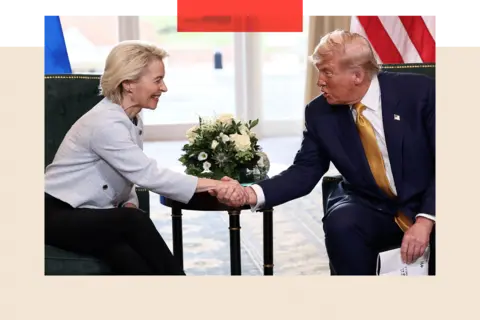
But it’s for the worse, in the sense that the typical tariff for selling into the US is higher than before – and more extreme than analysts predicted just six months ago.
Trump may have hailed the size of the agreement of the US with the EU – but these are not the tariff-busting deals we equated with tearing down trade barriers in previous decades.
The greatest fears, the warnings of potential disaster, have receded. But Ben May, Director of global macro forecasting at Oxford Economics, says that US tariffs had the capacity to “damage” the global economy in several ways.
“They are obviously raising prices in the US and squeezing household incomes,” he says, adding that the policies would also reduce demand around the world if the world’s largest economy ends up importing fewer goods.
Winners and losers: Germany, India and China
It’s not just about the size of tariff, but the scale of trading relationship with the US. So while India potentially faces tariffs of over 25% on its exports to the US, economists at Capital Economics reckon that, with US demand accounting for just 2% of that nation’s gross domestic product, the immediate impact on growth could be minor.
The news is not so good for Germany, though, where the 15% tariffs could knock more than half a percentage point off growth this year, compared to what was expected earlier in the year.
That’s due to the size of its automotive sector – unhelpful for an economy that may be teetering on the brink of recession.
Meanwhile, India became the top source of smartphones sold in the US in the last few months, after fears of what may lie in store for China prompted Apple to shift production.
On the other hand, India will be mindful that the likes of Vietnam and the Philippines – which face lower tariffs when selling to the US – may become relatively more attractive suppliers in other industries.
Across the board, however, there’s relief that the blow, at least, is likely to be less extensive than might have been. But what has been decided already points to longer-term ramifications for global trading patterns and alliances elsewhere.
And the element of jeopardy introduced into a long-established major relationship with the US, lent added momentum to the UK’s pursuit of closer ties with the EU – and getting a trade deal with India over the line.
For many countries, this has served as a wake up call – a need to remain alive to fresh alliances.
A very real political threat for Trump?
As details are nailed down, the implications for the US economy become clearer too.
Growth in the late spring there actually benefitted from a flurry of export sales, as businesses rushed to beat any higher tariffs imposed on American goods.
Economists expect that growth to lose momentum over the rest of the year.
Tariffs that have increased from an average of 2% at the beginning of the year to around 17% now have had a notable impact on US government revenue – one of the stated goals of Trump’s trade policy. Import duties have brought in more than $100bn so far this year – about 5% of US federal revenue, compared to around 2% in past years.
Treasury Secretary Scott Bessent said he expected tariff revenue this year to total about $300bn. By comparison, federal income taxes bring in around $2.5tn a year.
American shoppers remain in the front line, and have yet to see higher prices passed on in full. But as consumer goods giants such as Unilever and Adidas start to put numbers on the cost increases involved, some sticker shock, price rises, loom – potentially enough to delay Trump’s desired rate cut – and possibly a dent to consumer spending.
Forecasts are always uncertain, of course, but this represents a very real political threat for a president who promised to lower consumer prices, not take actions that would raise them.
Trump and other White House officials have floated the idea of providing rebate checks to lower-income Americans – the kinds of blue-collar voters who have fuelled the president’s political success – that would offset some of the pocketbook pain.
Such an effort could be unwieldy, and it would require congressional approval.
It’s also a tacit acknowledgment that simply boasting of new federal revenue to offset current spending and tax cuts, and holding out the prospect of future domestic job and wealth creation is politically perilous for a Republican party that will have to face voters in next year’s midterm state and congressional midterm elections.
The deals yet to be hammered out
Complicating all this is the fact that there are many countries where a deal is yet to be hammered out – most notably Canada and Taiwan.
The US administration has yet to pronounce its decisions for the pharmaceuticals and steel industry. The colossal issue of China, subject to a different deadline, remains unresolved.
Trump agreed to a negotiating extension with Mexico, another major US trading partner, on Thursday morning.
Many of the deals that have been struck have been verbal, as yet unsigned. Moreover it is uncertain if and how the strings attached to Trump’s agreements – more money to be spent purchasing American energy or invested in America – will actually be delivered on.
In some cases, foreign leaders have denied the existence of provisions touted by the president.
When it comes to assessing tariff agreements between the White House and various countries, says Mr May, the “devil is in the detail” – and the details are light.
It’s clear, however, that the world has shifted back from the brink of a ruinous trade war. Now, as nations grapple with a new set of trade barriers, Trump aims to call the shots.
But history tells us that his overarching aim – to return production and jobs to America – may meet with very limited success. And America’s long-time trading partners, like Canada and the EU, could start looking to form economic and political connections that bypass what they no longer view as a reliable economic ally.
Trump may be benefitting from the leverage afforded by America’s unique position at the centre of a global trading order that it spent more than half a century establishing. If the current tariffs trigger a foundational realignment, however, the results may not ultimately break in favour of the US.
Those questions will be answered over years, not weeks or months. In the meantime, Trump’s own voters may still have to pick up the tab – through higher prices, less choice and slower growth.
[BBC]

Latest News
Trump says US will ‘obliterate’ Iran’s power plants if Strait of Hormuz not open before 48-hour deadline

President Donald Trump says the US will “obliterate” Iranian power plants if the Strait of Hormuz is not open within 48 hours – the waterway is vital for global oil shipping.
Iran warns it will retaliate against all US-linked energy infrastructure in the Middle East if its power plants are attacked.
Trump also says he has achieved his war aims “weeks ahead of schedule”, adding: “Iran wants to make a deal. I don’t”
More than 100 people have been injured after strikes on southern Israel. The target appears to have been a nuclear facility 13km away from the city of Dimona
Meanwhile, Israel says it launched a wave of strikes on the Iranian capital. It follows an attack on Iran’s Natanz nuclear facility, Tehran says
An attempted Iranian strike on the joint UK-US base on Diego Gracia happened late on Thursday night into Friday morning, the BBC understands. Foreign Secretary Yvette Cooper says the UK won’t be drawn into wider conflict
[BBC]
Three weeks after the joint US-Israeli war against Iran began, the conflict has reached a fuzzy state of mixed messages and uncertainty, with Donald Trump’s public comments often seemingly contradicted by realities on the ground.
The war is “very complete, pretty much”, Trump has said, but new American ground forces – including a Marine expeditionary unit – are moving into the region. It is “winding down”, but US and Israeli bombing and missile strikes on Iranian targets continue unabated.
Opening the Strait of Hormuz, the geographic choke point through which 20% of the world’s oil export travels, is a “simple military manoeuvre”, but for now only Iranian-approved ships are transiting the waters.
The Iranian military is “gone”, but drones and missiles are still striking targets in the region and targets have extended as far as the joint US-UK base on Diego Garcia.
In a Friday evening Truth Social post published while he was flying from Washington to his Florida resort for the weekend, the US president provided a numbered list of American military objectives for the Iran war, which he said the US was “getting really close” to fulfilling.
The items, comprising his most detailed statement on the subject since the war began, included degrading or destroying Iran’s military, its defence infrastructure and its nuclear weapons programme, as well as protecting American allies in the region.
Not included was the goal of securing the Strait of Hormuz, which Trump said should be the responsibility of other nations that are more dependent on oil exports from the Gulf. The president has frequently noted that the US is a net exporter of energy and does not rely on oil from the Middle East – although such a view glosses over the global nature of the fossil fuel market, where price fluctuations directly impact the price at American gas pumps.
Trump’s Truth Social post also made no call for Iranian regime change. Gone are any references to approving the nation’s next leader or “unconditional surrender”, which Trump had insisted on in the early days of the war.
In Trump’s latest outline of his objectives, it is possible that the US could end its operation with Iran’s current anti-American leadership in power, its oil exports still flowing and its ability to assert some measure of control over the Strait of Hormuz intact.
If that is an unappealing resolution to a war that the president and his aides have said began with the 1979 Iran Revolution and that they would finish, there is an alternative route that involves the US ground forces presently on the way to the Middle East region.
Just over a week ago, US media reported that a Marine expeditionary unit, with about 2,500 combat soldiers and supporting ships and aircraft, had been dispatched from Japan to the Middle East, which it should reach in the coming days. Another Marine force of similar size recently departed its base in California with its arrival expected in mid-April.
Military analysts have suggested that the US could be planning to capture Kharg Island. an 3-sq-km (8-sq-mile) slice of land that contains Iran’s primary oil export terminal. Doing so could, in theory, cut off the nation’s oil shipments, depriving the nation of much-needed revenue and forcing it to make greater concessions to the Americans in exchange for an end to hostilities.
Trump on Friday said that he wasn’t sending ground troops to Iran, but added: “If I were, I certainly wouldn’t tell you”. Clarity, it seems, is not his intention.
The threat of such a move prompted Iran’s state media to report on Saturday that any attack on Kharg Island would lead Iran to cause “insecurity” in the Red Sea, another key global shipping transit point, and “set fire” to energy facilities throughout the region.
Iran’s warning underscores the dangers that would accompany a US escalation that further exposes American military forces to Iranian reprisals.
Earlier this week, US media reported that the Trump administration was preparing to ask Congress for $200bn (£150bn) in emergency funding for the ongoing Iranian military operation. Such a request would suggest that, far from winding down, the White House is preparing for a long, expensive fight.
The initial reaction from Congress, including from Trump’s Republican allies, was cautious at best.
“We’re talking about boots on the ground. We’re talking about that kind of extended activity,” said Republican Congressman Chip Roy of Texas.
“They have got a whole lot more briefing and a whole lot more explaining to do on how we’re going to pay for it, and what’s the mission here.”
The so-called “fog of war” doesn’t just cloud the thinking of military planners, it also affects the perception of politicians and the public.
The Iran war, it seems, is at a pivot. But which direction it takes from here is a puzzle.
(BBC)
Latest News
Heat Index likely to increase up to ‘Caution level’ at some places in the Western, Sabaragamuwa, Southern and North-western provinces and in Anuradhapura, Monaragala, Mannar and Vavuniya districts

Warm Weather Advisory
Issued by the Natural Hazards Early Warning Centre of the Department of Meteorology
at 3.30 p.m. on 21 March 2026, valid for 22 March 2026.
Heat index, the temperature felt on human body is likely to increase up to ‘Caution level’ at some places in the Western, Sabaragamuwa, Southern and North-western provinces and in
Anuradhapura, Monaragala, Mannar and Vavuniya districts.
The Heat Index Forecast is calculated by using relative humidity and maximum temperature and this is the condition that is felt on your body. This is not the forecast of maximum temperature. It is generated by the Department of Meteorology for the next day period and prepared by using global numerical weather prediction model data.

Effect of the heat index on human body is mentioned in the above table and it is prepared on the advice of the Ministry of Health and Indigenous Medical Services.
ACTION REQUIRED
Job sites: Stay hydrated and takes breaks in the shade as often as possible.
Indoors: Check up on the elderly and the sick.
Vehicles: Never leave children unattended.
Outdoors: Limit strenuous outdoor activities, find shade and stay hydrated.
Dress: Wear lightweight and white or light-colored clothing.
Note:
In addition, please refer to advisories issued by the Disaster Preparedness & Response Division, Ministry of Health in this regard as well. For further clarifications please contact 011-7446491.

Trump says US will ‘obliterate’ Iran’s power plants if Strait of Hormuz not open before 48-hour deadline

Showers may occur at several places in the Western, Sabaragamuwa and Southern provinces and in Nuwara-Eliya district after 1.00 pm.

PM Harini leads panel to protect public services

Sajith slams President over war conduct and economic missteps

Johnston Fernando, sons held in Lanka Sathosa lorry misuse case

Gura: The unsung hero

‘Dates have the highest sugar content to fight Coronavirus’

Sunday Island 27 December – Headlines

#SundayIsland 17th December – Headlines

Sunday Island – 28th March

Sunday Island Headlines – 21 March

Sunday Island – 21st February – Headlines
-

 Business7 days ago
Browns EV launches fast-charging BAW E7 Pro at Rs. 5.8 million
-

 News5 days ago
CIABOC questions Ex-President GR on house for CJ’s maid
-

 News6 days ago
Sri Lankan marine scientist Asha de Vos honoured at UNGA opening
-

 Features7 days ago
Achievements of the Hunduwa!
-

 News6 days ago
Australian HC debunks misleading travel risk claims for Sri Lanka
-

 Latest News6 days ago
Wednesdays declared a government holiday with effect from 18th March
-

 News4 days ago
Bailey Bridge inaugurated at Chilaw
-

 News4 days ago
Pay hike demand: CEB workers climb down from 40 % to 15–20%