
Latest News
Trump signs Thailand-Cambodia ceasefire pact at ASEAN summit in Malaysia

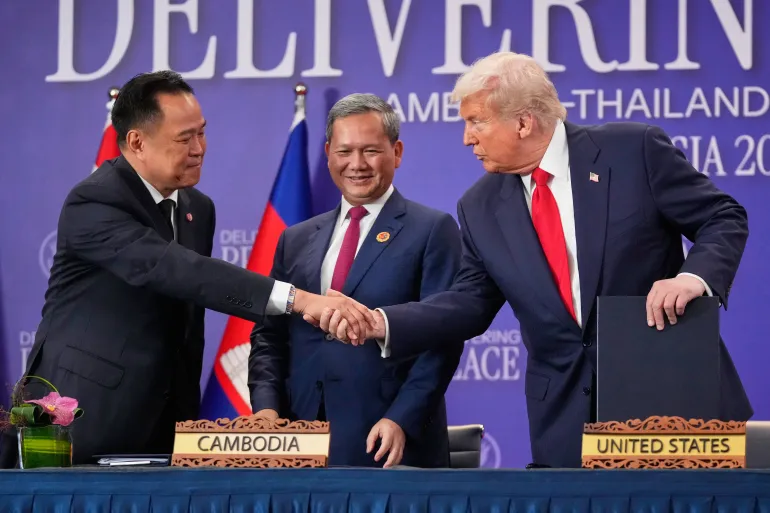
United States President Donald Trump has presided over the signing of a ceasefire between Thailand and Cambodia and announced several trade deals on his first visit to Asia since re-entering the White House.
Trump cosigned the ceasefire on Sunday with his Malaysian, Thai and Cambodian counterparts on the sidelines of the Association of Southeast Asian Nations (ASEAN) summit in Kuala Lumpur.
Thai Prime Minister Anutin Charnvirakul, Cambodian Prime Minister Hun Manet, and Malaysian Prime Minister Anwar Ibrahim joined Trump for a ceremony marking the deal, which builds on a ceasefire that halted deadly border fighting in July.
”We did something that a lot of people said couldn’t be done,” Trump said.
Anutin said the agreement created “the building blocks for a lasting peace”, while Hun Manet called it a “historic day”.
Anwar said the agreement “reminds us that reconciliation is not concession but an act of courage”.
The agreement follows a truce reached in July when Trump used the threat of higher tariffs against both countries to persuade them to end five days of fighting that killed dozens of people and displaced hundreds of thousands.
The first phase of the agreement involves Thailand’s release of 18 Cambodian soldiers and the removal of heavy weapons and landmines from the border region. Malaysian troops are to be deployed to ensure the fighting does not restart.
Territory along the 800km (500-mile) frontier between Thailand and Cambodia has been disputed for decades as a result of a vaguely defined French border treaty dating back to 1907.
The most recent conflict relates to a segment of territory near the border with Laos and another area that is home to several 1,000-year-old temples dating back to the Angkor Empire.
After signing the ceasefire on Sunday, Trump inked separate trade deals with Cambodia, Thailand and Malaysia as well as agreements on critical minerals with Bangkok and Kuala Lumpur.
Under the agreements, all three countries pledged to remove most trade barriers on US exports, particularly US agricultural products.
US tariffs on the three Southeast Asian countries remained at 19 percent.
Trump is on a six-day visit to Asia that is expected to culminate in his first face-to-face meeting with Chinese President Xi Jinping since 2019 on the sidelines of the Asia-Pacific Economic Cooperation forum in South Korea on Thursday.
Trump will depart for Japan on Monday, where he will meet newly sworn-in Prime Minister Sanae Takaichi. He will then travel to South Korea on Wednesday.

While the photo-op with Trump has come and gone, questions remain about the details of the ceasefire and whether it will hold.
Missing from the fanfare are any details about the border itself, said Sebastian Strangio, a journalist and author of Cambodia: From Pol Pot to Hun Sen and Beyond.
“They were never going to address the fundamental question, which is the disagreement on the demarcation of the border and disputes over specific territories,” Strangio told Al Jazeera.
“This was always going to be a hastily assembled deal to give Trump his political theatre and his ceremony. It was never going to be more than an elaborate version of the ceasefire deal they signed on July 28,” he said.
Strangio said the fact Trump has tied his personal prestige to the ceasefire could encourage the leaders of Cambodia and Thailand to enforce it but tensions remain high on the ground.
Sporadic violence has also broken out in the border region since the ceasefire, and a peace process will be complicated by the removal of landmines, he said.
Reporting from Sa Kaeo, Thailand, Al Jazeera’s Tony Cheng said the agreement signed on Sunday essentially reinforced “agreements that have already been made”.
Malaysian troops were supposed to deploy under the initial agreement signed in July but have not yet arrived, he said.
He said that while Thais welcomed “any kind of move towards peace”, they were viewing the agreement as “the beginning of the end” to the conflict rather than hailing it as having resolved the dispute in itself.
“The devil is going to be in the details of this agreement,” Cheng said.
He said the Thai military has been working to clear some disputed border areas at the same time as some villages have been building new bomb shelters in recent weeks.
“So people here are still concerned this could go either way,” he said.

Trump’s economic agreements with Malaysia, Cambodia and Thailand include significant economic commitments from the countries.
Thailand committed to buying $2.6bn a year in US farm products, $5.4bn a year of US energy products and 80 US aircraft worth $18.8bn, while Cambodia pledged to work with US aerospace company Boeing “in support of Cambodia’s aviation ecosystem development,” according to the White House.
Malaysia pledged to buy up to $3.4bn a year in liquefied natural gas from the US plus $200m a year of “coal and telecommunication products”, as well as 30 aircraft from the US with the option to buy 30 more, and to make capital fund investments in the US totalling $70bn.
Malaysia also said it would refrain from “banning, or imposing quotas on, exports to the United States of critical minerals or rare earth elements” and also ensure “no restrictions are imposed on the sale of rare earth magnets to US companies,” according to the White House.
Shiro Armstrong, a professor of economics at Australian National University’s Crawford School of Public Policy, said the deals undermined “ASEAN unity and the principle of equal treatment”.
“There was so much progress made in Malaysia’s leadership of ASEAN in coordinating a collective response that brought coherence to ASEAN’s multilateral principles, but these deals take the shine off that at the very least and potentially undermine everything that was achieved,” Armstrong told Al Jazeera.
“That means this deal was a very expensive one for a photo op. It’s difficult to understand what Malaysia gets from this and what they were thinking,” he added.
[Aljazeera]



Latest News
Cabinet approves relief meaures to persons affected due to the War situation in the Middle East
Approval has been granted at the Cabinet Meeting held on 30-03-2026 to provide relief by granting up to rupees 20/- per litre of 92 Octane Petrol, and up to rupees 100/- per litre of Auto Diesel utilized for public transport to minimize the impact on the day today life of the people and the entire economy as a result of escalation of fuel prices due to the war situation in the Middle East region.
Apart from that, the Cabinet of Ministers approved the resolution furnished by the President in his capacity as the Minister of Finance, Planning and Economic Development to grant the following relief for low – income generators, electricity consumers, farmers, fisheries community, and small tea planters who have been exposed to the direct impact of the energy price hike:
(i) Provision of an additional special allowance for April 2026 to low-income generating categories registered under the ‘Aswesuma’ Programme, irrespective of family size: • Providing rupees 7,500/- to a family in the extremely poor category
Providing rupees 5,000/- to a family in the poor category
Providing rupees 2,500/- to a family in the transitional category
(ii) Instead of transferring the additional cost borne for engaging thermal power plants for generating electricity due to the fuel price hike and prevailing dry weather circumstances to the electricity consumers, the additional cost is to be borne by the Government for a period of 03 months so that a relief can be provided to the electricity consumers utilizing below 90 units.
(iii) Increasing the fertilizer subsidiary of rupees 25,000/- per hectare given at present up to rupees 30,000/- per hectare for the Yala season and increasing the fertilizer subsidiary of rupees 15,000/- per hectare given for additional crops that are cultivated in the paddy fields up to rupees 18,000/- per hectare for the Yala season.
(iv) Provide a 50 kg sack of Urea required for the Yala season at a fixed price of Rupees 10,200/- for farmers through Agrarian Services Centres.
(v) Provide a subsidiary of Rupees 50/- per liter for up to 25 liters per day per single-day fishing vessel, for a maximum of 25 days per month, for a period of three (3) months.
(vi) Provide a one-time payment of Rupees 150,000/- per multi-day fishing vessel engaged in fishing activities during the next three (3) months.
(vii) Provide an additional one-time fertilizer allowance of Rs. 5,000 per 50 kg bag of fertilizer to small tea cultivators, in addition to the existing Rs. 4,000 fertilizer subsidy provided by the Sri Lanka Tea Board.

The Cabinet of Ministers has approved the resolution furnished by the President in his capacity as the Minister of Digital Economy, to appoint H.M.J.M.Herath, a special Grade officer in Sri Lanka Administrative Service, who is currently serving as the District Secretary / Government Agent of Kegalle, to the post of Commissioner General of Registration of Persons
Latest News
Cabinet gives green light for old court complex buildings located in Galle Fort to be utilized for a Tourism Promotion Project.
The Galle fort which has been declared as a World Heritage by the United Nations Educational, Scientific, and Cultural Organization (UNESCO), attracts over three (3) hundred thousand local and foreign tourists per year.
Under the Greater Galle Development Plan (2021–2030), Galle Fort has been declared a World Heritage Tourism Zone. Further, having conserved the archaeologically valued buildings existing in the Galle Fort, the Urban Development Authority has planned an integrated development project programme, themed as the ‘Galle Regeneration Project’.
The Cabinet of Ministers has approved the resolution furnished by the Minister of Transport, Highways and Urban Development to relocate the High Court and Magistrate’s Court, which are currently functioning within Galle Fort, to the newly constructed court complex at Beligaha, Galle and to assign the existing buildings to the Urban Development Authority for the implementation of a tourism promotion project under a Public–Private Partnership (PPP) mechanism under this programme.

AKD admits import of substandard coal, blames technicalities and supplier

‘Sri Lanka – China relations: Community with a Shared Future’ launched


ISA operationalises country partnership strategy through high-level Sri Lanka mission

Coal-blackened moralists

The university bought AI, now it’s buying back the pencil

‘Dates have the highest sugar content to fight Coronavirus’

Sunday Island 27 December – Headlines

#SundayIsland 17th December – Headlines

Sunday Island – 28th March

Sunday Island Headlines – 21 March

Sunday Island – 21st February – Headlines
-

 Features3 days ago
Ranjith Siyambalapitiya turns custodian of a rare living collection
-

 News6 days ago
2025 GCE AL: 62% qualify for Uni entrance; results of 111 suspended
-

 News3 days ago
Global ‘Walk for Peace’ to be held in Lanka
-
 Editorial6 days ago
Search for Easter Sunday terror mastermind
-
 Opinion5 days ago
Hidden truth of Sri Lanka’s debt story: The untold narrative behind the report
-

 Opinion6 days ago
Is there hope for Palestine?
-
 Features5 days ago
The Ramadan War
-

 Features3 days ago
Beyond the Blue Skies: A Tribute to Captain Elmo Jayawardena