
Latest News
Trump says US does not need UK aircraft carriers for Iran war

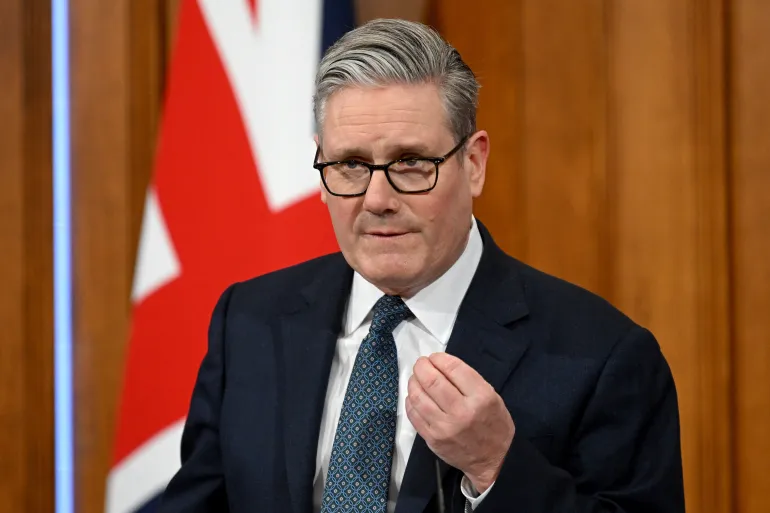
United States President Donald Trump has posted on social media that he does not need the United Kingdom to deploy aircraft carriers to the Middle East, amid the ongoing war with Iran.
Saturday’s post on Truth Social follows a statement from the UK’s Ministry of Defence that one of its two flagship aircraft carriers, the HMS Prince of Wales, has been placed on “high readiness”.
“The United Kingdom, our once Great Ally, maybe the Greatest of them all, is finally giving serious thought to sending two aircraft carriers to the Middle East,” Trump wrote.
“That’s OK, Prime Minister Starmer, we don’t need them any longer — But we will remember. We don’t need people that join Wars after we’ve already won!”
The post, with its reference to the UK as a “once great ally”, signals a deepening rift between the two countries that has emerged since Trump returned to office last year.
The divide appears to have deepened over the past week, as the US and Israel continue to hammer Iran as part of a war they launched on February 28.
The conflict has sparked fears across the Middle East, as retaliatory strikes from Tehran target US allies across the region.
Already, an estimated 1,332 people have been killed in Iran, and the US has confirmed the deaths of six of its service members. More deaths have been reported in countries like Lebanon, Kuwait, the United Arab Emirates and Iraq.
The UK government has increased its involvement in the war on Iran, widely considered illegal under international law.
The UK Defence Ministry, for instance, said on Saturday that the government of Prime Minister Keir Starmer had allowed the US to use its military bases for what it termed “limited defensive purposes”.
The bases include RAF Fairford in Gloucestershire and tbe Diego Garcia site in the Chagos Islands, located in the Indian Ocean. Initially, there had been reports that Starmer had blocked the US use of the bases.
In the immediate aftermath of the initial US-Israeli strike, Starmer appeared to blanche at the prospect of joining the war.
He and the leaders of France and Germany issued a joint statement, underscoring that any actions they might take would be defensive in nature.
“We will take steps to defend our interests and those of our allies in the region, potentially through enabling necessary and proportionate defensive action to destroy Iran’s capability to fire missiles and drones at their source,” the joint statement said.
“We have agreed to work together with the US and allies in the region on this matter.”
But Starmer has had to push back on domestic criticism both for and against joining the war.
On Monday, he told the UK Parliament, “We are not joining the US and Israeli offensive strikes”, citing the need to protect “Britain’s national interest” and “British lives”.
The war in Iran remains largely unpopular in the UK. The polling firm Survation conducted a survey over the last week of 1,045 British adults, and it found that 43 percent of respondents called the war not justifiable.
When asked if they supported Starmer’s initial decision not to allow the US to use British bases, 56 percent of respondents approved. Only 27 percent said it was the wrong choice.
Thousands of protesters gathered outside the US embassy in London on Saturday to call for an end to the ballooning conflict.
But Trump has upped his criticism of Starmer over the past week, further fraying relations with the UK government.
On March 3, for instance, he held an Oval Office meeting with German Chancellor Friedrich Merz where he said repeatedly he was “not happy with the UK”.
Of Starmer, Trump added, “This is not Winston Churchill that we’re dealing with.”
Trump has long admired Churchill and last year installed a bust of the wartime prime minister in the Oval Office, just as he had during his first term.
By contrast, the US president has issued a flood of criticism against Starmer, particularly for his 2024 decision to transfer control of the Chagos Islands to Mauritius.
The transfer comes after the International Court of Justice found the UK acted unlawfully in 1965 by separating the islands from Mauritius to create a separate colony.
The deal with Mauritius, however, allows the US and the UK to maintain a military base on Diego Garcia, part of the archipelago.
Trump has repeatedly slammed the transfer, however, writing on social media that “giving away extremely important land is an act of GREAT STUPIDITY”.
Tensions between the US and UK also rose in January after Trump told Fox News that NATO allies had “stayed a little off the frontlines” during the US war in Afghanistan.
Starmer responded that he found Trump’s comments “to be insulting and frankly appalling”.
The Trump administration, however, has signalled it is pivoting away from its traditional European allies in favour of more politically aligned countries.
At a summit on Saturday with right-wing Latin American leaders, US Secretary of State Marco Rubio appeared to praise the attendees while casting shade on other allies.
“At a time when we have learned that oftentimes an ally, when you need them, maybe may not be there for you, these are countries that have been there for us,” Rubio told the summit.
[Aljazeera]


Iran has named Mojtaba Khamenei as its new supreme leader, just over a week after the assassination of his father, Ayatollah Ali Khamenei , in joint United States-Israeli strikes that have.plunged the entire region into a sprawling war.
The 56-year-old, who will now be charged with leading the Islamic Republic through the biggest crisis in its 47-year history, was named by clerics as his father’s successor on Sunday.
Key leaders, Iran’s powerful Islamic Revolutionary Guard Corps (IRGC), and the armed forces were quick to pledge their backing to the new leader.
Ali Larijani, secretary of the Supreme National Security Council, who has been tasked with steering Iran’s security strategy since the US and Israel launched their all-out offensive, called for unity around the new supreme leader.
Parliament Speaker Mohammad Bagher Ghalibaf welcomed the choice, saying that following the new supreme leader was a “religious and national duty”.
Mojtaba Khamenei has never run for office or been subjected to a public vote, but has for decades been a highly influential figure in the inner circle of the supreme leader, cultivating deep ties to the IRGC.
In recent years, Khamenei has increasingly been touted as a top potential replacement for his father. His selection could be a sign that more hardline factions in Iran’s establishment retain power, and could indicate that the government has little desire to agree to a deal or negotiations in the short term as the war enters its second week.
Al Jazeera’s Ali Hashem described Khamenei as his “father’s gatekeeper”.
“He adopts the positions of his father with respect to the United States, with respect to Israel. So we are expecting a confrontational leader. We’re not expecting any moderation,” he said.
“However, if this war comes to an end and he is still alive, and he is able to continue running the country, there is going to be big potential… to find new routes for Iran,” Hashem said.
(Aljazeera)

Global oil prices have jumped above $100 (£75.11) a barrel for the first time since 2022 as the escalating US-Israeli war with Iran has fuelled fears of prolonged disruption to shipments through the Strait of Hormuz.
Iran on Sunday named Mojtaba Khamenei to succeed his father Ali Khamenei as Supreme Leader, signalling that a week into the conflict hardliners remain in charge of the country.
The US and Israel launched fresh waves of airstrikes across Iran over the weekend, hitting multiple targets including oil depots.
Major disruption to energy supplies from the region threatens to push up prices for consumers and businesses around the world.
Early on Monday in Asia, Brent crude was around 15.5% higher at $107.16, while Nymex light sweet was up by more than 17% at $106.77.
Stock markets in the Asia-Pacific region fell sharply in early trading on Monday, with Japan’s Nikkei 225 index down by more than 5% and the ASX 200 in Australia more than 3.5% lower.
Many in the markets predicted that oil would hit the $100 a barrel mark this week.
In the event it took about a minute to jump 10%, and then another 15 minutes to rise a further 10% in early Asian trading.
Last week the markets had been relatively relaxed about the seeming nightmare scenario for millions of barrels of crude and liquefied natural gas trapped in the Gulf, unable or unwilling to transit the Strait of Hormuz.
But the escalations over the weekend, alongside scenes of destruction of energy infrastructure both in Iran and across the Gulf, saw the markets take rapid fright.
The question now is where does this go? Some analysts argue that if the shutdown in the strait lasts until the end of March, we could see record oil prices above $150 a barrel.
The existing rise is likely to further increase petrol prices, and those of important derivative products such as jet fuel and vital precursors for fertilisers.
The physical supplies from the Gulf are mainly consumed in Asia.
Already however there are signs that Asian consumers are bidding up prices for US gas, with some tankers originally heading for Europe turning around in the mid-Atlantic.
US President Donald Trump responded to the jump in prices by saying that short term rises were a “small price to pay” for removing Iran’s nuclear threat.
His energy secretary told US broadcasters on Sunday that Israel, not the US, was targeting Iran’s energy infrastructure, amid some concern about rising domestic pump prices caused by the war.
(BBC)


SriLankan Airlines Resumes Flights to Riyadh and Dubai

Iran names Khamenei’s son as new supreme leader after father’s killing

Oil prices jump above $100 for first time in four years

Dry weather will prevail over the island

FSP warns of possible coal shortage

Repatriation of Iranian naval personnel Sri Lanka’s call: Washington

‘Dates have the highest sugar content to fight Coronavirus’

Sunday Island 27 December – Headlines

#SundayIsland 17th December – Headlines

Sunday Island – 28th March

Sunday Island Headlines – 21 March

Sunday Island – 21st February – Headlines
-

 News4 days ago
University of Wolverhampton confirms Ranil was officially invited
-

 News5 days ago
Legal experts decry move to demolish STC dining hall
-

 News4 days ago
Female lawyer given 12 years RI for preparing forged deeds for Borella land
-

 News3 days ago
Peradeniya Uni issues alert over leopards in its premises
-

 Business5 days ago
Cabinet nod for the removal of Cess tax imposed on imported good
-
 News4 days ago
Library crisis hits Pera university
-

 News3 days ago
Wife raises alarm over Sallay’s detention under PTA
-
 Business6 days ago
War in Middle East sends shockwaves through Sri Lanka’s export sector