
Latest News
Trump ousts Waltz as national security adviser and nominates him for UN post

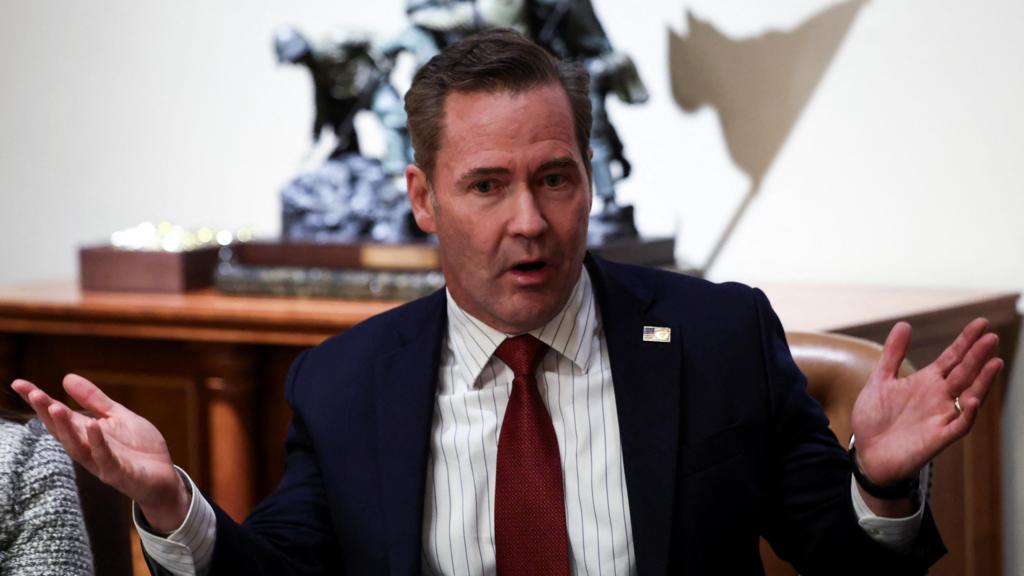
US President Donald Trump has removed Mike Waltz from his post as national security adviser, and will nominate him as ambassador to the United Nations.
In a post on social media, Trump thanked Waltz for his work and said he would be temporarily replaced by Secretary of State Marco Rubio, who will continue as America’s top diplomat.
Waltz had faced criticism for mistakenly adding a journalist to a chat group where sensitive military plans were discussed – a political embarrassment likely to feature during confirmation hearings for the UN post.
The former Florida congressman is the first senior member of the administration to leave the White House in Trump’s second term.
“From his time in uniform on the battlefield, in Congress and, as my National Security Advisor, Mike Waltz has worked hard to put our Nation’s Interests first,” Trump wrote in a post on Truth Social. “I know he will do the same in his new role.”
Waltz posted a short statement on X, alongside a screenshot of the announcement by the president.
“I’m deeply honoured to continue my service to President Trump and our great nation,” he wrote.
According to the BBC’s US partner CBS News, Trump decided to nominate Waltz as UN ambassador just hours before the announcement on Thursday.
Multiple sources told the network he was ousted because of the Signal situation and a perception in the White House that he did not properly vet National Security Council staff, among other reasons. But the sources said Trump respects Waltz so he was given a soft landing and a high-profile new post.
However, the BBC spoke to several US officials – who wished to remain anonymous – and they suggested the Trump administration believed Waltz might struggle to be confirmed by the Senate, allowing the president to get rid of him completely without having to fire him.
Waltz has been under scrutiny since he acknowledged in March mistakenly adding the editor-in-chief of the Atlantic magazine, Jeffrey Goldberg, to a group chat on Signal with top US security officials.
Confidential plans for a military strike on Yemen’s Houthis were discussed on the message chain, whose members included Waltz, Rubio and Defence Secretary Pete Hegseth.
There was uncertainty on Thursday over the fate of Waltz’s deputy, Alex Wong, a seasoned foreign policy hand from Trump’s first term who was also on the Signal chat.
Wong was asked about the leak during an interview with the BBC’s Newsnight programme on Wednesday. He said the administration had been “very successful” in taking on Yemen’s Houthis and “the president led on that”.
In March, lawmakers questioned some of the other Signal chat participants at hearings, including the director of national intelligence and the director of the CIA.
The UN ambassador position remains unfilled. Trump withdrew the nomination of his first pick, New York congresswoman Elise Stefanik, amid Republican concerns about preserving their slender majority in the House of Representatives.
Minnesota Governor and former Democratic vice-presidential candidate Tim Walz made light of the national security adviser’s exit on Thursday.
He posted on X: “Mike Waltz has left the chat.”
Waltz has continued to use Signal, according to an image captured by a Reuters photographer at a White House cabinet meeting on Wednesday.
The zoomed-in picture showed Waltz checking his phone and a chat ongoing with a contact saved under the name of JD Vance, who is US vice-president.
The message from the Vance contact read in part: “I have confirmation from my counterpart it’s turned off. He is going to be here.”
In an interview with Fox News aired on Thursday evening, Vance rejected any suggestion that Waltz had been fired, saying he was actually being promoted.
“I like Mike,” said Vance. “I think he’s a great guy. He’s got the trust of both me and the president.
“But we also thought that he’d make a better UN ambassador as we get beyond this stage.”
Trump’s announcement, meanwhile, of the latest role for Rubio appeared to catch state department officials off guard.
Rubio will now be the first official to serve both as secretary of state and national security adviser since Henry Kissinger half a century ago.
Rubio is also acting head of both the gutted United States Agency for International Development and the National Archives.
Some reports suggest Steve Witkoff, a real estate developer and personal friend of Trump who is currently a US Special Envoy to the Middle East, could ultimately replace Waltz.
Another name being touted as a potential candidate by some in Washington is also one of Trump’s special envoys, Ric Grenell, who has a longer diplomatic track record.
Trump went through four national security advisers in his first term. The first, Michael Flynn, served for just three weeks.
Another, John Bolton, later wrote an unflattering book about Trump.
Bolton told the BBC on Thursday that Waltz’s removal was reminiscent of the “chaos” from Trump’s first term.
[BBC]

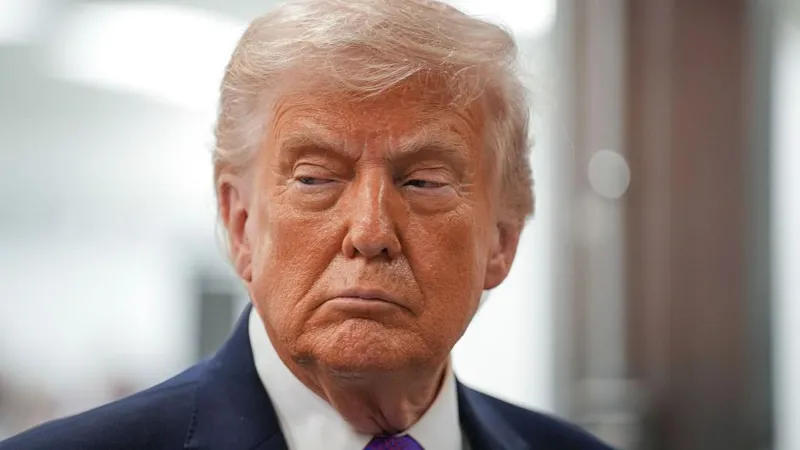
Three weeks after the joint US-Israeli war against Iran began, the conflict has reached a fuzzy state of mixed messages and uncertainty, with Donald Trump’s public comments often seemingly contradicted by realities on the ground.
The war is “very complete, pretty much”, Trump has said, but new American ground forces – including a Marine expeditionary unit – are moving into the region. It is “winding down”, but US and Israeli bombing and missile strikes on Iranian targets continue unabated.
Opening the Strait of Hormuz, the geographic choke point through which 20% of the world’s oil export travels, is a “simple military manoeuvre”, but for now only Iranian-approved ships are transiting the waters.
The Iranian military is “gone”, but drones and missiles are still striking targets in the region and targets have extended as far as the joint US-UK base on Diego Garcia.
In a Friday evening Truth Social post published while he was flying from Washington to his Florida resort for the weekend, the US president provided a numbered list of American military objectives for the Iran war, which he said the US was “getting really close” to fulfilling.
The items, comprising his most detailed statement on the subject since the war began, included degrading or destroying Iran’s military, its defence infrastructure and its nuclear weapons programme, as well as protecting American allies in the region.
Not included was the goal of securing the Strait of Hormuz, which Trump said should be the responsibility of other nations that are more dependent on oil exports from the Gulf. The president has frequently noted that the US is a net exporter of energy and does not rely on oil from the Middle East – although such a view glosses over the global nature of the fossil fuel market, where price fluctuations directly impact the price at American gas pumps.
Trump’s Truth Social post also made no call for Iranian regime change. Gone are any references to approving the nation’s next leader or “unconditional surrender”, which Trump had insisted on in the early days of the war.
In Trump’s latest outline of his objectives, it is possible that the US could end its operation with Iran’s current anti-American leadership in power, its oil exports still flowing and its ability to assert some measure of control over the Strait of Hormuz intact.
If that is an unappealing resolution to a war that the president and his aides have said began with the 1979 Iran Revolution and that they would finish, there is an alternative route that involves the US ground forces presently on the way to the Middle East region.
Just over a week ago, US media reported that a Marine expeditionary unit, with about 2,500 combat soldiers and supporting ships and aircraft, had been dispatched from Japan to the Middle East, which it should reach in the coming days. Another Marine force of similar size recently departed its base in California with its arrival expected in mid-April.
Military analysts have suggested that the US could be planning to capture Kharg Island. an 3-sq-km (8-sq-mile) slice of land that contains Iran’s primary oil export terminal. Doing so could, in theory, cut off the nation’s oil shipments, depriving the nation of much-needed revenue and forcing it to make greater concessions to the Americans in exchange for an end to hostilities.
Trump on Friday said that he wasn’t sending ground troops to Iran, but added: “If I were, I certainly wouldn’t tell you”. Clarity, it seems, is not his intention.
The threat of such a move prompted Iran’s state media to report on Saturday that any attack on Kharg Island would lead Iran to cause “insecurity” in the Red Sea, another key global shipping transit point, and “set fire” to energy facilities throughout the region.
Iran’s warning underscores the dangers that would accompany a US escalation that further exposes American military forces to Iranian reprisals.
Earlier this week, US media reported that the Trump administration was preparing to ask Congress for $200bn (£150bn) in emergency funding for the ongoing Iranian military operation. Such a request would suggest that, far from winding down, the White House is preparing for a long, expensive fight.
The initial reaction from Congress, including from Trump’s Republican allies, was cautious at best.
“We’re talking about boots on the ground. We’re talking about that kind of extended activity,” said Republican Congressman Chip Roy of Texas.
“They have got a whole lot more briefing and a whole lot more explaining to do on how we’re going to pay for it, and what’s the mission here.”
The so-called “fog of war” doesn’t just cloud the thinking of military planners, it also affects the perception of politicians and the public.
The Iran war, it seems, is at a pivot. But which direction it takes from here is a puzzle.
(BBC)
Latest News
Heat Index likely to increase up to ‘Caution level’ at some places in the Western, Sabaragamuwa, Southern and North-western provinces and in Anuradhapura, Monaragala, Mannar and Vavuniya districts

Warm Weather Advisory
Issued by the Natural Hazards Early Warning Centre of the Department of Meteorology
at 3.30 p.m. on 21 March 2026, valid for 22 March 2026.
Heat index, the temperature felt on human body is likely to increase up to ‘Caution level’ at some places in the Western, Sabaragamuwa, Southern and North-western provinces and in
Anuradhapura, Monaragala, Mannar and Vavuniya districts.
The Heat Index Forecast is calculated by using relative humidity and maximum temperature and this is the condition that is felt on your body. This is not the forecast of maximum temperature. It is generated by the Department of Meteorology for the next day period and prepared by using global numerical weather prediction model data.

Effect of the heat index on human body is mentioned in the above table and it is prepared on the advice of the Ministry of Health and Indigenous Medical Services.
ACTION REQUIRED
Job sites: Stay hydrated and takes breaks in the shade as often as possible.
Indoors: Check up on the elderly and the sick.
Vehicles: Never leave children unattended.
Outdoors: Limit strenuous outdoor activities, find shade and stay hydrated.
Dress: Wear lightweight and white or light-colored clothing.
Note:
In addition, please refer to advisories issued by the Disaster Preparedness & Response Division, Ministry of Health in this regard as well. For further clarifications please contact 011-7446491.
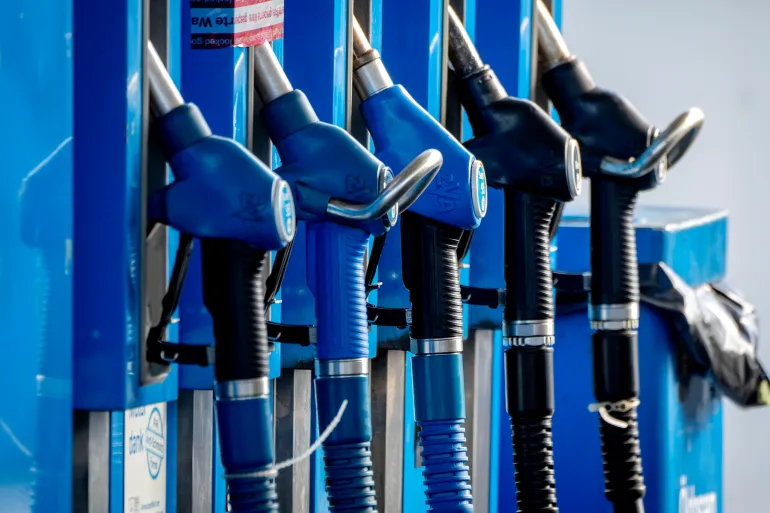
The Ceylon Petroleum Corporation (Ceypetco) has announced a revision of fuel prices, effective from midnight today (21).
Accordingly,
Auto Diesel – Rs. 382 (increased by Rs. 79)
Super Diesel – Rs. 443 (increased by Rs. 90)
Petrol 92 Octane – Rs. 398 (increased by Rs. 81)
Kerosene – Rs. 255. (increased by Rs. 60)
Petrol 95 Octane – Rs. 455 (increased by Rs. 90)


Showers may occur at several places in the Western, Sabaragamuwa and Southern provinces and in Nuwara-Eliya district after 1.00 pm.

PM Harini leads panel to protect public services

Sajith slams President over war conduct and economic missteps

Johnston Fernando, sons held in Lanka Sathosa lorry misuse case

Gura: The unsung hero

The Iran War, Global Oil Crisis, and Local Options

‘Dates have the highest sugar content to fight Coronavirus’

Sunday Island 27 December – Headlines

#SundayIsland 17th December – Headlines

Sunday Island – 28th March

Sunday Island Headlines – 21 March

Sunday Island – 21st February – Headlines
-

 Business6 days ago
Browns EV launches fast-charging BAW E7 Pro at Rs. 5.8 million
-

 News4 days ago
CIABOC questions Ex-President GR on house for CJ’s maid
-

 News5 days ago
Sri Lankan marine scientist Asha de Vos honoured at UNGA opening
-

 Features6 days ago
Achievements of the Hunduwa!
-
 Latest News7 days ago
QR code system will be implemented for fuel with effect from 06.00 a.m. today (15th)
-

 News5 days ago
Australian HC debunks misleading travel risk claims for Sri Lanka
-

 Latest News5 days ago
Wednesdays declared a government holiday with effect from 18th March
-

 News3 days ago
Pay hike demand: CEB workers climb down from 40 % to 15–20%