
Latest News
Trump calls on Iran to ‘move quickly’ on nuclear proposal


United States President Donald Trump says that Iran has his administration’s proposal regarding its rapidly advancing nuclear programme as negotiations between the two countries continue.
Trump made the remarks on Friday on board Air Force One as he ended his trip to the United Arab Emirates. It is the first time he has acknowledged sending a proposal to Tehran after multiple rounds of negotiations between US Middle East envoy Steve Witkoff and Iranian Foreign Minister Abbas Araghchi.
“We’re in very serious negotiations with Iran for long-term peace,” Trump told a journalist when asked about the proposal. “We’re not going to be making any nuclear dust in Iran. I think we’re getting close to maybe doing a deal without having to do this,” he said. “But most importantly, they know they have to move quickly, or something bad is going to happen.”
On Thursday, Araghchi spoke to journalists at the Tehran International Book Fair and said that Iran had not received any proposal from the US yet.
Araghchi also criticised what he called conflicting and inconsistent statements from the Trump administration, describing them as either a sign of disarray in Washington or a calculated negotiation strategy.
Witkoff at one point suggested that Iran could enrich uranium at 3.67 percent, then later said that all Iranian enrichment must stop.
“We are hearing many contradictory statements from the United States – from Washington, from the president, and from the new administration,” Araghchi said.
“Sometimes we hear two or three different positions in a single day.”
Araghchi later stressed that Iran will not give up uranium enrichment. “Mark my words: there is no scenario in which Iran abandons its hard-earned right to enrichment for peaceful purposes,” he wrote in a social media post.
Iranian diplomat Kazem Gharibabadi also reiterated on Friday that the right to enrich uranium is Tehran’s “absolute red line”.
Iranian and American officials have met in Oman and Rome in recent weeks for the negotiations mediated by Oman’s Foreign Minister Badr al-Busaidi, a trusted interlocutor between the two nations.
The talks seek to limit Iran’s nuclear programme in exchange for the lifting of some of the crushing economic sanctions the US has imposed on the Islamic republic.
Trump has previously threatened to launch attacks targeting Iran’s nuclear programme if a deal isn’t reached.
Some Iranian officials have warned that Tehran could pursue a nuclear weapon with their stockpile of uranium enriched to near weapons-grade levels.
Separately on Friday, Iranian officials also met officials from Britain, France and Germany in Istanbul to discuss their nuclear negotiations with Washington.
Iran’s Deputy Foreign Minister Kazem Gharibabadi, who attended the talks in the Turkish city, said in a post on X: “We exchanged views and discussed the latest status of the indirect nuclear negotiations and the lifting of sanctions.”
Gharibabadi added that if necessary, Tehran would meet with the so-called E3 – the European parties to the 2015 nuclear deal, along with China, Russia and the United States – once again to continue discussions, after several meetings since last year.
Trump had effectively torpedoed the deal during his first term by unilaterally abandoning it in 2018 and reimposing sanctions on Iran’s banking sector and oil exports.
A year later, Iran responded by rolling back its own commitments under the deal, which provided relief from sanctions in return for UN-monitored restrictions on Iran’s nuclear activities.
[Aljazeera]


Acting President Delcy Rodríguez says the earthquakes have killed at least 164 people and injured 971.
Wednesday evening’s 7.2 and 7.5-magnitude earthquakes were among the strongest to strike Venezuela in more than a century and could be felt throughout the region.
State TV showed three children, covered in dust but alive, pulled from the rubble in La Guaira state, which Rodríguez described as a “disaster zone” and one of the areas hardest hit by the quakes because of the large number of collapsed buildings.
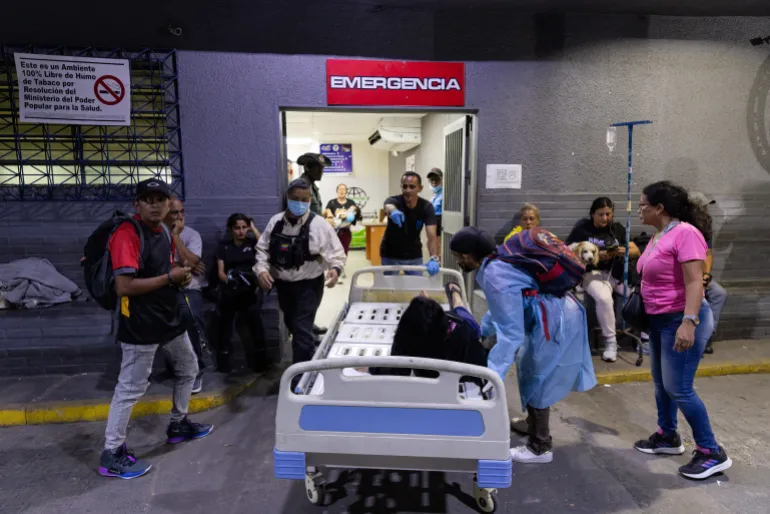
A victim arrives at an emergency room in Caracas [Aljazeera]
(Aljazeera)
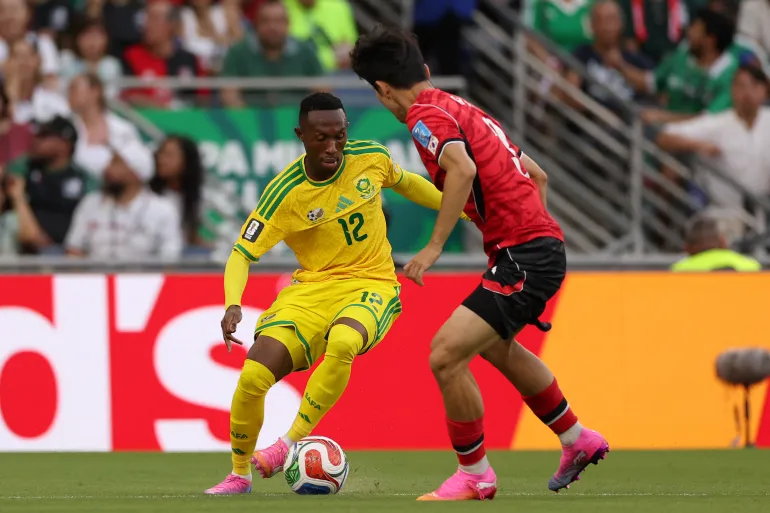
South Africa beat South Korea 1-0 to reach the World Cup knockout rounds for the first time in their history, an astonishing turnaround after a dismal opening defeat.
Bafana Bafana, playing at the tournament for the first time since South Africa hosted it in 2010, were widely written off after their 2-0 loss to Group A winners Mexico.
But they battled to a draw against the Chez Republic and came out on top of what was effectively a shootout with South Korea for second place in Monterrey, thanks to Thapelo Maseko’s second-half strike.
South Korea coach Myung-Bo Hong made a shock call by leaving captain Son Heungmin – considered by many to be Asia’s greatest-ever player – out of the starting lineup.
The Asian team started strongly, with stand-in captain Kim Minjae’s powerful header blocked on the goal line by Aubrey Modiba, before Lee Kangin flashed wide.
South Africa quickly settled, playing with hunger and adventure, but their finishing was wasteful.
They seemed certain to take the lead in the 30th minute when the ball fell to Evidence Makgopa after South Korean goalkeeper Kim Seunggyu parried Thalente Mbatha’s shot. But Makgopa could only tamely poke the ball straight at the goalkeeper from close range.
Son came on at the start of the second half, one of three changes made by coach Hong as he sought to change the script.
Early in the second period, Maseko squandered another good position, while South Korea forward Oh Hyeongyu tested goalkeeper Ronwen Williams at the other end.
As news filtered through from Mexico City that the host nation were leading against the Czech Republic, there was an added sense of urgency.
South Africa seized their moment, with Tshepang Moremi crossing to Maseko, who this time kept his cool, firing home inside the near post in the 63rd minute.
South Korea pushed hard in the closing stages but ran out of time, meaning South Africa will face cohosts Canada in Los Angeles on June 28 .
Mexico topped the group with nine points after winning all three of their matches.
[Aljazeera]
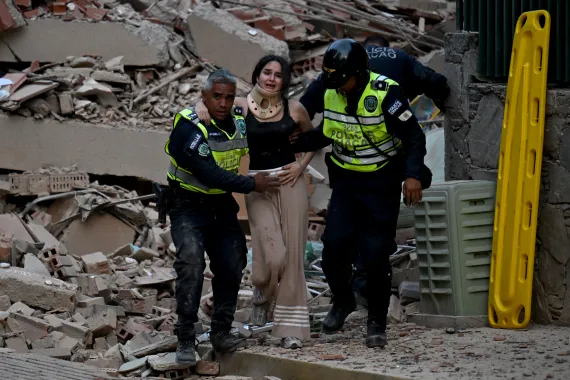
Back-to-back powerful earthquakes have struck Venezuela, collapsing buildings in the capital, Caracas, and killing at least 32 people and injuring over 700.
Acting President Delcy Rodriguez declared a state of emergency and said that the Simon Bolivar International Airport in Caracas is closed due to damage.
The US Geological Survey (USGS) has said that the first earthquake, measuring magnitude 7.2, struck west of Moron, about 168 km (104 miles) west of Caracas. A second tremor of magnitude 7.5 hit near the same area just a minute later. The USGS has warned that “high casualties and extensive damage are probable” and that the “disaster is likely widespread”.

(Aljazeera)

Venezuela earthquakes: At least 164 dead, 971 injured as toll rises

Representatives from the Ceylon Chamber of Commerce meet PM

Progress of Housing Project for Malayagam Community families funded by India reviewed

South Africa stun South Korea to reach World Cup knockouts for the first time

Tremors of 7.5, 7.2 kill 32, injure hundreds in Venezuela

Former Minister Wijeyadasa Rajapakshe’s son arrested by CIABOC

‘Dates have the highest sugar content to fight Coronavirus’

Sunday Island 27 December – Headlines

#SundayIsland 17th December – Headlines

Sunday Island – 28th March

Sunday Island Headlines – 21 March

Sunday Island – 21st February – Headlines
-

 News7 days ago
Creditor receives USD 2.5 mn as Lankan public bears loss from theft of Treasury funds
-

 News6 days ago
Creditor not yet paid
-
 News6 days ago
Consumers bearing 22% tax burden despite 18% VAT claim: Dr. Harsha de Silva
-

 Features5 days ago
Nanda Pethiyagoda Wanasundara as three generations of family saw her
-

 Features4 days ago
Sri Lanka developing independent hydrographic capabilities
-

 Opinion7 days ago
SriLankan Airbus struck by lightning
-

 Editorial5 days ago
Fuel crisis: Beyond price debate
-

 Latest News4 days ago
Sooryavanshi thumps fastest List A fifty as India A win tri-series