
Features
Transformation, Reinvigoration and Reinvention: The Art and Life of George Keyt (1901 – 1993)

Part 2
By Dr. SinhaRaja Tammita-Delgoda
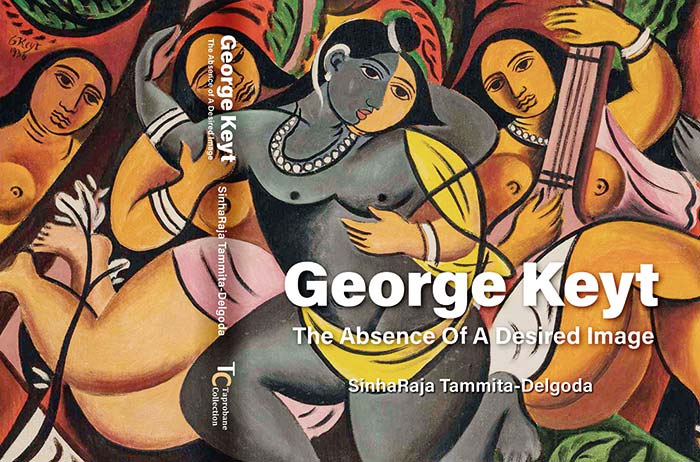
The material for this article has been drawn from the recently published work, George Keyt. The Absence of a Desired Image by SinhaRaja Tammita-Delgoda (Taprobane Collection, Sri Lanka 2023)
Modernism appealed to Keyt’s temperament, liberating him as a man and an artist. Confined and stifled by the morals and conventions of the day, he had already broken with its social codes. Modern art and its innovation opened up a new path for him. Enabling him to be free, to be different and to be himself, it gave him the tools to interpret the new world and the new life he had carved out for himself.
A revolutionary painter is one who wantonly breaks rules in order to liberate his expression from the bonds of academic art. Why must they do this? In order to create new forms…
George Keyt, Modern Art and the East, Ceylon Observer, June 9. 1963
The discovery of Picasso and Braque revolutionized Keyt’s thinking and his painting. Adopting the tenets of Cubism to reshape and reassemble nature, he began to distort form and shape. Breaking up the body, Keyt simplified it into basic geometric forms. Rearranging its appearance, he highlights sharp edges and curvilinear forms to produce multiple intersecting views. Combining cutting lines, sinuous curves and jagged angles, Keyt created his own idea of perspective. Like Picasso, Keyt combined distortion with bold outline, creating oval faces with sharp profiles, often bisecting and dissecting at the same time.
The innovations of modern art made a profound impression in the Ceylon of the 1930s. Its originality, its iconoclasm and its sheer vitality appealed to an emerging generation who were starting to break away from the traditional forms of painting. In 1887 the British administration established the Ceylon Society of Arts. Modeled along the lines of the Royal Academy, it was designed to cater to the wealthy urban and commercial classes who had established themselves during the 19th century. Intended for a group whose social and cultural standards were of the West, the aim of the Society was to “encourage pictorial art” in the colony.
During nearly four centuries of Portuguese, Dutch and British occupation, Ceylonese culture was in eclipse, and the old aristocracy was replaced by a rich urban class whose social and cultural standards were of the West. Colonial education introduced alien standards of art until, in the 19th century, the worst kind of Victorian naturalism became the goal of artistic accomplishment.
-
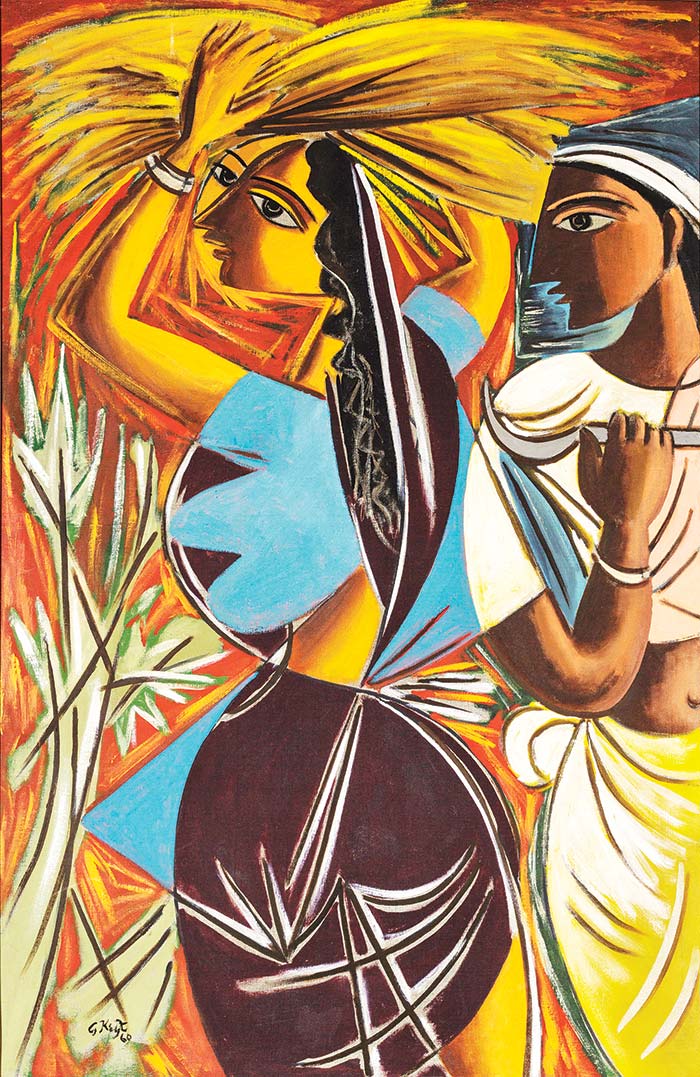
- The Reapers (1960). George Keyt. Oil on Canvas. 136 x 87 cm. Taprobane Collection
-
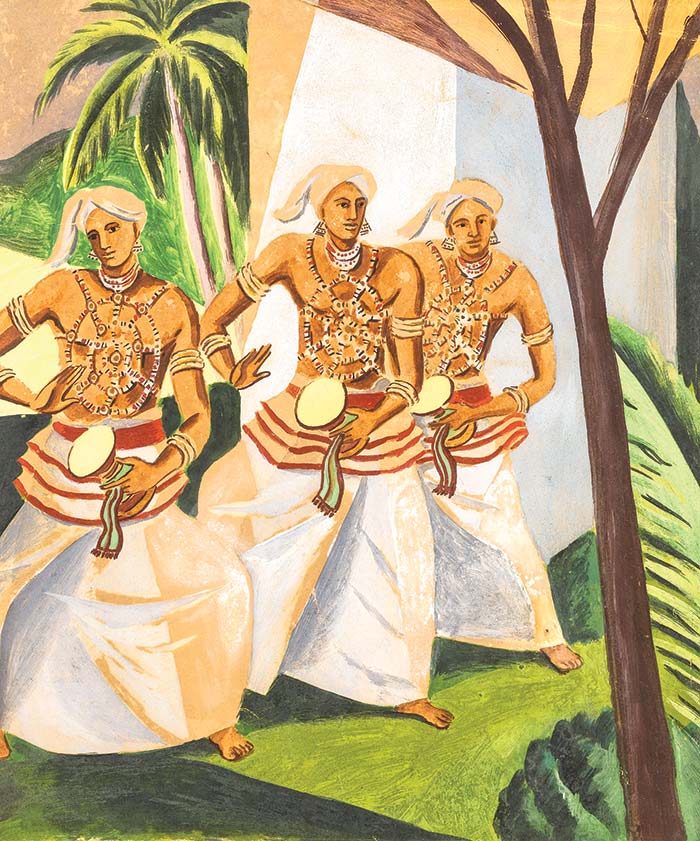
- Untitled (Musicians) (Late 1920s). George Keyt. Pencil Ink Gouache on Paper. 42.9 x 35 cm. Taprobane Collection
William Graham, The Studio Magazine (1954) Dominated by wealthy and influential families who had proved themselves loyal and useful to the British Crown, the Ceylon Society of Arts was a product of the Victorian era, steeped in the conventions of naturalism and representation. Deeply conservative in its attitudes to art, its style reflected the tastes and ideals of the English middle class at the time. The Society had little interest in the artistic traditions of the country and was actively opposed to the developments taking place in contemporary art. All artists had to paint in the style of the reigning British aesthetic. Those who did not were seen as misfits and non- conformists and were rejected.
On August 20, 1943, five years before Independence a new, independent group of artists was founded. It was composed of all those who had been excluded by the Ceylon Society of Arts. Known as the 43 Group, it became Asia’s first modern art movement. The 43 Group sought to portray the country’s life, values and traditions in a modern idiom. Inspired by European modernism and the traditional arts of India and Ceylon, the artists agreed to work in their own respective styles, creating, experimenting and interpreting as they saw fit.
The first artistic movement of its kind in Asia, the 43 Group had evolved at a time when both Ceylon and India were still colonies. At a time when modernism was closely associated with change, anti-colonialism and nationalism, the 43 Group generated widespread interest and attention. It also led the way on the Indian subcontinent, where it became the first modernist movement to establish itself.

Georges Braques and Pablo Picasso
In the years which followed Independence, the 43 Group held a series of regular exhibitions which gradually established modern art in Sri Lanka. By the early fifties, the 43 Group was winning international acclaim and showing its work in Europe. The 43 Group’s synthesis of traditional forms with modern Western influence attracted widespread praise and comment. In February 1954, William Graham, writing in The Studio, London’s leading magazine of contemporary art, described the 43 Group as “The most significant movement in Eastern Art today.
Breaking with the colonial past, modernism offered a new way of thinking and painting, providing George Keyt with a series of stepping stones, it gave him the opportunity to explore and to experiment, to innovate and to re-invent. Keyt did not avoid these stepping stones. For him, they were merely markers, which enabled him to learn and to grow, to formulate his own visual language and go his own way. Although Keyt had adopted modernism to reinterpret the human form, he did not allow it to dominate or diminish his interpretation. Whereas Braque and Picasso dispensed with line and form, Keyt retained his love of line and outline, maintaining his feeling for the human form.
Once Keyt had rejected Christianity, Buddhism and then Hinduism provided him with an alternative set of beliefs and a way of life. This grounded him in the cultural context of South Asia. In Keyt’s eyes, South Asia possessed what Europe lacked – an ancient creative history and a spiritual tradition of its own. He was too embedded in this reality to allow any set of theories or canons to dominate his vision.
One of the most perceptive analysts of Keyt’s assimilation of modernism was the British civil servant, art historian and curator W.G. Archer (1907-1979). Keeper of the Indian Section at the Victoria and Albert Museum from 1949-1959, Archer was one of the most prominent authorities on Indian art of the time. He came to know Keyt well and featured him in his seminal study India and Modern Art (1959).

Author of the Book Dr SinhaRaja Tammita-Delgoda speaking
Archer was aware that the reproductions of Braque and Picasso had an invigorating effect on Keyt. All of a sudden Keyt realized that he had a “whole new series of idioms ready to hand for conscious adoption.” According to Archer, the example of Picasso helped Keyt discover his own inner consciousness and develop his own style. It offered him a new way of thinking and painting which opened up a way forward. For Keyt, modernism was merely an instrument. ” What Europe provided was but a tool, a method.”
The product of a deeply urbanized and colonized culture, Keyt turned his back on the society that he knew. Rejecting the secure, established path he had been destined to follow he
embraced the language, art and culture of Sri Lanka’s Sinhala Buddhist civilization, carving out a new identity and life for himself. In the same way that he abandoned the security and stability of his upbringing, Keyt broke with the artistic traditions of his day. In the dying years of the empire, Keyt borrowed, learned and innovated to create anew. Fusing several traditions together, he drew on many cultures and many art forms to evolve a distinct art form of his own. In living the life of his paintings, he transformed himself, as a man and an artist.











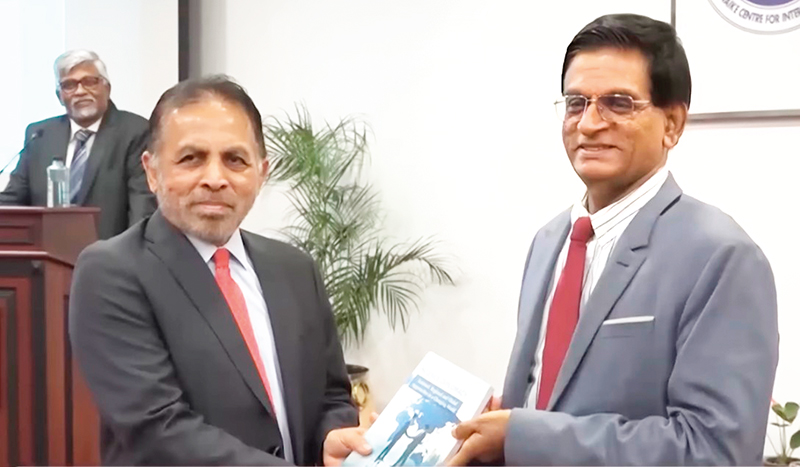
Today marks a truly historic and momentous occasion in the realm of transdisciplinary diplomacy in our country. We gather here with a twofold purpose of profound national and global significance: the establishment of the Science Diplomacy Forum, and the launch of the volume Science Diplomacy: National, Regional and Global Approaches in a Changing World.
This volume brings together valuable and timely contributions from internationally renowned experts representing all key regions of the world — North America, Latin America, Europe, Africa, West Asia, South Asia, and Oceania. It reflects a rich diversity of perspectives, experiences, and insights that speak to the increasingly interconnected nature of science, policy, and diplomacy in our rapidly transforming world.
I am deeply heartened — and indeed humbled — by the presence of such a distinguished constellation of leaders, professionals, intellectuals, scholars, and luminaries from diverse domains, including international relations, science and technology, higher education, and governance. It is rare to witness such an extraordinary and diverse assembly of intellectual, professional, and academic excellence under one roof. Your presence affirms the importance of the cause we serve and the promise of the path we are charting together. Your support, encouragement, and engagement give life, purpose, and direction to this vital endeavour.
As Chief Editor of this volume, it is both a great honour and a profound responsibility to extend a warm and heartfelt welcome to all our distinguished guests and invitees. I am conscious that this august gathering is not assembled to listen to a lengthy welcome address, but rather to engage with the substantive proceedings of this event, enriched by five eminent personalities, four distinguished speakers, and an able and competent moderator — all of whom possess exceptional mastery of the subject. I shall therefore be brief.
Among us today are former and current Ministers and people’s representatives, members of the diplomatic corps, Secretaries to Ministries, distinguished panelists, valued contributors to the volume, Vice-Chancellors, Members of the Board of Management and Academic Affairs Board of the BCIS, Heads of institutions, professors, senior government officials, professionals, journalists, and many others — too numerous to acknowledge individually, yet each of you is most warmly welcomed. I receive you all, whether present in person or online, with the utmost warmth, respect, and appreciation.
The panel discussion constitutes the pièce de résistance of this event. We are deeply honoured to be joined by four eminent personalities:
Her Excellency Siri Walt, Ambassador of Switzerland to Sri Lanka;
Professor Pierre-Bruno Ruffini, former Chair of the EU Science Diplomacy Alliance; and former Ambassadors Mr. Bernard Goonatilleke and Dr. Palitha Kohona — all of whom bring exceptional depth of experience and insight to this important subject.
Their discussion will be guided by our distinguished moderator, Mr. Naushard Cader, a truly cosmopolitan personality, widely respected for his breadth of knowledge and his keen understanding of global affairs and science diplomacy. I extend to all our speakers and our moderator a very warm welcome and my sincere appreciation for their willingness to share their wisdom with us this evening.
Allow me, however, to place this event in perspective.
We gather this evening not merely to introduce a book, nor solely to inaugurate a forum, but to reflect together on an idea whose time has unquestionably arrived.
We meet at a moment of profound global transition and conflict. The international landscape is marked by turbulence, uncertainty, and rapid transformation. The world is shifting from a relatively stable post–Cold War configuration toward an increasingly multipolar order. While multipolarity carries the promise of greater balance and strategic autonomy, it also brings intensified competition among major powers, fluid alliances, and growing unpredictability.
At the same time, the rules-based international order — which for decades provided smaller nations with a measure of predictability and protection — is under visible strain and threat. Institutions are contested. Norms are challenged. Economic interdependence deepens even as geopolitical fragmentation intensifies. Supply and value chains now account for nearly seventy percent of global trade, binding nations in complex webs of mutual dependence. Yet such interdependence has not prevented trade wars, sanctions regimes, technological decoupling, and regional conflicts.
For small and economically vulnerable states, this evolving environment is especially daunting. When global rules weaken, asymmetries of power become more pronounced. Bilateral negotiations between unequal partners can leave smaller nations disadvantaged. Without adequate legal, geological, scientific, technological, and diplomatic expertise, such states may struggle to safeguard their long-term national interests and sovereignty. Vulnerability, in the absence of knowledge and capacity, risks translating into marginalisation.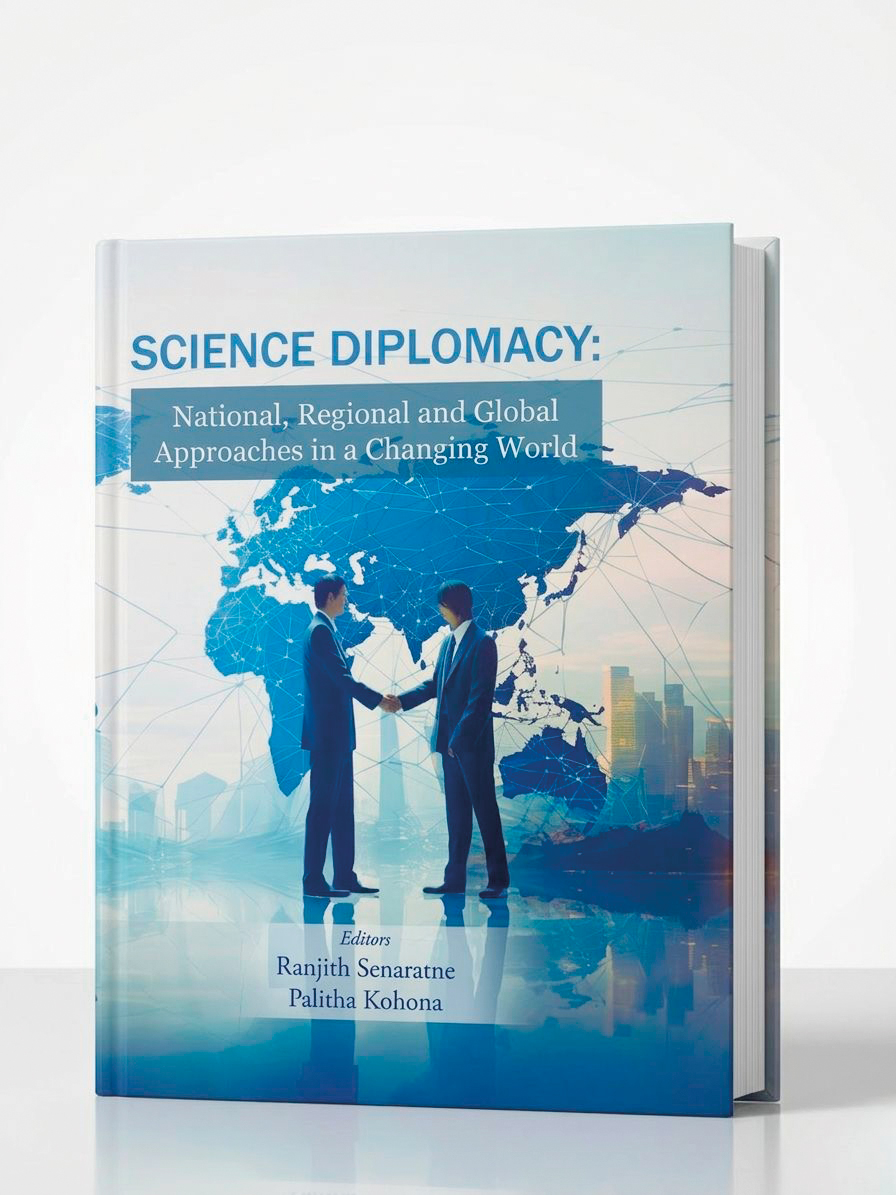
Overlaying this geopolitical transformation is a constellation of interconnected global challenges. Climate change is no longer a distant projection; it is a lived reality. Sea levels are rising. Extreme weather events are intensifying. Food, water, and energy security remain fragile. Pandemics have exposed vulnerabilities in global health systems. Cyber threats transcend borders. Environmental degradation, biodiversity loss, and marine pollution threaten livelihoods and ecosystems alike.
These challenges are systemic and transboundary. Almost every major issue — whether global, regional, or national in scale — involves science and technology, either in understanding root causes or in devising effective solutions.
Traditional diplomacy, while indispensable, is no longer sufficient on its own. The defining issues of our time are not purely political or military; they are scientific, technological, environmental, and societal. They demand evidence-based policymaking, interdisciplinary collaboration, and sustained transnational cooperation.
It is within this context that science diplomacy emerges — not as an academic abstraction, but as a strategic necessity.
Nowhere are these realities more visible than in the Indian Ocean.
Unlike the Atlantic or Pacific Oceans, which possess longstanding institutional architectures and extensive scientific mapping, the Indian Ocean remains comparatively underexplored and under-institutionalised. Covering roughly one-fifth of the world’s oceanic expanse, it carries a substantial share of global energy shipments and maritime trade. Its seabed resources — including critical and rare-earth minerals — remain only partially surveyed. Many of its coastal and island nations are developing economies with limited scientific and technological capacity to explore, monitor, and sustainably manage these resources.
The Indian Ocean is unique. It is bordered predominantly by developing and emerging states. It hosts remarkable cultural, religious, and political diversity. It is home to some of the world’s most climate-vulnerable communities. Increasingly, it has become a central theatre of global strategic competition, viewed by some nations through distinct geostrategic lenses.
This maritime space is simultaneously a lifeline and a fault line. It sustains global commerce and local livelihoods. Yet it is also a theatre where geopolitical interests intersect — sometimes converge, sometimes collide.
At the heart of this ocean lies Sri Lanka.
Geographically, our island sits astride one of the busiest East–West shipping routes in the world. Historically, Sri Lanka has been a hub of commercial, cultural, and intellectual exchange. Today, that strategic location presents both opportunity and responsibility.
Sri Lanka’s history, enriched by iconic figures such as Dr. Gamini Corea, Hon.
Lakshman Kadirgamar, Judge Christopher Weeramantry, Dr. Neville Kanakaratne and Dr. Jayantha Dhanapala, stands as a powerful testament to our long-standing contributions to global diplomacy and international governance. Our nation provided leadership within the Non-Aligned Movement, positioning itself as a bridge between civilizations at a time of deep ideological division. We also made history by producing the world’s first woman Prime Minister, affirming our commitment to political progress and inclusive governance.
Today, we are called upon once again to build upon this distinguished legacy — by championing regional unity, promoting sustainable development, and addressing critical contemporary challenges such as climate change, maritime security, and environmental sustainability.
We must navigate complex geopolitical currents while safeguarding sovereignty and strengthening economic resilience. We face vulnerabilities common to island and littoral states: climate change, coastal erosion, marine pollution, and supply chain disruptions. Our development aspirations must be balanced with environmental stewardship and maritime security considerations.
Yet within these challenges lies profound opportunity.
Sri Lanka can position itself as a regional convener — a hub for ocean science, climate research, marine biodiversity studies, disaster risk reduction, and blue economy innovation. Through platforms such as BIMSTEC, the Indian Ocean Rim Association, and SAARC, we can advance cooperative marine research, harmonise environmental standards, strengthen early warning systems, and promote sustainable maritime governance grounded in international law.
But to do so effectively, we must invest in knowledge — and in the diplomacy of knowledge.
Science diplomacy operates along three mutually reinforcing dimensions:
First, science in diplomacy — where scientific evidence informs foreign policy decisions.
Second, diplomacy for science — where diplomatic engagement enables international research collaboration and shared infrastructure.
Third, science for diplomacy — where scientific cooperation itself becomes a bridge for confidence-building, even when political relations are strained.
Importantly, science diplomacy extends beyond the natural sciences. The humanities and social sciences are equally vital. Technology must be guided by ethics. Data must be interpreted within cultural contexts. Policy must consider equity and justice. Diplomats of the future must be fluent not only in international law and negotiation, but also in scientific literacy and interdisciplinary thinking.
In a fragmented world, science offers a neutral vocabulary. It encourages transparency, peer review, and open data. It shifts discourse from rhetoric to evidence. It fosters long-term thinking in political environments often dominated by short-term calculations.
For small and vulnerable nations, science diplomacy is empowerment. It strengthens capacity. It enhances credibility. It enables engagement with larger powers on firmer ground — armed not merely with moral argument, but with data, research, and technical expertise.
The book we launch today reflects a diversity of experience and insight. It is intentionally transdisciplinary because the problems we face are transdisciplinary. It is intentionally global because no region can address these challenges in isolation.
In Sri Lanka, science diplomacy remains at a formative stage. The establishment of the Science Diplomacy Forum signals our determination to move beyond dialogue toward sustained institutional engagement. It envisions training programmes for diplomats and scientists, embedding scientific advisory mechanisms within governance structures, and building networks among universities, research institutes, industry, and policymakers. It seeks to cultivate a new generation equipped to navigate the interface between knowledge and negotiation.
We aspire for the Science Diplomacy Forum to be transformative — a true game changer.
Excellences, Ladies and Gentlemen,
We live in an era of mounting uncertainty — but also of extraordinary human ingenuity. The same interconnectedness that transmits crises also enables collaboration. The same technologies that disrupt can also heal and transform.
Change is inevitable. The deeper question is whether we will shape that change cooperatively, constructively, and inclusively.
For Sri Lanka, for the Indian Ocean region, and for the broader global community, science diplomacy offers a pathway beyond zero-sum thinking. It channels competition into collaboration around shared public goods. It aligns national interest with regional stability. It transforms vulnerability into resilience through knowledge.
Let this book be not merely a publication, but a platform for sustained reflection and action.
Let the Science Diplomacy Forum be not merely an institution, but a living bridge between evidence and policy, between research and responsibility, between nations and neighbours.
Let Sri Lanka reaffirm its role as a bridge — not a battleground — in the Indian Ocean.
In a world where rules may falter, let evidence guide us.
In a world where tensions may rise, let dialogue endure.
In a world of turbulence, let science diplomacy be our compass — guiding us toward peace, stability, dignity, and shared prosperity.
Welcome Address and Opening Remarks made by Emeritus Prof. Ranjith Senaratne
Former General President,
Sri Lanka Association for the Advancement of Science recently on the occasion of the Founding of the Science Diplomacy Forum and the Launch of the Book Science Diplomacy:
National, Regional and Global Approaches in a Changing World

From one day of celebration to 364 days of transformation
The international women’s day was just celebrated all over the world. I saw many organiations share their slogans, and organize panel discussions, presentations, and exhibitions to support women empowerment. Slogans, themes, colors play vivid and vociferous role across the world, commemorating the international women’s day.
Alas, the colors are faded, slogans are weaned, themes are forgotten, over the next 364 days, pushing UN Chapter on Women’s Rights come up with more illustrious themes and slogans.
From Bread and Peace to Rights and Action
According to the recorded history, the Women’s day first introduced on 28th February 1909 in America, raising a voice of women against poor working conditions and poor pay in garment factories. This took a more revolutionary form in 1917 in Russia against World War I, where a mass of women protested under the theme of “Bread and Peace”.
Starting from basic needs such as bread and peace, the International Women’s Day theme has evolved towards freedom and independence, justice and inclusion.
Over the years, the rise of feminism brought cultural refinements and highlighted women’s rights. Looking back the historical evolution of women’s role, we see that matrimony has faded and patriarchy evolved with religious and geopolitical forces intertwined with the social expectation. The importance and respect for women, given in the ancient civilisations, diminished with medieval civilization, and subsequent colonisation. The rise of patriarchy domesticated women as homemakers, at the same time prompting their voices to rise for dignity and equitable treatment.
Rise of Feminism
In a typical Western-household of 20th century, husband was the bread winner of the family and the wife managed household affairs. In this era, women’s affairs were restricted to daily chores, creating a boundary wall restricting their access to corporate jobs, free voices. Betty Friedman was a remarkable lady who observed the domestic suffering of women and challenged ‘feminine mystique’ through her 1963 book. She disclosed the feminine mystique, which celebrated women as good housewives, and the belief that women could find satisfaction from domestic chores, home making, marriage, raising children, cooking, washing and taking care of husband’s needs. Betty disclosed that the unhappiness and boredom experienced by the domesticized women, and their inability to live up to the feminist mystique defined by the male dominant society had no name and difficult to express in words. Betty’s claim was supported by the theories of Abraham Maslow, who introduced motivation to grow along the hierarchy of needs. Betty, declared that feminine mystique denies basic growth needs of women, where their desires limited to shelter, food, safety and love only.
In this era women’s jobs were confined preeminently to teaching, and caregiving. STEM fields: science, technology, engineering and medicine were dominated by males, leaving less space for women. As you may have heard in the medieval era women who practiced medicine were branded as ‘witches’ and many were burned alive rooting out the knowledge and courage of women. Women who practiced and taught science and astronomy, were also branded for witch craft and condemned to death. The social pressure suppressed women confining them to domestic chores. In the industrial era women were hired for factory work under low wages and less facilities. In this period Women’s organisations were gathered demanding freedom and justice for women, calling for equal opportunities and rights enjoy their male counterparts. The evolution of women’s movements culminated in 1975, where the first International Women’s Day was commemorated on 8th March 1975.
Celebration and Contradiction
Since 1975, women were celebrated for a day in every year across the globe, with various themes and color codes to showcase the world that all women have rights and demanding fair treatment. The theme colors of International Women’s day are Purple, Green and White.
Purple stands for justice, dignity, and loyalty to the cause.
Green for hope and growth.
White for purity and unity.
In 1996, the International Women’s Day declared a theme to embrace, which is; “Celebrating the Past, Planning for the Future.” In the year 2023, the theme was ‘Embrace Equity’, which evolved to ‘Inspire inclusion’ in 2024, and the year 2025 theme was ‘Accelerate Action’. In 2026, there are three themes; 1. Give to Gain, 2. Balance the Scales, 3. Rights. Justice. Action.
Fragmented Focus Diminishes Values
Multiple themes and competing messages can unintentionally dilute momentum. Unity is not uniformity, but coherence matters; shared direction makes shared progress possible. Emerging three themes to celebrate international women’s day in 2026, implicate lack of solidarity, and unity among women’s organizations to share a common theme. Inclusion, equity and accelerated action have not yet achieved by the women globally, neither locally, nor in small communities. We are bound to question whether the women stay true to the meanings of theme colors that represent womanhood.
Thus, isn’t it vital to explore what goes wrong with our themes and slogans on this Women’s day, before setting foot without solid foundation for what we claim for? Or is it only a day that dawn women’s organisations to gather women in elite society, or identified group of women to enjoy a cup of tea over futuristic speeches of identical society, which treat women with high respect and equity?
One thing we must understand is the world is evolving, so does the roles, rights, and actions of women. Although, women shouted and pleaded for opportunities to enter male dominate world of work, today in many countries including Sri Lanka, women occupies majority of administrative positions and clerical level jobs. Even, the labour positions, dominated by males, are now occupied by the females in many sectors. However, women still bear the traditional homemaker role as well, while juggling with work, and studies to sustain jobs and promotions. This modern day scenario has made women more prone to chronic stress related deceases. The break of rest, too rigid demands coming from work and family, their own desires to move up the corporate ladder, outsmart neighbourers, and craving to make their children better than the others have made women’s lives miserable and breaching the themes and slogans that cater to the women’s prosperity.
Today’s environment has resulted many women to abandon dignity, purity, and hope, overlook unity and justice. If you see social media contents shared by women, you may not be surprised by my statements. The dignity, purity and hope for betterment of women is vanishing on screen. Young girls’ addiction to drugs, liquor and tobacco, sexual misbehaviour, and rising school-aged pregnancies are critical concerns that women’s movements must pay attention today.
What We Must Demand Now: Right Education and Just Acts
Women’s day slogans need a shift. Rather than demanding equal rights as men, we must demand right education for women and girls. We shall not stop at demanding justice as given to the men, but shout and make women and girls aware of ‘Just Acts’, and encourage them to act justly, for themselves, without exposing them to be victims of social media, and ill temptations.
Digital lives of women and girls can amplify comparison, quick outrage, and performative ideals. For girls and women, this can mean unrealistic bodies, curated success, and unsafe online spaces. What we need isn’t more judgment; it’s digital literacy, psychological safety, reproductive health awareness, and robust support systems, so women can flourish on and off‑line. We must educate women and nourish and foster the moral values among women and girls to stay pure in thoughts and actions, we must empower women and girls to keep hope and grow continuously. We must share a culture of inclusion among women to enhance solidarity and stay true to unified action for the betterment of women, and the society.
Women as Creators and Modifiers of the World
The history of International Women’s Day is a call for rights and justice. Today, the next horizon is to build cultures at home, at work, and society. Women are the creators and modifiers of the world. They are to add color to lives of those around them. In fact, WOMEN, do not need to call for justice, rights and action. WOMEN, need to call the hidden power, strength and courage within them and create a world that assures every being in it receives justice, and enjoys rights.
Thus, whether themes multiply or fade, the test is not in the rally or the ribbon, it is in the 364 days after. The colours may be vivid on stage, yet the colors are faded in practice if we do not live them. Let us re‑design life with dignity, unity, courage, and continuous growth. Let us educate, include, and act justly. Let us awaken strength within, so that every woman, every girl, and every community can thrive by being a Woman Who Re‑designs Life!
(The author is a senior education administrator, researcher,
management consultant and a lecturer.)
By Dr. Chani Imbulgoda
cv5imbulgoda@gmail.com)
Features
Illegal solar push ravages Hambantota elephant habitat: Environmentalist warns of deepening crisis

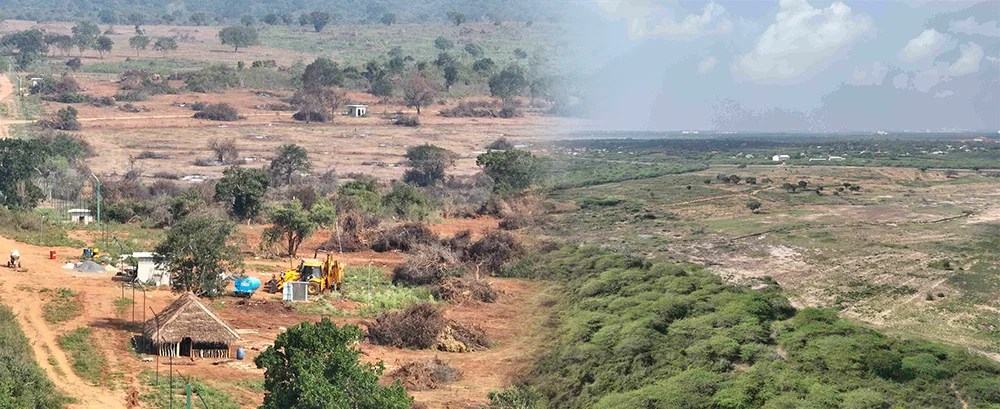
A large-scale move to establish solar power plants in Hambantota has triggered a major environmental and social crisis, with more than 1,000 acres of forest—identified as critical elephant habitat—cleared in violation of the law, environmental activist Sajeewa Chamikara said.
Chamikara, speaking on behalf of the Movement for Land and Agricultural Reform, said that 17 companies have already begun clearing forest land along the boundaries of the Hambantota Elephant Management Reserve. The affected areas include Sanakku Gala, Orukemgala and Kapapu Wewa, which are known to be key elephant habitats and long-used movement corridors.
He said that what is taking place cannot be described as development, but rather as a large-scale destruction of natural ecosystems carried out under the cover of renewable energy expansion.
According to Chamikara, the clearing of forests has been carried out using heavy machinery, while large sections have also been deliberately set on fire to prepare the land for solar installations. He said that electric fences have been erected across wide stretches of land, effectively blocking elephant movement and fragmenting their natural habitat.
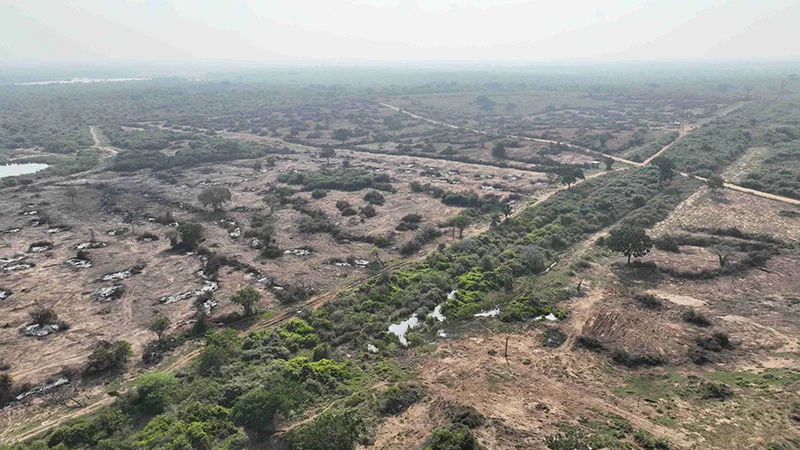
“These forests are not empty lands. They are part of a living system that supports wildlife and nearby communities. Once destroyed, they cannot be easily restored,” he said.
The projects in question include a 50 megawatt solar development undertaken by five companies and a larger 150 megawatt project implemented by 12 companies. The larger project is reported to be valued at around 150 million US dollars.
Chamikara stressed that these projects are being carried out in a coordinated manner and involve extensive land clearing on a scale that raises serious environmental concerns.
He further alleged that certain companies had paid about Rs. 14 million to secure support and move ahead with the projects. He said this points to a troubling failure of oversight by state institutions that are expected to protect forests and wildlife habitats.
“This is not only an environmental issue. It is also a serious governance issue. The institutions responsible for protecting these lands have failed in their duty,” he said.
Chamikara pointed out that under the National Environmental Act, any project of this scale must receive prior approval through a proper Environmental Impact Assessment process.
He said that clearing forest land before obtaining such approval is a direct violation of the law.
He added that legal requirements relating to archaeological assessments had also been ignored. Under existing regulations, large-scale land clearing requires prior evaluation to ensure that sites of historical or cultural value are not damaged.
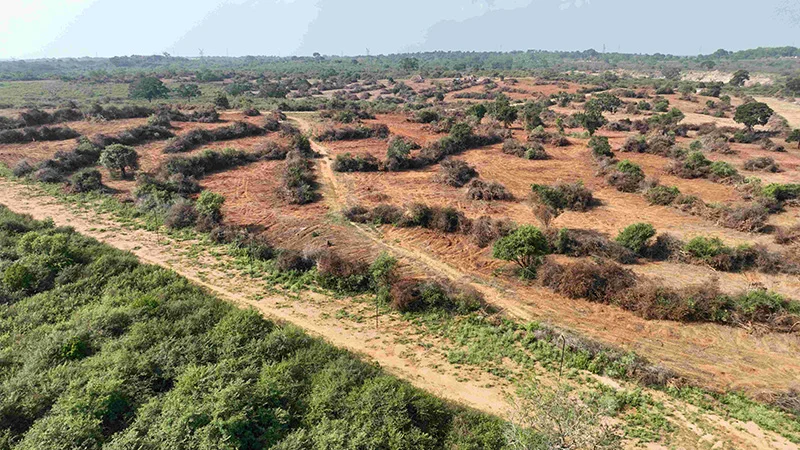
“The law is very clear. You cannot go ahead with projects of this nature without proper approval. What we are seeing is a complete disregard for legal procedure,” Chamikara said.
The environmental impact of these activities is already becoming visible. With their natural habitats destroyed, elephants are increasingly moving into nearby villages in search of food and shelter. This has led to a sharp rise in human-elephant conflict in several areas.
Areas such as Mayurapura, Gonnooruwa, Meegahajandura and Thanamalvila have reported increasing encounters between humans and elephants. According to Chamikara, more than 5,000 farming families in these areas are now facing growing threats to their safety and livelihoods.
He warned that farmers are being forced to abandon their lands due to repeated elephant intrusions, while incidents involving damage to crops and property are rising. There have also been increasing reports of injuries and deaths among both humans and elephants.
“This is turning into a serious social and economic problem. When farmers cannot cultivate their lands, it affects food production, income and rural stability,” he said.
Chamikara also raised concerns about the broader environmental consequences of clearing forests for solar power projects. While renewable energy is promoted as a solution to reduce carbon emissions, he said that destroying forests undermines that goal.
“Forests play a key role in absorbing carbon dioxide. When you clear and burn them, you are increasing emissions, not reducing them. That defeats the purpose of promoting solar energy,” he explained.
He added that large-scale deforestation in dry zone areas such as Hambantota could also affect local weather patterns and reduce rainfall, which would have further negative impacts on agriculture and water resources.
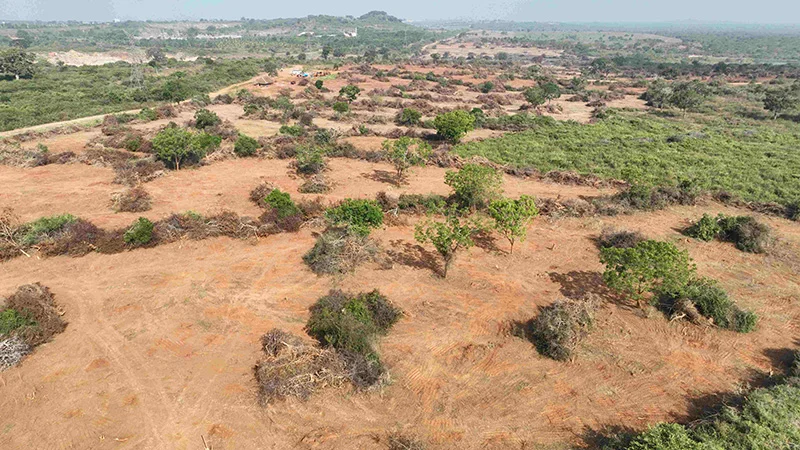
Chamikara called for a shift in policy, urging authorities to focus on more sustainable approaches to solar power development. He said that rooftop solar systems on homes, public buildings and commercial establishments should be given priority, as they do not require clearing large areas of land.
He also recommended that solar projects be located on degraded or abandoned lands, such as areas affected by past mining or other low-value lands, rather than forests or productive agricultural areas.
“Renewable energy development must be done in a way that does not destroy the environment. There are better options available if there is proper planning,” he said.
Chamikara urged the Central Environmental Authority and the Department of Wildlife Conservation to take immediate action to stop ongoing land clearing and investigate the projects. He stressed that all activities carried out without proper approval should be halted until legal requirements are met.
He warned that failure to act now would lead to long-term environmental damage that could not be reversed.
“If this continues, we will lose not only forests and wildlife, but also the balance between people and nature that supports rural life. The consequences will be felt for generations,” he said.
The situation in Hambantota is fast emerging as a critical test of whether development goals can be balanced with environmental protection. As pressure grows, the response of authorities in the coming weeks is likely to determine whether the damage can still be contained or whether it will continue to spread unchecked.
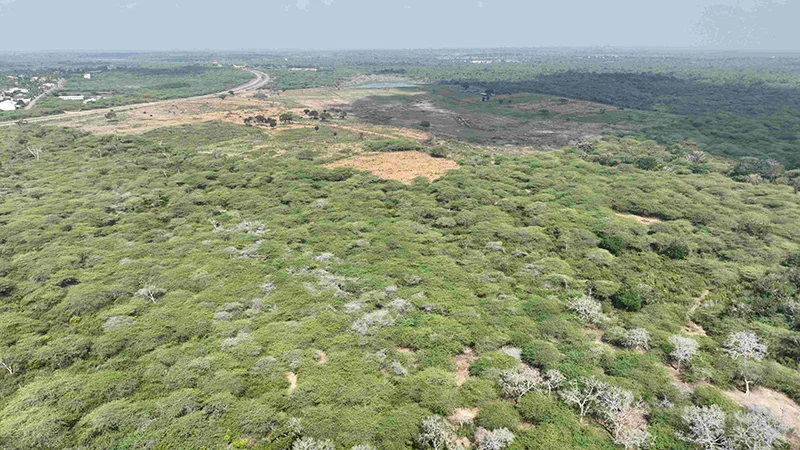
By Ifham Nizam

CIABOC tells court Kapila gave Rs 60 mn to MR and Rs. 20 mn to Priyankara

Opposition moves no-faith motion against Energy Minister Kumara Jayakody

NJC takes up cudgels on behalf of Sallay, who played pivotal role in combating terrorism

Leopards haunt Pera Uni having already killed several cattle at Vet Faculty

Fifa rules women’s teams must have female coaches

Banks to operate five days a week; shorter hours on Wednesday

‘Dates have the highest sugar content to fight Coronavirus’

Sunday Island 27 December – Headlines

#SundayIsland 17th December – Headlines

Sunday Island – 28th March

Sunday Island Headlines – 21 March

Sunday Island – 21st February – Headlines
-

 Business4 days ago
Browns EV launches fast-charging BAW E7 Pro at Rs. 5.8 million
-

 Life style5 days ago
From culture to empowerment: Indonesia’s vision for Sri Lanka
-

 News2 days ago
CIABOC questions Ex-President GR on house for CJ’s maid
-
 Business6 days ago
Sri Lanka Institute of Information Technology raises the bar for academic excellence
-

 Life style5 days ago
Ranjith Fernando celebrates cricketing journey with Hob Nails to Spikes
-

 Latest News5 days ago
QR code system will be implemented for fuel with effect from 06.00 a.m. today (15th)
-

 News3 days ago
Australian HC debunks misleading travel risk claims for Sri Lanka
-

 News3 days ago
Sri Lankan marine scientist Asha de Vos honoured at UNGA opening