
Editorial
To dock or not to dock


Monday 15th August, 2022
Sri Lanka is like a storm-tossed bark struggling to remain afloat in an ocean of economic trouble; it is lucky to have avoided a head-on collision with a massive Chinese vessel, Yuan Wang 5 (YW-5), a ballistic missile and satellite-tracking ship, which is on its way to Hambantota. Colombo has finally stopped dillydallying and decided to allow the vessel to make a port call. India and the US have softened their collective stance on the Chinese ship’s visit. It was thought that the YW-5 issue would lead to a bitter diplomatic row with India, and if what was feared had come to pass with New Delhi cranking up pressure on Colombo to deny YW-5 permission to dock, it would have been a double whammy for Sri Lanka, which is dependent on the restructuring of Chinese debt to secure the much-needed IMF bailout package, and cannot afford to antagonise India, which is propping up its economy. All’s well that ends well.
There are lessons to be learnt from the ship controversy. Colombo was initially all at sea. The Rajapaksa-Wickremesinghe government seemed divided on the issue with vital information one needed to figure out the provenance of the issue being suppressed. So, the arguments and counterarguments anent the issue were based on surmises, hunches, assumptions, hearsay, etc. Thankfully, the Foreign Ministry has put the record straight albeit belatedly.
It behoves Sri Lanka to be mindful of India’s security concerns in handling maritime affairs. Perhaps, it is not the scheduled arrival of YW-5 as such that New Delhi was concerned about but the possibility of China continuing to use the Hambantota Port to berth more such vessels in the future. (China would not have secured a port in a strategic location in the Indian Ocean for nothing!) It is only natural that India and its QUAD allies think China is testing the water.
It is the voice of the QUAD that one has heard through the critics of the YW-5 voyage. There is reason to believe that they are promoting a US-led drive to isolate China internationally. YW-5 embarked on its current voyage amidst a Chinese naval exercise near Taiwan in response to US Speaker Nancy Pelosi’s recent controversial visit to Taipei notwithstanding objections from Beijing.
Colombo has acted tactfully by reportedly asking India and the US to specify the reasons for their misgivings about the Chinese vessel’s port call. However, it defies comprehension why Colombo requested Beijing to defer the arrival of YW-5 at Hambantota for replenishment, after granting permission.
Meanwhile, the argument that China is sending its survey vessel all the way to Hambantota to spy on South India does not sound tenable. In fact, it reflects naivety on the part of those who make that claim, for China is equipped to spy on its rivals without taking the trouble of deploying its ships and drawing international attention to such missions unnecessarily. In this day and age, technology is so advanced that information about even what lies at the edge of the universe, as it were, could be gathered without any craft ever getting anywhere near it.
Sri Lanka is already battered and bruised enough economically and certainly does not want any diplomatic rows to contend with. It has to get its foreign policy right. It had better take steps to avoid issues like the docking of YW-5 in the future lest it should become a victim of the big-power rivalry, which is intensifying; it ought to decide what types of ships will be allowed to berth at its ports, formulate a policy to that effect and make it known to the rest of the word so that unnecessary controversies could be averted, and hegemonic nations bent on projecting their power on a global scale will not be able to flex their naval muscles at the expense of Colombo.


Monday 12th October, 2026
Fifty-one government MPs have proposed a parliamentary select committee (PSC) probe into the 1983 anti-Tamil violence, known as Black July, and make recommendations to Parliament. Their call has come close on the heels of a private member’s motion presented by Democratic Tamil National Alliance MP Selvam Adaikalanathan, demanding that a Presidential Commission of Inquiry be appointed to establish the truth about the 1983 ethnic violence, assess the damage and recommend measures to prevent its recurrence. The government has argued that a parliamentary select committee will be a far more effective mechanism than a presidential commission to examine the tragic events, enforce accountability and promote reconciliation.
There is no reason why the government cannot appoint a Presidential Commission to probe Black July. The calls for fresh probes into the 1983 anti-Tamil pogrom indicate that questions about the adequacy of previous investigations have remained unresolved for more than four decades. Those efforts did not result in a comprehensive, independent and effective process for holding the organisers and perpetrators of the violence criminally accountable.
The problem with parliamentary probe committees is that the ruling party can manipulate them by appointing a majority of their members. How the UPFA government used a PSC in 2012 to harass the then Chief Justice Dr. Shirani Bandaranayake before clearing the way for her ‘impeachment’ is a case in point.
The current government led by the JVP should have launched an investigation into the 1983 anti-Tamil pogrom much earlier. A thorough probe may shed light on hitherto undisclosed aspects of organised anti-Tamil violence, and the survivors of the pogrom and the families of the victims deserve justice. The Jayewardene government falsely blamed the JVP, the Communist Party and the Nava Sama Samaja Party for the pogrom and proscribed them. The JVP could not have its proscription removed and remained underground. The Jayewardene regime created conditions for the second JVP uprising, which plunged the country into a bloodbath.
Several other campaigns of violence, including mass killings, have not been properly investigated. The JVP’s terror campaign in the late 1980s and the equally brutal counter terror operations conducted by two UNP governments, under Presidents Jayewardene and President Ranasinghe Premadasa, claimed tens of thousands of lives. Those crimes must also be investigated. The incumbent government promised to launch a probe into the Batalanda torture chamber, but baulked at doing so. Maybe it did not want to open a can of worms. The JVP-led government has taken steps to reopen or expedite investigations into high-profile assassinations and other crimes under previous governments. But it has not ordered a probe into the extrajudicial execution of its own founding leader, Rohana Wijeweera, while in state custody, in 1989.
In June 2014, the Retired Senior Police Officers’ Association requested the Presidential Commission to Investigate Complaints Regarding Missing Persons to investigate the massacre of approximately 600 policemen by the LTTE in the Eastern Province in 1990. The commission identified the massacre as one of several grave incidents requiring further investigation by a special probe team with a view to gathering evidence for criminal proceedings. The police personnel surrendered to the LTTE on the orders of the Premadasa government. It is believed that many of them may have survived if they had been allowed to fight. SJB MP Chaminda Wijesiri has been sentenced to an 18-month jail term for obstructing, threatening and assaulting a group of police officers, but the massacre of 600 policemen has not been probed. This contrast raises an uncomfortable question: why do the police act decisively in individual cases while the 1990 massacre of their own personnel remains uninvestigated.
Any future PSC probe into the 1983 ethnic violence should focus on the findings of previous investigations, their inadequacies, why their recommendations were not fully implemented, whether fresh evidence could be ascertained, and, most all, what practical steps could be taken to address the continuing demand for truth and accountability.
One can only hope that the proposed PSC probe is not intended to distract public attention from the government’s failure to fulfil its election pledge to hold the Provincial Council elections within one year of assuming office.

The past few weeks have seen several high-profile arrests, much to the delight of critics of former rulers whose governments were widely associated with abuse of power, the suppression of democracy, political interference in key state institutions and corruption.
The arrest and remand of former First Lady Shiranthi Rajapaksa have triggered what may be described as a social media feeding frenzy, with government propagandists having a field day. The Rajapaksas and their allies were accused of manipulating legal and judicial processes for political expediency and harassing the Opposition when they were in power. Today, the boot is on the other foot, and they are crying foul. If only they had realised then that those who manipulate the law for political ends might one day find themselves at the receiving end of the same treatment.
It is hardly surprising that the JVP-led government is accused of resorting to show arrests and detentions to divert public attention from pressing issues and advance its political agenda. The government has gone on the offensive, seeking to neutralise key Opposition figures politically. Its modus operandi brings to mind Maslow’s hammer, the cognitive bias of relying excessively on a familiar tool or approach to tackle every problem, much like someone who has only a hammer and sees every problem as a nail. Critics see the suppression of dissent as ingrained in the JVP’s political culture and consider it naïve to expect a JVP-led government to refrain from using state power against its political opponents. After all, successive governments have done so, setting deeply damaging precedents.
Minister and Leader of the House Bimal Rathnayake took great pains in Parliament on Thursday to debunk the Opposition’s claim that the government has launched a witch-hunt against its political rivals. He sought to convince the House and the public that the government had nothing to do with most of the court cases and investigations against the Opposition politicians and their family members. He said all cases against Opposition politicians, except a few, had been filed during the Yahapalana and SLPP governments. If it is true that the cases were initiated under previous administrations, can the JVP/NPP leaders legitimately claim credit for fulfilling their pledge to punish the corrupt? Shouldn’t that credit go to the UNP and the SLFP, the two main constituents of the Yahapalana coalition?
Can anything be more disingenuous than politicians’ claims that they keep their hands off the legal process and the administration of justice? Governments in this country are notorious for making the wheels of justice turn at a politically expedient pace, often resorting to flimsy excuses to justify their shameful actions. While justice delayed is justice denied, justice hurried is justice buried. Justice must be neither delayed nor rushed to achieve political ends. It must be allowed to take its course, free from political interference. This has not happened under any government during the past several decades.
Some suspects are arrested and remanded or detained even before investigations against them get underway in earnest. Such action ought to be the exception, if it is warranted at all, rather than the rule. Otherwise, it could turn law enforcement into political theatre and investigations into a witch-hunt in the eyes of the public. The police and the Commission to Investigate Allegations of Bribery or Corruption must therefore act with such impartiality and professionalism that they cannot reasonably be accused of staging arrests to help the government of the day score political points. As legal experts have pointed out, premature arrests before investigations have established reasonable grounds for suspicion, risk violating individual liberty and the presumption of innocence, compromising the gathering of reliable evidence, and undermining public confidence by making law enforcement appear politically motivated or driven by a desire for publicity rather than justice. Perceptions matter as much as reality when it comes to the dispensation of justice.
The incumbent leaders ought to remember that they, too, will eventually lose their grip on power and may sooner or later have to answer for their actions. Their administration is already facing very serious questions over several controversies, including the release of 323 shipping containers without mandatory inspections, coal procurement, the disappearance of US$ 2.5 million from Treasury funds and alleged import rackets. When the Rajapaksas were at the height of their power, who would have imagined that some of them, too, would one day find themselves in remand prison? The incumbent leaders and their associates would do well to learn from their predecessors’ predicament.

Saturday 10th October, 2026
It will soon be showtime in Parliament. The Opposition has submitted a motion of no confidence against Speaker Dr Jagath Wickramaratne to Secretary General of Parliament Kushani Rohanadheera. Debates on no-confidence motions invariably descend into slanging matches, with members of both sides of the House trading insults and dragging one another’s reputations through the mud.
The motion of no confidence reportedly contains about 50 allegations, including misconduct, misuse of public property, financial irregularities, conflict of interest and violation of parliamentary procedures. The Opposition has called upon the Speaker to step down immediately.
The fate of no-confidence is not difficult to guess. What determines the outcome of a vote on such a motion is the numbers the opponents and the proponents can muster. There is no such thing as a conscience vote in the Sri Lankan Parliament. The Opposition has only 66 members as opposed to the government’s 159 including the Speaker. Some Opposition MPs are accused of running with the hare and hunting with the hounds. They disappear during crucial votes in the House. So, the no-confidence motion against the Speaker is doomed. The Opposition cannot be so naïve as to expect a different outcome; it is apparently planning to use the motion to inflict maximum possible damage on the government.
Gone are the days when the Speakers acted impartially, commanding the respect of all members of the House. Over the past several decades, the Chair has been reduced to little more than an appendage of the government of the day. Hence the Opposition’s frequent complaints of grievances. Worryingly, the campaigners for democracy and rights and privileges of lawmakers act out of expediency rather than principle once ensconced in power.
Ideally, the Speaker should be independent of political parties if he or she is to act impartially. Time was when political parties did not field candidates to challenge the Speakers at general elections. That helped A. F. Peiris (1952) and R. S. Pelpola (1960) enter Parliament without facing competition. The practice was that a Speaker would not normally be opposed at the next general election, reflecting the expectation that the office should be impartial and above party politics.
There have also been instances where the Speakers were elected unanimously in Parliament. They include Speaker Wickramaratne, his predecessors Asoka Ranwala and the late Anura Bandaranaike. Sadly, Ranwala had to resign over a degree certificate issue and Dr Wickramaratne is facing a no-confidence motion.
A government with a parliamentary majority can shoot down no-confidence motions with ease, but the issues raised by the Opposition do not go away. The SLPP-UNP government defeated a no-confidence motion against the then Health Minister Keheliya Rambukwella over a procurement scam, but subsequently he was prosecuted. It also defeated a no-confidence motion against Speaker Mahinda Yapa Abeywardena. But both the SLPP and the UNP suffered humiliating defeats at the last general election. Most of the SLPP MPs who voted to defeat the no-confidence motions against Rambukwella and Abeywardena could not even contest the last general election. The NPP MPs defeated a no-confidence motion against the Energy Minister Kumara Jayakody, but he had to step down subsequently albeit over some other allegation and legal action. This is something the JVP/NPP politicians who think no end of their supermajority ought to take cognisance of.

Showers above 75 mm are likely at some places in the Western, Sabaragamuwa, Central, Southern, Uva and North-Western provinces and in Anuradhapura and Mannar districts.

New prison regulations for monks serving jail terms soon: President’s Office

CP alleges NPP has taken the blame for illegal US sanctions on Iranian vessels

Ex-Tiger witness claims Ekneligoda proposed to fire missile at MR’s plane

Chandrasekaran welcomes Indian stand of Katchatheevu

Alleged killer of couple apprehended

‘Dates have the highest sugar content to fight Coronavirus’

Sunday Island 27 December – Headlines

#SundayIsland 17th December – Headlines

Sunday Island – 28th March

Sunday Island Headlines – 21 March

Sunday Island – 21st February – Headlines
-

 Features4 days ago
The Sri Lankan who made Scottish history
-

 Features6 days ago
Preventing grievances from becoming communal
-

 Sports4 days ago
Nissanka absence opens door for Sri Lanka’s young guns
-

 News5 days ago
Gnansara Thera to be assigned to prison printing section: Officials
-

 News3 days ago
NDB fraud Rs 60mn more than reported
-

 News3 days ago
Removing monk’s robes matter for Sangha to decide: Mahanayake Theras
-

 Features4 days ago
Future of Sri Lanka’s state university system: Should it be shut down and reopened?
-
 News5 days ago
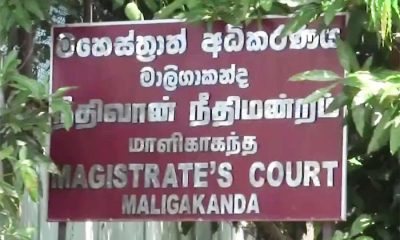
OIC of FCID summoned before Maligakanda Magistrate