
Latest News
Titan submersible imploded due to poor engineering, say US officials


OceanGate’s Titan submersible imploded on its journey to the wreck of the Titantic because of poor engineering and multiple failures to test the vessel, according to an official report.
Titan imploded in June 2023, killing all five passengers on board including OceanGate’s chief executive.
The US National Transportation Safety Board (NTSB) found the engineering process behind the vehicle was “inadequate”, resulting in faults which meant it failed to meet strength and durability requirements.
The NTSB said because the firm did not adequately test Titan it did not know its actual strength. It was also unaware it was damaged and should have been removed from service before its last voyage.
Titan disappeared in the North Atlantic as it attempted to dive to the wreck of Titanic which lies some 372 miles from St. John’s in Newfoundland and Labrador in Canada.
In August, the US Coast Guard released a damning report into the implosion which found that the incident was ‘preventable’ and criticised OceanGate’s “critically flawed” safety practices.
Stockton Rush, OceanGate’s chief executive and co-founder, operated the Titan on its final journey.
The passengers, who paid up to $250,000 each to take part in the dive, deep-sea explorer Paul-Henri Nargeolet, Shahzada Dawood and his 19-year-old son Suleman Dawood and Hamish Harding.
Designed and built by OceanGate, the Titan was 6.7m (22ft) long with a passenger compartment made of carbon fibre, with titanium used in its domes and some other segments.
The doomed submersible which imploded at a depth of 3,363m (11,033ft) – the Titanic wreck is located at 3,880m – was the second version of the craft. OceanGate had condemned the first version following testing.

During its investigation, the NTSB discovered issues with the safety culture at OceanGate.
While some employees said safety was a priority, others, including a former director of marine operations and a technician, highlighted an environment “where safety issues, particularly design issues, were ignored”.
One technician at the firm said he had concerns about OceanGate’s business model, in particular accepting paying clients as “mission specialists” as opposed to passengers.
Under US regulations, it is illegal to transport passengers in an experimental submersible.
The technician told the NTSB that he informed Mr Rush: “you can’t just change the title of a person when you’re receiving compensation.”
In a later conversation on the same subject, the technician recounted that Mr Rush said: “If the US Coast Guard became a problem, he would buy himself a congressman and make it go away”.
OceanGate has permanently wound down its operations since the incident.
In its report, the NTSB discovered that a contributing factor to the implosion was that US and international voluntary guidance and US small passenger vessel regulations “were insufficient to ensure OceanGate adhered to established industry standards”.
The NTSB has recommended that the US Coast Guard commissions a study into how so-called pressure vessels which carry people are assessed and, if changes are suggested, regulations be updated.
[BBC]

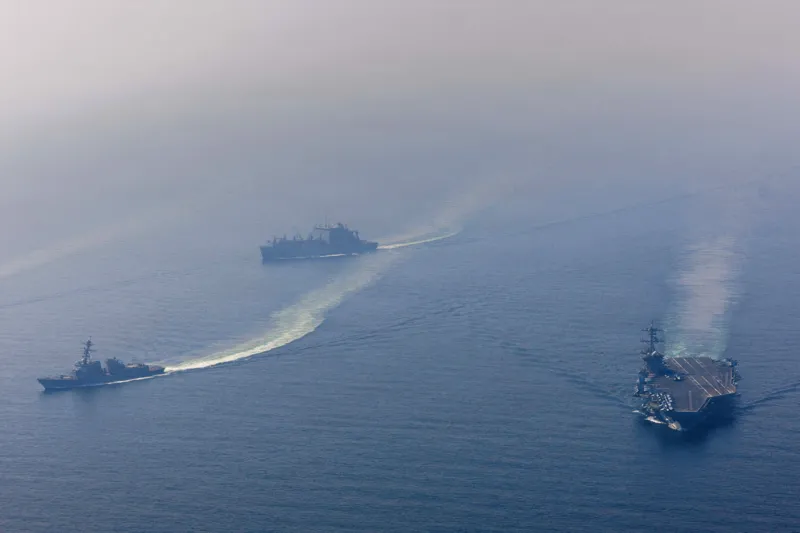
BBC Verify has confirmed the location of US aircraft carrier the USS Abraham Lincoln near Iran using satellite imagery, as Washington continues to put pressure on the country over its military program and recent deadly crackdown on protesters.
US and Iranian officials are set to meet in Swizerland on Tuesday for a second round of talks. Iran says the meeting will focus on its nuclear programme and the potential lifting of economic sanctions imposed by the US. Washington has previously indicated it wants to discuss other issues as well.
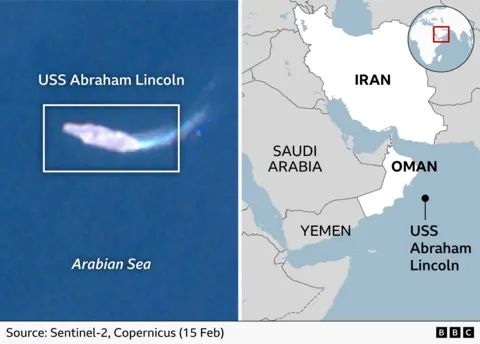
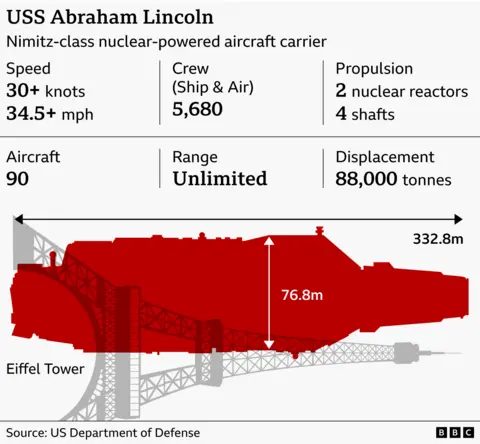
The Abraham Lincoln, which leads a strike group with three guided missile destroyers, carries 90 aircraft including F35 fighters, and 5,680 crew, was reportedly deployed to the Gulf region in late January but has not been seen in satellite imagery until now. It has been located off the coast of Oman, around 700km from Iran.
The US has also reportedly sent the USS Gerald R Ford, the world’s largest warship, to the Middle East, which could arrive in the region within the next three weeks.
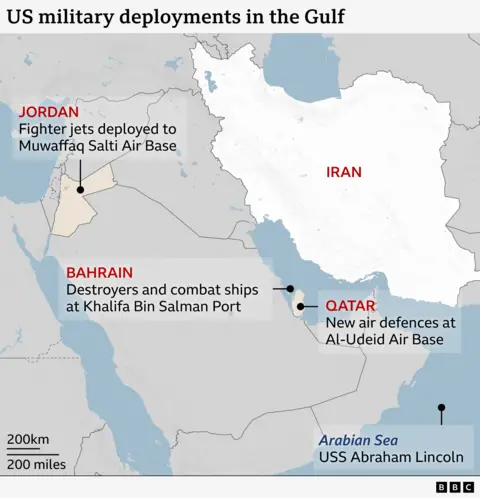
The Abraham Lincoln’s arrival adds to what we know about the current US military build-up in the Middle East over the past few weeks, where BBC Verify has tracked an increase of US destroyers, combat ships and fighter jets in the region.
Publicly available images from the European Sentinel-2 satellites show Abraham Lincoln in the Arabian Sea around 150 miles (240km) off the coast of Oman.
It had not been seen since it reportedly entered the region in January but it had been crossing the open sea where satellite coverage is limited. Military assets on land are more visible and frequently captured on satellite.
It means we have now tracked 12 US ships in the Middle East through satellite imagery: the Abraham Lincoln, a nuclear-powered Nimitz-class carrier, which together with three Arleigh Burke class destroyers forms a carrier strike group; plus two destroyers capable of carrying out long-range missile strikes and three specialist ships for combat near to the shore that are currently positioned at Bahrain naval station in the Gulf. Two other destroyers have been seen in the eastern Mediterranean near the Souda Bay US base, and one more in the Red Sea.
We have also been following the movements of US aircraft in the region, where we have seen an increase of F-15 and EA-18 fighter jets stationed in Muwaffaq Salti military base in Jordan, and an increase in US cargo planes and refuelling and communications aircraft moving towards the Middle East from the US and Europe.
The US Central Command released images of the Abraham Lincoln flanked by destroyers, fighter jets, surveillance aircraft and coastguard vessels in the Arabian Sea in an apparent show of military prowess on 6 February, which Iran has met with its own show of force.
On Monday the Islamic Revolutionary Guard Corps (IRGC) launched a maritime drill in the Strait of Hormuz, located in the Gulf between Oman and Iran. The drill saw IRGC Commander‑in‑Chief Maj Gen Mohammad Pakpour inspecting naval vessels at a harbour before missiles are seen launching from a ship, the IRCG-linked Tasnim News Agency reported.
The Strait is considered one of the world’s most important shipping routes and a vital oil transit choke point. Around a fifth of the world’s oil and gas flows through the Strait, including from Kharg Island, Iran’s main oil export terminal. Pakpour was seen flying over the island in a helicopter in the report showing Iran’s latest military manoeuvres.
Military intelligence expert Justin Crump told BBC Verify that the current US military preparations in the Middle East show “more depth and sustainability” than its manoeuvres ahead of the seizure of former Venezuelan president Nicholas Maduro in January, or the operation carrying out air strikes on Iran’s nuclear facilities last June.
They all feature a carrier strike group and several destroyers operating independently. However, the US deployed its assets in Venezuela and Iran last year under quite different circumstances.
The US deployed the Gerald R Ford to the Caribbean ahead of its strikes on Venezuela, one of eight warships we tracked in the region at the time, though it used fewer aircraft as it could easily send jets from surrounding US bases on America’s mainland or from its base in Puerto Rico instead. The US also deployed amphibious assault ships within the Caribbean, which can be used as launch platforms for helicopter operations as was seen with the capture of Maduro. But Venezuela’s military is generally seen as less capable of defending itself or retaliating against the US.
When the US struck Iran last year in Operation Midnight Hammer, which targeted Iran’s nuclear facilities, it was attacking a country with a much more powerful military than Venezuela. Iran’s military is capable of hitting US bases across the Middle East.
During Midnight Hammer the US had two aircraft carrier strike groups in the region, five destroyers placed in the Mediterranean and Red Seas, and three combat ships in the Gulf. It had also moved squadrons of fighter jets and refuelling aircraft from the US to Europe, but the B2 stealth bomber flights that were used to hit the Fordo, Isfahan and Natanz nuclear sites actually took off from US bases in Missouri.
Crump, chief executive of risk and intelligence company Sibylline, said the build-up of US warships and aircraft, as well as eight existing airbases in the region would allow it to conduct a “fairly intensive and sustained strike rate” of about 800 sorties a day, with the aim of rendering any Iranian responses “ineffective”.
“What we are seeing isn’t just strike preparation, but rather a broader deterrent deployment capable of being scaled up or down,” he said. “This means it has more depth and sustainability than the force packages arranged for either Venezuela or Midnight Hammer last year. It’s designed to sustain an engagement and counter all potential responses against US assets in the region and, of course, Israel.”
[BBC]
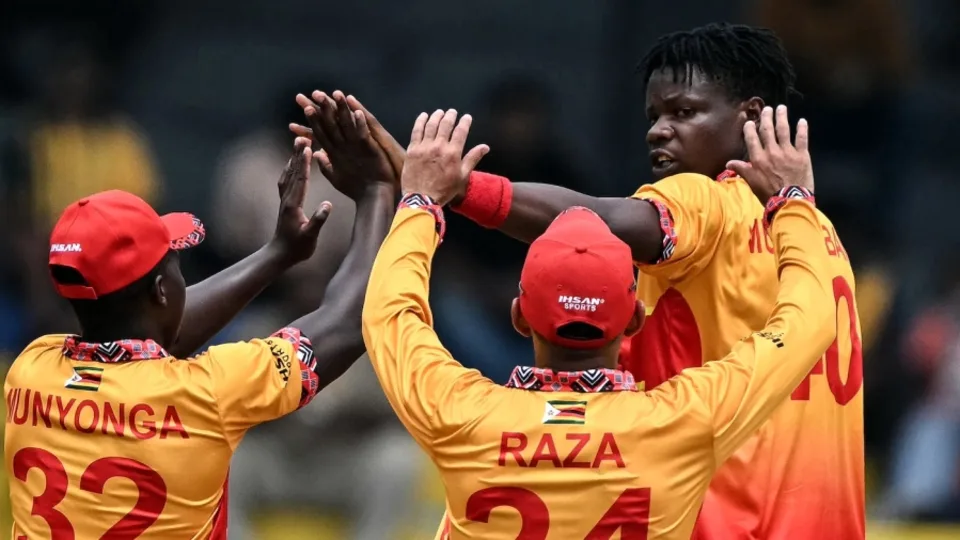
When Ireland arrived in Kandy on Sunday afternoon, with just two points after three games, their chances of qualifying for Super Eights may have seemed fanciful. But courtesy an outstanding Sri Lankan chase against Australia on Monday night, the possibilities for Group B have been thrown wide open.
Sri Lanka have qualified, but Ireland now know that a win against Zimbabwe on Tuesday will keep them in with a very real chance of qualification – provided Sri Lanka also beat Zimbabwe in their final match.
If those very specific set of circumstances – including Australia beating Oman – occur, then Australia, Zimbabwe and Ireland could all end on four points each, separated solely by net run-rate.
But that might be getting ahead of ourselves. Zimbabwe simply need to win against Ireland to end all speculation, and considering they’re coming off a stunning 23-run victory over Australia, it would take a brave person to back against them.
Captain Sikandar Raza is also not one to allow his team to let their guard down. He has emphasised the need to maintain focus, warning that earlier performances will “count for nothing if the team slips up now.
Ireland, meanwhile, have lost to Sri Lanka and Australia earlier in the tournament but their dominant 96-run win over Oman – including a tournament-high of 235 – will have provided a timely boost in confidence. They also come in with a chip on their shoulder, over constant comparisons to Associate nations, something they will be keen to put right with a win over Zimbabwe.
Lending more unpredictability to this game is that the historical rivalry is remarkably balanced, with both sides having won eight apiece of their 18 T20I meetings.
With the extra bounce on offer, the Pallekele International Cricket Stadium is one of the rare Sri Lanka grounds where more wickets have fallen to seam (201) than spin (154). It would be no surprise if seamers from both teams prove to be the difference on Tuesday.
In Richard Ngarava, Blessing Muzarabani and Brad Evans, Zimbabwe have a pace triumvirate that can be the envy of any side in this tournament. They’ve taken 16 wickets amongst them, and managed to brush past Australia even with Ngarava out of the XI. Moreover, Muzarabani has won two Player-of-the-Match awards.
In Mark Adair, Ireland have the quintessential work horse. Despite making his debut after Josh Little and Barry McCarthy, he’s played more T20Is – 100 – than the other two and managed to pick up 142 wickets. He also loves bowling against Zimbabwe; his 24 wickets are the most he has taken against an opposition. With Little finding his form last time out with a first three-for since March 2024, Ireland will know any chance of success depends on how quick their seam-bowling unit find their rhythm.
Ireland are unlikely to change a winning combination after their exploits against Oman.
Ireland (probable XI): Tim Tector, Ross Adair, Harry Tector, Lorcan Tucker (capt & wk), Curtis Campher, George Dockrell, Gareth Delany, Mark Adair, Josh Little Barry McCarthy, Matthew Humphreys
Zimbabwe would have had a close eye on the pitch Sri Lanka played Australia on, but the only expected change is the return of Richard Ngarava who missed out last time as a precaution.
Zimbabwe (probable XI): Brian Bennett, Tadiwanashe Marumani (wk), Dion Myers, Sikandar Raza (capt), Ryan Burl, Tashinga Musekiwa, Brad Evans, Wellington Masakadza, Graeme Cremer, Blessing Muzarabani Richard Ngarava
[Cricinfo]

Sri Lanka survived an early onslaught to qualify for the 2026 T20 World Cup Super Eights, leaving Australia right at the exit door and hoping for a miracle.
The returning captain Mitchell Marsh and the returning-to-runs Travis Head were brutal in taking Australia to 104 in the first 50 legal deliveries, but some spectacular fielding and spin bowling helped Sri Lanka take 10 for 77 off the last 70 balls.
In front of a partying full house in Pallekele, Sri Lanka’s two most prolific batters, Pathum Nissanka and Kusal Mendis, brought out both the axe and paper cuts to slice through the chase. Nissanka, who had earlier dropped Glenn Maxwell and then dismissed him with a stunner, went on to score an unbeaten hundred and take Sri Lanka home with two overs to spare.
In the absence of Matheesha Pathirana, who walked off with a calf injury in his first over, their spinners contributed six wickets to go with excellent closing from Dushmantha Chameera. Australia’s lead spinner Adam Zampa, among the best T20 spinners of all time, took no wicket and was lucky to go for only 41 in his four overs.
Brief scores:
Sri Lanka 184/2 in 18 overs [Pathum Nissanka 100*, Kusal Mendis 51, Pavan Rathnayake 2*; Marcus Stoinis 2-41] beat Australia 181/10 in 20 overs [Mitchell Marsh 54, Travis Head 56, Josh Inglis 27, Glenn Maxwell 22; Dushmantha Chameera 2-56, Maheesh Theekshana 1-37, Dushan Hemantha 3-37, Dunith Wellalage 1-33, Kamindu Mendis 1-19] by eight wickets
[Cricinfo]

US build-up of warships and fighter jets tracked near Iran

Showers above 75 mm are likely at some places in the Central, Uva and Eastern provinces and in Polonnaruwa district

Zimbabwe take on Ireland with clarity about Super Eights path

CEB seeking tariff hike while making huge profits, says opposition trade union leader

BASL protest march

IMF MD here

‘Dates have the highest sugar content to fight Coronavirus’

Sunday Island 27 December – Headlines

#SundayIsland 17th December – Headlines

Sunday Island – 28th March

Sunday Island Headlines – 21 March

Sunday Island – 21st February – Headlines
-

 Life style2 days ago
Marriot new GM Suranga
-

 Business1 day ago
Ministry of Brands to launch Sri Lanka’s first off-price retail destination
-

 Features2 days ago
Monks’ march, in America and Sri Lanka
-
 Midweek Review6 days ago
A question of national pride
-

 Business6 days ago
Autodoc 360 relocates to reinforce commitment to premium auto care
-

 Opinion5 days ago
Will computers ever be intelligent?
-

 Features2 days ago
The Rise of Takaichi
-

 Features2 days ago
Wetlands of Sri Lanka: