
News
TISL opposes draconian clauses in Data Protection Bill, urges MPs to address them before passing it


The Transparency International Sri Lanka (TISL) yesterday called on Members of Parliament that the Data Protection Bill should not be passed until serious concerns are addressed.
It said in a release that the second reading of the Bill on Personal Data Protection is scheduled for today (09) and there are three key concerns about the Bill in its current form, adding that MPs should not rush through enacting the law until concerns are addressed.
TISL statement: On 9th of March 2022, the Personal Data Protection Bill is scheduled for the second reading in Parliament. This Bill aims to regulate the processing of personal data by identifying and strengthening the rights of data subjects – persons whose data is held by a processor or controller. However, Transparency International Sri Lanka (TISL) remains deeply concerned about three key areas in this Bill, including the impact on certain rights and freedoms, if enacted in its current form.
The creation of a legal framework on personal data protection can be viewed as an important step in safeguarding human rights, especially at a time when information has become both a tool to be used by the people and against them.
However, TISL’s three key concerns on this Bill are as follows:
1. Severe impact on journalism – The Bill does not recognize ‘Journalistic Purpose’ or data processing in the exercise of freedom of the press or freedom of expression as a condition for processing data. This means that media, including broadcast media, will be restricted from using personal data when reporting, as they become data controllers and processors in the use of personal information of others for journalistic activities. TISL recommends that ‘journalistic purpose’ should be identified as a legitimate condition to process data, in order to ensure that access and publication of information for journalistic purposes is not unduly restricted?
2. Data Protection Authority has wide powers, and is not independent – The Bill designates a ‘government controlled’ body as the Data Protection Authority. The Authority does not have sufficient safeguards against political interference or attempts at diluting its powers and functions. Further, the Data Protection Authority, being a non-judicial and non-independent body, is given the power to investigate into sources of obtaining data and to impose penalties of up to Rs. 10 million per non-compliance on data controllers and data processors who fail to comply with the directives of the Authority. This has implications on the rights of persons in general and could also lead to the Authority seeking information regarding sources from journalists and media. TISL recommends that an independent Data Protection Authority is set up for the purposes of the Act.
3. Impact on the Right to Information – In its current form, the provisions of the Bill prevail over the provisions of any other written law, including the Right to Information Act, in case of any inconsistency. This can lead to derogation from the fundamental right to information, especially in practice. Therefore, TISL recommends including a specific exception to ensure that the Right to Information Act is not overridden in case of inconsistency.
Earlier in 2022 and in 2021, TISL officially raised these concerns with the Ministerial Consultative Committee on Technology and with all 225 Members of Parliament.
The draft framework on personal data protection which was produced in 2019 has two crucial points that could improve the current Bill. The preamble of the 2019 framework specifically refers to Sri Lanka’s constitutional Right to Information as a crucial right, recognising the need for the public interest to be balanced with the protection of personal data. The 2019 draft also called for the appointment of three members to the Government Controlled authority enforcing the Bill, through a public application process. This step could be crucial to ensure that the authority remains independent.
Since it is critically important that there is a harmonious formulation of the Personal Data Protection law with other existing rights and protections in the best public interest, TISL calls on all Members of Parliament and the Ministerial Consultative Committee on Technology to not rush through the process of enacting this important law, without ensuring that these concerns are addressed.
TISL Executive Director Nadishani Perera commenting on the matter noted that “If enacted in its current form, the Data Protection Bill could become a well-meaning law which could yet be abused. The Bill could be used to create a chilling effect in the media and among whistleblowers which would be a blow to Sri Lanka’s democracy.”


President Anura Kumara Dissanayake stated that a spiritual revival is essential in fostering economic revival within the country, and that the best determination people can make on this Vesak Full Moon Poya Day is to properly recognise the responsibility entrusted to all citizens to safeguard the Buddha Sasana and the Dhamma for future generations, and to unite in fulfilling that responsibility.
The President made these remarks on Wednesday morning (27) while attending the inaugural ceremony of the State Vesak Festival held at the Midellawala Purana Rajamaha Viharaya in Thihagoda.
The President also pointed out that Buddhism does not belong solely to those of us living today or only to the monks clad in robes, but that the Buddha Dhamma was preached for the liberation and well-being of all humanity. He further stated that the Government expects to promptly introduce the necessary legislation to enable the Maha Sangha to maintain the Sangha institution in accordance with Vinaya discipline.
The 2026 State Vesak Festival, marking the 2570th Buddhist Year, is being held under the theme “Abhiththaretha Kalyane” and titled “Dakshina Prabha”, centred around the city of Matara from Wednesday until 1 June, in line with National Vesak Week.
The “Dakshina Prabha” National Vesak Festival consists of two Vesak zones: the “Prathipaththi Pooja” zone and the “Amisa Pooja” zone. The Prathipaththi Pooja zone is centred around the historic Matara Fort area, while the Amisa Pooja zone is located within the city of Matara and the Beach Park vicinity.
The Prathipaththi Pooja zone features an exhibition of sacred relics, Dhamma sermons and discussions conducted by eminent preachers, devotional poetry recitals, and programmes on almsgiving, observance of sil and meditation.
The Amisa Pooja zone includes a giant Vesak pandal erected near the Fort Wall and city centre, a creative Vesak lantern competition at the Matara Beach Park, devotional music performances by the Tri-Forces and Police near Pigeon Island, puppet shows and cultural performances showcasing Southern traditional arts.
Several special attractions have also been organised, including a modern AI-powered light display featuring Buddhist symbols and patterns in the sky, Jataka story presentations through traditional Southern puppetry, and digital screenings of Jataka stories and films across the city using LED displays.
In parallel with the State Vesak Festival, a photographic exhibition organised by the High Commission of India in Sri Lanka was also inaugurated under the patronage of President Anura Kumara Dissanayake and Indian High Commissioner Santosh Jha. The President and accompanying dignitaries also viewed the exhibition.
A special commemorative stamp issued for the 2570th State Vesak Festival, along with a set of three Vesak commemorative stamps featuring three temples in the Matara District, was also officially released at the event. The first stamp was presented to the President.
President Anura Kumara Dissanayake also presented official “Pooja Bhoomi Sannas” declarations to several religious sites of historical significance in the Southern Province.
Addressing the State Vesak Festival, President Anura Kumara Dissanayake stated:
“Today, we are participating in a historic and significant occasion in Sri Lanka. The Buddha was one of the greatest teachers ever to appear in the world. His birth, Enlightenment and Parinirvana all fall on this Vesak Full Moon Poya Day. We have commemorated this sacred occasion over many centuries.
What is the reason that this Dhamma has survived for so long? Buddhism was introduced to Sri Lanka 236 years after the passing of the Buddha, that is, 2,334 years ago from today. I believe the reason this Dhamma has endured for such a long period, while preserving its essence, is because it is based on causality and grounded in realism.
The Buddha preached the Dhamma he had realised to sixty disciples on the very first Esala Full Moon Poya Day after attaining Enlightenment. He instructed them to preach this Dhamma for the welfare and happiness of the many.
The first factor behind the endurance of the Dhamma is therefore its foundation on causality. The second factor is our venerable Maha Sangha who are guardians of the Dhamma and Vinaya.
For a long period, the Dhamma survived through oral tradition. Until the teachings were committed to writing, it must have been extremely difficult for a single monk to memorise the entirety of the teachings. Therefore, according to the various Nikayas, the Dhamma was divided and preserved orally with immense dedication by the Maha Sangha.
We know that the Digha Nikaya was preserved by the Digha reciters, the Majjhima Nikaya by the Majjhima reciters, and the Samyutta Nikaya by the Samyutta reciters.
In this manner, the Maha Sangha preserved and transmitted the Dhamma and its essence orally for centuries. Later, during the reign of King Walagamba, the Tripitaka was committed to writing and preserved in written form.
Today, there are books of sermons within temples. But who conveys the essence of those books to the Buddhist people? I have never seen a monk merely turning pages and preaching directly from a text. Our monks study the Dhamma, absorb that knowledge and then preach it to the people.
There was a request to amend Sections 41 and 42 of the Viharagam and Devalagam Act of 1931. There was also a request to restore the authority to take disciplinary action through the Dhamma courts against monks who violate discipline.
The Maha Sangha of the three Nikayas formally submitted this request to me in writing. Our Minister presented a Cabinet paper on the matter, which received Cabinet approval. Accordingly, amendments were drafted.
As we know, all such amendments must receive the approval of the Attorney General’s Department. The Department proposed several revisions, and recently I facilitated discussions between the Chief Prelates and Secretaries of the Malwathu, Asgiri, Ramanna and Amarapura Chapters, together with the Commissioner of Buddhist Affairs and the Attorney General.
I was informed by the venerable Maha Sangha that a final consensus had been reached during these discussions. Therefore, we will very soon introduce the necessary laws to enable the Sangha institution to be maintained in accordance with Vinaya discipline.
This Dhamma does not belong only to those of us living today, nor solely to monks in robes. It was preached for the liberation and well-being of all humanity. Therefore, we all bear the responsibility of ensuring that the essence of this Dhamma is preserved without being destroyed.
As our Sobitha Nayaka Thera pointed out, we have witnessed instances today where the Dhamma is distorted under the very guise of the Dhamma itself. What can rulers do in such circumstances? He invited me to act as kings of the past once did. We are prepared to do so. However, for such measures, we require the support of the venerable Maha Sangha who are guardians of the Dhamma and Vinaya.
I invite everyone to work together to safeguard the Dhamma preached for the liberation of all humanity. I do not wish these actions to be interpreted merely as political or governmental decisions. I would rather they be understood as measures we must take as Buddhists. These should become Buddhist decisions taken for the sake of the Dhamma, the Buddhist people and the future.
Looking at our history, whenever we declined spiritually, we also declined economically. Likewise, when we declined economically, we declined spiritually as well. Every era in which we experienced spiritual revival was also an era of economic prosperity.
Therefore, as we move towards becoming an economically prosperous nation once again, our country also requires a spiritual revival. The effort of both myself and this Government is to bring about that economic and spiritual revival together.
During the reigns of King Dutugemunu, King Wasabha, King Mahasen and King Parakramabahu I of Polonnaruwa, Sri Lanka experienced both spiritual enlightenment and economic prosperity.
Economic prosperity cannot be achieved merely by constructing buildings, roads, factories and technological infrastructure. True economic revival can only be achieved within a righteous society, a society built on understanding, compassion towards others, and the rejection of hatred, anger and hypocrisy.
A righteous society and economic revival must progress together. Therefore, we aspire to make this era one that will be remembered in Sri Lankan history as a period of spiritual revival. Alongside that, I am confident that economic revival will also be achieved.
We have already undertaken significant work towards this objective. In particular, the World Buddhist Conference is scheduled to be held in Sri Lanka this November. I believe this will become a major milestone in the country’s spiritual revival.
Whenever religious places encounter hardship or disaster, the Government stands ready to intervene and assist. We must build a nation founded on both righteousness and strong economic progress.
Just as the Government has its responsibilities in this regard, I also strongly hope that our venerable monks will fulfil the responsibilities entrusted to them. Buddhism and our society share an inseparable historical bond.
Before Buddhism arrived in Sri Lanka 2,334 years ago, what kind of society existed here? It was the Dhamma that transformed this land into a society with a refined culture and identity. Without the spread of Buddhism, it is difficult even to imagine what kind of civilisation we would have become.
We are a people who feel compassion for the suffering of others. During times of disaster, people do not consider race or caste, they feel empathy for everyone.
Buddhism played a tremendous role in shaping the Sri Lankan nation into one that is cultured, humble and hospitable. I believe the arrival of Arahat Mahinda Thera laid the foundation for the Sri Lankan nation itself.
Therefore, distorting this noble Dhamma causes pain to all of us. The decline of disciplined monks within a distorted interpretation of the Dhamma is also deeply painful.
After 21 monks were arrested in connection with narcotics offences, I held discussions with the Maha Nayaka Theras of the three Nikayas. They proposed that, if possible, the monks should be disrobed before being produced before court. How can we take monks to court in handcuffs?
The representatives of the three Nikayas agreed to this proposal and further decided that those proven innocent could later be re-ordained. However, legal procedures are governed by the law and not by the Dhamma, and therefore that course of action could not be implemented.
Any disgraceful incident connected to the Dhamma causes us deep sorrow. We are a nation shaped around the temple. In our villages, the Poson festival was the principal celebration. The monk who taught us Buddhism was our village chief monk.
When monks walked along the gravel roads to the tank for their evening bath, people would kneel by the roadside in reverence. We are a people shaped by that spirituality. It was the monks who taught us the Dhamma, morality and the future. When disputes arose in our villages, it was the monks who resolved them.
Because of this deep spiritual connection, these incidents cause us great pain.
Therefore, the Venerable Theras must be granted the authority necessary to maintain discipline within their institutions. I know that not only I, but also the Maha Sangha led by the Maha Nayaka Theras, are deeply distressed by these developments.
If there are forces attempting to build opposition against liberating this Dhamma based on such incidents, then the time has come for us to reflect upon ourselves. Otherwise, should we allow a Dhamma protected for over 2,615 years to perish before our very eyes?
Throughout history, monks risked their lives to protect the Upasampada ordination lineage. Should we not remember them? Kings of the past lived in hiding to protect the Dhamma.
If a Dhamma protected in such a manner is now being distorted before our eyes and subjected to slander and false accusations, what should we do?
On this Vesak Full Moon Poya Day, we must reflect upon ourselves. The Buddhist community, priests, moulavis, kurukkals, all of us, must work once again towards safeguarding our children and younger generations and towards reviving religion in our country.
Schoolchildren and members of the security forces are being arrested due to narcotics-related offences. Drugs are spreading in large quantities. Why is this happening?
Where discipline, morality and social values collapse, crime, abuse and social crises inevitably emerge. At this moment, when we commemorate the Birth, Enlightenment, and the Passing away (Pari nibbāna) of our Supreme Teacher, a responsibility has been entrusted to all of us to free this country from such conditions. I invite everyone to unite in that effort.”
(PMD)
Latest News
Let us all build a society valued with peace and harmony, guided by unity and solidarity beyond all differences – PM

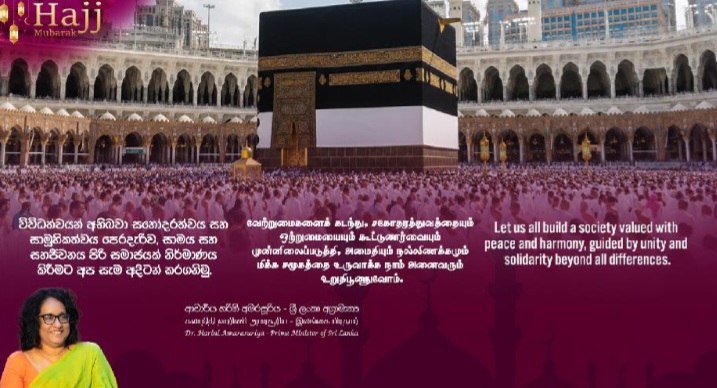
Prime Minister Dr Harini Amarasuriya issuing a message on the occasion of the Hajj festival called upon all Sri Lankans to build a society valued with peace and harmony, guided by unity and solidarity beyond all differences
The Prime Minister’s message:
“On the occasion of “Eid-ul-Adha” or the Hajji Festival, celebrated with great reverence by Muslims across the world upholding the values of selflessness, unity, and compassion, I extend my felicitations to the Muslim community in Sri Lanka and around the world.
On this special Day, the festival of Hajji commemorates the boundless devotion to God and the noble spirit of generosity demonstrated by Prophet Ibrahim. This festival reflects the willingness of humanity to dedicate even its most precious possessions for the greater good of humankind and the devotion towards the God.
On this day, the most important lesson we must all understand is the value of rising above our differences and standing together in unity and solidarity. The message of Eid-ul-Adha, founded upon sharing and compassion, serves as a great example in our journey towards building a strong, peaceful, and prosperous Sri Lanka.
Therefore, setting aside narrow divisions, we must all resolve to act with respect and kindness towards one another and work together to create a society valued with peace and solidarity.
May this Hajji Festival bring happiness, peace, prosperity, and blessings to you all”.
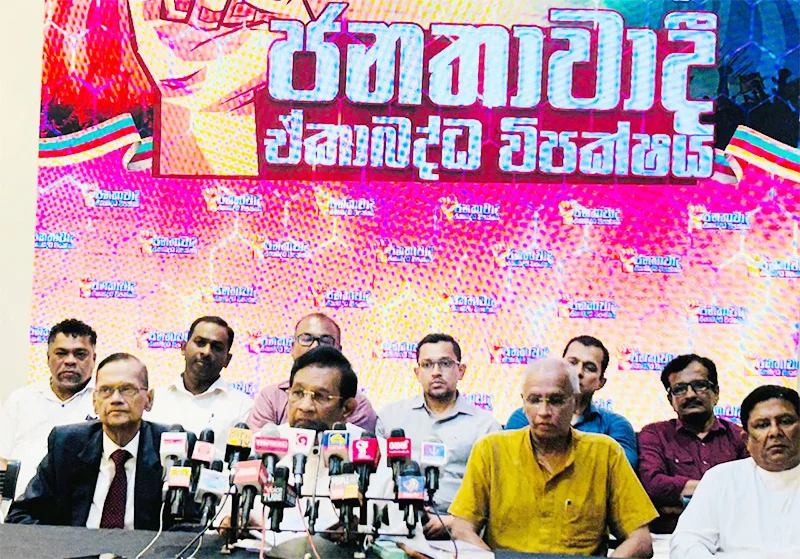
Ranil-led group asks govt. to hold PC polls
Former Cabinet Minister Dr. Rajitha Senaratne yesterday (27) claimed that there was no consensus between the JVP and the NPP regarding the long delayed Provincial Council (PC) polls.
Dr. Senaratne said that though JVP General Secretary Tilvin Silva had declared in Jaffna, over the last weekend, that it wouldn’t be possible to conduct PC polls this year, due to financial constraints and legal impediments, the position of NPP General Secretary Dr. Nihal Abeysinghe was different.
Addressing the media at Hotel Nippon, on behalf of the People’s United Opposition grouping, operating out of Ranil Wickremesinghe’s Flower Road Office, Dr. Senaratne, who represents the UNP, claimed that the JVP/NPP was all out to postpone the long delayed PC polls. The New Democratic Front (NDF) parliamentary group, elected to the current Parliament, received the backing of Wickremesinghe.
The ex-Minister explained how the NPP, with a 159-member parliamentary group, could comfortably secure the approval of the Parliament to conduct the PC polls under Proportional Representation system.
Declaring that they would submit combined candidate lists at the PC polls, Dr. Senaratne declared that those who declined to join them would be considered traitors.
Dr. Senaratne emphasised that there was no need for alliances and their objectives could be achieved through fielding combined candidate lists.
The Illankai Thamil Arasu Kadchi (ITAK) was represented by former lawmaker and acting Secretaray General of ITAK but the Sri Lanka Podujana Peramuna (SLPP) and the main Opposition Samagi Jana Balawegaya (SJB) weren’t represented.
Convenor of the People’s United Opposition Prof. G. L Peiris, at the beginning of the briefing, explained how the people were deprived of their democratic rights by the NPP, through the postponement of PC polls.
On Tuesday (26) MPs Shanakiyan Rasamanikkam, Mano Ganesan, and Nizam Kariapper attended a joint Opposition discussion with SJB and others, organised by PAFFREL. MP Rasamanikkam has criticised the delay in holding PC elections.
The Batticaloa District MP highlighted that he had already presented a private member’s bill to facilitate the conduct of elections, under the earlier system.
Rasamanikkam said:”The four Opposition members representing the Parliamentary Select Committee affirmed their stance to hold the Provincial Council elections under the preferential voting system.
“We noted, however, that the establishment of this committee appears to be a measure to further delay the process.
“Concurrently, an Additional Solicitor General of the Attorney General’s Department presented two proposals for conducting the elections.
“One of these recommendations involves introducing minor amendments concerning women and youth representation to the private member’s motion I tabled in Parliament, which seeks to hold the Provincial Council elections under the previous system.”
Meanwhile, PAFFREL said that altogether 42 political parties and civil society organisations were involved in that discussion.
PAFFREL said that of the 42 political parties and monitoring organisations that participated in the discussion, all but one political party consented to endorse the following joint statement. And it was decided to forward the joint statement to the Parliamentary Select Committee and the government.
“We, the secretaries of political parties and representatives of the other organisations, who attended the meeting organised by PAFFREL at the Hector Kobbekaduwa Agricultural Training and Research Institute, on 26 May, 2026, agreed to the proposal adopted to hold the Provincial Council elections as per the electoral system prevailed prior to the enactment of Act No. 17 of 2017, pending the final outcome of the Parliamentary Select Committee. We also agreed to ensure 25% representation of women and youth on a voluntary basis.”

State Vesak Festival held with the participation of the President

Let us all build a society valued with peace and harmony, guided by unity and solidarity beyond all differences – PM

Showers will occur at times in the Western, Sabaragamuwa and North-western provinces and in Galle, Matara, Kandy and Nuwara-Eliya districts

Rajitha calls for combined lists, denounces those unwilling to join as traitors

20 lawmakers, four officials visiting China

More Japanese funds for demining operations in the north

‘Dates have the highest sugar content to fight Coronavirus’

Sunday Island 27 December – Headlines

#SundayIsland 17th December – Headlines

Sunday Island – 28th March

Sunday Island Headlines – 21 March

Sunday Island – 21st February – Headlines
-

 Business6 days ago
Historic launch of CCWE Fashion Week & International Summit 2026
-

 News4 days ago
All-New GRAVITE launches at LKR 6.99 Mn
-
 Features4 days ago
The NPP’s pivot to the past
-
 News3 days ago
Police probe underway to ascertain links between criminals deported from UAE and local politicians
-
 News2 days ago
Easter Sunday carnage: Court told Maulana’s statement cannot be accepted without cross-examination
-

 Opinion6 days ago
The need to reform Buddhist ecclesiastical order
-
 Features4 days ago
End of Peacekeeping
-
 Opinion2 days ago
Undermining the democratic political framework