
Sports
Time to turn over a new leaf

by Rex Clementine
Cricket is in a crisis. For the first time in the history Sri Lanka suffered losses in a World Cup to teams like Afghanistan and Bangladesh. While those two teams finished ahead of Sri Lanka and qualified for the Champions Trophy, the 1996 champions finished a disappointing ninth and were knocked out of the Champions Trophy. Sri Lanka Cricket has borne the brunt of the criticism but the persons who were responsible for the team and players have been exempted from scrutiny.
There are arguments that these are the best set of players we have. That may be true, but we could have been smarter with how we used some of our players. If we are short of skill, then sidelining so many seniors was a no brainer.
It was sheer arrogance to leave Angelo Mathews from the World Cup campaign but eventually the selectors had to bite the bullet and draft him in as an injury replacement. Thisara Perera suffered a similar fate but unlike Mathews he had thrown in the towel soon after being left out. He did a Roshan Mahanama by retiring hurt.
How badly Sri Lanka struggled not having a finisher in their ranks during the World Cup and Thisara would have been ideal given his experience and the ability to clear the ropes. Not that Thisara was completely flawless. He did have issues but that’s why you need mature selectors to deal with professional sportsmen.
The selectors burnt more bridges than building them during their three year tenure. It was a period of disaster for the national cricket team. Now the nation is in mourning, but nobody has resigned.
The selectors need to be held accountable no doubt but so does the mastermind who has been calling the shots from behind the scenes.
Another popular slogan for the team’s poor World Cup campaign is that we play on bad wickets at home. That is of course true. But you did not complain when you beat Australia in an ODI series. You were covering yourself in glory saying you had just beaten Australia but conveniently forgot that it was achieved on doctored wickets.
You knew pretty well that the World Cup was going to be played on belters and not rank turners. You only have got yourselves to blame. You hoodwinked the public and took them for a ride while giving the players a false sense of security.
You’ve also packed all key positions of the side with your club mates and several requests to draft in capable men like some former captains fell on deaf ears. But now that you are on borrowed time, you don’t mind having some of those former captains in key decision-making positions. What a pity.
Some consultants have created so much havoc and inflicted much damage. We can not afford another year of mediocracy, poor planning and continue this blame game. You come in with so many conditions that you will not do this and that and you want your own people. When all that has backfired, it’s time to shut up and pack your bags.
There’s no point in crying over the spilt milk. Every individual barring Head Coach Chris Silverwood who oversaw Sri Lanka’s World Cup campaign should be discontinued and there should be no renewal of contracts. Why Silverwood is spared one may wonder. That’s because the only area Sri Lanka have shown some improvement in the last two years is fast bowling and that’s credit to Silverwood.
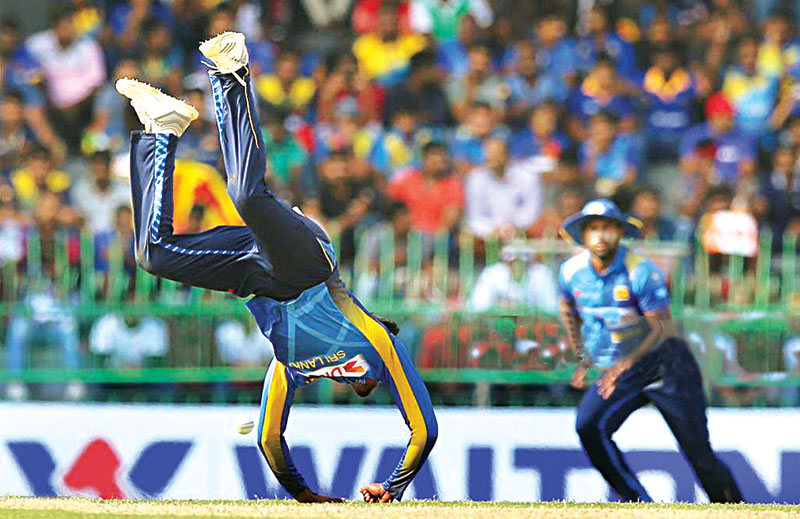
The culture of the Sri Lankan team definitely has to change. The term optional training has its benefits, but it will not work with a bunch of fat, unfit, lethargic and lazy players. The number of catches that Sri Lanka spilled during the World Cup is a case in point. Fielding is one discipline which does not require enormous amount of skill and can be mastered with sheer hard work. You don’t see that happening with the current team.
Even the young players who come into the system showing so much hunger and desperate to become the best they can be are caught up with the lazy system we have, and you fear the worst for young players like Sadeera Samarawickrama, Charith Asalanka and Dunith Wellalage.
We have already seen precious talents like Niroshan Dickwella going waste and not able to stage a comeback. How many more talents we will let go astray before we realize that it’s time to fix the mess.
Injury management has been another area that we have been awful at. The team was plagued by injuries in Australia last year with half a dozen players returning home. Assurances were given that the issue will be addressed but precious little was done, and injuries again affected Sri Lanka’s campaign in India.
Lack of power hitters is an acute problem facing the team. Every team has an excellent finisher in white ball cricket. There’s Glenn Maxwell for Australia, Suryakumar Yadav is doing the job for India, David Miller has turned out to be Killer Miller for South Africa while Glenn Phillips has settled in at New Zealand having moved from South Africa seeking greener pastures. We Sri Lankans are trying out Test specialists at the finishers’ role. There is a lot that needs to be done to put cricket right. Let’s start it by fixing the think tank.








Central College produced a remarkable final day comeback to win the Battle of the North Big Match, defeating St. John’s College by three wickets after an outstanding eighth-wicket partnership between Murali Thison and Jesuthasan Nitharsan.
Central had been playing second fiddle to their arch-rivals for most of the match until the morning of the third day, when Thison and Nitharsan turned the game around with a match-winning unbeaten stand of 93 runs.
At the start of the final day Central were in a difficult position, trailing by more than 120 runs with only four wickets in hand. Overnight batsman Iyathure Kabishek, who had scored 21, was dismissed after adding 37 runs for the seventh wicket with Thison. From that point onwards, Thison and Nitharsan combined to frustrate the St. John’s bowlers, batting together for 12 overs to guide their team to a memorable victory.

Emmanouil Karalis in action in Rouen
Thison had already been a thorn in the flesh of the St. John’s batting line-up from the opening day, capturing 12 wickets in the match, including seven in the second innings. However, his superb bowling effort initially appeared likely to go in vain due to Central’s poor batting performance.
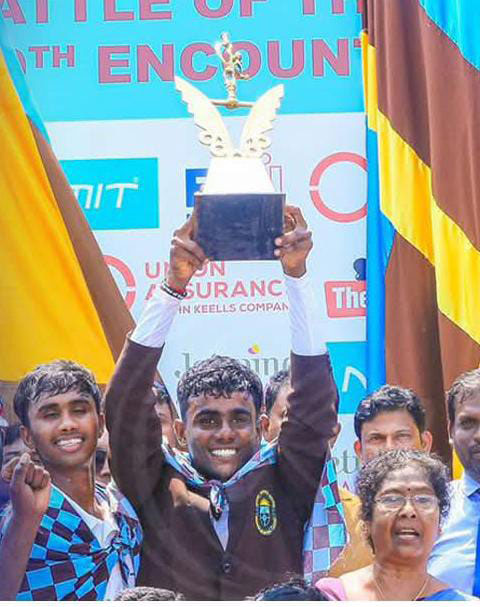
Central beat St. John’s by three wickets at the Battle of the North Big Match.
Central had struggled in their first innings, being bowled out for just 95 runs, with the highest individual score coming from Antanareshan Abishek who made 23. Only three other batsmen reached double figures, while Thison was dismissed for just one run.
In contrast, Thison rose to the occasion in the second innings, producing a magnificent unbeaten 81 that proved to be the cornerstone of Central’s successful chase. His innings came off 126 balls and included eight boundaries and a six.
Nitharsan played the perfect supporting role with a brisk unbeaten 44 off just 33 deliveries, striking five fours and two sixes to accelerate the scoring during the decisive stand.
Earlier in the innings, openers Jayaseelan Jenoshan (20) and Kabilan Amalan (45) had given Central a solid start, putting on 44 runs for the first wicket.
St. John’s had earlier gained the advantage with a first-innings lead, and in their second innings a brilliant century from Uthayanan Abijoyshanth — 121 off 105 balls with 15 fours and four sixes — helped them post a challenging total of 247.
Despite the odds being heavily stacked against them heading into the final day, Central’s determined batting display, led by Thison and Nitharsan, ensured a memorable turnaround and a thrilling victory in the historic Battle of the North.

The traditional Big Match between St. Sebastian’s College Moratuwa and Prince of Wales’ College Moratuwa ended in a draw after an absorbing contest at De Soysa Stadium Moratuwa on Sunday.
St. Sebastian’s produced a strong second innings batting display with five top-order batsmen scoring half centuries to finish on 279 for five wickets declared, setting their arch rivals a target of 230 runs for victory.
Prince of Wales struggled in their run chase and were reeling at 54 for five wickets at stumps after 28 overs when play concluded.
Batting first, St. Sebastian’s were bowled out for 214 runs with Chamath Wellalage providing the main resistance with a half century. Nethul Anuhas and Rusandu Silva shared the bowling honours for the Cambrians, claiming three wickets each.
Prince of Wales responded with 263 runs in their first innings to take a slender lead. Suwahas Fernando anchored the innings with a well-compiled 77 off 145 deliveries, holding the top order together. Opening batsman Palingu Perera also made a valuable contribution with 42 runs.
Milantha Silva was the standout bowler for the Sebastianites, delivering a marathon spell of 36.2 overs to capture five wickets for 100 runs. Koshendra Fernando provided good support, claiming three wickets while bowling 31 overs.
In their second innings, St. Sebastian’s mounted an impressive batting effort. Thivanka Fernando (50), Kaveesha Perera (52), Lashen Fernando (54), Koshendra Fernando (66 not out off 68 balls) and Chamath Wellalage (50 not out off 49 balls) all struck half centuries as the Sebastianites declared at 279 for five, setting up an intriguing finish.
However, the Cambrians lost wickets at regular intervals during their chase before the match eventually ended in a draw.


Iran names Khamenei’s son as new supreme leader after father’s killing

Oil prices jump above $100 for first time in four years

Dry weather will prevail over the island

FSP warns of possible coal shortage

Repatriation of Iranian naval personnel Sri Lanka’s call: Washington

Indian Ocean must remain peace zone: Sajith

‘Dates have the highest sugar content to fight Coronavirus’

Sunday Island 27 December – Headlines

#SundayIsland 17th December – Headlines

Sunday Island – 28th March

Sunday Island Headlines – 21 March

Sunday Island – 21st February – Headlines
-

 News3 days ago
University of Wolverhampton confirms Ranil was officially invited
-

 News4 days ago
Legal experts decry move to demolish STC dining hall
-

 News3 days ago
Female lawyer given 12 years RI for preparing forged deeds for Borella land
-

 News2 days ago
Peradeniya Uni issues alert over leopards in its premises
-

 Business5 days ago
Cabinet nod for the removal of Cess tax imposed on imported good
-

 News3 days ago
Library crisis hits Pera university
-

 News2 days ago
Wife raises alarm over Sallay’s detention under PTA
-

 Business5 days ago
War in Middle East sends shockwaves through Sri Lanka’s export sector