
Opinion
Time for night soil fertiliser

A series of articles appeared in The Island newspaper connected with the use of ammonium sulphate as fertiliser versus the use of compost. I do not contest the efficacy of ammonium sulphate/urea as a successful plant/soil additive.
However, I have my doubts regarding the efficacy of compost as a successful plant/soil additive. This is partly based on my observations and on what I had read.
There is a block of land in the suburbs of Colombo, adjoining a public road. On the other side of the road is a paddy field, subject to floods, which is very regular in this area. Years ago even the road used to get inundated.
The topography of the land is unique, rectangular in shape with the section near the land, flush with the road surface, while the other end is about 10 feet above the surface level of the road.
Since 1980, no synthetic fertiliser, urea, or ammonium sulphate had been applied to this property. There are about six coconut plams near the road, three in the middle of the property and four at the other end.
The garden sweepings, kitchen refuse, which include ash from the hearth used to boil water, is dumped at the foot of the coconut plants, other than those near the road. The plants near the road (also close to the paddy field) have a good yield while the rest are a near absolute failure, at most a nut or two a month.
The kitchen refuse is allowed to compost itself in polybags served at the supermarkets. From what I understand the garden sweepings, and the kitchen refuse, forms compost.
This is in contrast to what I observed when I was a child. While schooling, I used to stay at a house near Matara. The houseowner had nearly 20 acres of land which had some coconut palms. At that time, there were no sealed toilets at Matara and Dondra. The toilets had buckets which were emptied daily by the Matara UC and the Dondra TC. They used to auction the toilet collection annually and the coconut land owners used to bid for them.
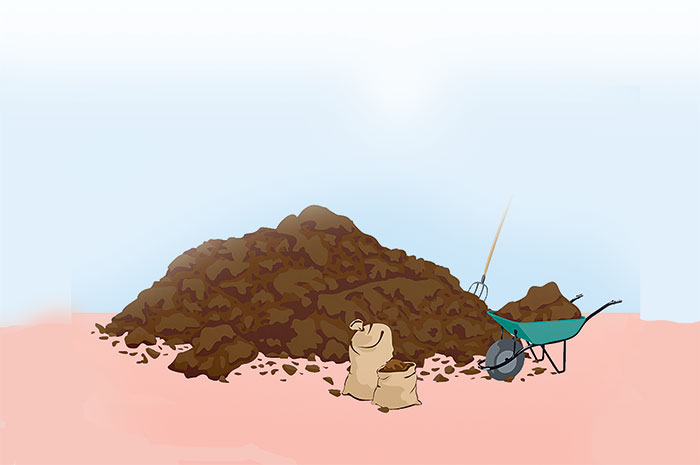
The land owner had to cut semi-circular ditches about six inches deep, and three feet away from the foot of the tree. The collections in the buckets were dumped in these ditches and covered with lime-calcium carbonate and covered with the excavated soil.
The yield was between 25-50 nuts per tree.
I was in the West Indies attached to a distillery there. The sugar complex had a library, from where I used to borrow books. There was a series of books by Lobsang Rampha, a Tibetian, who used to describe the manner in which the Tibetians handled their plantations – rice crops. He describes how the Tibetians used night soil (human excreta) as fertiliser and the high yield of the crops. Tibet is, I understand, a mountain terrain.
That was beyond me. Later on, I came to understand that use of night soil is very common in the East, and that it is being practised in the villages of our neighbouring countries even today. I also infer that a few decades ago even the inhabitants of Europe and Americas may have resorted to the use of night soil.
With modern technology, we should be able to get a better value for our night soil.
Do not forget that four girls in Nigeria were able to produce electricity using urine as the raw material, using a domestic generator.
It is high time we rediscovered our roots.
S. P. UPALI S.
WICKRAMASINGHE
Malabe.spupalis@yahoo.com.


If there exists a print media personality who does not receive the due recognition and appreciation he rightfully deserves, it undoubtedly is ‘Jeffrey’ of The Island newspaper. The works of many a journalist have been frequently highlighted and appreciated but the capabilities and efficiency of personnel of the calibre of ‘Jeffrey ‘ are, more or less, taken for granted.
In every sphere of life, professional or occupational, there are people who function, not necessarily from behind the scenes, but nevertheless perform an equally efficient service, which in all probability goes unnoticed.
To be frank, even before reading the headlines of the Newspaper, as is customary now, my eyes seek for the Cartoon of the day. Indeed, a sight for sore eyes each morning, the lovable ‘Jeffrey’ makes my day.
Suffice to say that a ‘Good Job done man’ type of occasional pat on the back, to a person who puts his very soul into his work, would touch the only place where it matters the most – his heart. If a smile could work wonders, then how much further would a word of appreciation go.
‘Jeffrey ‘ has, time and again through his cartoons, aptly proven his innovative and creative skills to present factual depiction of current affairs, both local and global. His drawing pen effortlessly covers all boundaries, irrespective of whatever nature. On a previous occasion, too, I have openly commended his abilities, finding it difficult to fathom how he could convey pertinent incidents, normally requiring hundreds of words to express, with a single drawing.
To all intents and purposes, ‘Jeffrey ‘ ranks much higher and could be considered as a rare find when compared with the numerous others actively engaged in this particular field of professionalism.
In ‘Jeffrey ‘, The Island newspaper indeed has a Cartoonist par excellence!
Jeffrey, more power to your elbow!
WILLIAM PHILLIPSZ

Scientists at Stanford Medicine have reported a discovery that could change how arthritis and joint damage are treated. In experiments on animals and human tissue, researchers found that blocking a protein linked to aging can restore worn cartilage in the knee and prevent arthritis after injury. The treatment works not by adding stem cells, but by reprogramming existing cartilage cells to behave in a more youthful way.
In aging mice, an injectable drug rebuilt knee cartilage that normally thins with age. In mice with knee injuries similar to anterior cruciate ligament tears, the same treatment prevented the onset of arthritis, a condition that often follows such injuries in humans. A pill form of the drug is already being tested in early clinical trials for age-related muscle weakness, raising hopes that a similar approach could one day be used for joints.
Human knee cartilage removed during joint replacement surgery also responded to the treatment. When exposed to the drug in the laboratory, the tissue began forming new cartilage that resembled healthy, functional joint cartilage. These findings suggest that cartilage lost to aging or arthritis might eventually be restored through injections into the joint or even oral medication, potentially reducing the need for knee and hip replacements.
Osteoarthritis affects about one in five adults in the United States and costs tens of billions of dollars annually in direct health care spending. Despite its prevalence, there is no drug that can stop or reverse the disease. Current treatment focuses on pain relief, physical therapy and, in advanced cases, joint replacement surgery.
The new therapy targets a protein known as 15-PGDH, which increases in the body with age. The research team classifies it as a gerozyme, a type of enzyme that contributes to the gradual decline of tissue function over time. Previous work from the same group showed that rising levels of 15-PGDH weaken muscles with age. Blocking the protein restored muscle strength and endurance in older mice, while forcing young mice to produce it caused muscle loss.
Unlike muscle, bone or blood, cartilage does not rely on stem cells to repair itself. Instead, cartilage cells called chondrocytes can change their gene activity. By inhibiting 15-PGDH, researchers found that these cells reverted to a more youthful state and began producing healthy cartilage again.
“This is a new way of regenerating adult tissue, and it has significant clinical promise for treating arthritis due to aging or injury,” said Helen Blau, professor of microbiology and immunology at Stanford and a senior author of the study.
There are three main types of cartilage in the body. Elastic cartilage forms flexible structures like the outer ear. Fibrocartilage is tough and shock absorbing, found between spinal vertebrae. Hyaline cartilage, also called articular cartilage, is smooth and glossy and allows joints such as the knees, hips and shoulders to move with minimal friction. Osteoarthritis mainly affects this last type.
The disease develops when joints are stressed by aging, injury or excess weight. Chondrocytes begin releasing inflammatory molecules and breaking down collagen, the main structural protein of cartilage. As collagen is lost, cartilage thins and softens, leading to pain, swelling and stiffness. Articular cartilage rarely regenerates on its own, and attempts to find stem cells capable of rebuilding it have largely failed.
In the new study, researchers compared knee cartilage from young and old mice and found that levels of 15-PGDH roughly doubled with age. When older mice were treated with a drug that blocks the protein, either throughout the body or directly in the joint, their knee cartilage thickened and regained function. Importantly, the new tissue was true hyaline cartilage rather than weaker fibrocartilage.
The results were equally striking in injured joints. In mice with ligament injuries, repeated injections over four weeks sharply reduced the likelihood of developing arthritis. Untreated animals showed high levels of 15-PGDH and developed arthritis within weeks. Treated animals moved more normally and placed more weight on the injured limb.
Detailed analysis showed that the treatment shifted the balance of cartilage cells. Cells associated with inflammation and cartilage breakdown became less common, while cells responsible for producing healthy joint cartilage increased markedly. This change occurred without the involvement of stem cells.
When human osteoarthritic cartilage was treated in the laboratory for one week, similar changes were observed. Levels of harmful gene activity fell, and signs of cartilage regeneration appeared.
The findings are encouraging but still early. While safety trials of a 15-PGDH inhibitor for muscle weakness have shown promising results, clinical trials focused on cartilage regeneration have yet to begin. Even so, researchers are optimistic.
“Imagine regrowing existing cartilage and avoiding joint replacement,” Blau said. For millions living with joint pain and stiffness, that possibility now seems closer than ever.

The RTI Commission has now confirmed what many suspected — although the RTI Act grants it independence to recruit staff, this authority is rendered toothless because the Treasury controls the purse strings. The Commission is left operating with inadequate manpower, limiting its institutional growth even as it struggles to meet rising public demand for information.
This raises an uncomfortable question: if the Treasury can repeatedly allocate billions to loss-making State-Owned Enterprises — some of which continue to hemorrhage public funds without reform — why is adequate funding for the RTI Commission treated as optional?
Strengthening transparency is not a luxury. It is the foundation of good governance. Every rupee spent on effective oversight helps prevent many more rupees being wasted through inefficiency, misuse, or opaque decision-making.
In such a context, can one really fault those who argue that restricting the Commission’s resources conveniently limits disclosures that may prove politically inconvenient? Whether deliberate or not, the outcome is the same: weaker accountability, reduced public scrutiny, and a system where opacity is easier than openness.
If the government is serious about reform, it must start by funding the institutions that keep it honest. Investing in RTI is not an expense — it is a safeguard for the public purse and the public trust.
A Concerned Citizen – Moratuwa

UK and France to send troops to Ukraine if peace deal agreed

Six dead and hundreds of flights cancelled as snow causes chaos across Europe

Prez seeks Harsha’s help to address CC’s concerns over appointment of AG

Govt. exploring possibility of converting EPF benefits into private sector pensions

Sajith accuses govt. of exacerbating people’s suffering to please IMF

Kelaniya Duruthu Perahera

‘Dates have the highest sugar content to fight Coronavirus’

Sunday Island 27 December – Headlines

#SundayIsland 17th December – Headlines

Sunday Island – 28th March

Sunday Island Headlines – 21 March

Sunday Island – 21st February – Headlines
-

 News1 day ago
Broad support emerges for Faiszer’s sweeping proposals on long- delayed divorce and personal law reforms
-

 News2 days ago
Private airline crew member nabbed with contraband gold
-

 News1 day ago
Interception of SL fishing craft by Seychelles: Trawler owners demand international investigation
-

 News4 days ago
Health Minister sends letter of demand for one billion rupees in damages
-

 Opinion6 days ago
Remembering Douglas Devananda on New Year’s Day 2026
-

 Features2 days ago
Pharmaceuticals, deaths, and work ethics
-

 News1 day ago
US raid on Venezuela violation of UN Charter and intl. law: Govt.
-

 Latest News2 days ago
Curran, bowlers lead Desert Vipers to maiden ILT20 title