
Latest News
Tim David smashes fastest T20I century for Australia to make it 3-0


Tim David produced a brutal display of hitting with Australia’s fastest T20I century from 37 balls as the visitors surged to a series-winning victory by chasing 215 with a massive 23 deliveries to spare on a boundary-filled night in St Kitts.
Shai Hope’s maiden T20I century, in which he formed an opening stand of 125 with Brandon King, helped West Indies post 214 for 4 and when Australia wobbled on 87 for 4 in the ninth over, the target was a considerable distance off.
However, David produced a breathtaking performance which rewrote the record books with firstly Australia’s fastest fifty from 16 deliveries, and then the century mark with the boundary that also brought victory. In all he plundered 11 sixes in his maiden T20 century.
Mitchell Owen, in his first international series, played his part with 36 off 16 balls in a fifth-wicket stand of 128 from just 46 balls.
This was only the eighth time in his 42 T20I innings for Australia that David had batted higher than No. 6 when he walked out following a scratchy innings from captain Mitchell Marsh. He was 15 off seven balls when he faced up to Gudakesh Motie in the 10th over and collected four consecutive sixes.
In the next over from Akeal Hosein he added two more, with a boundary between them taking him to fifty off 16 balls. Such was his focus and confidence of match-ups, that he turned down a single in Roston Chase’s only over so he could retain the strike against the offspinner and proceeded to take three further sixes as the chase quickly came down towards a run-a-ball. Numerous times the umpires needed to call for the replacement box of balls with a few souvenirs now lying outside Warner Park for anyone who wanted to have a look.
The game was probably gone from West Indies, but they gave David a life on 90 when King dropped a sitter at deep midwicket. After that, the only slight danger to the century record was whether Owen would finish the game first. But despite Owen being handed a six when Rovman Powell stepped on the rope taking a catch at long-on, David wasn’t denied and comfortably eclipsed the previous record of 43 balls set by Josh Inglis against Scotland last year.
West Indies’ captain put together a top-class innings to dominate the home side’s display, becoming just the second West Indian after Chris Gayle to have centuries across all formats. He was a little sluggish initially and was 5 off seven balls before finding his first boundary but from there was in control throughout. He hit his stride by taking advantage of Glenn Maxwell’s powerplay over with a four and consecutive sixes, and then put Owen out of the ground – the first, but not last instance of that for the night.
Hope’s fifty came from 26 balls – with King’s following off 30 deliveries – and he then motored towards three figures including consecutive sixes off Adam Zampa. However, it took him eight balls to go from 92 to his century, reaching from 55 deliveries, as Australia again bowled well in the closing overs.
As well as West Indies started, there was always a question of how many would be enough on the postage stamp ground where mis-hits would sail for six. After the opening stand of 125 was broken they also struggled to really put their foot down in the latter stages of the innings with overs 15 to 18 providing 36 runs. Sherfane Rutherford produced an especially momentum-sapping 12 off 13 balls.
In a game where the ball was regularly flying over the rope, Sean Abbott’s figures stood out like a beacon. Having been recalled in place of Matt Kuhnemann, he finished with 4-0-21-0 including 14 dot balls. He bowled two inside the powerplay for 11, a third in the midst of the King-Hope stand which cost just three in the ninth over then his last in the 17th.
As so often, Nathan Ellis also played his part by conceding just six off the 18th over as Hope and Rutherford became stuck in the closing overs. Australia were not blemish-free in the field, particularly around the boundary, but David’s display meant it barely mattered.
Brief scores:
Australia 215 for 4 in 16.1 overs (Mitchell Marsh 22, Glenn Maxwell 20, Josh Inglis 15, Cameron Green 11, Tim David 102*, Mitchell Owen 36; Jason Holder 1-35, Romario Shepherd 2-39) beat West Indies 214 for 4 in 20 overs (Shai Hope 102*, Brandon King 62, Sherfane Rutherford 12; Nathan Ellis 1-37, Adam Zampa 1-51, Mitchell Owen 1-23) by six wickets
[Cricinfo]

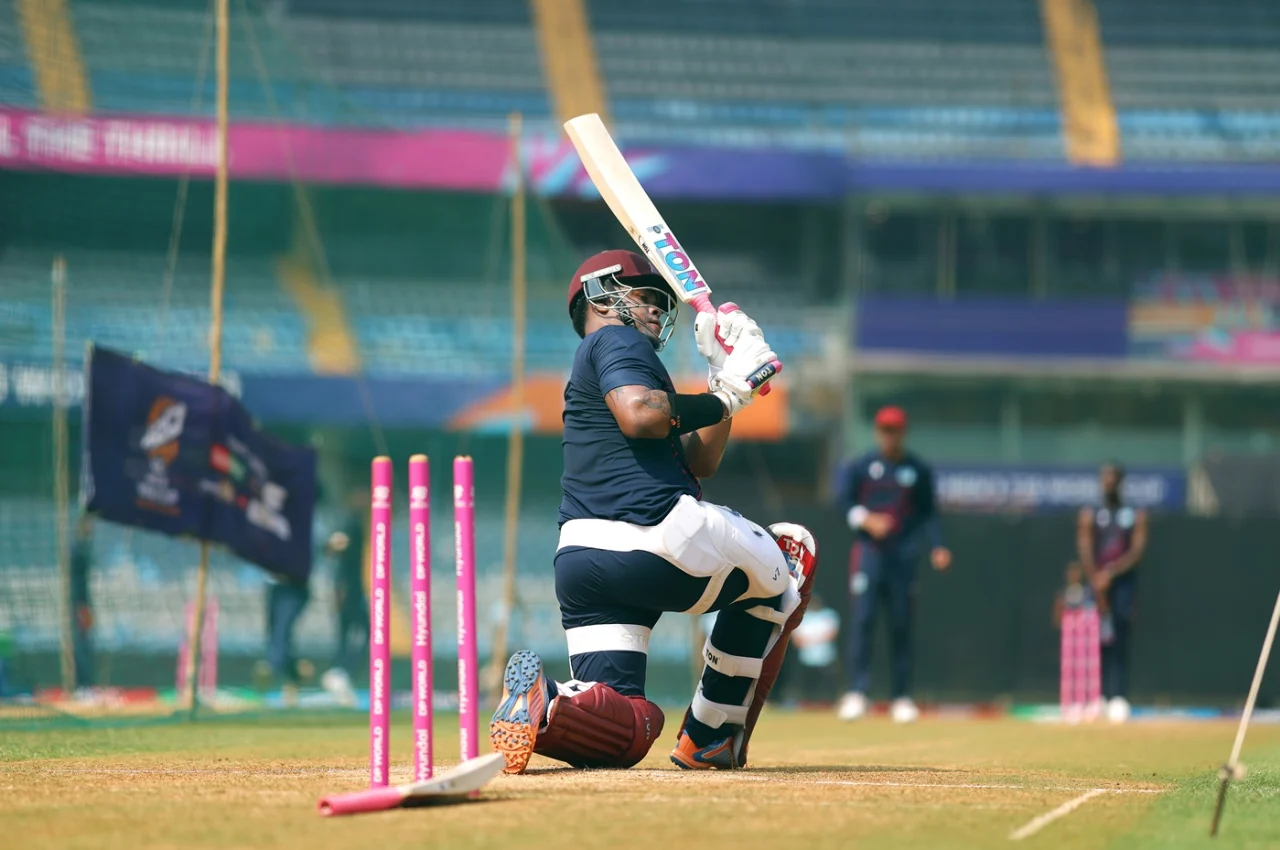
Two years ago, Zimbabwe failed to qualify for the T20 World Cup. Not only did they make the competition this time, they entered the Super Eights unbeaten.
First, it was Blessing Muzarabani who shut Australia down on a slow pitch in Colombo. Then their top four silenced the Khettarama crowd by chasing down 189 against Sri Lanka. The common factor in those wins were also Brian Bennett’s fifties and Sikandar Raza’s quick cameos. Muzarabani and Brad Evans are also among the top ten wicket takers in the tournament.
With contributions from several players, Zimbabwe could prove a handful for West Indies in Mumbai. They will have to make a quick adjustment, though, having played all their group matches in Sri Lanka, while West Indies have already played twice at the Wankhede.
These two sides have faced each other only four times in T20 internationals. When lined up player-against-player, West Indies – also undefeated – look stronger with bat, with an in-form Shai Hope, a rejuvenated Shimron Hetmyer at No. 3, and a solid finisher in Sherfaine Rutherford.
Having as many as three allrounders – with Romario Shepherd in line to return after injury – gives them the option of playing three fast bowlers and three spinners. It’s an ideal mix in Mumbai, where the quicks (35 wickets) and spinners (34) have been equally effective, averaging 26.28 and 26.25 respectively this tournament.
It’s a big game for both sides, with matches against India and South Africa to follow next. Who will get on the points table first?
Blessing Muzarabani is an early wicket-taker and a serial wicket-taker. He has height, pace and discipline on lengths that can be threatening, especially with the new ball. He also bowls at the death where he generally goes on the shorter side peppered in with the odd slower ball. That’s as all-conditions as it gets in T20s, and form is on his side too.
West Indies have a clear batting approach outlined by regular boundary hitting, and Shai Hope is the initiator and the glue as he sets up and builds innings. He has the virtues of an upgraded anchor who doesn’t have to shut down when the team is on the back foot. He is coming off two fifties, the second of which against Nepal saw him power through even as wickets fell at the other end.
Shepherd is fit again. He had strapping on his right leg as he bowled and batted for a while on Saturday. He hit one over the roof, but wasn’t as comfortable while bowling. If fit, he could replace Matthew Forde.
Zimbabwe haven’t tinkered with their squad much and that’s likely to remain the case. They could bring back Richard Ngarava for Graeme Cremer if they feel the need for pace.
West Indies (probable): Brandon King, Shai Hope (capt & wk), Shimron Hetmyer, Roston Chase, Rovman Powell, Sherfane Rutherford, Jason Holder, Romario Shepherd/Matthew Forde, Akeal Hosain, Shamar Joseph, Gudakesh Motie.
Zimbabwe (probable): Brian Bennett, Tadiwanashe Marumani (wk), Dion Myers, Sikandar Raza (capt), Ryan Burl, Tony Munyonga Tashinga Musekiwa, Brad Evans, Wellington Masakadza, Graeme Cremer/Richard Ngarava, Blessing Muzarabani
[Cricinfo]

Mexico’s most wanted man and the leader of the feared Jalisco New Generation (CJNG) drug cartel has been killed during a security operation to arrest him, the defence ministry has said.
Nemesio Oseguera Cervantes, known as “El Mencho”, died on Sunday as he was being taken to the capital Mexico City, after being seriously injured in clashes between his supporters and the army.
Four CJNG members were killed in the town of Tapalpa, the central-western Jalisco state. Three army personnel were also injured. The US had given Mexico with information that assisted the operation.
CJNG retaliated by setting cars alight, building roadblocks and attacking security forces in eight states.
Mexico’s President Claudia Sheinbaum Pardo later urged people to remain “calm”.
In a post on X, she wrote that “in most parts of the country, activities are proceeding normally”.
The CJNG cartel – which had its original power base in Jalisco – is now present across Mexico.
El Mencho, a 59-year-old former police officer, ran a vast criminal organisation responsible for trafficking huge quantities of cocaine, methamphetamine and fentanyl into the US.
It had offered a $15m (£11.1m) reward for information leading to El Mencho’s capture.
In a statement, the Mexican defence ministry said the operation was “planned and executed” by the country’s special forces.
Aircraft from the Mexican Air Force and the National Guard were also deployed.
It also said that several armoured vehicles and weapons – including rocket launchers – were seized during the operation.
The US had been providing information to Mexico that assisted its operation, the statement said.

Eyewitnesses have filmed plumes of smoke rising over several cities including Guadalajara – one of the host cities of the forthcoming Fifa World Cup.
In the tourist hotspot of Puerto Vallarta, on the Jalisco coast, potentially thousands of tourists are trapped in the resort around the fighting.
Throughout Sunday, there were reports of gunmen on the streets in Jalisco and elsewhere.
The governor of Jalisco, Pablo Lemus Navarro, on social media advised residents of the state to adhere to a code red warning and avoid leaving their homes.
He also said that public transport was suspended in the state.
The US Department of State issued a shelter-in-place warning for US citizens in the states of Jalisco, Tamaulipas, as well as some areas in Michoacan, Guerrero and Nuevo Leon.
Former US ambassador to Mexico and Deputy Secretary of State Christopher Landau described El Mencho on social media as “one of the bloodiest and most ruthless drug kingpins.”
He added that El Mencho’s death was “a great development for Mexico, the US, Latin America, and the world”.
The killing of El Mencho represents a victory for the Mexican president in her fight against the country’s drug cartels.
It also could strengthen her relationship with US President Trump, who often has demanded more progress on security in Mexico.
However, if the security forces can’t bring the situation under control quickly, the Mexican administration’s victory may be overshadowed by the cartel’s violent response.
The Jalisco cartel has gained notoriety since it was formed in about 2010 for a series of attacks on security forces and public officials.
It has downed an army helicopter with a rocket-propelled grenade, killed dozens of state officials, and has even been known to hang the bodies of its victims from bridges to intimidate its rivals.
[BBC]
Stop press. India’s victory streak in T20 World Cups was halted at 12 by the side they stole one from in the final of the last World Cup. After a surprise call to bat first, South Africa recovered from 20 for 3 to post 187 and then launched just about the perfect defence both with tactics and execution in significant dew to secure a 76-run win, which could have significant net-run-rate implications as well.
David Miller and Dewald Brevis started the comeback with some special hitting to balance Jasprit Bumrah’s 3 for 15 with analysis of 4-0-47-1 for Varun Chakravarthy. Even though they lost muscle just before the death overs, Tristan Stubbs took 20 to give South Africa something to work with.
Given the dew and the improvement in batting conditions after the first four overs, 187 seemed light, but almost everything they tried with the ball worked.Aiden Markram bowled the first over and had an India opener out for a duck, Ishan Kishan this time. Marco Jansen had a wicket first ball, Lungi Ngidi was unhittable with his slower balls, Keshav Maharaj produced three boundary catches in one over, the catching was sensational, and the biggest partnership they allowed was 35.
Bumrah, Arshdeep hurt South Africa
It feels like a long time ago, but South Africa’s decision to bat first didn’t look good when Bumrah and Arshdeep Singh ran through the top order. Bumrah was spot on, getting Quinton de Kock with a ball that seamed back in to hit top of leg and bowling a bewitching slower offcutter with the new ball to get rid of Ryan Rickelton. With Arshdeep Singh getting Aiden Markram for the seventh time in the last 51 balls he has bowled at him, India looked unstoppable.
Miller, Brevis show class
Coming in at 20 for 3, it would have been easy for Miller to play the scoreboard and not the conditions. It is a skill we can’t even fathom the enormity of to judge that the conditions are improving and that they need to go for a big score and then to be able to execute it.
Miller, at his home ground in the IPL, used all his experience of the conditions to aim straight, go after spin more than pace, and pull South Africa out of the hole. Before Brevis could join his party, Miller had already raced away to 32 off 17, including a step-hit six and a four off Varun, which does suggest a bit of overpitching thanks to his proficiency off the back foot. Brevis announced him with a no-look six off Varun in the same over.
There was a point when the first seven overs of seam had gone for 3 for 37 as against 3-0-39-0 from spin. This is when India’s sloppiness turned up. That last ball to make it seven overs was a no-ball from Hardik Pandya. Miller hit the free hit for a six. Soon Shivam Dube offered him another free hit, which he again hit for a six to get to fifty.
Between those two free hits, Brevis showed glimpses of his genius, putting paid to Dube’s wide lines with two sixes and a four. Dube had his own back with another Brevis dismissal on the pull for 45 off 29, but followed it up with that no-ball.
Stubbs provides the finish
Varun was headed for his worst analysis in T20Is when he managed to have Miller caught at long-off for 63 off 35, staying seven short of the most he has conceded. The wicket came just before the death overs, allowing Bumrah to bowl at new batters. Bumrah returned two overs for eight runs and the wicket of Corbin Bosch, but Stubbs took toll of the only slightly soft over he could get at the death. Facing all six balls from Pandya in the last over, he hit two sixes off the last two balls to end up with 44 off 24.
Dream start for South Africa
It had been telegraphed, emailed and faxed that Markram would take the new ball against the three left-hand batters at the top. This time Kishan played two balls normally for dots, then tried to go over mid-on, but nearly fell prey to the low bounce of the black-soil pitch. Then he tried to slog across the line, Markram got this ball to grip, and India had lost an opener for a duck in four of their five matches.
India didn’t separate the left-hand batters with Suryakumar Yadav sticking to his comfort zone of No. 4. Varma didn’t quite wait for offspin to do damage as he charged at Jansen first ball and edged a lifting delivery.
The field sets against Abhishek Sharma, who got on the board in World Cup with a four off Markram and then a six and four off Rabada, but South Africa tied him down with clever fields and bowling. In his 12-ball stay, Abhishek played seven false shots. When he connected, there was a deep point and a deep cover in place. The final false shot was a product of that field set and a knuckle ball from Jansen. Abhishek must have thought even half a hit would be good enough with no one out on the leg side, but the knuckle ball stood up off his bat, and Bosch took a sensational catch despite a collision with Maharaj.
Bosch can do now wrong
India promoted Washington Sundar, who played ahead of Axar Patel because of South Africa’s left-hand batters but bowled only two overs for 17. He found himself stuck before edging the first ball he faced from Borch through to the keeper. Soon a length ball down the leg side took the cue end of Suryakumar’s bat for a catch to short midwicket. Surya scored 18 off 22. The asking rate had gone past two a ball four balls he was dismissed.
Strange last quarter
A perplexing sixth-wicket stand followed when Pandya and Dube seemed happy with 30 off 23 balls leading into the drinks break, suggesting they might be taking the MS Dhoni route of narrowing the gap and salvaging the net run rate. However, immediately after drinks everybody wanted to hit a six off every ball, and we had three c Stubbs b Maharaj dismissals in the 15th over.
With no batting left, Dube could do only so much although Miller did drop Dube once to impart the only little blemish on South Africa’s night. It didn’t hurt them much.
Brief scores:
South Africa 187 for 7 in 20 overs (David Miller 63, Dewald Brevis 45, Tristan Stubbs 44; Arshdeep Singh 2-28, Jasprit Bumrah 3-15, Varun Chakravarthy 1-47, Shivam Dube 1-32) beat India 111 in 18.5 overs (Abhishek Sharma 15, Suryakumar Yadav 18, Washington Sundar 11, Shivam Dube 42, Hrdik Pandya 18; Aiden Markram 1-05, Marco Jansen 4-22, Keshav Maharaj 3-24, Corbin Bosch 2-12) by 76 runs
[Cricinfo]

Coal ash surge at N’cholai power plant raises fresh environmental concerns

Akuregoda double murder: Suspected gunman in custody a duly discharged ex-soldier

Those who hid under beds fearing Gotabaya, now talking big: Justice Minister

Demand for accommodating Thimphu principles in promised Constitution: ITAK says it was not party to that move

Tamil politicians tell the UK NPP govt. not fulfilling its promises

Protection of Occupants Bill: Good, Bad and Ugly

‘Dates have the highest sugar content to fight Coronavirus’

Sunday Island 27 December – Headlines

#SundayIsland 17th December – Headlines

Sunday Island – 28th March

Sunday Island Headlines – 21 March

Sunday Island – 21st February – Headlines
-

 Features1 day ago
Why does the state threaten Its people with yet another anti-terror law?
-

 Features1 day ago
Victor Melder turns 90: Railwayman and bibliophile extraordinary
-

 Features1 day ago
Reconciliation, Mood of the Nation and the NPP Government
-
 Features1 day ago
Victor, the Friend of the Foreign Press
-
 Latest News2 days ago
New Zealand meet familiar opponents Pakistan at spin-friendly Premadasa
-

 Latest News2 days ago
Tariffs ruling is major blow to Trump’s second-term agenda
-

 Latest News3 days ago
ECB push back at Pakistan ‘shadow-ban’ reports ahead of Hundred auction
-

 Features1 day ago
Barking up the wrong tree