
Latest News
Tickner and Rae bowl West Indies out for 205 to give New Zealand the edge

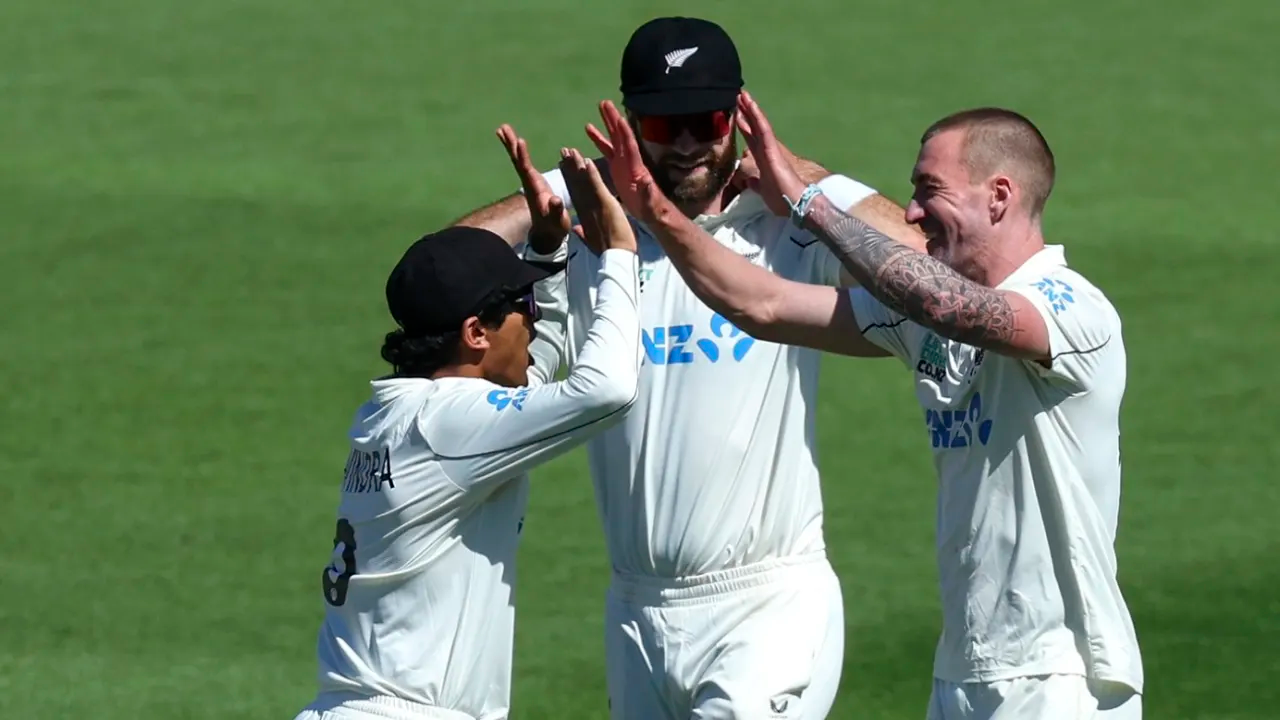
New Zealand’s patchwork fast-bowling attack delivered a strong show on the opening day of the second Test in Wellington, dismissing West Indies for 205 inside 75 overs at Basin Reserve. But the sight of Blair Tickner being stretchered off late in the afternoon with a suspected dislocated left shoulder took some sheen off their day of dominance.
Tickner, playing his first Test in two years and leading the bowling with 4 for 32, was central to turning a bright West Indies start into yet another collapse, while Michael Rae, the 30-year-old debutant drafted into a severely depleted pace unit, complemented him with 3 for 67 in an energetic outing that gave New Zealand the bite they had lacked in the opening hour. That bite mattered because the first hour had belonged entirely to West Indies despite losing the toss, in a match where the hosts announced five changes and the visitors three.
On a pitch far milder than the traditional green seamer, John Campbell and Brandon King put on 66 for the opening wicket. Jacob Duffy and Zak Foulkes, burdened with heavy workloads from the first Test after the injuries to Matt Henry and Nathan Smith in Christchurch, bowled honest but ineffective spells that allowed scoring opportunities.
Campbell drove through the line, King played compactly, and West Indies looked assured.
But once New Zealand turned to Tickner and Rae – fresher workload-wise, and sharper in pace – the difference was visible. They operated either full or short but always at the stumps or the body, and the tone of the innings shifted dramatically.
Tickner was the first to strike when he prised out King in the 17th over. King, playing the Test after Tagenarine Chanderpaul picked up a side strain on the eve of the Test, and opening for only the second time in his Test career, was pinned lbw when Tickner’s delivery from a short-ish length jagged in and hit him on the pad. One over later, Kavem Hodge was undone for a duck by a fuller ball from Tickner that tailed in late and struck him in front of middle and leg. The double-blow helped New Zealand quickly erase an indifferent start heading into the lunch break.
Rae, who had leaked runs in his first spell in Test cricket, made an impact after lunch. Coming around the wicket, he angled a full ball across Campbell, who leaned into a drive with firm hands and edged to first slip, and at 93 for 3, West Indies’ position was slipping.
Shai Hope and Roston Chase attempted to restore stability with a 60-run stand for the fourth wicket. Hope scored freely but never convincingly; Tickner and Rae repeatedly hurried him with the short ball, and he took two blows to the helmet with concussion checks following as the afternoon surface grew livelier. Hope reached 48, but Tickner finally cracked him with another rising delivery that he tried awkwardly to fend off, gloving a catch to Kane Williamson at third slip. That, Tickner’s third wicket, had seemed almost inevitable given the sustained discomfort he had caused the batters, and Chase followed soon after, cramped by a Tickner delivery that jagged in sharply to catch the inside-edge on to leg stump for 29.
Justin Greaves, West Indies’ double-centurion in Christchurch, lasted 52 balls before Rae drew a faint outside edge with a tight off-stump line. Mitchell Hay completed the catch behind the stumps, leaving West Indies’ lower order exposed. Rae then trapped Kemar Roach lbw with a fuller delivery that kicked enough to beat the bat and straighten into middle stump, and at 184 for 7, the innings was in freefall.
But New Zealand’s mood would sour dramatically in the next over. Tickner sprinted across from fine leg to stop a boundary-saving flick from Tevin Imlach and dived full-length near the rope. He landed awkwardly, stayed down, and the players signalled urgently as medical staff from both New Zealand and the venue rushed to him. After several minutes of treatment, he was stretchered off – sitting up, but in pain – to warm applause from the Basin Reserve crowd. He later left the ground in an ambulance, with early indications pointing to a suspected dislocated shoulder.
Glenn Phillips, the most prolific wicket-taker in New Zealand’s XI with 31 strikes coming into the game, then removed the last recognised batter, bowling Imlach with a fuller ball that straightened just enough to beat the inside edge.
Anderson Phillip was run out soon after attempting a risky single – first surviving a throw from Devon Conway but then succumbing when an alert Kristian Clarke broke the stumps on the rebound. Duffy ended West Indies’ innings by having Ojay Shields edge to third slip to end the innings at 205. West Indies lost their last seven wickets for just 52 runs.
New Zealand openers Tom Latham and Conway batted nine overs before stumps, with West Indies’ seamers asking questions occasionally and inducing a couple of edges that didn’t carry to the slip cordon. The 24 runs they added before stumps gave New Zealand the firm upper hand, now behind by only 181 behind going into the second day where batting promises to be easier.
Brief scores:[Day 1 Stumps]
New Zealand 24 for no loss (Devon Conway 16*, Tom Latham 7*) trail West Indies 205 in 75 overs (Shai Hope 48, John Campbell 44; Blair Tickner 4-32, Michael Rae 3-67) by 181 runs


Five members of the Iranian women’s football team have been granted humanitarian visas in Australia after their elimination in the Asian Cup, the government in Canberra says.
Immigration Minister Tony Burke said the women “were moved to a safe location” by Australian police. He said other squad members had been told they are welcome to stay in the country.
The women had been due to fly home, but supporters had raised fears for their safety after the team declined to sing the national anthem ahead of their match against South Korea last week.
This prompted criticism in Iran, with one conservative commentator accusing the team of being “wartime traitors” and pushing for harsh punishment.
Australia’s humanitarian visa programme grants permanent protection to refugees and people in humanitarian need. Visa holders can live, work and study in the country.
Speaking early on Tuesday, Burke said the five players were happy for their names to be confirmed as Fatemeh Pasandideh, Zahra Ghanbari, Zahra Sarbali, Atefeh Ramazanzadeh, and Mona Hamoudi.
“They want to be clear they are not political activists. They are athletes who want to be safe,” he said, adding that talks had been going on over several days.
He said that on Monday “it was made clear that there were five women who wanted to be able to stay in Australia”.
The group left their hotel the same day and were moved to a safe location by police.
Burke said he met the women at that location and then signed off for their applications to go onto humanitarian visas – a process completed at about 01:30 local time on Tuesday (15:30 GMT Monday).
“I say to the other members of the team, the same opportunity is there. Australia has taken the Iranian women’s soccer team into our hearts. These women are tremendously popular in Australia.
“But we realise they are in a terribly difficult situation with the decisions that they’re making,” the Australian minister said.
Australian Prime Minister Anthony Albanese later confirmed that the five players had been given humanitarian visas.
On Sunday evening, hundreds of supporters surrounded the Iranian Lionesses’ coach as it left the stadium on the Gold Coast, with chants of “save our girls”.
On Monday, the BBC witnessed dramatic scenes inside the team’s five- star hotel when several players left the lobby in a group after speaking to activists.
Shortly after they departed, a second group – including a translator and the head coach – burst in looking panicked, and rushed through the hotel before returning to their rooms.
A family member of one of the women – speaking on condition of anonymity – told Australian news site ABC they were being protected by police, and intended to claim asylum.
“I want to kiss the hands of everyone who helped,” the unnamed relative told ABC.
On Monday, US President Donald Trump took to his Truth Social platform to demand action.
Australia should “give asylum” to the women, Trump said in his initial post. “The US will take them if you won’t,” he added.
Around an hour later, Trump posted again to say he had spoken to Australia’s Prime Minister Anthony Albanese and “five have already been taken care of, and the rest are on their way”.
Trump’s post appeared to also suggest some of the team feared for the safety of their families back in Iran and so felt they must “go back”.
“In any event, the Prime Minister is doing a very good job having to do with this rather delicate situation. God bless Australia!” Trump said.
The Trump administration put all asylum decisions on hold at the end of last year, and has stopped issuing immigrant visas for citizens from dozens of countries including Iran. It has said the administration wants to bring “an end to the abuse” of the system.
Last year, two groups of Iranians – including people whose asylum applications had been unsuccessful – were deported from the US back to Iran. The groups reportedly included members of the LGBT community,who face severe legal and social repercussions in Iran.
[BBC]
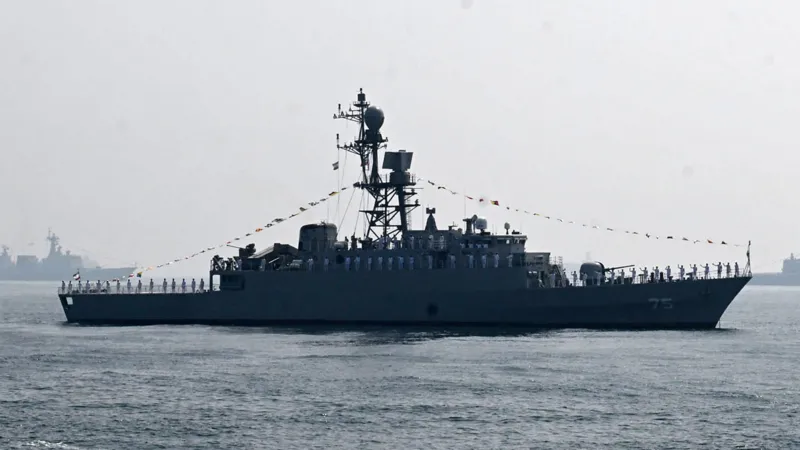
The Iranian warship Iris Dena was given permission by India to dock three days before it was torpedoed by a US submarine, India has said.
Foreign Minister S Jaishankar said Iran had sought permission for three of its ships to dock at Indian ports on 28 February – the day the US and Israel began a war on Iran – and permission was granted by India on 1 March.
The ships’ movements between 1 and 4 March are not clear and nor is why only one of them made it to India.
The sinking of the Iris Dena, with 130 sailors on board, in international waters off Sri Lanka’s southern coast on 4 March marked a dramatic widening of the war – and raised questions about India’s authority in its backyard.
It was the first military strike outside the Middle East since the US and Israel launched their war on Iran. President Donald Trump has said destroying Iran’s navy is one aim of the assault.
The three Iranian ships – Iris Dena, Iris Bushehr and Iris Lavan – had all participated in a military exercise hosted by India between 15 and 25 February in the coastal city of Visakhapatnam.
They left Indian waters on 25 February and were likely to have been in international waters on 28 February – when the US and Israel began attacking Iran.
“The Iranian side had requested permission on 28 February for three ships in the region to dock at our ports. This was accorded on 1 March,” Jaishankar told parliament on Monday. “Iris Lavan actually docked on 4 March in Kochi. The crew is currently in Indian naval facilities. We believe that this was the right thing to do.”
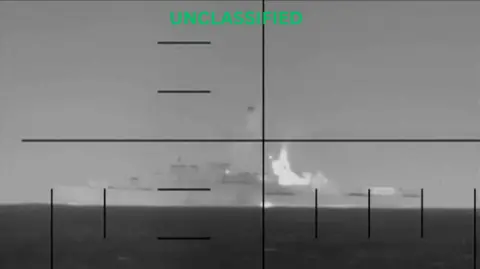
On 4 March, Iris Dena sank after being hit by a torpedo fired from a US submarine, killing at least 87 of its crew members.
According to the Indian Navy, the Iris Dena was operating about 20 nautical miles – roughly 23 miles (37km) – west of Galle in waters that fall under Sri Lanka’s designated search-and-rescue zone on the day it was struck.
The US tracks vessels across the world’s oceans, and a quarter of its submarine fleet of 65-70 is at sea at any given time, according to analysts.
Iran’s Foreign Minister Abbas Araghchi said last week the US had “perpetrated an atrocity at sea, 2,000 miles away from Iran’s shores” and that the warship was “struck in international waters without warning.”
Later, Sri Lanka said it had provided sanctuary for Iris Bushehr on 5 March, a day after it requested for docking following an engine malfunction.
Eventually, India also confirmed that Iris Lavan was docked in its southern city Kochi.
The BBC has written to the Iranian embassy in India and India’s external affairs ministry seeking clarification on the movements of the three Iranian naval vessels after Delhi granted them permission to dock.
US Defence Secretary Pete Hegseth has touted the attack on Iris Dena as an example of America’s military prowess, claiming it was “the first sinking of an enemy ship by a torpedo since World War Two”.
While it is the first time since 1945 that an American submarine has sunk an enemy ship this way, the UK and Pakistan have both sunk vessels using torpedoes since then.
The Iris Dena was one of about 20 Iranian navy vessels destroyed since Israel and the US launched co-ordinated strikes on Iran.
[BBC]

The white ball series between Afghanistan and Sri Lanka, scheduled to be held in the UAE from March 13 to 25, is likely to be postponed indefinitely due to the ongoing military conflict in West Asia.
While neither ACB nor SLC has issued an official statement, ESPNcricinfo has learned that both boards have agreed the series cannot take place in the UAE, keeping the ongoing crisis in mind. While both boards are still discussing alternatives, the bilateral series is unlikely to be shifted elsewhere due to logistical challenges.
The series comprising six white-ball matches was scheduled to start on March 13 starting with the three T20Is. The T20I leg was scheduled in Sharjah – on March 13, 15 and 17 – while the three ODIs were scheduled in Dubai on March 20, 22 and 25.
The series was set to be Afghanistan’s first under Ibrahim Zadran’s leadership, with the opener taking over the reins from Rashid Khan after a group-stage exit in the World Cup.
Last week, six matches of the ICC Men’s Cricket World Cup League 2 in Nepal involving Oman, UAE and the hosts were postponed because of the conflict.
The travel plans of several teams that were in India and Sri Lanka for the men’s T20 World Cup have also been disrupted owing to airspaces being closed or limited in West Asia.
Despite being knocked out over the last week, the contingents from West Indies and South Africa have been stuck in Kolkata, and received clarity only on Sunday, that they will be flying out on Tuesday.
[Cricinfo]

Five Iranian footballers granted Australian visas after anthem protest

Prime Minister on official visit to Manila, Philippines

It is the government’s responsibility to ensure women’s rights are realized in everyday Life, and are not confined merely to Laws – PM

North Korea cancels Pyongyang Marathon for ‘some reasons’

Canadian officials rescue 23 people who floated away on ice sheet

India offered sanctuary to Iranian ship three days before US sank it

‘Dates have the highest sugar content to fight Coronavirus’

Sunday Island 27 December – Headlines

#SundayIsland 17th December – Headlines

Sunday Island – 28th March

Sunday Island Headlines – 21 March

Sunday Island – 21st February – Headlines
-
 News4 days ago
University of Wolverhampton confirms Ranil was officially invited
-

 News5 days ago
Legal experts decry move to demolish STC dining hall
-

 News4 days ago
Female lawyer given 12 years RI for preparing forged deeds for Borella land
-

 News3 days ago
Peradeniya Uni issues alert over leopards in its premises
-

 Business5 days ago
Cabinet nod for the removal of Cess tax imposed on imported good
-
 News4 days ago
Library crisis hits Pera university
-

 News3 days ago
Wife raises alarm over Sallay’s detention under PTA
-

 Business6 days ago
War in Middle East sends shockwaves through Sri Lanka’s export sector