
Latest News
This year’s Budget has covered all sectors – Prime Minister

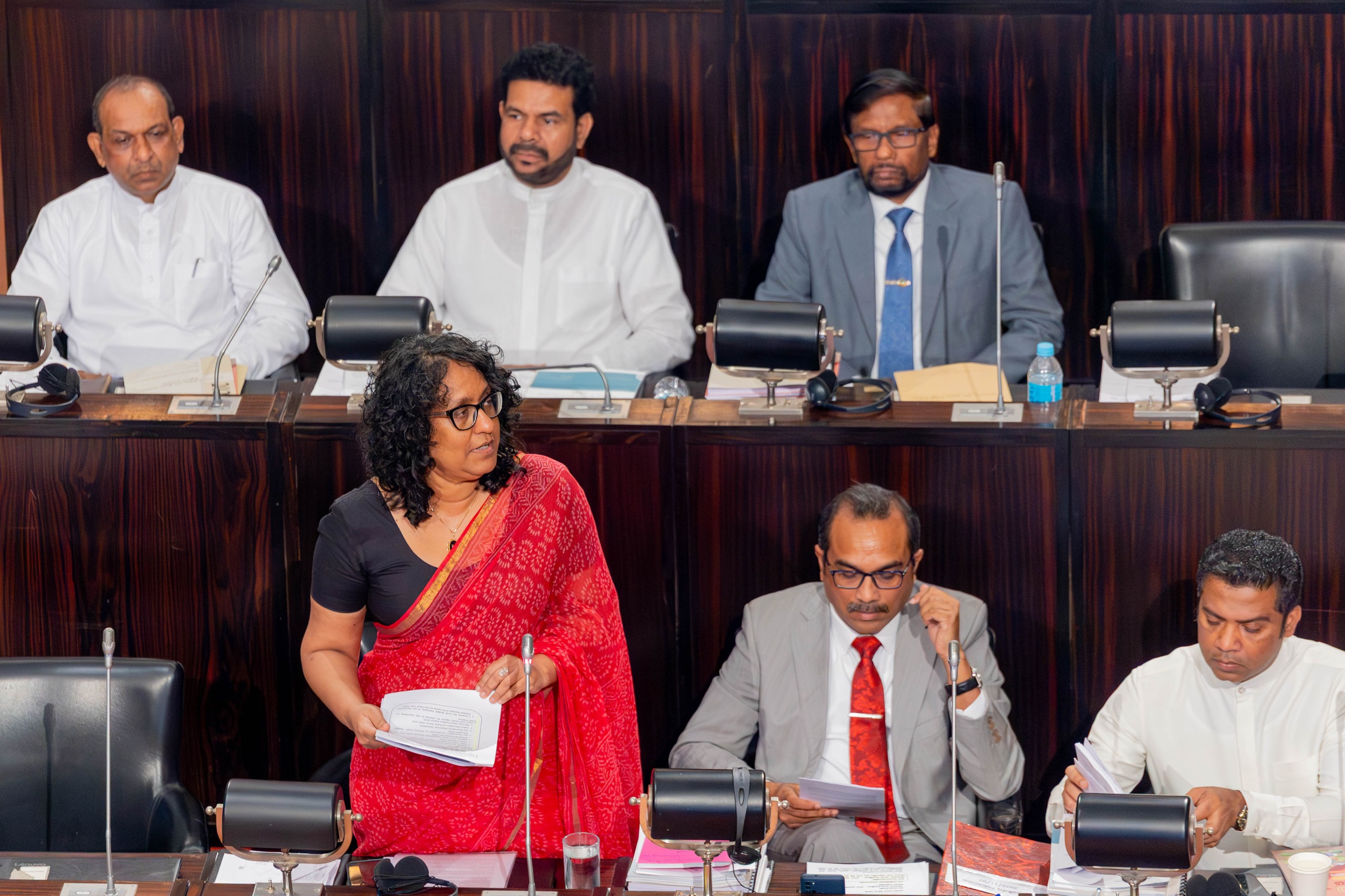
Prime Minister Dr. Harini Amarasuriya stated that this year’s Budget covers all sectors of the country, and that the Government does not act based on short-term personal agendas or interests.
The Prime Minister made these remarks in Parliament on November 8, while commenting on the Appropriation Bill presented for the year 2026.
Addressing further, the Prime Minister stated,
If the Members of Parliament, setting aside the divisions, had truly listened to the President’s Budget speech, they would have realized that there were many valuable lessons and insights to be learned from both the speech and the proposals contained within the Budget.
Behind the contents, proposals, and statistics of the Budget lies a deeply meaningful message. I urge everyone to take the time to understand that message properly.
This budget speech as well as the budget itself. demonstrates how results can be achieved and how a nation can progress through a politically disciplined governance and visionary leadership when formulating policies involves proper planning and when formulating laws as well as governing them with discipline take place to achieve defined goals and that is what is truly important right now.
This is the second budget of the current government. Our first Budget was presented in April 2025. When we assumed office, there was uncertainty how long it will take for us to recover from this considering the state of the country and the international platform at that time as well as the shattered ideas of the people. It was that time this Government came into power.
With taking over a collapsed nation, the government presented its first budget in April. The figures presented yesterday cover the period from April to September, as that budget was applicable only for nine months. The full expenditure will only be visible by December.
Within the plan to stabilize the country, the President demonstrated successful governance through financial discipline, something that must be appreciated. Regardless of political differences, we can now move forward collectively, identifying and addressing shortcomings together.
Already, within the six months of implementing the first budget, we have shown more than 50% progress. The government expects this figure to grow even further by December 31. Since many projects only began implementation in September, viewing the progress from that perspective will give us a more accurate picture.
We must remember that we have reached this stage after taking over a fallen nation. The Opposition now acknowledges that the Treasury has managed to maintain savings. The government is maintaining fiscal discipline, and none of this has happened by chance. These are the results of visionary leadership, a lesson we must recognize and appreciate.
We can also take pride in the fact that, unlike previous governments, we did not fill state institutions with people when we assumed power. We made no mass replacements. Though even some of our own party members criticized us for that, we wanted to prove that with proper leadership, clear vision, and structured planning, the existing public service can deliver results. Of course, there is room for improvement with greater efficiency and better performance.
The reason for the significant relief to the public service, and giving away the second installment from January as well as increasing the allowances and other benefits is to increase greater efficiency and productivity. Funds have been allocated for this purpose in the budget.
Our goal is to transform the public service into one that is efficient, democratic, and goal-oriented. Compared to January 2025, we can already see progress in this process. We are confident that by 2026, there will be even greater advancement with more structured and result-driven development. We are not working for short-term or personal political gain, but collectively, as a team, for the long-term development the nation needs. This marks a significant transformation that can only be understood when one remembers the condition of the country we took over.
Shared understanding that this journey toward planned, collective national progress understood by both the government and by public officials and the people has shared to seeing these results. This is a process that cannot be compared simplistically with previous governments. The difference and the ongoing transformation must be properly understood.
We are not acting based on personal agendas, ministerial egos, or political motives. We are implementing a coordinated, team-based plan developed with the nation’s needs in mind. All 159 of us in the government understand our respective responsibilities and are committed to fulfilling them to ensure the success of the overall plan.
I believe that the Opposition has studied our policy framework in depth perhaps more than we have memorizing page numbers and paragraphs. I remind them fondly that this is our five-year plan. We have a long-term vision for the country.
Five years from now, in the next election, we will debate our progress on public platforms.
Today, the Opposition accuses us of threatening democracy and the multiparty system. I would like to ask them where exactly has democracy been endangered? We are operating by fully respecting Parliament’s financial authority. Is enforcing the law an act against democracy? Is applying the law equally to everyone undemocratic?
Now, you have all come together from various parties. When many parties merge into one, that is when the multiparty system is truly at risk. Therefore, if there is a threat to multiparty democracy today, it arises from the Opposition itself from its inability to protect and represent its own parties effectively before the people.
The government has no desire, nor time, to abolish the multiparty system. We came to power not for the Opposition, but for the people to rebuild the nation and fulfill the people’s aspirations. As we pursue that goal, politics itself is changing. The expectations of the people from politics are changing. This is the greatest transformation taking place, a change in the country’s political culture. The people will not return to the old ways. Unless the Opposition understands this new political culture and adapts to it, they will not be able to grasp the true nature of this transformation.
It must also be emphasized that no sector or social group has been neglected or excluded in this budget. The government has carefully identified the key national challenges and the vulnerable social groups that need protection. Within one year, we have presented a clearly structured, logically planned program addressing immediate issues while also setting out long-term strategies for sustainable solutions. Therefore, it is impossible to claim that anything significant has been ignored.
With the country now stabilized, this budget focuses on the next step followed by how to ensure growth, how to manage the surplus funds in the Treasury effectively for the people’s benefit, and how to prevent another economic crisis.
[Prime Minister’s Media Division]


An unprecedented wave of AI-generated misinformation about the US-Israel war with Iran is being monetized by online creators with growing access to generative AI technology, experts have told BBC Verify.
Our analysis has found numerous examples of AI-generated videos and fabricated satellite imagery being used to make false and misleading claims about the conflict which have collectively amassed hundreds of millions of views online.
“The scale is truly alarming and this war has made it impossible to ignore now,” says Timothy Graham, a digital media expert at the Queensland University of Technology.
“What used to require professional video production can now be done in minutes with AI tools. The barrier to creating convincing synthetic conflict footage has essentially collapsed,” he says.
The US and Israel began launching strikes on Iran on 28 February. In response, Iran has launched drone and missile attacks on Israel, as well as multiple Gulf nations and US military assets in the region.
Many have turned to social media to search for and share the latest information and to help make sense of a fast-moving week of conflict.
The platform X announced this week it will temporarily suspend creators from its monetization programme if they post AI-generated videos of armed conflict without a label.
The scheme rewards eligible users whose posts create large numbers of views, likes, shares and comments with payments from the platform.
“It’s a notable signal that they’ve noticed that this is a big problem,” says Mahsa Alimardani, a researcher specialising in Iran at the Oxford Internet Institute.
We asked TikTok and Meta, the company of Facebook and Instagram, if they intend to take similar action, but they did not respond to our requests for comment.
A typical example of an AI-generated video that BBC Verify has tracked appears to show missiles striking the city of Tel Aviv in Israel as the sound of explosions rings out in the background.

This video has been featured in more than 300 posts which have then been shared tens of thousands of times across social media platforms.
Some X users turned to the platform’s AI chatbot Grok to confirm the video’s veracity. But in many cases seen by BBC Verify, Grok wrongly insisted that the AI-generated video was real.
Another fake video, viewed tens of millions of times, claims to show Dubai’s Burj Khalifa skyscraper in flames, while a crowd of people seem to be running towards the building.
This AI-generated footage spread widely online at a time of considerable concern from residents and tourists about the drone and missile strikes on the city.
“Fake videos like these have a detrimental impact on people’s trust in the verified information they see online and make it much harder to document real evidence,” says Alimardani.

A new feature of this conflict analysed by BBC Verify is the emergence of AI-generated satellite imagery.
We verified multiple real videos showing Iranian drone and missile strikes on the US Navy’s Fifth Fleet headquarters in Bahrain on the first day of the conflict.
A fabricated photo, shared on X by the state-linked newspaper The Tehran Times, began to spread the following day and claimed to show extensive damage to the base.
The fake appears to be based on real satellite imagery of a US naval base in Bahrain taken in February 2025, which is publicly available online.
According to Google’s SynthID watermark detector, the fake image was generated or edited with a Google AI tool.
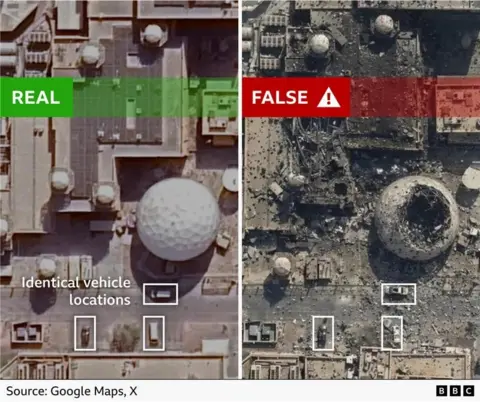
Three vehicles parked outside are also in the exact same spot in both the genuine satellite imagery and the AI picture – despite the photos allegedly having been taken a year apart.
Google’s AI tools, including its video generator Veo, are on the growing list of popular AI platforms, like OpenAI’s Sora model, Chinese AI app Seedance, and Grok which is built into X.
“The number of different tools that are now available to create a wide range of highly realistic AI manipulations is unprecedented,” says Henry Ajder, a generative AI expert.
“We have never seen these tools so available, so easy and so cheap to use,” he says.
This has led to a surge of AI-generated content online “because the pipeline onto social media can now be almost fully automated,” says Victoire Rio, executive director of the technology policy non-profit What To Fix.

X’s head of product said on Tuesday that “99%” of the accounts spreading AI-generated videos like these were trying to “game monetization” by posting content that will generate large amounts of engagement in return for payment through the app’s Creator Revenue Sharing programme.
The platform does not publish how many accounts are part of the programme, or how much money they can make.
But Graham estimates that X could pay about “eight to 12 dollars per million verified user impressions”.
“Creators have to hit five million organic impressions in three months, plus hold an X premium subscription, to be eligible,” he added.
“Once you’re in, viral AI-generated content is basically a money printer,” he says. “They’ve built the ultimate misinformation enterprise.”
X did not respond to our request for comment or our questions about the Creator Revenue Sharing programme.
Experts have told BBC Verify that while many social media companies say they are trying to change their moderation and detection systems to address the scale and speed at which AI-generated content spreads, there is no simple solution to the problem.
“The deeper issue is that engagement-driven monetisation and accurate information are fundamentally in tension, and no platform has fully resolved that tension or perhaps ever will,” says Graham.
[BBC]

Explosions have rocked one of Teheran’s main commercial airports, with eyewitnesses reporting a burning plane and large plumes of smoke at the Mehrabad airport – Iran’s busiest airport and main domestic hub – in footage shared on social media. Satellite imagery taken on Friday shows multiple aircraft were at the airport.
Israel earlier said it was launching a new wave of strikes on Iran
[BBC]

Retiring skipper Alyssa Healy fell cheaply late on a bowler-dominated opening day that saw debutants Lucy Hamilton and Sayali Satghare produce spectacular starts to their Test careers.
Thirteen wickets fell on a grassy WACA surface, including Healy who on 13 hit Satghare straight to backward point with 30 minutes left before stumps. Healy trudged off the field – perhaps not for the final time – to a loud ovation as India, fielding four debutants, hit back after being bowled out in 62.4 overs.
Annabel Sutherland, backing up her earlier standout bowling effort, steadied before the close alongside Elllyse Perry, who is playing as a specialist batter after recovering from a quad strain.
After Healy elected to bowl to kick-start her swansong, left-arm quick Hamilton ignited Australia by clean bowling Smriti Mandhana for 4 in a brilliant start to her Test career.
She also claimed the wickets of Jemimah Rodrigues, who top-scored with 52, and Sneh Rana to finish with 3 for 31 off 11 overs in an impressive first up effort after earning selection over uncapped Maitlan Brown.
Australia’s seamers relished the conditions as they swung the pink ball menacingly to cause nightmares for an India side returning to Test cricket for the first time since mid-2024.
Sutherland was unplayable for long stretches as she hooped the ball around to finish with 4 for 46 off 17 overs, figures that could have been even better if not for four dropped catches off her bowling.
Australia’s sloppy performance in the field prolonged India’s first innings and meant they had the tough task of fronting up to bat under lights. Satghare lifted India by knocking over Georgia Voll with a menacing delivery that pitched well outside off-stump before swinging back to hit leg stump.
Fellow debutant Kranti Gaud also had a first wicket to remember when she dismissed Phoebe Litchfield, largely thanks to a brilliant catch from Rodrigues at backward point.
It led to Healy walking out to a mighty ovation, but India weren’t in a generous mood as they clawed back into a contest they must win if they are to draw the multi-series format.
Healy’s day had started brightly when the coin fell in Australia’s favour for the first time in the multi-format series. Her decision to bowl caused a groan in the terraces with fans itching to watch her bat.
But the supporters were soon in full voice when Hamilton, 19, was introduced into the attack in the second over. She came close to a wicket on her fourth delivery but a reviewed lbw shout on opener Shafali Verma was unsuccessful due to an inside edge.
Hamilton only had to wait until her third over to get through Mandhana with a cracking full-pitched delivery that comprehensively beat the bat and smashed into middle stump.
She was mobbed by her teammates before bowling a fierce short delivery to fellow debutant Pratika Rawal, who streakily opened her account through the slip cordon.
Hamilton, who earlier received her baggy green from Beth Mooney, returned the impressive figures of 1 for 12 from five overs in her first spell. But India hung tough with Shafali – maturely resisting her attacking instincts – and Rawal combining well in a rearguard to get through the new ball.
Sutherland entered the attack and started a fabulous bowling performance by cutting short Shafali’s blossoming knock on 35 with a terrific delivery that was caught behind.
It was a reward for Sutherland who had earlier been desperately unlucky not to pick up the wicket of Rawal after Hamilton fumbled in the gully. In what proved to be a costly missed chance, Rodrigues was reprieved by Voll at short-leg on 0 when she fended a fierce short delivery from Sutherland.
But Sutherland was not to be denied after she enticed Rawal into edging to gully where Hamilton hung onto her first catch at Test level. Captain Harmanpreet Kaur started swiftly before her off-stump was knocked by a pearler from Darcie Brown as India entered the tea break in trouble at 99 for 4.
Sutherland continued to be irrepressible after the resumption and dismissed Deepti Sharma with a length ball as the pressure heightened on Rodrigues and Richa Ghosh, who was purely in survival mode early in her innings.
Local hero Alana King was held back until the 40th over and Rogrigues decided it was time to put the foot down, counterattacking to devastating effect with four consecutive boundaries.
She sped to her half-century off 74 balls with the milestone reached in fitting style with a gorgeous drive as she continued to take a liking to King’s legspin.
Just when the partnership started to gather momentum, Ghosh threw it away when she hit a dragged down delivery from Ashleigh Gardner straight to short midwicket before Rodrigues tamely flicked a loose delivery from Hamilton to square leg.
Hamilton bagged Rana as India spiraled to 157 for 8 before debutant Kashvee Gautam attacked just like she had done during the ODI series. She eventually ran out of support with Sutherland claiming her fourth wicket when she dismissed Satghare.
The hectic day’s play also launched a new era at the revamped WACA ground with most spectators nestled in the rare shaded areas – still an issue even after the redevelopment – as the temperature peaked at 37 degree Celsius with a similar forecast set for day two.
Brief scores: [Stumps Day 1]
Australia Women 96 for 3 in 27 overs (Ellyse Perry 43*, Annabel Sutherland 20*; Kranti Gaud 2-28) trail India Women 198 in 62.4 overs (Shafali Verma 35, Jemmimah Rodrigues 52, Kasnvee Gautam 34*; Darcie Brown 2-41, Annabel Sutherland 4-46, Lucy Hamilton 3-31) by 102 runs
[Cricinfo]

Qatar partially reopens airspace as Iranian strikes continue to hit Gulf

The final voyage of the Iranian warship sunk by the US

AI-generated Iran war videos surge as creators use new tech to cash in

Huge explosions rock major Tehran airport as Israel strikes ‘regime infrastructure’

India hit back but Sutherland, Hamilton impress to give Australia the edge

Heat Index at ‘Caution Level’ in the Sabaragamuwa province and, Colombo, Gampaha, Kurunegala, Anuradhapura, Vavuniya, Hambanthota and Monaragala districts

‘Dates have the highest sugar content to fight Coronavirus’

Sunday Island 27 December – Headlines

#SundayIsland 17th December – Headlines

Sunday Island – 28th March

Sunday Island Headlines – 21 March

Sunday Island – 21st February – Headlines
-
 Features5 days ago
Brilliant Navy officer no more
-

 Opinion5 days ago
Sri Lanka – world’s worst facilities for cricket fans
-

 News2 days ago
Legal experts decry move to demolish STC dining hall
-

 News1 day ago
University of Wolverhampton confirms Ranil was officially invited
-

 Features5 days ago
A life in colour and song: Rajika Gamage’s new bird guide captures Sri Lanka’s avian soul
-

 Business3 days ago
Cabinet nod for the removal of Cess tax imposed on imported good
-

 Features6 days ago
Overseas visits to drum up foreign assistance for Sri Lanka
-

 Features6 days ago
Sri Lanka to Host First-Ever World Congress on Snakes in Landmark Scientific Milestone