
Features
Thilo Hoffmann’s contribution towards improving and creating protected areas

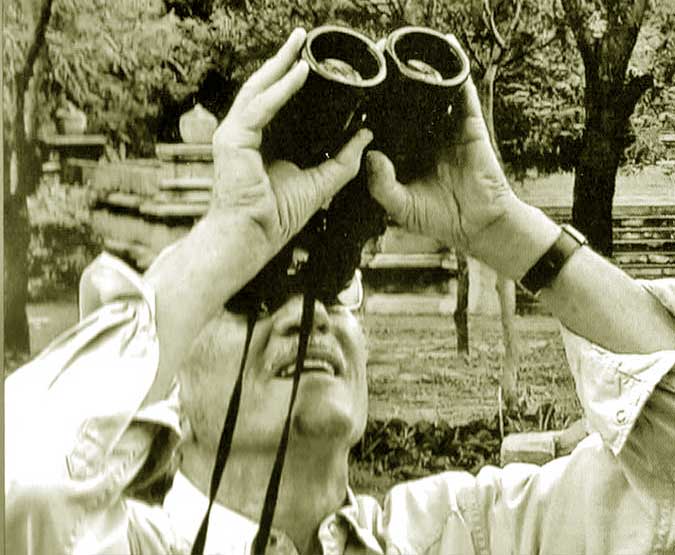
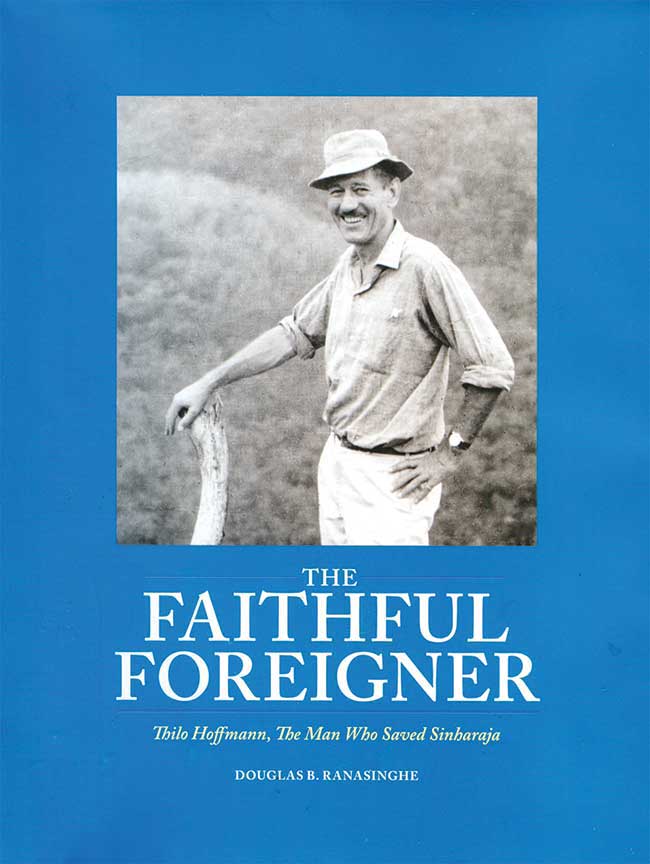
Excerpted from the authorized biography of Thilo Hoffmann by Douglas. B. Ranasinghe
Set out below is an account of Thilo Hoffmann’s other work in nature conservation site by site. Further details about his involvement in some of these sites and yet others are found elsewhere in this book.
1) Wilpattu National Park
When the important Western section of Wilpattu had only the status of Sanctuary, and it was even proposed that there should be a public road across it, Thilo intervened on behalf of the WNPS and persuaded the government to make it part of the Wilpattu National Park.
The two Intermediate Zones to the South and East were incorporated in the Park at his suggestion. It was an important consolidation, as the Wilpattu East IZ occupied a major portion of the present Park.
He proposed, as also described in the last Chapter, a further extension to the Park as a Marine Sanctuary. This proposal, too, was supported by ample documentation prepared by him.In recognition of Hoffmann’s contribution to the cause of conservation of nature and wildlife in Sri Lanka, the Talawila bungalow at Wilpattu was named after him by the Ministry of State in 1985. On this occasion two conservationists were honoured in this manner, the other being Dr. RL Spittel.
2) The South-East Complex
On Hoffmann’s suggestion all the Intermediate Zones in the country were incorporated into National Parks. Thus the land in the Yala complex with that status was made part of the Yala, now Ruhunu, National Park. He also proposed extending the Park into the ocean to include the Basses ridge and reefs.
As the President of WNPS Thilo was pleased when the Society was invited on two occasions to participate in discussions at the Ministry of Irrigation, Power and Highways on the Heda Oya Project and the development of the Lower Uva area. He pointed out that, if implemented, the projects would have a very considerable impact on exiting and proposed conservation areas, notably the entire Yala complex, the Lahugala-Kitulana Sanctuary and also the very important Bundala Sanctuary, the two last named now National Park.
In 1977 Thilo gave his view on this project in an article to Loris under the title ‘Major Threat to the Oldest Wildlife Reserve’. He brought to the notice of technocrats and administrators that National Parks and other National Reserves are areas sacrosanct by definition and law, which cannot be altered and changed at will, that it is only the National State Assembly which can decree and approve boundary alterations in these.
Further, he strongly argued that buffer zones of natural forest or of plantation forest should be established and maintained in lieu of Intermediate Zones when the latter were incorporated in the National Parks. His opposition to the construction of hotels on the Yala coast is also set out together with his comments on visitor pressure at the Ruhunu National Parkrk’, below.
The Lahugala-Kitulana National Park of 1,550 hectares was declared on October 31, 1980 especially for the protection of elephants, and the Bundala National Park of 6,216 hectares was declared on October 15, 1990 mainly for waterbirds. The earlier planned development projects were abandoned.The Bundala National Park was named Sri Lanka’s first Ramsar Site in 1991. Thilo’s role in this, and the declaration of other Ramsar Sites, is also recorded in this book.
 3) Gal Oya National Park
The Gal Oya National Park, of 25,900 hectares, was established on December 12, 1954 by the Gal Oya Development Board for the protection of the new reservoir, the Senanayake Samudraya, and was handed over to the Department of Wildlife in 1965. It lies in the dry zone low country, and is part of the Uva Province. The basic concept of the Park was to provide at least a small, fully protected catchment and protective area for the reservoir – whose total catchment is much larger.
Thilo made several visits, and reported to the authorities on shortcomings and the improvements that could be made. In April 1973 – just after climbing Ritigala Peak and despite a painful back injury, a slipped disc – Thilo spent four days in this National Park, sleeping in the open and walking long distances in the company of several officers of the Wildlife Department, in order to obtain a clear picture of the conditions in the Park at that time.
It contains the greatest extents of talawas with mana grass and the fire resistant aralu, bulu, nelli and gammalu (Pterocarpus marsupium) trees and madu. Hoffmann published a summary of the report on this visit in Loris, titled ‘The Gal-Oya National Park. His ideas, in brief, were:
1. This is the most beautiful and attractive National Park. The combination of its wildlife, notably elephants and birds, the special flora and the impressive landscape makes it ideal for visitors, including foreign tourists. The potential of the Park was great and basic access relatively easy with almost daily flights to and from Ampara. Opening it for visitors should be the first priority of the Department.
2. The boundaries of the Park should be altered with the inclusion of a few square miles of additional land, notably along the Western flank. The most important corrections suggested were those concerning the inclusion of the ‘Nilgala wedge’, the Pallang Oya Reservoir (now called Jayanthi Wewa), and all uninhabited land west of the Namal Oya and the reservoir of that name and/or the road from Iginiyagala to Mullegama.
3. For tourist and visitor development:
a) Have several boats because a trip on the waters of Senanayake Samudraya is an unforgettable experience and the best way to see elephants.
b) Establish one major viewing track and a few jeep tracks. The major track could be from Mullegama via Bubula and Henebedda to Makara where the Gal Oya River enters the lake through a picturesque boulder-strewn gorge.
c) A bungalow and a camping site at Makara.
These suggestions were made nearly 40 years ago and are still valid.
Some time later a foreign company proposed to take over the Gal Oya National Park and develop it as a tourist project. Thilo opposed this project because he feels that in a National Park only full government control, which is subject to public scrutiny, can guarantee the proper maintenance of correct conservation practices. Further, the Fauna and Flora Protection Ordinance does not allow the alienation of land under its purview, or commercial activities such as private tourist camps in National Parks.
This principled stand caused Thilo further worry in his dealings with the WWF, and added to his troubles in the matter of the presidency of the WNPS. The reasons were that a member of the WNPS Committee was the designated Manager of the private Gal Oya project, and the foreign company had close ties to the WWF.
Thilo and the WNPS had upheld the same position in the battle against a chain of hotels along the coast in the Yala National Park, and in the construction of the Society’s own bungalows, which are all outside National Parks.
4) Udawalawe National Park
After years of agitation by the WNPS, the Udawalawe National Park was declared by the Government in June 1972, when Mr S. D. Saparamadu was Director of the Department of Wildlife Conservation. Like Gal Oya it was mainly meant as a protection for the reservoir.
The new ‘Park’ was in desolate condition. It was crisscrossed by tracks for the extraction of timber and large-scale cultivation. Large numbers of people worked in felling camps, and many capitalist landholdings had been cleared. Bananas, chillies, tobacco, tomatoes and other crops were grown, with paid labour living in wadiyas on the land. Much of the forest had been cleared, and wild animals exterminated in these areas. The Park was a hive of illegal human activity.
There were also extensive teak plantations, and the State Timber Corporation was busy removing all the usable timber trees from the area.One month after the declaration Hoffmann visited the new Park, mostly on foot, during several days, and wrote a detailed report, which was later published in Loris, titled ‘The New Uda Walawe National Park’. A copy with a request for action was handed over to Mr Saparamadu as Director of the Wildlife Department. It is the only detailed account and description of the state of all parts of the Park at that time, and contains a number of specific recommendations for improvement.
During that visit the newly appointed Park Warden had stated: “It was a mistake to declare this Park.” He felt that it was beyond redemption, as did his mentor and friend, the earlier Director. Thilo comments:
“Contrary to what S. D. Saparamadu writes in his book Sri Lanka: A Wildlife Interlude (2006), the Wildlife and Nature Protection Society welcomed the establishment of the new Park for which it had lobbied over the years. This is recorded in the WNPS annual reports and Loris as they had foreseen its great potential.
The Society, however, was not happy when after the declaration nothing happened with regard to the desperate situation of the Park, despite the appointment of a few staff without the means to assert the Department’s authority over it. When Director Saparamadu retired a few years later, in early 1975, the Park was in the same desolate state.
Subsequent Directors did what was required, and the Park was properly opened for the public in 1980. It was also somewhat enlarged, and now comprises 30,821 hectares. It has amply fulfilled the high expectations which Thilo and the WNPS had of it. Thilo says:
“Saparamadu’s book contains many more distortions, manipulations of facts and downright untruths. There is hardly a chapter in which he does not disparagingly refer to “the wildlife establishment”, by which he means the WNPS, described as “western educated, English speaking and mostly Christian”. He and – in some ways – his predecessor were the extreme cases of supercilious bureaucrats with minds battened down against anything and anyone outside their own establishment. Arrogant confrontation and denial instead of friendly collaboration was the rule.”
In Thilo’s report to Loris in 1972 – written after his visit – he noted the matters set out below:
1. In the eastern sector, there were at least four timber wadiyas. The area had been systematically logged since the 1950s. As a result there were no large trees to be seen anywhere.
2. Large tracts of abandoned chenas were overgrown with Lantana and eupatorium, the latter recently introduced from abroad: New land was being cleared for cultivation.
3. The Forest Department had established 3,500 acres of teak plantations in the Park. 500 acres were newly earmarked for a three-year chena control system.
4. Inside the eastern sector there are two ancient villages, Sinuggala with four families and Nebodawewa with two families.
5. Few animals were observed. A leopard was seen, a very rare occurrence here. The presence of elephants was noted. It was recorded that there was a potential carrying capacity of about 150 elephants. Though not a single spotted deer was seen, dry deer skins were observed in timber wadiyas.
6. Logs were being loaded into lorries using tame elephants.
7. The situation in the western sector of the Park (west of the Walawe River) was very similar with chenas and settlements. The latter would have to be excised, but the higher lying part, north of Kuda Oya, was ecologically very valuable because of its special character, containing talawa.
The report (in 1972) ended with the following sentence: “The new Uda Walawe National Park has a future and is worth a special effort; no more time must, however, be wasted.”











Features
Independence of the judiciary, democratic governance, and dismantling of the executive presidency:

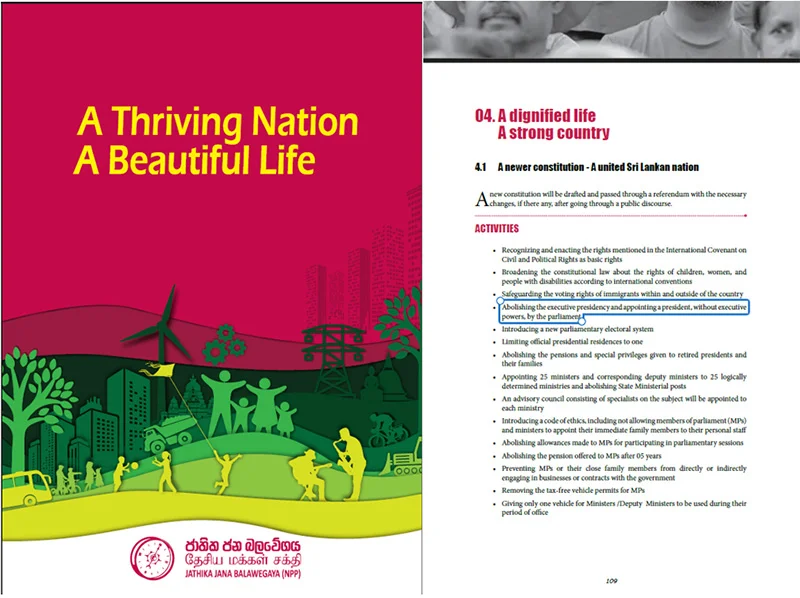
the basis for drafting a new constitution
By Savitri Goonesekere
( This is an edited version of the transcript of a talk given at a public seminar titled ‘Why should we rally for a new people’s constitution?’, held at the National Library Auditorium on 11 September 2026 and organised by the Young Lawyers’ Association. )
Today there is so much confusion: what is Constitutionalism? What is a Constitution? Why do we need a Constitution? We must recognise that, it has been civil society, including professionals in this country, who have always articulated a voice on issues of public concern. If you remember the time of COVID, we had the medical professionals articulating a voice because this was a matter of public concern. So, the Bar Association, too, has expressed views on public concerns. We have with us this evening, President’s Counsel Mr. M. A. Sumanthiran, and Mr. Geoffrey Alagaratnam, and we will have President’s Counsel Mr. Saliya Pieris, who will join us later.
They and many other leading lawyers have always led from the front. And in that regard, in the case of the legal profession, inevitably there are areas of public concern that necessarily mean that they have to call the government to account. When that happens, the Bar Association is required to question government’s action or inaction including their policies
Now, in the past, I don’t think it was as bad as today, because today we have such adversarial, confrontational politics that if by any chance—and an unlucky chance—the Opposition’s stand on a matter happens to coincide with that of professionals, then there’s a delegitimisation of the professionals. That is wrong because professionals must have the courage to speak for their profession, even when they question the government. Constitutionalism and Constitution-making, to be functional, must have bipartisan consensus. When that is not there, even professionals who articulate a voice are seen as either anti-government, against government, or worse, lackeys of the government.
I think citizens should be aware of these realities, and therefore reflect on what it means to have a Constitution. What is a Constitution? A Constitution is, after all, the basic law of a country which will regulate the governance system. And to regulate a governance system, you have to have a framework for governance. The framework for governance also then will have to have institutions of governance. That would be what you call the system of governance. Now, those institutions of governance also have to be embedded and linked with some values, and a values framework.
In the 20th and 21st centuries, we have basically two forms or frameworks of governance. One is Democracy. The other is what we call centralised power with perhaps a single leader. That kind of governance does not focus in the way that Democracy does on the Sovereignty of the people, the rights and liberties of citizens of the country. Therefore, we need to understand in Constitution-making where we stand. Is it going to be for Democracy or is it going to be for another form of government? And I say this because today we’re constantly talking of the Democratic deficit, the failures of Democracy. Contrasted with that are countries which have strong leadership, single leadership, supposed to propel our counties into economic growth and a wonderful future.
In that context, therefore, we need to ask ourselves: what is the value in Democracy? Now Democracy, we must understand, was born of an evolutionary framework developed from a time when there was single leadership by a king, a monarch. Democracy didn’t come overnight. It had to dismantle monarchy and single leadership, and that’s what it did. Historically we know that basic ideas on Democracy as a form of governance can be traced to the Greek civilisation and time of what we call the Western Enlightenment. It was the Western Enlightenment that brought together these ideas of the Sovereignty of the People, a social contract between government and the People who are governed, and the central importance of the People of a country. That is Democracy. That did not come overnight. It took centuries. It took ideologies. It took thought. It required struggle born also of blood and tears.
Today we dismiss Democracy and this history and say, “Oh, it is elitist liberalism.” But we must not forget that Democracy was born as an evolution from monarchy and single leadership, replacing this with the concept of government that respected the rights of the Sovereign people. The central importance of the Sovereign Peoples rights to be protected from abuse of state power is the foundation of democracy as a form of governance. The European countries and the UK engaged with that system of governance.
By 1948, when the UN Charter and the International instruments were drafted, there were two different approaches to governance. One was the Western tradition born of their experience evolving from monarchy to People’s rights and People’s sovereignty that focused on civil liberties: freedom from torture, freedom of speech, freedom of expression, freedom to protest—those are civil liberties. But the weakness was that there was no recognition of social and economic rights as the rights of the people: that was absent in that tradition.
On the other hand, there were member states from the Communist countries, which had the centralized, authoritarian system of governance. They did not recognise civil liberties, but focused on meeting all their people’s social and economic needs as rights: health, education, shelter.
In 1948, we must remember that there were therefore two major international treaties or covenants: one, a Covenant on Civil and Political rights, and another one on Economic and Social rights. That was the Cold War period. But then subsequently through the years, there were changes. In the 1990s, there was the flowering of the human rights tradition. Member states of the UN came together at the Vienna World Conference in 1993, which then recognized that ALL these rights should be human rights of peoples across the globe
So, the Western liberal civil liberties tradition, linked with that of the countries of the Global South like Malaysia, China, and Russia—which recognized and gave importance to social and economic rights. And then a consensus developed that ALL these rights are important; they are “indivisible.” We witnessed this in the 1990s, and the early years of this millennium in the development of many international Conventions which declared human rights on the basis of both civil liberties and social and economic rights.
One would have thought that we would achieve a global consensus on the broadening of the meaning of democracy and a movement away from this concept of strong leadership without civil liberties. But we have not had that. In place of that, we have had a decline in multilateralism in the UN system, giving way to bilateralism, once again back to this focus on two systems: Democracy or strong single leadership.
In this global context, let us compare the situation in countries like ours, which experienced decolonization: countries which knew the impact of colonialism. What happened in those countries? These civil liberties, the legacy of the colonial powers, were used in freedom struggles. They were used to dismantle colonialism. That is why the idea that this liberal tradition of civil rights is a colonial white man’s sudda-law should be challenged. Because this is not so. These countries of South Asia and Africa internalised the values of Democracy, the systems of governance known as Democracy, and built for their nations Constitutions which recognized the importance of civil liberties and control of state power And you see this in India, you see this in Nepal, you see this in Sri Lanka: we had the same concepts of the importance of civil liberties in Constitutionalism. But we focussed on civil liberties. Social and economic rights in the Vienna Convention were considered only as social policies, following the Western tradition on people’s rights.
And what is the meaning of Constitutionalism? The Sovereign people have given their consent to the rulers to rule subject to protection of THEIR rights. And that means that Constitutionalism must prevent the abuse of State and Government power. . Today sometimes we talk of authoritarian Constitutionalism, we talk of abusive Constitutionalism. That’s a contradiction. If Constitutionalism is to prevent abuse of state, government power, you can’t have authoritarian constitutionalism or abusive constitutionalism. What you can say is you can abuse of constitution making process to embed an authoritarian system of governance.
So, we must now, therefore, recognise that even today, if we say there’s a Democratic deficit, this system of governance has been used in our countries to give a better quality of life to our people. There have been failures; there are dysfunctional areas, but that does not mean you have to reject something which has been a powerful force for recognising the importance of the citizens of a country.
I think today when we are challenged with all this talk on the deficit of democracy, the importance of single leadership and authoritarian governance to deliver development, we must stay the course and say: “No, for Sri Lanka, from 1948 we have had Democratic governance.” Governments have not delivered in many areas—true—so the challenge is to focus on Constitutionalism in a new Constitution. Priority must be given to help the government to deliver on the gaps that we have, and ensure the well-being of our people. Constitutionalism must be the basis for drafting a new constitution.
I think we have to also challenge this often-repeated statement that we have a “78-year curse” in governance. We have had deficiencies, but we have had Democratic governance. Central to that has been regular elections and the resilience of the People. Also, the contribution of the courts of this country, the lawyers of this country in ensuring that there has been some accountability in governance.
Some of you may not remember, but I have lived through dark times. I have witnessed the horror of the murder of a dear student, a politician whose head was cut off by the JVP—the Deshapremi at that time—and stuck on his gate. He had young children. I have gone with my husband in dark curfew streets to help clear a body for burial, where the first person who opened the poll, a relative, was killed at the General Election the JVP prohibited.
So, we in this country have lived through dark times. But we also have moved from that dark past to a point where those involved in an armed struggle the JVP entered into the democratic political process. They did so in 1994. Having come into that political process, the Democratic process, it is a commitment made to the people. We must hold this government with its JVP partner to deliver on Democracy, and not any other system of governance.
Let us look at our history of Constitutionalism and Constitution making. What is our history? 1948: we had the parliamentary system. We had, particularly in relation to the minorities, decisions of the appeal courts which have been criticised, which did not take into account minority rights. So, there were deficiencies. But we had a written constitution, we had courts, we had public administration and law enforcement systems that functioned. That was the dividend of post-independence freedom and political autonomy in Sri Lanka.
Then in 1972: with a massive mandate, we had a government which again brought in the 1972 “autochthonous” or home grown constitution. But what did it do? In fact, it interpreted the Sovereignty of the People as the Sovereignty of Parliament and parliamentarians. And that made Democracy dysfunctional. There is a recorded history of the abuse of power that took place at the time, including the conflict with the courts.
Now change was promised in 1978 Constitution. The people gave a massive mandate for a Dharmishta anduwa. And then what happened ? Again, we put in place all the democratic institutions as we know them, the system of democracy familiar in the liberal tradition. But a huge gap was the aggrandizement of power in the strong Executive Presidency, which has led to decades of problems in the governance of this country.
The Executive Presidency of 1978 has destabilised what were good public institutions. It has contributed to an ethos where, in institutions, the person who is considered the boss is supposed to lead, and everybody else does not question him/her. That happens in the public sector today in many institutions, and I’m told (and it looks like it does) that sometimes this also happens in the private sector. So, we have developed what you call a boss-man culture which seeps down to society, not just public institutions and governance. The Executive Presidency, therefore, has contributed to the weakening of many public institutions and also, to a large extent, a culture of corruption, and abuse of power.
This decline has been understood, and because it has been understood, since the year 2000 we have been asking for a new Constitution that will eliminate the Executive Presidency. Successive political leaders including the current President and their political parties have pledged in election manifestos to do this. At least the Chandrika Bandaranaike government fulfilled that promise and brought such a constitution in 2000 to abolish the Executive Presidency and strengthen the democratic institutions to achieve accountable governance to the People. Unfortunately, a subsequent and recent executive President and his party tore that Constitution to shreds in Parliament. That was 2000.
(To be continued)
by Jehan Perera
The NPP government is going after powerful figures from the past and present who have engaged in corruption, fraud and criminal activity in a way that no previous government in Sri Lanka has done. Former ministers, politicians and senior state officials are among those facing investigations and legal proceedings. The government has placed before Parliament a document listing 50 cases involving corruption, fraud and other crimes. These include not only financial offences but also cases relating to the Easter Sunday attacks, the killings of Lasantha Wickrematunge and Wasim Thajudeen, the disappearance of Prageeth Ekneligoda and attacks on journalists Keith Noyahr and Upali Tennakoon.
The significance of this effort is that it can demonstrate that nobody is above the law, regardless of political connections or social standing, which will help restore public confidence in institutions that have long been distrusted. It could also recover public resources, improve the investment climate and strengthen the foundations for a more prosperous and just Sri Lanka. When criticised for focusing on the past and not the present, the government position is that these investigations were initiated under earlier governments, particularly between 2015 and 2019, and that it is now allowing investigators to proceed to deal with the backlog without political interference.
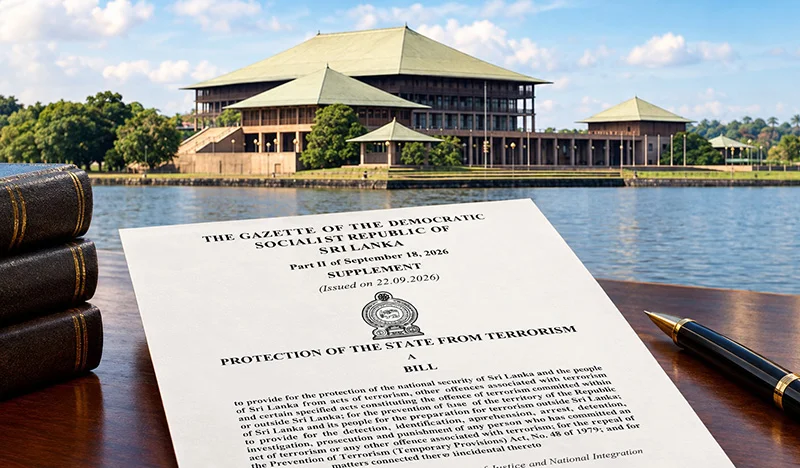
But there is an aspect of the government’s approach that is less justifiable. While pursuing past wrongdoing by powerful individuals, it is also advancing a triumvirate of draft laws that could give the state sweeping powers over citizens, organisations and dissent in the present and future. The draft Prevention of Terrorism legislation, the Prevention of Organised Crimes Bill and the NGO Registration and Supervision Bill raise serious questions about the over-centralisation of power. Each of these laws strengthens the powers of the state while weakening the rights and safeguards that protect people from their misuse and thus questions the basic rights of people in democracy where ‘the power of the people is vested in the government’. This is a recipe for future misrule rather than the rule of law. As the well-known saying goes, power corrupts and absolute power corrupts absolutely.
Proposed Laws
The real test of system change, for which the government obtained an overwhelming mandate, requires not only a government willing to hold others accountable, but one prepared to subject itself to the same principles of legality, transparency and restraint. The three proposed laws that are particularly important in this regard are the Protection of the State from Terrorism Bill, the Prevention of Organised Crimes Bill and the NGO Registration and Supervision Bill. Each of these draft laws has been presented as serving a legitimate purpose. Preventing terrorism, combating organised crime and ensuring that NGOs do not facilitate money laundering or terrorist financing are proper responsibilities of the state. Sri Lanka has international obligations in these areas, and no responsible government can disregard them. However, the existence of a legitimate objective does not justify every means adopted to achieve it.
The proposed Protection of the State from Terrorism Bill illustrates the problem. Although its definition of terrorism draws on a model developed by a former United Nations Special Rapporteur, the Human Rights Commission of Sri Lanka has warned that the definition of terrorism extends beyond the model and could bring legitimate political protest, trade union action and civil disobedience within the scope of counter-terrorism legislation. Its concerns also include prolonged detention, inadequate judicial oversight and restrictions on access to legal counsel. These are objections that go to the heart of the relationship between the citizen and the state. The government cannot credibly promise to protect democratic freedoms while creating powers that could be used to restrict them. It is necessary for the government to reassess the draft through transparent consultation and revise provisions that could criminalise legitimate dissent.
The Prevention of Organised Crimes Bill raises similar concerns. It is presented as giving effect to the United Nations Convention against Transnational Organised Crime, which Sri Lanka ratified in 2006. The Centre for Policy Alternatives (CPA) has argued that the convention does not require many of the bill’s provisions. The proposed law extends to a broad range of offences, permits detention orders lasting up to a year, makes confessions to police admissible for purposes of legal evidence, and introduces extensive surveillance powers. A law intended to dismantle criminal networks should not create a parallel system of exceptional powers that could be applied far beyond organised crime. Nor should safeguards developed through years of experience with abuses under the Prevention of Terrorism Act be weakened through legislation bearing a different name. The government should review whether or not existing laws could be used effectively to control these crimes or whether each exceptional power is necessary.
Civil Society
The proposed NGO Registration and Supervision Bill presents another test of the government’s intentions. The government may reasonably seek transparency in the finances of organisations receiving public or foreign funds, including measures to prevent money laundering and terrorist financing. It seeks to justify its overreach on the grounds of meeting the internationally mandated requirements of the Financial Action Task Force (FATF) for the Asia-Pacific region. But these objectives do not justify placing civil society and NGOs under excessive administrative control when even the FATF ranks them as low to medium risks. The draft bill would require registration and renewal, impose extensive obligations on organisations and empower authorities to suspend or deregister them on broadly framed grounds. It is important to redraft provisions that confer excessive discretion over registration, renewal, suspension and deregistration of NGOs.
Among the concerns raised by United Nations human rights special rapporteurs with regard to the draft NGO law are provisions requiring organisations to align with government policies and restrictions that could affect advocacy, dissent and freedom of association. The implications extend well beyond organisations that engage directly with the government. Community groups, human rights organisations, independent researchers and organisations working on reconciliation or accountability could find their activities constrained by uncertainty over how these provisions might be interpreted. Organisations that criticise government policies are not thereby working against the country. Their freedom to do so is part of what distinguishes a democracy from a system in which the government determines which opinions and activities are acceptable.
The government has generated considerable public goodwill through its pursuit of corruption and criminality. It should not assume that this goodwill gives it an unlimited mandate to strengthen the coercive powers of the state. The NPP knows from its own history that governments can treat dissent as a threat and use the machinery of the state against their opponents. There is still time to correct the drafts through transparent public consultation, narrow definitions of offences, meaningful judicial control over detention and surveillance, and effective remedies against arbitrary decisions. A government that pursues corruption while weakening safeguards against state abuse risks undermining its own achievements. Besides bringing to light the abuse of power by previous governments, the NPP government needs to build a system in which no future government can abuse power in the belief they can get away with it.

 By Ramya Kumar
According to the Quality Assurance Council (QAC) of the University Grants Commission (UGC), quality assurance (QA) refers to “the means (i.e. the policies, attitudes, actions, procedures, etc.), by which an institution can guarantee with confidence and certainty, that the standards and quality of its educational provision are being maintained and enhanced”.
An expansive structure has been in place since 2005 to govern and implement QA processes within the state university system. The QAC is the focal point at the UGC that implements external reviews of state universities and institutes. Each university has its own Centre for Quality Assurance (CQA) tasked with performing QA in line with QAC directives. Faculties, in turn, have Internal Quality Assurance Cells (IQAC) performing their own QA; they are answerable to the CQA.
The big question is whether this all-encompassing top-down QA system, that in many ways undermines the internal dynamics of university governance, actually supports universities to enhance the quality of education. This article highlights some concerns.
Top-down check-box activities
The QAC conducts external reviews of universities and degree programmes. A review team appointed by the UGC (who may or may not have experience in the institution/programme in question) examines the self-evaluation report submitted by the said institution/programme. The team then conducts a site visit to verify the claims made in the university’s self-evaluation report, clarify issues identified during the desk review, and examine how QA procedures operate in practice. The team holds meetings with the university administration, members of the Council and Senate, Deans, Heads of Departments, academic and non-academic staff, students, and others. Following the visit, a draft report is submitted to the relevant institution/programme for comment before final publication. The reviewed institution/programme then prepares and publishes an action plan addressing the recommendations, with subsequent monitoring of progress.
There are some worthy QA initiatives under implementation, such as improving facilities for students with disabilities and strengthening mechanisms to address sexual- and gender-based violence. However, for the most part, QA activities have little to do with improving the quality of education. They are mostly preoccupied with monitoring faculty and department websites, digital transformation, student feedback, subject evaluation, course evaluation, peer evaluation, and, more recently, staff appraisal. These activities, which consume an inordinate amount of time—so precious at understaffed universities—have become check-box activities completed to generate evidence for the next review. Below is an excerpt of a conversation between two academics (1 and 2) that conveys how QA plays out at universities (reproduced with permission).
1: … .it’s like social media you know, like posting things on Facebook or twitter or Instagram. When people do a lot of social media, everything they do, they do thinking, “okay I’m going to post it in this way… this I have to put on my Instagram.” QA is a little like that… everything is considered in light of, “ah we can use this for the review, as evidence… for example very recently we were encouraged to have all the things that we do in our department in the faculty newsletter so then they can put in the review. Every little thing has to be noted down….
2: And with pictures and all…
1: At the very least it has to be written so that you have written evidence .. you can’t be doing something for the sake of doing something or because it is good for the department … and sometimes people tell me “oh yea that’s a good idea we can fit that under this x, y section of the review..”
2: Yea, and nobody really thinks about the actual outcome… whether it’s actually helping anyone..
1: I also find that a lot of the words that we used in different ways have now been co-opted to the QA discourse ..including quality.. I can’t actually say what I want as an “outcome”, for example, that the outcome of this workshop is that my students “think about” … then I am told “ah but no that’s not one of the Bloom’s taxonomy words, “think about”.…
2: And the worst part is these medical and agriculture people, these types of people go around spreading it like some kind of gospel!
1: Yea, this cookie cutter way of doing things, they think is the height of innovativeness or creativity, when actually it is so mundane … for me the most awful thing about it is like some fungus of mundanity has taken over through QA reviews.
2: yea, when you say QA, my mind closes off immediately and I stop listening…
Auditing everything but power
QA leaves out crucial aspects of university governance. For instance, there is no review or assessment of the “quality” of university administrations under Criterion 1 or the integrity of procedures governing the promotion of academic staff under Criterion 6 of the institutional reviews.
The majority in the Council—the university’s executive and governing body, which is responsible for selecting the Vice-Chancellor (VC)—are appointed in ad hoc fashion. Apart from the Ex-Officio members in the Council (VC, Deans, etc.), and the two members elected by the Senate, the remainder are appointed by the UGC with no formal consultation or vetting procedure. The VC appointment process described in UGC Circular No. 03/2023 exemplifies how an ostensibly technical process can become entangled in political sycophancy. The Registrar invites applications for the position of VC through advertisement. Applicants must submit a curriculum vitae, a statement of vision for the university and supporting documents. The University Council appoints a three-member Search Committee of senior academics to encourage “eminent persons” to apply, while the UGC appoints a former VC from another university to “observe” the selection process.
A Special Meeting of the University Council is convened. Candidates are interviewed and must make a presentation to the Council Members, followed by questions. Each Council member “gives marks” for seven prescribed criteria: strategic focus (20%), effective leadership (20%), holistic thinking/conceptual skills (10%), academic and research excellence (15%), personal integrity (10%), professional communication (10%) and managerial competence (15%). Marks are averaged, and the Council recommends three candidates to the UGC in rank order. The UGC-appointed observer separately submits a confidential report on the selection process.
This procedure is expected to guarantee quality, but does it? Applications are submitted to the Council Members, who have been appointed on questionable bases, and who are expected to review the applications and give scores, based on objective assessments. But, in reality, most Council Members are manipulated by VC candidates, who often have personal ties with them. The UGC-appointed observer usually has no genuine interest in the outcome. And there is no way for anyone to actually question the Council’s decision once it is made. Although the highest-ranked candidate may ultimately be appointed, the selection remains a political decision made by the President, who retains the discretion to appoint any one of the three.
External reviews also do not look into the promotions of academic staff, except to scrutinise whether there are policies and procedures in place to govern promotion. Academic staff may apply for promotion to Professor once they satisfy the prescribed eligibility requirements, which typically include the period of service, academic qualifications, research and publication achievements, teaching experience, and contributions to the university and wider community. Applications are evaluated against specified criteria, with research output and academic contributions assessed through documentary evidence and expert evaluation. Under the UGC’s scheme for Professors, two experts from outside the applicant’s institution assess specified aspects of research and knowledge dissemination. Again, beneath this technical process, which is externally evaluated, lies a problematic points-based scheme that can be manipulated and abused with impunity.
Rethinking university QA
Like the VC election process and the schemes of promotion for academic staff, QA reviews are open to manipulation. Before a review, there is a chaotic rush to complete evidence gathering and reporting. Academics leave all other work aside, including at times their teaching, to focus on completing documentation and preparing reports. The standardised criteria in the review manuals and scoring sheets often do not reflect differences in disciplines and institutional contexts. But this does not really matter because any serious problems experienced by institutions or programmes are hastily brushed under the carpet to conceal any evidence that could taint the review. The goal is to obtain an A or at least a B grade at whatever cost.
QA may result in positive change if it moves beyond top-down check-box activities towards internally designed and owned processes encompassing all aspects of university governance, led by departments and faculties, and supported by adequate resources. The current QA system needs to be dismantled and replaced by procedures that are accountable, not to the UGC, but to our students and the communities we serve.
(Ramya Kumar is attached to the Department of Community and Family Medicine, Faculty of Medicine, University of Jaffna)
. Kuppi is a politics and pedagogy happening on the margins of the lecture hall that parodies, subverts, and simultaneously reaffirms social hierarchies.

Heavy showers above 100 mm are likely at some places in the Western, Sabaragamuwa, Southern, Central, and North-western provinces and in Anuradhapura district.

Sri Lanka, India caught in US-Iran ship crisis

Namal further remanded

IMF projects Lankan economic growth to moderate amidst mounting global uncertainties

Major Gen Pushpakumara assumes command of 56 Infantry Division

Dickwella axed, Bandara earns maiden Test call up

‘Dates have the highest sugar content to fight Coronavirus’

Sunday Island 27 December – Headlines

#SundayIsland 17th December – Headlines

Sunday Island – 28th March

Sunday Island Headlines – 21 March

Sunday Island – 21st February – Headlines
-

 Features6 days ago
The Sri Lankan who made Scottish history
-

 Sports6 days ago
Nissanka absence opens door for Sri Lanka’s young guns
-

 News5 days ago
NDB fraud Rs 60mn more than reported
-

 News5 days ago
Removing monk’s robes matter for Sangha to decide: Mahanayake Theras
-
 News6 days ago
Shiranthi R remanded until 13 Oct.
-

 Features6 days ago
Future of Sri Lanka’s state university system: Should it be shut down and reopened?
-

 News3 days ago
Sri Lanka escalates anti-graft drive with Shiranthi’s jailing
-
 News4 days ago
NPP govt. reminded of its responsibilities as US warship leaves Colombo