
Features
The Winter Adventure In 16 Countries – Part B

CONFESSIONS OF A GLOBAL GYPSY
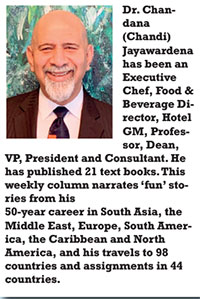
By Dr. Chandana (Chandi) Jayawardena DPhil
President – Chandi J. Associates Inc. Consulting, Canada
Founder & Administrator – Global Hospitality Forum
chandij@sympatico.ca
 Continuing from Wales, Ireland, a 24-hour voyage, quick visits to three French cities…
FRANCE
We left Paris just before midnight in a train to Bordeaux. Due to the bad winter weather, the train was late by an hour. We could not get any sleep in the freezing compartments. There was no running water in the washrooms as the taps were frozen. After moving from compartment to compartment, finally around 3:00 am, we found a relatively warmer place to get a few hours of sleep.
Bordeaux
We reached our destination for the day around 7:00 am. Having recently completed the Higher Certificate program in Wines and Spirits at the world headquarters of the Wine and Spirit Education Trust (WSET) in London, I was particularly pleased to be in Bordeaux. It is the hub of a famed wine-growing region in the world. As the taps in the station were also frozen, we were compelled to have an expensive, quick wash with a few bottles of Perrier Sparkling Water. After leaving our backpacks in a locker and having a quick breakfast at a café near the railway station, we commenced a day of exploration of a very interesting city.
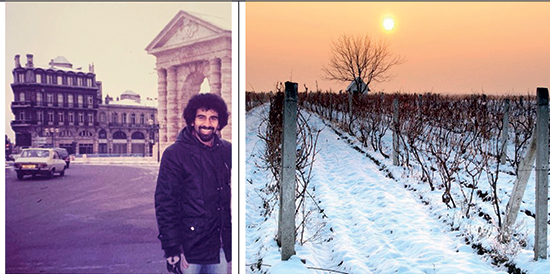
Bordeaux is a port city on the Garonne River in southwestern France. Apart from some of the best-known wines, it is known for its Gothic Cathédrale Saint-André, 18th century mansions and notable art museums such as the Musée des Beaux-Arts de Bordeaux. With around 650,000 residents, Bordeaux was the sixth-most populated city in France after Paris, Lyon, Marseille, Lille, and Toulouse.
Bordeaux is home to the world’s main wine fair, Vinexpo. Bordeaux is also one of the French centres of gastronomy and business tourism for the organization of international congresses. Bordeaux is an international tourist destination for its architectural and cultural heritage with more than 350 historic monuments making it, after Paris, the city with the most listed or registered monuments in France.
We then boarded a crowded train for a 30-hour ride from Bordeaux to Porto in Portugal travelling right across Spain. Due to high demand for sleeping berths, with some difficulty we managed to obtain two sleepers in a car occupied by an old Portuguese couple travelling with their little granddaughter. They were very kind and hospitable. They shared their snack dinner with us. Pão com chouriço (yeasted dough rolls that are filled with the famous pork sausage known as chouriço) were delicious. We shared our bottle of sweet Madeira fortified wine with them.
Up to the time we crossed the French-Spanish border passing a Spanish railway station in a small city, Irun, our train was punctual. After that we experienced several long stops and delays. As we were very tired, we went to sleep soon after sunset and got up long after sunrise to find that the winter storm had continued. The scenery was diverse and breathtakingly beautiful. Unfortunately, we were not comfortable as all the taps were frozen and the train toilets were not functioning. We eventually reached the Spanish-Portuguese border near a small city, Fuentes de Oñoro and finally reached Porto, after a six-hour delay.
PORTUGAL
Portugal is a country whose mainland is located on the Iberian Peninsula of Southwestern Europe, and whose territory also includes the Atlantic archipelagos of the Azores and Madeira. It features the westernmost point in continental Europe. Its Iberian portion is bordered to the west and south by the Atlantic Ocean and to the north and east by Spain, the sole country to have a 1,232 km long land border with Portugal. Its territory had been continuously settled, invaded and fought over since prehistoric times. It was inhabited by Ancient Greek traders, the Romans, Germanic peoples, the Moors, among others.
In the 15th and 16th centuries, Portugal established the first, global maritime and commercial empire, becoming one of the world’s major economic, political and military powers. During this period, today referred to as the Age of Discovery, Portuguese explorers pioneered maritime exploration with the discovery of what would become Brazil. Portugal acquired great riches by exploiting the trade in spices, slaves, sugar, textiles and other goods.
Arriving in Portugal, I thought of the many influences (culture, customs, cuisine, words, religion and names) of the Portuguese in Sri Lanka through a period of around 150 years. The first Europeans to visit Sri Lanka in modern times were the Portuguese in 1505. The Portuguese built a fort in the port city of Colombo in 1517 and gradually extended their control over the coastal areas of the island.
In Sri Lanka, the Portuguese used incentives, as well as brutal methods of terrorising residents to force them to change religions, culture and names. Many modern Sri Lankan names can be traced from the Portuguese, and 6% of the population of Sri Lanka today, are Catholics. Many friends I grew up with, have Portuguese family names such as Perera, Fernando, Mendis, De Silva, De Alwis, De Almeida, etc. Resulting from a treaty the King of Kandy made with the Dutch, the Portuguese invaders were gradually eliminated by 1658.
Portugal has left a profound cultural, architectural and linguistic influence across the globe, with a legacy of around 250 million Portuguese speakers around the world. It is the ninth most spoken language in the world. Indian troops invading Portuguese occupied Goa in 1961 and the handover of Macau to China in 1999 marked the end of what can be considered one of the longest colonial empires in history. I wondered how a relatively small country with a small population made such an impact around the world.
Three 20th century revolutions in 1910, 1927 and 1974 have shaped modern-day Portugal. The first, the October 5, 1910 revolution, brought an end to the Portuguese monarchy and established the highly unstable and corrupt Portuguese First Republic. In 1985, Portugal had just reached a population milestone of 10 million. Out of that national total, over 25% lived in the capital, Lisbon and over 10% lived in the second city, Porto.
Porto
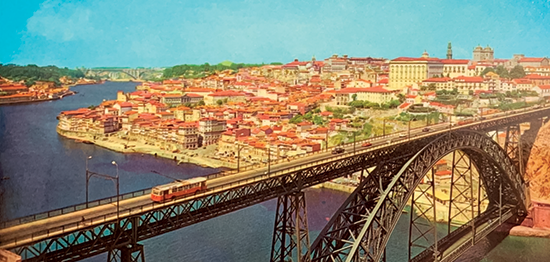
On entering Porto, we were impressed with a massive bridge over The Douro, the highest-flow river of the Iberian Peninsula, where it flows to the Atlantic Ocean at Porto. It is a beautiful view. Porto is a coastal city in north west Portugal known for its stately bridges and port wine production.
We found a room for the night in an old hotel for only £5 and walked in the medieval riverside district founded in the 12th century. The narrow-cobbled streets, merchants’ houses and small cafés were all very quaint. The next day we did a three-hour city tour by bus. Before catching a train to Madrid, I told my wife, “Our friends were correct. A short visit to a city like Porto is not enough. We must return here for at least a week to further explore the region.”
Twenty years later, I returned to Porto, as an invitee of the National Portuguese Hotel Association. I was very happy to get that opportunity in 2005, to spend a week in this beautiful city and taste varieties of the best Port Wine and do many tours of the region. I delivered a keynote address on the topic, ‘Branding of Hotels’ at the XIX National Congress on Hotel and Tourism Industry.
I am seated in the middle of the stage before my keynote address in Porto in 2005
Lisbon
Most of the Portuguese expeditions of the Age of Discovery departed from Lisbon during the period from the end of the 15th century to the beginning of the 17th century, including Vasco da Gama’s expedition to India in 1498. The following years of the 16th century started off Lisbon’s golden era: the city was the European hub of commerce between Africa, India, the Far East and later, Brazil.
The express train from Porto took only three and half hours to arrive in Lisbon. Portugal’s hilly, coastal capital city was very impressive. We enjoyed a three-hour city tour by bus, which covered the imposing São Jorge Castle, de Abril suspension bridge and the National Azulejo Museum. We also visited the 16th-century monuments, Belém Tower and Jerónimos Monastery, which were declared UNESCO World Heritage Sites in later years. Just outside Lisbon is a series of Atlantic beaches, from Cascais to Estoril. After the tour we had a long walk in the city centre, and watched a beautiful sunset.
We boarded a night train from Lisbon to the Spanish capital, Madrid. In out compartment, we chatted with a few young Australian travellers. They were travelling like hippies for a year in between their university studies. They were friendly and we shared some common adventurous attitudes about world travel. I taught them to play the popular South Asian card game, 304. We played several rounds of this game, until it was bed time.
SPAIN
Although we travelled from France to Portugal, right across Spain, we did not detrain in any Spanish railway station. This was our first visit to this historically significant country. We planned to see the two main cities of Spain, Madrid and Barcelona, and a couple of smaller cities en route. Compared to Portugal, Spain was much larger. In 1985, it had a population of 38 million.
We were excited to visit Spain as Spanish art, music, literature and cuisine have been influential worldwide, particularly in Western Europe and the Americas. As a reflection of its large cultural wealth, today Spain has the world’s fourth-largest number of World Heritage Sites (49) and is the world’s second-most visited country. Its cultural influence extends over 570 million Hispanophones, making Spanish the world’s second-most spoken native language.
Madrid
We reached Madrid by mid-morning. In 1985, Madrid had a population of 4.5 million. Up to that point of our six-week trip, Madrid was the second largest city we visited, after Paris. Our plan was to spend the full-day in Madrid and catch another night train to our next destination. Unfortunately, the luggage storage facility in the train station was full, so we had to carry our bags with us during our tours.
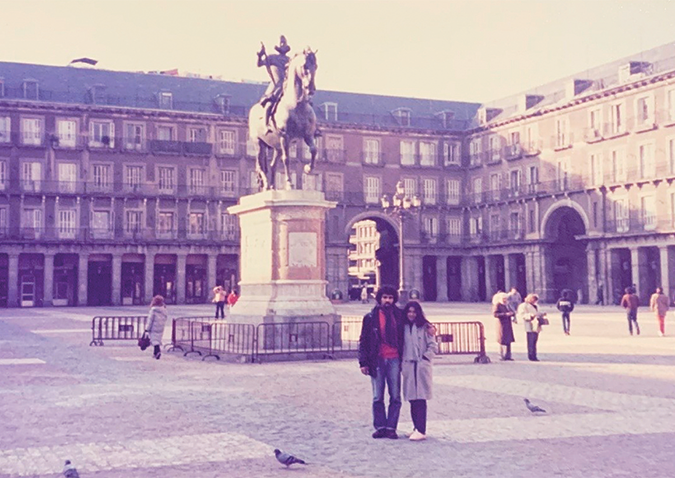
In Madrid we did a long city tour and visited many key attractions, including Gran Vía (the main tourist and shopping artery in the centre of the capital), the Royal Palace, the Prado Museum, and Plaza Mayor, which was considered the iconic spot in the heart of the city’s historic district. We also visited the largest university in Madrid, La Universidad Complutense de Madrid. It had over 80,000 students, including many from other Spanish-speaking countries, who were on scholarships.
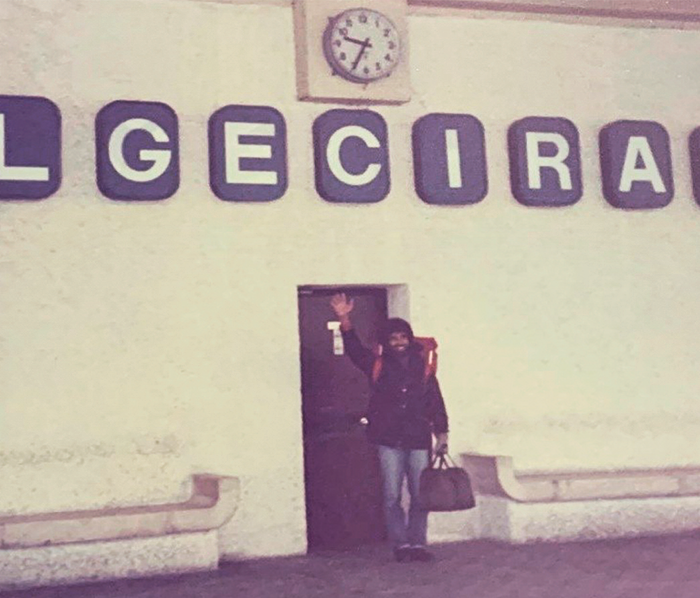
The heating in the next night train was not very effective. Now experienced winter train travellers, we were quick to move from compartment to compartment until we found a relatively warmer place for a good night sleep. As we travelled closer to the southern tip of Spain, Algeciras, the weather became a little warmer.
Ship from Algeciras to Africa
Our voyage from Algeciras in Spain to Africa took less than four hours. We met three university students on the ship, and had lunch together. Robert and Fritz were from West Germany, and were travelling with their Moroccan university mate, Kalik, who had invited his friends to his family home in Casablanca.
Our plan was simply to visit the port city, Tangier in Morocco for the day and then take a ship back to Spain. After some persuasion by our new friends, we changed our plan. In London, my wife and I had recently seen the 1942 movie classic ‘Casablanca’, and loved its famous song, ‘As Time Goes By’, played on the piano by a character in the movie, Sam.
Stealing a line from the movie, I said to my wife playfully, ‘Play it again, Sam!”. We then decided to extend our trip to Morocco by going to its commercial capital, Casablanca.
Will continue in next week’s article:THE WINTER ADVENTURE IN 16 COUNTRIES – Part “C”,
with adventures in Morocco, Spain, and France …


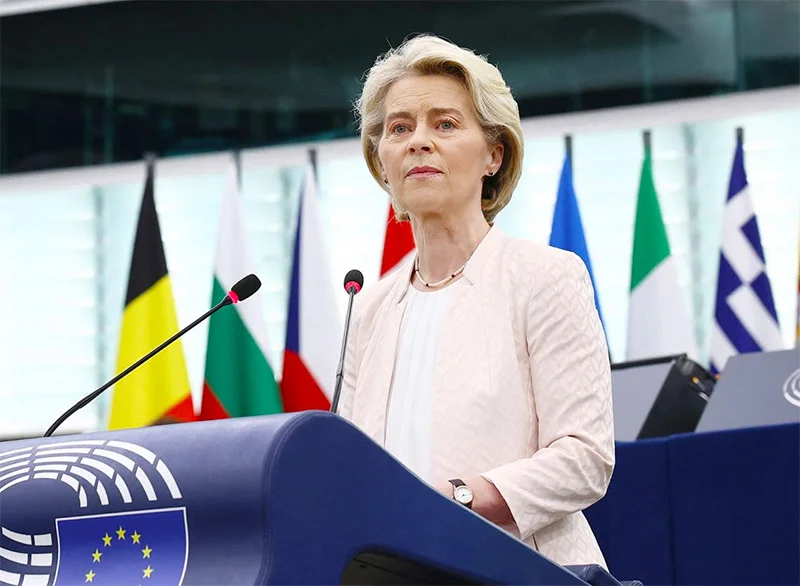
 European Commission President Ursula von der Leyen addressing the World Economic Forum in Davos, Switzerland on Tuesday put forward the EU’s viewpoint on current questions in international politics with a clarity, coherence and eloquence that was noteworthy. Essentially, she aimed to leave no one in doubt that a ‘new form of European independence’ had emerged and that European solidarity was at a peak.
These comments emerge against the backdrop of speculation in some international quarters that the Post-World War Two global political and economic order is unraveling. For example, if there was a general tacit presumption that US- Western European ties in particular were more or less rock-solid, that proposition apparently could no longer be taken for granted.
For instance, while US President Donald Trump is on record that he would bring Greenland under US administrative control even by using force against any opposition, if necessary, the EU Commission President was forthright that the EU stood for Greenland’s continued sovereignty and independence.
In fact at the time of writing, small military contingents from France, Germany, Sweden, Norway and the Netherlands are reportedly already in Greenland’s capital of Nook for what are described as limited reconnaissance operations. Such moves acquire added importance in view of a further comment by von der Leyen to the effect that the EU would be acting ‘in full solidarity with Greenland and Denmark’; the latter being the current governing entity of Greenland.
It is also of note that the EU Commission President went on to say that the ‘EU has an unwavering commitment to UK’s independence.’ The immediate backdrop to this observation was a UK decision to hand over administrative control over the strategically important Indian Ocean island of Diego Garcia to Mauritius in the face of opposition by the Trump administration. That is, European unity in the face of present controversial moves by the US with regard to Greenland and other matters of contention is an unshakable ‘given’.
It is probably the fact that some prominent EU members, who also hold membership of NATO, are firmly behind the EU in its current stand-offs with the US that is prompting the view that the Post-World War Two order is beginning to unravel. This is, however, a matter for the future. It will be in the interests of the contending quarters concerned and probably the world to ensure that the present tensions do not degenerate into an armed confrontation which would have implications for world peace.
However, it is quite some time since the Post-World War Two order began to face challenges. Observers need to take their minds back to the Balkan crisis and the subsequent US invasions of Afghanistan and Iraq in the immediate Post-Cold War years, for example, to trace the basic historic contours of how the challenges emerged. In the above developments the seeds of global ‘disorder’ were sown.
Such ‘disorder’ was further aggravated by the Russian invasion of Ukraine four years ago. Now it may seem that the world is reaping the proverbial whirlwind. It is relevant to also note that the EU Commission President was on record as pledging to extend material and financial support to Ukraine in its travails.
Currently, the international law and order situation is such that sections of the world cannot be faulted for seeing the Post World War Two international order as relentlessly unraveling, as it were. It will be in the interests of all concerned for negotiated solutions to be found to these global tangles. In fact von der Leyen has committed the EU to finding diplomatic solutions to the issues at hand, including the US-inspired tariff-related squabbles.
Given the apparent helplessness of the UN system, a pre-World War Two situation seems to be unfolding, with those states wielding the most armed might trying to mould international power relations in their favour. In the lead-up to the Second World War, the Hitlerian regime in Germany invaded unopposed one Eastern European country after another as the League of Nations stood idly by. World War Two was the result of the Allied Powers finally jerking themselves out of their complacency and taking on Germany and its allies in a full-blown world war.
However, unlike in the late thirties of the last century, the seeming number one aggressor, which is the US this time around, is not going unchallenged. The EU which has within its fold the foremost of Western democracies has done well to indicate to the US that its power games in Europe are not going unmonitored and unchecked. If the US’ designs to take control of Greenland and Denmark, for instance, are not defeated the world could very well be having on its hands, sooner rather than later, a pre-World War Two type situation.
Ironically, it is the ‘World’s Mightiest Democracy’ which is today allowing itself to be seen as the prime aggressor in the present round of global tensions. In the current confrontations, democratic opinion the world over is obliged to back the EU, since it has emerged as the principal opponent of the US, which is allowing itself to be seen as a fascist power.
Hopefully sane counsel would prevail among the chief antagonists in the present standoff growing, once again, out of uncontainable territorial ambitions. The EU is obliged to lead from the front in resolving the current crisis by diplomatic means since a region-wide armed conflict, for instance, could lead to unbearable ill-consequences for the world.
It does not follow that the UN has no role to play currently. Given the existing power realities within the UN Security Council, the UN cannot be faulted for coming to be seen as helpless in the face of the present tensions. However, it will need to continue with and build on its worldwide development activities since the global South in particular needs them very badly.
The UN needs to strive in the latter directions more than ever before since multi-billionaires are now in the seats of power in the principle state of the global North, the US. As the charity Oxfam has pointed out, such financially all-powerful persons and allied institutions are multiplying virtually incalculably. It follows from these realities that the poor of the world would suffer continuous neglect. The UN would need to redouble its efforts to help these needy sections before widespread poverty leads to hemispheric discontent.

 Hi! This week I’ve come up with tips to brighten up your skin.
* Turmeric and Yoghurt Face Pack:
You will need 01 teaspoon of turmeric powder and 02 tablespoons of fresh yoghurt.
Mix the turmeric and yoghurt into a smooth paste and apply evenly on clean skin. Leave it for 15–20 minutes and then rinse with lukewarm water
Benefits:
Reduces pigmentation, brightens dull skin and fights acne-causing bacteria.
* Lemon and Honey Glow Pack:
Mix 01teaspoon lemon juice and 01 tablespoon honey and apply it gently to the face. Leave for 10–15 minutes and then wash off with cool water.
Benefits:
Lightens dark spots, improves skin tone and deeply moisturises. By the way, use only 01–02 times a week and avoid sun exposure after use.
* Aloe Vera Gel Treatment:
All you need is fresh aloe vera gel which you can extract from an aloe leaf. Apply a thin layer, before bedtime, leave it overnight, and then wash face in the morning.
Benefits:
Repairs damaged skin, lightens pigmentation and adds natural glow.
* Rice Flour and Milk Scrub:
You will need 01 tablespoon rice flour and 02 tablespoons fresh milk.
Mix the rice flour and milk into a thick paste and then massage gently in circular motions. Leave for 10 minutes and then rinse with water.
Benefits:
Removes dead skin cells, improves complexion, and smoothens skin.
* Tomato Pulp Mask:
Apply the tomato pulp directly, leave for 15 minutes, and then rinse with cool water
Benefits:
Controls excess oil, reduces tan, and brightens skin naturally.
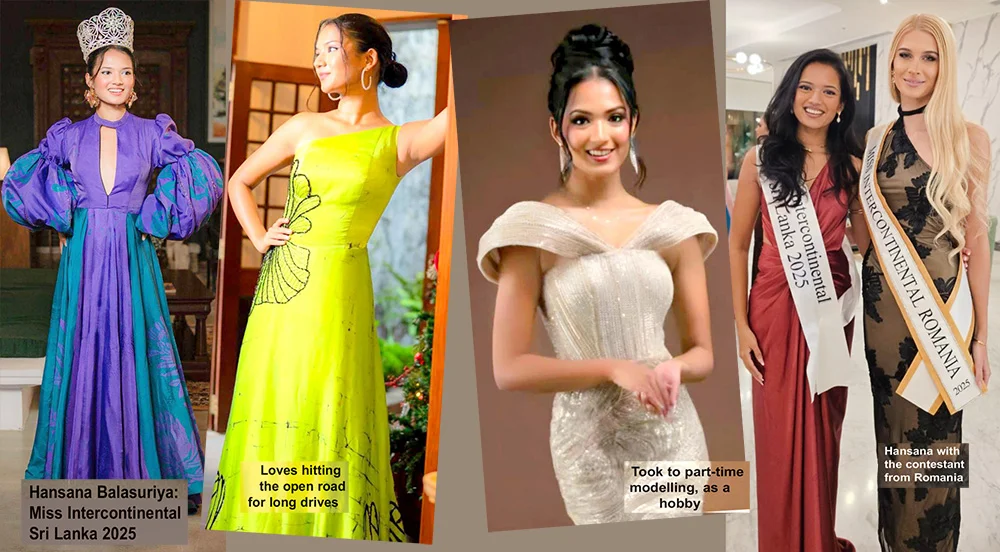
 That’s precisely what 25-year-old Hansana Balasuriya has in mind – shooting for the stars – when she was selected to represent Sri Lanka on the international stage at Miss Intercontinental 2025, in Sahl Hasheesh, Egypt.
The grand finale is next Thursday, 29th January, and Hansana is all geared up to make her presence felt in a big way.
Her journey is a testament to her fearless spirit and multifaceted talents … yes, her life is a whirlwind of passion, purpose, and pageantry.
Raised in a family of water babies (Director of The Deep End and Glory Swim Shop), Hansana’s love affair with swimming began in childhood and then she branched out to master the “art of 8 limbs” as a Muay Thai fighter, nailed Karate and Kickboxing (3-time black belt holder), and even threw herself into athletics (literally!), especially throwing events, and netball, as well.
A proud Bishop’s College alumna, Hansana’s leadership skills also shone bright as Senior Choir Leader.
She earned a BA (Hons) in Business Administration from Esoft Metropolitan University, and then the world became her playground.
Before long, modelling and pageantry also came into her scene.
She says she took to part-time modelling, as a hobby, and that led to pageants, grabbing 2nd Runner-up titles at Miss Nature Queen and Miss World Sri Lanka 2025.
When she’s not ruling the stage, or pool, Hansana’s belting tunes with Soul Sounds, Sri Lanka’s largest female ensemble.
What’s more, her artistry extends to drawing, and she loves hitting the open road for long drives, she says.
This water warrior is also on a mission – as Founder of Wave of Safety,
Hansana happens to be the youngest Executive Committee Member of the Sri Lanka Aquatic Sports Union (SLASU) and, as founder of Wave of Safety, she’s spreading water safety awareness and saving lives.
Today is Hansana’s ninth day in Egypt and the itinerary for today, says National Director for Sri Lanka, Brian Kerkoven, is ‘Jeep Safari and Sunset at the Desert.’
And … the all-important day at Miss Intercontinental 2025 is next Thursday, 29th January.
Well, good luck to Hansana.

Indonesian Naval Ship ‘KRI SULTAN ISKANDAR MUDA – 367’ arrives in Colombo

Royal Navy of Oman Ship ‘AL SEEB’ calls at Port of Colombo

Jacks out with illness as Sri Lanka bat against England

Mechanism to be established involving university academics and experts for Education Reforms – President

New integrated framework to bring all stakeholders together to safeguard and rebuild Central highlands – President

ICC T20 World Cup Trophy tour in Sri Lanka launched under President’s patronage

‘Dates have the highest sugar content to fight Coronavirus’

Sunday Island 27 December – Headlines

#SundayIsland 17th December – Headlines

Sunday Island – 28th March

Sunday Island Headlines – 21 March

Sunday Island – 21st February – Headlines
-

 Editorial4 days ago
Illusory rule of law
-
 News5 days ago
UNDP’s assessment confirms widespread economic fallout from Cyclone Ditwah
-

 Editorial5 days ago
Crime and cops
-
 Features4 days ago
Daydreams on a winter’s day
-

 Editorial6 days ago
The Chakka Clash
-
 Features4 days ago
Surprise move of both the Minister and myself from Agriculture to Education
-
 Features3 days ago
Extended mind thesis:A Buddhist perspective
-
 Features4 days ago
The Story of Furniture in Sri Lanka