
Business
The US occupation of the Indian Ocean ‘Zone of Peace’

(Continued from yesterday)
This too has enabled and embolden the current attempt by Washington to occupy and colonize the Indian Ocean, and levy tolls on ships plying the maritime silk route. This, ironically, despite President Trump’s and his MAGA base’s preference for American isolationism and anti-immigrant policies.
Does the US attempt to toll ships in the Indian Ocean reflect deep seated insecurities of a declining Empire in an increasingly multipolar world also given the history and geography of the Supercontinent of Asia?
The Americas are separate from the Supercontinent of Asia by the vast Atlantic and Pacific Oceans. The US is geographically distant from ‘Mackinder’s heartland’ —the interconnected landmass of Asia, Africa and the European Peninsular traversed by ancient and modern land and maritime Silk Routes and the growth hub of the world. As a multipolar world emerges enabling the next Asian Century, is the US anxious about its global relevance given distance from the earth’s heartlands and population centers?
Are Washington’s imperial anxieties the reason that US intelligence think tanks sought to re-invent the world’s oceanic geography and history by coining the “Indo-Pacific” neologism, partitioning the Indian Ocean World? And is the tide turning? The US Indo-Pacific Command recently dropped the “Indo” and reverted to Pac Com.
From Greenland to Chagos Islands: With a little help from Andy Burnham
When the Indian Ocean was declared a Zone of Peace in 1971 the United Kingdom and US had forcibly displaced the native population of the Chagos Islands to build the huge Diego Garcia military base. Chagos Islands, called the British Indian Ocean territory (BIOT) by some, had been colonized at a time when Britannia Ruled the waves. That was an era of British imperialism when the vast Indian Ocean was referred to as a ‘British Lake’ or Pond.
Today there’s news that President Trump seeks to buy the occupied Chagos Islands from Mauritius, much like he sought to purchase Greenland from Denmark. The huge environment polluting US-UK Diego Garcia military base is located due southwest of Sri Lanka and the Maldives.
US Purchase of Chagos Islands would no doubt need help from the latest British Prime Minister, Andy Burnham, who supported Tony Blair’s Iraq war adventure in search of non-existent weapons of mass destruction before doing a volte face.
It was from the Diego Garcia military base that US missiles recently targeted Iran across the Indian Ocean, and US airplanes flew bombing missions over Afghanistan during America’s global war on terror. It was only in March 2019 that the International Court of Justice (ICJ) ruled that the UK and US occupation of the Chagos Islands was illegal under international law.
Any sale of the Chagos Island would also require the Modi Government in New Delhi to turn a blind eye to US led hyper-militarization of the Indian Ocean. The land-locked Modi regime in north India appears to have turned its back on the Indian Ocean facing South Indian Dravidian States– Tamil Nadu, Kerala, Andhra, and Karnataka –whose Seamen constitute the majority of Indian sailors who have perished due to the US blockade of the Strait of Hormuz.
Foreign Minister Jaishankar has ignored the IOZP declaration which was supported by Congress Prime Minister Indira Gandhi 55 years ago. Dr. Jaishankar has preferred rather to sign up to the US-led new ‘security architecture’ in the Indian Ocean and related environment polluting war games such as the Malabar exercises which saw whales and dolphins dying en mass in Sri Lanka in 2022. The new US led military security architecture of the Indian Ocean clearly targeting China and Iran, includes the QUAD (India, Japan, Australia and US) in the eastern part, I2U2 (Israel, India, UAE and USA) in the western Indian Ocean.
India remains excluded from the white racist nuclear submarine club, AUKUS comprised of Australia, UK and US, targeting China and the Indian Ocean World.
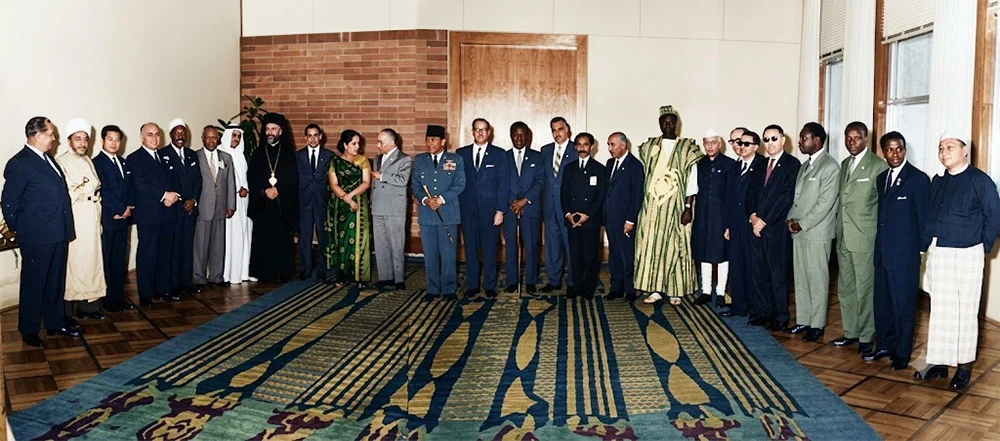
Spearheading the UNGA declaration of the Indian Ocean as a ‘Zone of Peace’ in 1971, Ceylon’s Sirimavo Bandaranaike was acutely aware of the geostrategic location of her county for control of Indian Ocean trade and energy supply chains.
Sri Lanka was called an ‘unsinkable aircraft carrier’ and valuable real estate in the Indian Ocean. Although the wealthiest county in South Asia by all metrics except the exorbitantly privileged US dollar, Sri Lanka is now ensnared in a Eurobond debt trap. It was forced to stage a sovereign default enabling the Washington Consensus (IMF and WB) to upend Economic Sovereignty and Energy Policy Autonomy through control of the Central Bank as the US Cold War in the Indian Ocean heated up in 2022. Because of its geostrategic location the county has long been an aid dependent OECD ‘donor darling’.
Geostrategic Sri Lanka is clearly once again in the cross-hairs of big power rivalry also given Chinese investments in the teardrop island, particularly the Hambantota Port which the US Central Intelligence Agency has deemed a “String of Pearls” harbor.
Thus in the first week of March to kick of the illegal war on Iran and the Indian Ocean world, the US torpedoed an Iranian frigate killing 85 sailors in the seas of Sri Lanka. The Sri Lanka Navy was able to save some of the survivors of the sunken IRIS Dena and provided humanitarian rescue to mitigate the US war crime in Sri Lanka’s maritime Exclusive Economic Zone.
Yet there were few protest when US Assistant Secretary of State for South and Central Asia, Paul Kapur, declared the Sri Lanka navy a partner of the US Indo-Pacific Strategy last week on board a gifted frigate.
Kapur, a member of the weaponized Indo-American Diaspora, delivered Satellite communications technology and 10 helicopters, Trojan horse gifts, no doubt to help the US war machine to surveil, monitor and torpedo as necessary Indian Ocean shipping lanes from Sri Lanka in the next bout of war on Iran and China once the 60 day pause is done. All this begs the question, would the SL Navy be partners to future US war crimes in the Indian Ocean henceforth?
Meanwhile, the Fake Left National People’s Power regime in Colombo has kept a deadly, deathly silence about US war crimes in the Indian Ocean – betraying Socialist Prime Minister Sirimavo Bandaranike’s bold vision for Peace at the center of the Indian Ocean World.
It is nevertheless to be hoped that Prime Minister Dr. Harini Amarasuriya may try to live up to the legacy of her predecessor who declared the ‘Indian Ocean a Zone of Peace for all time’ with great prescience. The UN and Foreign Ministry of Sri Lanka would do well to host an International Conference to mark 55 years of IOZP this December 16, given its relevance to Global Peace and Security amid renewed attempts by some NATO countries to occupy and colonize the Indian Ocean World.
Finally, Sri Lanka needs to regain its Global South History and establish an museum for the World’s First woman head of State who led the IOZP Declaration as a leader of NAM in 1971, while bringing genuine independence to the country on May 22, 1972, when the Democratic Socialist Republic of Sri Lanka was born from the ashes of the British Dominon of Ceylon, still a colony of the UK.
Prime Minister Bandaranaike’s achievements at home and abroad have been carefully erased and curated as part of the wider erasure of NAM and Global South History. We need a new history of Sirimavo Bandaranike beyond the framing of a housewife to came to power after the CIA-MI6 assassination of her husband Solomon Dias Bandaranaike- as the leader who bought Genuine Independence to Sri Lanka and the Indian Ocean World for awhile until reactionary forces reasserted themselves.
(Concluded)
By Darini Rajasingham-Senanayake

By Hiran H. Senewiratne
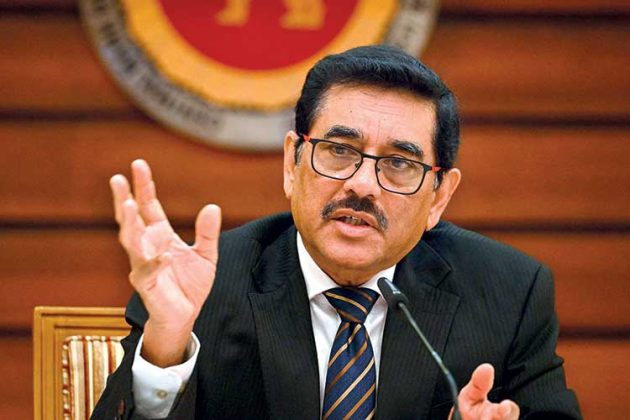
The rupee has stabilised somewhat in recent weeks reflecting the impact of policy measures that have been taken thus far, Central Bank Governor Dr Nandalal Weerasinghe said.
“We will continue to closely monitor domestic and global developments for emerging risks and expect the monetary policy tightening carried out previously to transmit to the economy in the period ahead, Central Bank Governor Dr Weerasinghe said at the monthly monetary policy review meeting held at Central Bank head office yesterday.
He said that the CBSL stands ready to take appropriate measures to ensure that inflation stabilises around the 5 percent target, while supporting the economy to reach its potential over the medium term.
Amid those developments the Central Bank kept its Overnight Policy Rate (OPR) unchanged at 8.75 percent, it said in a statement, after considering the evolving conditions and outlook on the domestic and global fronts.
Dr Weerasinghe added: ‘Renewed tensions in the Middle East have resulted in a surge in global commodity prices, particularly petroleum. These developments are likely to dampen global economic prospects with potential spillover.
‘The current low level of inflation, at 1.6 percent year -on-year in February 2026, relative to the target of 5 percent provides sufficient space to accommodate the impact of higher energy prices and their spillovers on inflation.
‘Headline inflation accelerated to 6.8 percent in June 2026, mainly due to higher domestic energy and food prices.
‘Headline inflation is expected to remain above the target of 5% in the near term before gradually returning to the target level. Core inflation is also expected to increase and remain around the headline inflation target.
‘The Board arrived at the decision to maintain the overnight policy rate after carefully considering the evolving conditions and outlook on the domestic and global fronts.
‘Renewed tensions in the Middle East have resulted in a surge in global commodity prices, particularly petroleum. These developments are likely to dampen global economic prospects with potential spillovers to the domestic economy through multiple channels.
‘The monetary policy tightening in May 2026 and its gradual transmission to the real economy are expected to moderate credit growth and the buildup of demand pressures going forward.
‘The pressure on the external sector caused by the Middle East conflict has eased somewhat, although the outlook remains uncertain due to renewed tensions.
‘Since April 2026, the external current account recorded a deficit, mainly because higher fuel import costs widened the merchandise trade deficit and tourism earnings slowed down.
‘Going forward, import demand, including demand for motor vehicles, is expected to reduce in response to recent policy measures.
‘Meanwhile, workers’ remittances have remained strong so far in 2026. Gross Official Reserves stood at USD 6.45 bn at the end of June 2026, amid foreign debt service payments.’
By Ifham Nizam
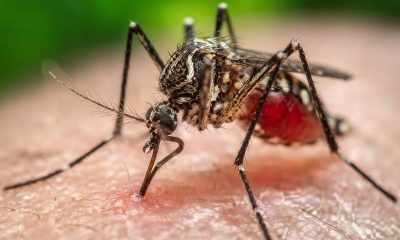
The mosquito that spreads dengue is tiny. The financial burden it leaves behind is anything but.
As Sri Lanka grapples with its worst dengue outbreak in nearly a decade, the country’s free public healthcare system is absorbing a mounting financial shock that experts say could run into billions of rupees, even as the human toll continues to rise.
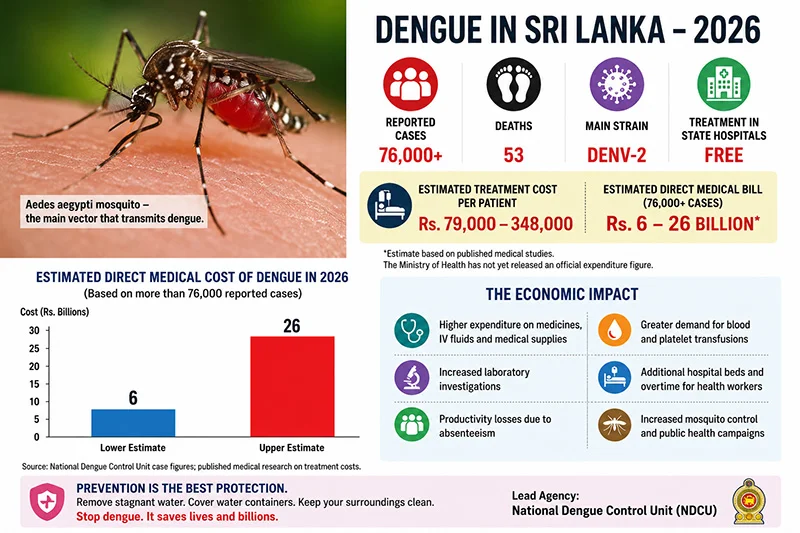
According to the National Dengue Control Unit (NDCU), more than 76,000 dengue infections and 53 deaths have been reported so far this year, making 2026 one of the most challenging years for dengue control in recent history.
The NDCU has warned that the outbreak is being driven largely by the highly virulent DENV-2 strain, while persistent rainfall, poor waste management and mosquito breeding in urban and semi-urban areas continue to fuel transmission.
Although the Ministry of Health has yet to publish an official estimate of the cost of treating dengue patients, the economic implications are becoming increasingly evident.
Published medical research estimates that treating a dengue patient costs between USD 239 and USD 1,056, depending on the severity of the illness. At an exchange rate of around Rs. 330 to the US dollar, this translates to approximately Rs. 79,000 to Rs. 348,000 per patient.
Applied to the more than 76,000 reported cases, the theoretical direct medical cost ranges from Rs. 6 billion to more than Rs. 26 billion. While many patients are treated as outpatients and therefore incur lower costs, the estimates underline the immense financial pressure being placed on Sri Lanka’s publicly funded healthcare system.
The National Dengue Control Unit has repeatedly urged the public to eliminate mosquito breeding sites, warning that hospitals alone cannot contain the outbreak without sustained community participation.
Health officials have intensified countrywide inspections, awareness campaigns and vector-control programmes as case numbers continue to climb.
Officials say hospitals have expanded dengue wards, increased bed capacity and deployed additional medical and nursing staff to cope with the surge in admissions.
The government has also mobilised Air Force drones to identify inaccessible mosquito breeding grounds while strengthening surveillance operations across high-risk districts.
The financial impact extends beyond the Ministry of Health. Families lose income when wage earners fall ill or parents stay home to care for infected children. Businesses suffer productivity losses, while schools experience increased absenteeism during peak transmission periods.
Sri Lanka’s previous major dengue epidemic in 2017 was estimated to have cost around Rs. 1.94 billion in healthcare and outbreak-control expenditure. With inflation, higher pharmaceutical prices and increased operational costs since then, health economists believe the financial burden of the current outbreak is likely to be substantially greater.
The outbreak also raises broader questions about climate resilience and public investment. Dengue is increasingly being recognised not merely as a seasonal health issue but as an economic challenge capable of straining government finances and slowing productivity.
For the National Dengue Control Unit, the message remains simple: prevention is far cheaper than treatment.
Every breeding site destroyed, every community clean-up campaign conducted and every household inspection completed reduces the need for costly hospital care.
As the monsoon continues to create favourable conditions for mosquito breeding, the NDCU warns that sustained public vigilance will determine whether the country’s health bill continues to climb—or begins to fall.
Business
Shantha Bandara reappointed SLCPI president as Chamber advances regulatory reform and patient access
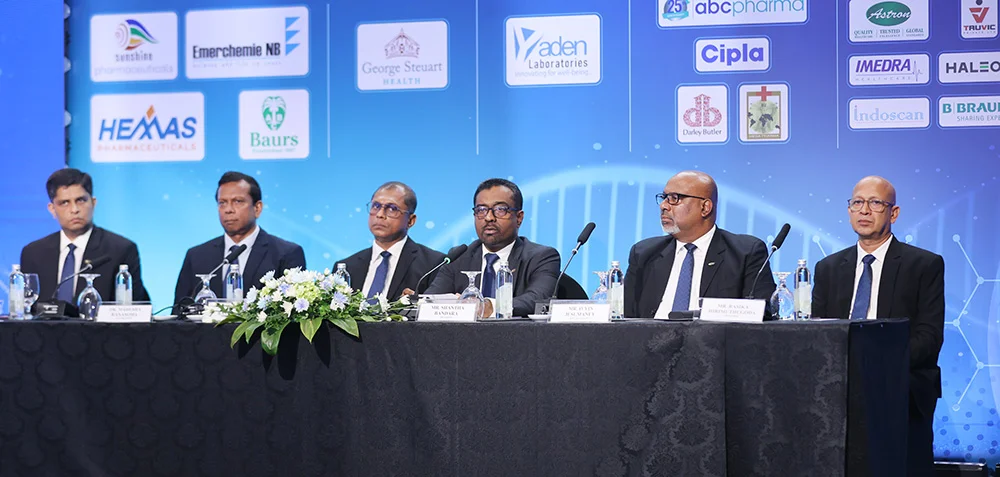
The Sri Lanka Chamber of the Pharmaceutical Industry (SLCPI) announced the reappointment of Sunshine Healthcare Lanka Ltd. Director and Chief Executive Officer Shantha Bandara as its President for the 2026/27 term at the Chamber’s 65th Annual General Meeting held at Cinnamon Grand Colombo.
The event was graced by Dr. Hansaka Wijemuni, Deputy Minister of Health, as Chief Guest, together with government representatives, healthcare partners, past presidents, member companies and other industry stakeholders.
Bandara’s reappointment provides continuity to a reform-oriented agenda that has strengthened the Chamber’s governance, ethical standards and engagement with policymakers and regulators. His renewed mandate will focus on converting the progress made during 2025/26 into practical regulatory improvements that support the availability, accessibility and affordability of quality medicines in Sri Lanka.
SLCPI represents more than 70 pharmaceutical importers, manufacturers, distributors and retailers. Its members account for over 90% of Sri Lanka’s private pharmaceutical market, while the wider industry directly employs more than 80,000 people and indirectly supports nearly 400,000.
Reflecting on the past year, Bandara said the industry had operated amid sustained domestic and global pressure. Exchange-rate volatility, disruptions to international shipping routes, rising freight, insurance, fuel and electricity costs, and constrained consumer purchasing power placed significant pressure on pharmaceutical supply chains and business viability.
Despite these challenges, SLCPI continued to engage constructively with the Ministry of Health, the National Medicines Regulatory Authority and other stakeholders, presenting evidence-based recommendations on pharmaceutical pricing, import licence renewals and continuity of supply.
A major achievement during Bandara’s first term was the adoption of new Articles of Association following extensive consultation, legal review and member engagement. The revised Articles provide a stronger constitutional foundation for the Chamber, clarify governance structures and reinforce member rights and responsibilities.
-

 Features5 days ago
Two memorable excerpts from a former SLAF commander’s memoir
-
 Business5 days ago
‘Giving up was never an option’: The fisherman who fought back after losing millions in SL
-

 Latest News5 days ago
Davis cup Asia/Oceania Group IV 2026 to be held in Colombo from 20th to 25th July
-
 Features5 days ago
Erdoğan’s New Republic
-

 Life style5 days ago
Taste of the Swiss Alps comes to Colombo
-
 News6 days ago
Evidence recorded in money laundering case against Yoshitha Rajapaksa
-
 Midweek Review2 days ago
Three high-profile alleged suicides shaping key investigations
-
 News6 days ago
Dengue outbreak gallops ahead: Infections surpasses 73,455, leaving 50 dead