
Features
The Trade Game’s New Rules: Sri Lanka’s Shot at Winning


The global trading system, once a beacon of predictability and cooperation, is in tatters. For decades, the World Trade Organisation (WTO) upheld a rules-based order grounded in principles like the Most Favoured Nation (MFN) clause, ensuring equitable treatment among trading partners. This framework fostered an era of unprecedented economic integration, lifting nations—large and small—through the tide of globalisation. Yet, that era is fading fast. The United States, long a champion of this system when it suited its interests, has detonated its foundations with escalating tariffs and unilateral protectionism. These measures, often targeting economic rivals like China, flout the WTO’s core tenets, replacing multilateral consensus with a power-driven free-for-all. The US’s selective tariffs—disregarding MFN principles—signal a retreat from cooperative trade norms, fragmenting the global economy into blocs shaped by political expediency rather than economic logic. For smaller nations like Sri Lanka, this shift is both a peril and a puzzle: the rules we relied upon are gone, and the future is being forged around us, whether we act or not.
This upheaval is not merely a bilateral spat between superpowers; it’s a seismic reconfiguration of global trade. The US, despite trumpeting its goods trade deficits, quietly maintains a surplus in services—a complexity drowned out by the rhetoric of protectionism. Its push to resurrect domestic manufacturing, especially in critical industries like semiconductors and steel, hints at a broader strategy to insulate itself from foreign competition. Historical parallels loom large: the Smoot-Hawley Tariff Act of 1930, which raised US duties on hundreds of imports, deepened the Great Depression by choking global trade. Today’s interconnected supply chains amplify that risk, where a single tariff can ripple across continents, slashing demand and destabilising markets. The likelihood of a full-blown trade war grows, with tit-for-tat retaliations threatening to redraw economic alliances. Growth forecasts for 2025 are already tilting downwards, and for Sri Lanka—just emerging from the bruising IMF-prescribed reforms—this instability could snuff out nascent recovery. Yet, amidst this chaos, the future is taking shape. Regional blocs are coalescing, new trade routes are emerging, and nimble nations are seizing opportunities. Sri Lanka cannot afford to stand still as the world moves forward.
Opportunities and Strategies for Sri Lanka:
Exploiting Trade Diversions and Gaps
The fracturing of traditional trade flows offers Sri Lanka a chance to step into the breach. As US buyers grapple with higher costs from tariff-hit countries like China, Sri Lanka could position itself as a viable substitute. Our apparel sector, already a global player, could capture market share lost by pricier competitors, while rubber products and electronics components—where we have latent capacity—could find new buyers. Beyond substitution, we could embed ourselves as a cost-effective link in supply chains shifting away from China, offering stability to multinationals wary of volatility. The actionable path is clear: identify tariff-affected goods where Sri Lanka holds competitive edges, then aggressively market these through international trade fairs, digital B2B platforms, and targeted outreach to US importers. This requires swift coordination between the Export Development Board and the private sector to seize the moment.
Strengthening Bilateral Trade Negotiations
While the WTO weakens, bilateral deals gain prominence. Sri Lanka must negotiate preferential trade agreements or tariff concessions with the US, focusing on key exports like tea, garments, and spices. Our status as a developing nation, potentially via the Generalised System of Preferences (GSP), offers leverage—though its reinstatement has been erratic since its lapse in 2020. Diplomatic and economic lobbying in Washington, backed by a clear case of mutual benefit, could restore or expand this access. Beyond the US, forging similar pacts with other major markets—such as the UK post-Brexit or Japan—would bolster our position. This demands a dedicated trade negotiation team, armed with data and a compelling narrative of Sri Lanka as a reliable partner in a turbulent world.
Diversifying Export Markets
Over-reliance on any single market, particularly the US, is a liability in this volatile landscape. Sri Lanka must pivot towards emerging economies and regional players—India, ASEAN, the Middle East, and Africa—where tariff structures are less prone to sudden shocks. India’s growing consumer base, for instance, could absorb more of our tea and apparel, while the Gulf’s demand for construction materials aligns with our rubber and coir strengths. Supporting small and medium enterprises (SMEs) to tap these markets is vital, through trade facilitation hubs, subsidised market research, and digital tools like e-commerce platforms. The Ceylon Chamber of Commerce could lead here, bridging SMEs with opportunities abroad.
Investing in Value Addition and Branding
Exporting raw materials confines us to low-profit cycles. Shifting to high-value, branded goods—think premium Ceylon teas with traceable origins, eco-friendly packaging, or artisanal spices—could transform our economic profile. Take tea: instead of bulk exports, we could market single-estate blends to affluent consumers in Europe or North America, commanding triple the price. Government support is key—tax incentives for innovation, grants for sustainable packaging, and training for entrepreneurs to build global brands. The success of Dilmah, a homegrown name, proves this model works; scaling it across sectors could redefine Sri Lanka’s export identity.
Attracting Foreign Direct Investment (FDI)
As multinationals flee US-China trade tensions, Sri Lanka can pitch itself as a neutral, cost-effective production hub. Our strategic location, skilled workforce, and existing Export Processing Zones (EPZs) are assets—if we market them right. Streamlining FDI approvals, cutting red tape, and offering tax holidays could lure firms in textiles, electronics, or even renewable energy components. Look at Vietnam, which has soaked up billions in FDI by positioning itself as a China alternative; Sri Lanka could emulate this with a fraction of the scale but equal ambition. The Board of Investment must prioritise this, showcasing our stability amid global upheaval.
Cushioning Vulnerable Sectors and Building Resilience
Not all sectors will thrive in this shift. Those hit by reduced global demand—say, gemstone exporters reliant on Western jewellers—need a lifeline: subsidies, credit guarantees, or export insurance to weather the storm. More broadly, Sri Lanka’s lack of a coherent industrial policy is a glaring weakness. Selling off state development banks like DFCC and NDB was a strategic blunder; we need a new institution tied to a long-term industrial vision, fostering manufacturing and innovation. Education, too, is underfunded—government spending is at historic lows, leaving us unprepared for a skills-driven economy. Job support programmes and a task force to tackle immediate business and worker uncertainties are urgent steps to shore up resilience.
Partnering with Regional Blocs
Isolation is not an option. The South Asian Association for Regional Cooperation (SAARC) is moribund, crippled by India-Pakistan tensions, but alternatives beckon. The Bay of Bengal Initiative for Multi-Sectoral Technical and Economic Cooperation (BIMSTEC) offers a platform to deepen ties with India, Bangladesh, and Thailand, prioritising collaborative growth. More ambitiously, the Regional Comprehensive Economic Partnership (RCEP)—the world’s largest trade bloc, spanning ASEAN, China, Japan, and Australia—looms as a game-changer. Could Sri Lanka join? It’s not a member yet, but observer status or a phased accession isn’t implausible. Our proximity to India, an RCEP signatory, and our trade complementarities (e.g., tea for China’s market, apparel for Southeast Asia) make a case. Joining would require aligning regulations, boosting competitiveness, and lobbying through diplomatic channels—perhaps via ASEAN ties. Even short of full membership, negotiating parallel deals with RCEP nations could integrate us into their supply chains, amplifying our reach. Regionalism, not nationalism, is our shield against global fragmentation.
The way forward
The rise of protectionism tests Sri Lanka, but it need not break us. History warns of downturns, yet today’s stakes—jobs, wages, stability—are too high for inaction. The government must act boldly: unite resources, strengthen resilience, and prioritise citizens over short-term politics. Economic openness and social cohesion remain our north stars. As the world reshapes itself, Sri Lanka must carve its place—not just to survive, but to thrive.
(The writer is Professor of Marketing University of Surrey. Views expressed in this article are personal)
by Prof. Chanaka Jayawardhena
Chanaka.j@gmail.com

by Rajan Philips
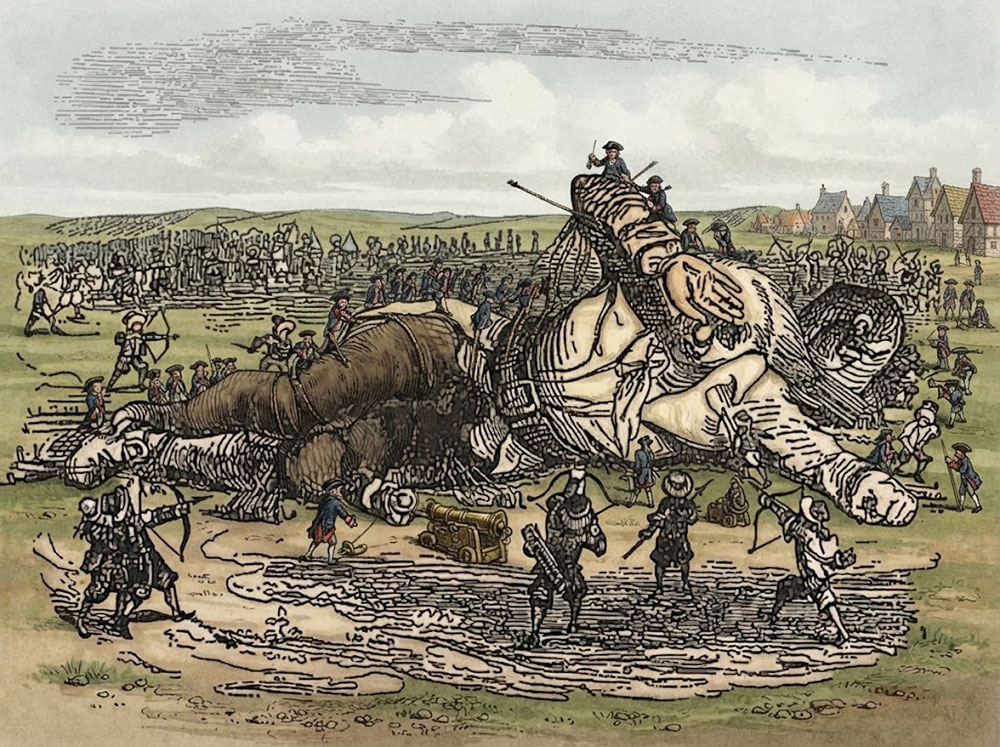
The 22nd Amendment has given the government’s critics a convenient cudgel to beat up the government. But there has been no crushing blow by any effective opponent. Too many people have been taking too many turns and striking too many blows, but no one has landed anything to shake the government in any way. The whole drama is the new Sri Lankan parody of Lilliputians taking on Gulliver. Nonetheless, the critics have found an opening to keep haranguing the government. There are two prongs to their exertions.
One is the pre-NPP past of the old JVP. In political years, the chasm is as wide as that between the Old Testament and the New Testament. This provides the basis for claiming that 22A is the NPP government’s first step towards ending parliamentary democracy. The hilarity of this accusation is matched by its hypocrisy inasmuch as the current chief accuser was also the high priest of the 18th Amendment that was set up to envision a third term for Mahinda Rajapaksa. Who else – but GL Pieris. One good thing the Bar Association did was to keep GL Pieris entirely out of its entourages.
The second front of attacks on the government is based on the JVP-NPP’s cohabitation in the Yahapalanaya diarchy of Sirisena and Wickremesinghe. Indeed, the question has been asked: Is Malimawa heading to be the second Yahapalanaya? If that were so, GL Peiris and others should be able to feign a sigh of relief that parliamentary democracy is indeed safe owing to the NPP’s incompetence. But the absurdity of the Malimawa – Yahapalanaya allusion is a different laugh. Perhaps, more than one laugh.
One is in the table-talk suggestion that “due to the misdeeds of Pohottuwa that followed Yahapalanaya, voters gave an overwhelming mandate to Malimawa…” Sanitizing the disaster that was Gotabaya presidency as misdeed is quite a feat. A more serious look is about the voters who gave the “overwhelming mandate to Malimawa.” Most of the Malimawa voters were peeled off the Pohottuwa vote block, while Yahapalanaya voters were left to choose between Sajith Premadasa and Ranil Wickremesinghe. Namal Rajapaksa who was supposed to stand down in support of Ranil Wickremasinghe in the hope of diverting Pohottuwa votes to RW. Instead, the Rajapaksa scion decided to get big race experience, fared badly in the race and caused another serial defeat for RW.
Arresting Politics
Now the political wheels are turning differently. Namal Rajapaksa has become the latest martyr of the government’s arresting politics. Illusorily or not, the young Rajapaksa believes that he’s finding political traction in the country and that the government is putting him behind bars to slow him down. Coming to his defence is of course the inscrutable (even to himself) Ranil Wickremesinghe.
Sajith Premadasa has apparently remained quiet so far, and so has the SJB. Neither has made any statement or expressed concern over the arrest of Namal Rajapaksa on Friday, September 4. It is not that Mr. Premadasa is becoming what Ranil Wickremesinghe was to Mahinda Rajapaksa – the government’s Minister of the Opposition, but the man has no political fire in his belly. If his passion is for wildlife, he should ask the government to put him in charge of running the Yala National Park. He can have a better animal farm there than what he seems to be suffering within his Party and in parliament.
Mr. Rajapaksa has been arrested over the Airbus purchase scandal that goes back to 2012 and 2013. The details of the scandal are known, and allegations of payoffs have been rumoured for quite a while. Yet it is the of pattern of Friday morning questioning, evening arrest and arraignment, and weekend incarceration – that has become all too familiar and fodder for cynical misgivings. There have been too many arrests but too few trials, let alone convictions. All arrests and no trials not only erodes public confidence in the process, but also let the criminals and their beneficiaries go Scot-free.
For his part, Namal Rajapaksa is claiming that the government timed his arrest to scuttle the political rally that he and the SLPP have scheduled for Saturday, September 12, in Anuradhapura. Their claim seems to that the Anuradhapura rally will mark the scion’s coming of age as a viable presidential candidate. The claim gets some credence in the context of the government’s own political planning for holding a series of pro-government public rallies where President Dissanayake will be both the show and substance. The first of the NPP rallies is coincidentally scheduled for Sunday, September 13, and also in Anuradhapura.
Next week, we will have all the commentaries and comparisons about the two rival rallies in Anuradhapura. Future rallies will show whether Mr. Rajapaksa is actually surging in the public recognition of his political abilities, and whether the government is actually concerned about this apparent surge and mounting a counter surge of its own. If all this were true, the irrelevance of Sajith Premadasa will become even more entrenched, and the personal relevance of Ranil Wickremesinghe will become even more real.
For the pundit theory is that while the NPP might view Namal Rajapaksa as a growing threat in popular politics, its more substantive fear is about Ranil Wickremesinghe and what he says about the economy. To wit, the government’s full throttled response to Mr. Wickremasinghe’s casual remark at a political book launch that the government may not be having enough forex reserves when foreign creditors come collecting in 2028.
The Real Question
The real question is apart from the show and tell of political rallies there is still not much to write home about government performance on the substance of the economy. The government has so far been quite good at keeping the economic house in order. Keeping order is not too difficult a task once you start keeping corruption out of the door. But there are no signs of the government doing anything substantial on the economic front, especially the export sector for without significantly increasing export earnings it will be impossible to carry out debt repayment.
The government has been commended for identifying 33 State-Owned-Enterprises (SOEs) for closure or restructuring. Yet there are a few biggies left, including the debt burdened Sri Lankan Airlines with about $ 2 billion estimated to be its accumulated losses. The government has also announced a slew of mega projects in highways and the energy sector. At the same time, there are ethno-economic criticisms that the government is delaying work on the KKS Harbour and the Palaly Airport projects that have Indian funding.
Highway projects can be a curse dressed up as blessing, and they are coming out of the same Rajapaksa economic playbook. There are rumours that would be corporate beneficiaries of mega highway projects have found an inside track to government decision makers. It is up to the government to prove that such allegations are untrue and to demonstrate that it will not be bought over in contract awards. Highway construction is also import heavy even with local contractors. The economic worry should be that with too many highway projects, all going on at the same time, there will be a drain on the limited forex reserves to bring in equipment and materials. That was the experience of the highway robberies under the Rajapaksas and the NPP government can forget the lessons from that era only at its peril.
On a positive note, there is commendable activity in the renewable energy sector, amidst warnings by the Public Utilities Commission (PUSCL) about new power cuts under El Niño weather conditions. The PUSCL recently approved new feed-in tariffs for electricity from renewable energy sources and has directed the newly minted National System Operator (NSO) to expedite the implementation of Battery Energy Storage System with sufficient capacity to accommodate solar energy. There is some and back-and-forth between the two agencies about implementation details, but that is a good disagreement to have as opposed to the prolonged agreement about doing nothing on renewable energy.
There is a new green light for the once controversial 350 MW LNG power project in Kerawalapitiya. The project is being undertaken by Sahasdhanavi Limited on a Build-Own-Operate-Transfer (BOOT) basis, and will be implemented in two phases. The unfortunate snag is that in both phases, initial operations will be based on diesel with expectation to switch to Regasified Liquefied Natural Gas (RLNG) which will require additional infrastructure and supply arrangements. One would hope that diesel generation will not become a permanent feature in Kerawalapitiya.
To its credit, the government launched Sri Lanka’s largest renewable energy project, the ‘Rividanavi’ Solar Power Park project, in September 2025, in the Monaragala District, as part of the target to generate 70% of the country’s electricity from renewable energy sources by 2030. Sooner the country reduces its reliance on thermal energy, the better for its economy and the environment.
The government seems to be wanting in messaging its achievements, big or small, to the public in consistent and convincing ways. The mode of messaging through presidential rallies may not have much benefit except during an election campaign. At the same time, the government is getting caught up in controversies of its own making. The exertions on all sides over the 22nd Amendment is a case in point. In the upshot, it is the judiciary that has been badmouthed and diminished. The lure of arresting politics could be appealing in the short term, but can come back to haunt one if no one gets convicted.
For all intent and purpose, the government has missed the bus on constitutional reforms. I would be the first to applaud if my prediction turns out to be incorrect. But the government cannot walk away from the economy the way it seems to have abandoned its promise on the constitution. And the challenge of managing even a small national economy is not getting any easier with all the havoc that the Trump Administration is wreaking on America and the world.

Nihal Passed away on 14th August, a few days after his 86th birthday. Nandi, Raffi and Anouk, his granddaughter, had been with him from New York till just a week before he died. In the weeks after he passed away, there have been glowing tributes to Nihal by his professional colleagues and from organisations in which he served. My tribute is personal, of friendship over decades with a multi-talented and kind-hearted gentleman, with a delightful sense of humour, who wore his talents so lightly.
I cannot speak of Nihal without talking of his wife Chitra. To me, they were an ideal union. They shared the same values of kindness, generosity, commitment, professionalism, humility and unquestionable integrity. They also shared many interests – in art, theatre, film, classical music (both oriental and western), literature and world affairs, to name a few. They were equal partners, each respecting the other’s views and looking out for the other. They had their arguments, but with never a loud, rude, harsh or unpleasant word.
I first met Nihal and his family nearly 50 years ago in Manhattan, New York. I had moved to Cornell University in Ithaca, New York, as a graduate student in January 1978. I had an introduction to them from my close friend Radhika Coomaraswamy, who had known them since her student days in New York. Nihal was Counsellor at the Sri Lanka Mission to the UN. He and Chitra, together with their 6-year old twins, Nandi and Satya, graciously opened their home to me. From the beginning, I was made to feel a part of this delightful family and I considered their apartment in Manhattan as my “home away from home”. I regularly dislodged one of the twins from a bed to a sleeping bag on the floor, whenever I turned up in the “Big Apple” on the six-hour greyhound bus ride from Ithaca, comfortable enough to occasionally bring a friend along as well!
I have such happy memories of walking in Central Park eating ice-cream with the foursome, or going to movies and Broadway shows with Chitra. Our friendship never wavered over the next several decades and geographical distances, as they moved from one diplomatic post to another. I remain ever-grateful to Radhika for that initial introduction.
My father (Sam Wijesinha) had befriended them before me, when he had accompanied a Parliamentary delegation to Australia in 1970, in his capacity as Secretary General of Parliament, and he was a great fan. Nihal was then acting High Commissioner and they had brought him to their home for a chat and informal dinner after an official party they had all three attended. When they got home, both Nihal and Chitra realized that neither had taken their keys with them and they were locked outside their own home with their guest! Undeterred, Nihal managed to prise open the kitchen window and climb into the house to let the other two in. My father remained a great admirer of Nihal and Chitra forever after!
From Counsellor in New York, Nihal rose to Ambassador status, SAARC Secretary-General and Foreign Secretary, and finally as our Ambassador in China. They were such fun and gracious hosts when my husband and I visited them in both Kathmandu and Beijing and made their home our base while travelling in Nepal and China. They were the perfect diplomatic couple, able to converse with, and entertain royalty, presidents, the literary, arts and business communities and regular citizens, with equal ease, grace and dignity. It certainly did not harm the Sri Lankan image that they were also an extraordinarily good-looking couple!
Nihal and Chitra met as students at Peradeniya University in its golden years. They enjoyed Ediriweera Sarachchandra’s plays at the famous open-air theatre, while Nihal was also President of the English Drama Society. On my return to Sri Lanka in the mid-‘80s, it was Chitra who introduced me to Sinhabahu and Maname, as well as all the glorious ballets performed by the Chitrasena and Vajira dance troupe.
As mentioned by others, Nihal was an authority on art and a painter himself. Nihal, Chitra and fellow students were befriended by George Keyt, then living in Kandy. Canvasses in their home showcase Nihal’s artistic talents, as well as early Keyt paintings, gifts from the artist himself. Later, Nihal served on and supported the George Keyt Foundation in many ways. He was also a lover of, and an authority on film. I remember especially the Audrey Hepburn and Humphrey Bogart classics. If one wished to watch, one had only to visit the Rodrigos and ask- Nihal had an entire collection of those DVDs.
Nihal could speak with authority, in language a lay person could understand, on geopolitics, especially the power changes taking place in an increasingly volatile world. His astuteness on Sri Lanka’s diplomatic relations was ahead of his time.
In the early 1990s, Nihal was Secretary to a high-level Foreign Affairs Study Group (FASG) appointed by President Premadasa and chaired by Dr. Gamani Corea, with Mervyn de Silva, Lakshman Kadirgamar and S.K. Wickremesinghe among its members.
As the Cold War had ended and Asia began emerging as an economic force, Nihal saw that, along with two economically awakening giants China and India, fast developing countries in East and South East Asia would become increasingly important to Sri Lanka for its own future development. He therefore officially co-opted me, from the Central Bank’s Economic Research Department, to provide the FASG with regular statistical updates of Sri Lanka’s economic and trade links with those very countries.
His thinking has proved correct, although I do not think successive Sri Lankan governments gave such astuteness the importance it warranted.
His final diplomatic posting, as Ambassador to China, reflected the enormous respect in which he was held. His time there was invaluable to Sri Lanka. Since his return to Sri Lanka in 2007, he was one of the most sought-after authorities on China in the region. He lectured in academic institutions and was a popular speaker on Sri Lanka’s foreign policy for well over a decade after his retirement.When his health began to deteriorate, he led a quieter life, meeting friends and family in their home, ably cared for by his devoted wife through the years that followed.
Nihal’s and Chitra’s interest in world issues and the arts have been inherited by, and nurtured in both Nandi and Satya, and most likely, Anouk too. Today, where are those delightful six-year olds whose beds I took over all those years ago?
Nandi is Head of Research at the New York Times Magazine, married to Raffi, a senior writer for the New Yorker, and Satya, a senior diplomat in Sri Lanka’s Foreign Service, currently serves as our Ambassador in Rome, with the same charm and professionalism as his father. So, to me, Nihal and Chitra were also role-model parents, giving their twins space to grow and develop their own individual personalities.
Nihal had many admirable qualities, but what I admired most was how his intellect and creative abilities sat so lightly on him. He shared of his knowledge, experience and wisdom without ever acting superior or talking down to anyone; he could turn a tense moment in a discussion and lighten the mood in a wink, with a delightfully witty remark or joke, and always had time to chat and joke with us younger adults, however busy his work schedule.
But Nihal was not all-perfect! It was Chitra, his soul-mate, he relied on so completely for all matters practical and financial, including hosting, entertaining and maintaining their homes all over the world, and for companionship, comfort, peace and harmony, in their own home in Colombo, in the final years of his life.
He will be missed by all who knew him, but we will all treasure memories of a talented, humane individual who made this world a better place. May he rest in peace.
Anila Dias Bandaranaike
Features
The Essence of the Notion of ‘Father’: A short review of Piyasara Gedara by Liyanage Amarakeerthi

By Ashanthi Ekanayake
There has been a trend in social media in inquiring of its users what their favourite literary works are and I took some time to explore which poem I might single out as the best of its kind written in English which is of personal significance. I immediately thought of the poem “Daddy” by Sylvia Plath. I made the choice quickly because I had been thinking of it since I began to read Amarakeerthi’s latest novel. The notion of the father and the larger metaphor of the patriarch or the arch patriarch has been something all societies have grappled with since the beginning. Plath declares in the second verse Daddy, “I have had to kill you.” This act of parricide has been a strong metaphor in many literary works and also in the etiological myths of many peoples.
I was initiated to the history of our race and nation as a young child and I remember that I had no qualms about accepting that I came from a lineage which had a certain “lion” in the beginning and that the lion had two children and that they “married” to start our race. Firstly, I heard this story as a young child and “marriage” did not mean much to me, secondly, I was from a generation which was not allowed to question and challenge my “elders and betters.” I was also a somewhat passive and placid child. When it was (unfortunately) my turn to do the honours in initiating my own offspring they were not so gullible. They were appalled and not impressed. They said in one voice “what ignominy to trace one’s beginning to parricide, bestiality and incest.” Fortunately for me I know some “Classics.’ So, my rejoinder was that even the Greeks and Romans have similar accounts and reminded them of Oedipus. Oedipus and Sinhabahu both have to kill their fathers to come into their own, regardless of the fact that Oedipus meets with tragedy. The notion of the patriarch and succession through parricide has been a historical reality and a literary strategy explored by many and has an etiological function.
In this sense the narrative of Piyăsara Gedara by Amarakeerthi Liyanage makes the reader question this accepted notion of the patriarch and also the role of the father/father figure by their presence and absence in the novel itself. Not stopping there Amarakeerthi uses the shadowy and unnamed yet unmistakable character of “sir,” in the novel as a parasitic dramaturge who has a rather overbearing personality. This shadowy figure is mirrored by the introduction of fathers who are not quite fathers in the later chapters. Amarakeerthi has been committed to writing novels experimenting with different styles while touching on themes which are current and relevant. His unhurried creative exercise has always managed to keep the reader engaged in questioning social norms and accepted values and exploring the very politics of the creative enterprise and also recent events. The metaphor borrowed from a renowned stylized stage play is an extended metaphor with the heart room of the Dias home gaining an importance as a significant space. (I refrain from exploring the obvious nationalist aspect because the readers will come to these assumptions on their own.)
Just as there are many fathers, Dias appears to be just like the youngsters in the narrative, lost in the ruminations of what his father might have achieved had he not been in the shadow of the dramaturge who himself remains a shadowy figure in the narrative rather like the murder instrument which is not one. His realisation that his father was not unique and not deserving of many of the accolades that Dias had wanted as a son for his father gives the novel a certain bildungsroman/coming of age quality even though Dias appears to be relatively old. A rather late coming of age for Dias because he has to see that his father was not all that he believed him to be. This aspect of the novel also resonates with the notions of anxiety of influence/anxiety of authorship because Dias whom the playwright wants to rename is in fact doing much of the groundwork in research for the work the person referred only as “sir.” The other fathers are of a variety of types that we encounter in our everyday relationships. The absence of one father encourages one character to become vigilante like. The introduction of the manikin/mannequin or “womannequin” provides an alter-ego to one of the characters who is also described as doll-like.
As always Amarkeerthi’s latest creation is packed with metaphors which keep the reader alert in piecing together the story. He opens the novel using a technique resonant with the ultra-performativity of the current day and age. His narrative has a cinematic quality which is in keeping with the modern experience of a drone capturing the action as it takes place. This makes the novelist appear very powerful, even godlike and the experience makes the reader a viewer in a sense. He ties this narrative strategy in the final few pages and carries it on to the acknowledgement which is rather like watching movie credits roll at the end where he names the cast and crew.
In addition to the dramatic/cinematic quality, the novelist also uses onomatopoeia as a narrative strategy which I will not spoil for those who are yet to read the novel. Among the many themes explored are the
There is an irony in the notion of the patriarch because the very patriarch we challenge literally or figuratively is the one who gives us our name and our being and makes us into who we are, and ultimately renders himself a figure we have to destroy in order to come into our own. All the characters in the novel, main and the relatively insignificant are all used in exploring this metaphor of the father.
Plath says at the end of the poem “Daddy, daddy, you bastard, I’m through.” The irony of the presence or absence of the father and the notion of bastardy and the stigma involved and the social necessity of the presence of a father, is an aspect of our lives we will continue to explore in our creative enterprise.
-

 Sports3 days ago
DDS set to lose Test captaincy
-

 Features7 days ago
After the parade: What a traffic OIC’s walk-out tells us
-

 Editorial7 days ago
Arrests as theatre
-
 News6 days ago
Thailand shuts door on undesirables from Sri Lanka
-

 Latest News7 days ago
Harshitha’s composed knock seals Sri Lanka’s semi-final berth
-

 News3 days ago
Sri Lanka faces new grid challenge as rooftop solar surges: former CEB GM
-
 Business6 days ago
CEB successor company breaks into top three in competitive BESS tender
-

 News7 days ago
‘Choka Malli’ slips out of country before travel ban