
Features
The ‘Summit for Democracy’ and its welcome stress on governance quality


A ‘Summit for Democracy’ conceptualized and organized by the US is expected to be conducted on December 9th and 10th in virtual mode and some major world powers, such as China and Russia, have not been invited to it. Such developments ought not to prompt any sections that matter in this connection to look askance at the US over its choice of invitees in consideration of the fact that politics are very much at the heart of such decision-making. It could not be otherwise, since politics are the ‘stuff and substance’ of international relations.
It should not come as a surprise too if the aim of the US in calling this forum is to project its power and influence globally. This should be expected of a super power. The forum could have the effect of accentuating international political cleavages and this too must be expected. Realpolitik is what we are up against in this summit to a considerable degree and it could not be otherwise.
 However, the hope of progressives the world over is likely to be that the essentials of democracy would come to be discussed and stressed, despite these serious constraints posed by politics. It is also hoped that the quality of democracy would receive adequate scrutiny and ways worked out as to how accountable governance could be advanced. In the absence of these inputs the summit would come to nought.
Democratic opinion the world over considers democracy to be chief among the US’ soft power assets. If the US political leadership thinks so too, the opportunity has come its way through the summit in question to prove to the world that this is really so. For example, the US cannot shy away from the need to make its territory safe and welcoming for all its ethnic communities, particularly minority groups.
The US should ideally be guided by the principle that every form of life within its boundaries ‘matters’. Such questions are at the heart of democratic advancement. The resolution of issues of this kind by any purported democracy has a close bearing on the quality of democracy manifested in it.
Reverence for life is at the centre of democracy. In this connection it is discouraging to note that students and teachers are continuing to be gunned-down in some US High Schools. In one such recent incident, two students and a teacher had been reportedly killed in a High School in Michigan, while scores of others had been injured. As a self-professed advanced democracy, the US is obliged to re-examine its Gun Laws and explore the possibility of doing away with them, so as to protecting life and nurturing a pro-peace culture within its borders. However, the US’ obligations by way of advancing the quality of its democracy do not end here. Much more needs to be done in a range of issue areas, but Gun Laws ought to be prime among its concerns.
India and Pakistan are two key states in South Asia that have been invited to the summit and this ought to be a high moment for them. Since South Asia’s advancement in a number of areas depends crucially on these regional heavyweights the hope of progressives is likely to be that the people of South Asia would gain eventually through the engagement of India and Pakistan in these deliberations on democracy.
The fact that Sri Lanka has been left out of the summit ought to be worrying for it. Fire-breathing nationalist opinion in Sri Lanka is likely to be of the view that this counts for nothing and that the US is in no position to sit in judgement over other countries on issues relating to democratic development. These nationalists are also likely to vociferate that Sri Lanka could depend on its ‘all-weather friends’ in Asia for support in a number of areas and that Western support is not of much consequence for its sustenance.
But such positions fly in the face of hard political and economic realities. To begin with, no major power in Asia would come to Sri Lanka’s rescue at the cost of its own political and economic links with the West. These powers’ economic wellbeing is integral to their having cordial ties with the US, for instance. China cannot afford to neglect its trade and investment ties with the US and vice versa. China would not risk too much for Sri Lanka’s sake.
Besides, there is the case of Uganda to consider. It has scarred itself badly by mortgaging some of its real estate to outside powers. Today, the latter are reportedly staking a claim to what they seem to have lost by forcibly occupying the territories concerned in Uganda. Small countries, such as Sri Lanka, have no choice but to relate cordially with all the major powers.
Of the subjects that are expected to come up for discussion at the summit, ‘Advancing respect for human rights’, ought to be of prime importance. This is at the heart of democratic development and it ought to be clear that countries that do not respect fundamental human rights could not be part of any discussion on democracy. Accordingly, authoritarian states cannot sit at conference tables of this kind. It ought to be equally plain that ‘one man rule’ or one-party rule could not figure in these talks since such dispensations are antithetical to basic human rights.
Currently, even in the West, the suitability of the US to head the summit in focus is being vigorously questioned and there are acceptable grounds for this. While it could be argued that the US is a flawed democracy, it needs to be remembered that the foremost democracies are growing, evolving and dynamic systems and are not static and stagnant in nature in those cultural environments that favour their adoption. Accordingly, democracy cannot be rigorously defined. Essentially, it could be defined only in terms of what it is not. For example, political systems that do not nurture individual rights cannot pass muster as democracies.
Thus, the summit offers opportunities for a fruitful discussion on what must be done to keep democracy ticking. Ideally, major democracies in Asia too need to conduct such parleys on ways of benchmarking democratic advancement. India, for one, could take on this responsibility, being one of the most advanced democracies in our region.

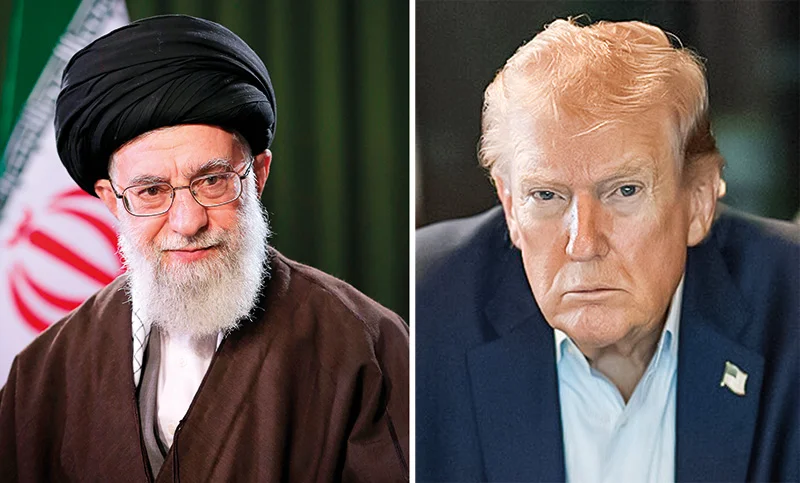
 It was Iran’s first spiritual head of state, the late Ayatollah Khomeini, who singled out and castigated the US as the ‘Great Satan’ in the revolutionary turmoil of the late seventies of the last century that ushered in the Islamic Republic of Iran. The core issue driving the long-running confrontation between Islamic Iran and the West has been religious identity and the seasoned observer cannot be faulted for seeing the explosive emergence of the current war in the Middle East as having the elements of a religious conflict.
The current crisis in the Middle East which was triggered off by the recent killing of Iranian spiritual head of state Ayatollah Ali Khamenei in a combined US-Israel military strike is multi-dimensional and highly complex in nature but when the history of relations between Islamic Iran and the West, read the US, is focused on the religious substratum in the conflict cannot be glossed over.
In fact it is not by accident that US President Donald Trump resorts to Biblical language when describing Iran in his denunciations of the latter. Iran, from Trump’s viewpoint, is a primordial source of ‘evil’ and if the Middle East has collapsed into a full-blown regional war today it is because of the ‘evil’ influence and doings of Iran; so runs Trump’s narrative. It is a language that stands on par with that used by the architects of the Iranian revolution in the crucial seventies decade.
In other words, it is a conflict between ‘good’ and ‘evil’ and who is ‘good’ and who is ‘evil’ in the confrontation is determined mainly by the observer’s partialities and loyalties which may not be entirely political in kind. It should not be forgotten that one of President Trump’s support bases is the Christian Right in the US and in the rest of the West and the Trump administration’s policy outlook and actions should not be divorced from the needs of this segment of supporters to be fully made sense of.
The reasons for the strong policy tie-up between Rightist administrations in the US in particular and Israel could be better comprehended when the above religious backdrop is taken into consideration. Israel is the principal actor in the ‘Old Testament’ of the Bible and is seen as ‘the Chosen People of God’ and this characterization of Israel ought to explain the partialities of the Republican Right in particular towards Israel. Among other things, this partiality accounts for the strong defence of Israel by the US.
For the purposes of clarity it needs to be mentioned here that the Bible consists of two parts, an ‘Old’ and ‘New Testament’ , and that the ‘New Testament’ or ‘Message’ embodies the teachings of Jesus Christ and the latter teachings are seen as completing and in a sense giving greater substance to the ‘Old Testament’. However, Judaism is based mainly on ‘Old Testament’ teachings and Judaism is distinct from Christianity.
To be sure, the above theological explanation does not exhaust all the reasons for the war in the Middle East but the observer will be allowing an important dimension to the war to slip past if its importance is underestimated.
It is not sufficiently realized that the Iranian Islamic Revolution of 1979 utterly changed international politics and re-wrote as it were the basic parameters that must be brought to bear in understanding it. So important is the Islamic factor in contemporary world politics that it helped define to a considerable degree the new international political order that came into existence with the collapsing of the Cold War and the disintegration of the USSR .
Since the latter developments ‘political Islam’ could be seen as a chief shaping influence of international politics. For example, it accounts considerably for the 9/11 calamity that led to the emergence of fresh polarities in world politics and ushered in political terrorism of a most destructive kind that is today disquietingly visible the world over.
It does not follow from the foregoing that Islam, correctly understood, inspires terrorism of any kind. Islam proclaims peace but some of its adherents with political aims interpret the religion in misleading, divisive ways that run contrary to the peaceful intents of the faith. This is a matter of the first importance that sincere adherents of the faith need to address.
However, there is no denying that the Islamic Revolution in Iran of 1979 has been over the past decades a great shaper of international politics and needs to be seen as such by those sections that are desirous of changing the course of the world for the better. The revolution’s importance is such that it led to US political scientist Dr. Samuel P. Huntingdon to formulate his historic thesis that a ‘Clash of Civilizations’ is upon the world currently.
If the above thesis is to be adopted in comprehending the principal trends in contemporary world politics it could be said that Islam, misleadingly interpreted by some, is pitting a good part of the Southern hemisphere against the West, which is also misleadingly seen by some, as homogeneously Christian in orientation. Whereas, the truth is otherwise. The West is not necessarily entirely synonymous with Christianity, correctly understood.
Right now, what is immediately needed in the Middle East is a ceasefire, followed up by a negotiated peace based on humanistic principles. Turning ‘Spears into Ploughshares’ is a long gestation project but the warring sides should pay considerable attention to former Iranian President Mohammad Khatami’s memorable thesis that the world needs to transition from a ‘Clash of Civilizations’ to a ‘Dialogue of Civilizations’. Hopefully, there would emerge from the main divides leaders who could courageously take up the latter challenge.
It ought to be plain to see that the current regional war in the Middle East is jeopardising the best interests of the totality of publics. Those Americans who are for peace need to not only stand up and be counted but bring pressure on the Trump administration to make peace and not continue on the present destructive course that will render the world a far more dangerous place than it is now.
In the Middle East region a durable peace could be ushered if only the just needs of all sides to the conflict are constructively considered. The Palestinians and Arabs have their needs, so does Israel. It cannot be stressed enough that unless and until the security needs of the latter are met there could be no enduring peace in the Middle East.
The two input gateways of communication, sight and sound, are quite well developed at birth. In fact, the auditory system becomes functional around 24 weeks in the womb, and the normal newborn can hear quite well after birth. However, the newborn’s vision is a little blurry at birth, and the baby sees the world in shades of grey, while being able only to focus on things 20 to 30 cm (8–12 inches) away. Coincidentally, this is perhaps the exact distance to a mother’s face during breastfeeding. By 2-3 months, there are colour vision capabilities and the ability to track. By 5-8 months, there is depth perception, and by 12 months, there is adult clarity of vision.
By the time a child turns five, his or her brain has already reached 90% of its adult size. This astonishing physical growth is not just happening on its own; it is, to a certain extent, fuelled by experience, and the most vital experience a young child can have is communication with his or her parents.
Modern developmental neuroscience has shifted our understanding of how children learn. We used to think babies were passive sponges, slowly absorbing the world. We now know they are active characters from day one, constantly seeking interaction to build the architecture of their minds. This architecture is not built by apps, vocabulary flashcards, or educational television. It is built through simple, loving, back-and-forth interactions with anyone they come across, but mostly their parents.
The Foundation: Serve and Return (0–12 Months)
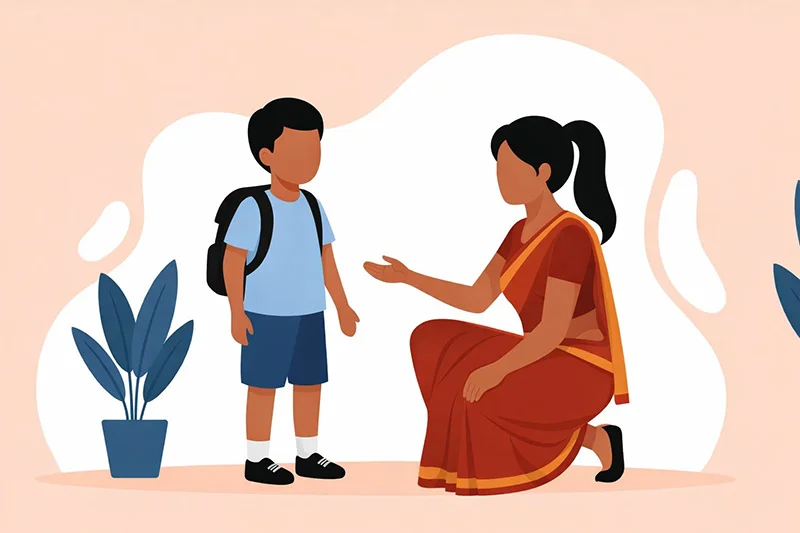
Communication with an infant from birth to one year of age begins long before they speak their first word. In the first year, the goal is to master a phenomenon called Serve and Return. This is a basic scenario picked up from the game of tennis. At the start of each game of a set in tennis, a player serves, and the opponent returns the serve. Just imagine a tennis match, where a baby “serves” by making a sound, making eye contact, reaching for a toy, or crying. The job of anyone in the vicinity, who very often are the parents of the baby, is to “return” the ball. If they babble, you babble back. If they point at a cat, you look and say, “Yes, that’s a furry cat!” This simple act does two things. The first is Brain Building, which creates and strengthens neural pathways in the language and emotional centres of the brain. The other is Emotional Security, a thing which teaches a baby that he or she has some help in the learning processes. The baby absorbs the notion that when he or she signals a need, his or her world will respond. This forms the basis of a secure attachment. Scientists have advocated that during this stage, people, especially the parents of a baby, should embrace what is called ‘parentese’. It is the use of a somewhat high-pitched, exaggerated voice. Research has shown that babies pay more attention to parentese than to regular adult speech, helping them to map the sounds of their native language more quickly.
The Language Explosion: Toddlers (1–3 Years)
When a child starts speaking words, the game changes considerably and quite profoundly. This period is defined by a rapid increase in his or her vocabulary and the beginning of grammar. It is very important to narrate everything. The people around, especially the parents, need to become kind of sports commentators for your life. While dressing them, one could say, “First we put on the red sock. After that, we put the other red sock on your left foot.” What we are doing by this is to give them the labels for the world they see.
It is also important to expand, but not truly correct, whatever the child says. If a toddler points to a car and says “Car!”, don’t just say “Yes.” Expand on it: “Yes, that is a big, fast, red car!” You are adding a new vocabulary and grammatical structure through a natural process. If the child says “Me go,” respond with, “Yes, you are going!” rather than correcting and saying “No…, you should say ‘I am going’.”
Toddlers love reading the same book, even one hundred times. While it may be tedious for those around the baby, it is important to realise that such repetition is vital for their learning. They are predicting what comes next, which is a core cognitive skill.
The Preschooler: Building Stories and Logic (3–5 Years)
By age three, the focus shifts from “what” to “why.” Preschoolers are beginning to understand complex emotions, time, and causality. This is the age at which it is best to ask questions which require thought and understanding. Such indirect open-ended questions would sound like “What was the best part of the park today?” or “How do you think that character in the story is feeling?“
A preschooler’s world is full of “big feelings” they cannot yet manage. When they are upset because they cannot have a cookie, avoid saying “Don’t cry over nothing.” Instead, name the emotion: “Don’t cry, you can have a cookie after dinner“. This teaches them emotional literacy. Parents and others around in the home could share stories about when they were little, or make up fantasy tales together. Storytelling teaches sequential logic (beginning, middle, end) and strengthens their imagination.
The Absolute Master Class: Learning Through Play
If communication is the fuel for brain development, play is the engine. For a child under five, play is not a break from learning; play is learning. It is how they explore physics (stacking blocks), mathematics (sorting shapes), social dynamics (sharing toys), and language (pretend play). We can boost their development exponentially by weaving communication into their play.
When a child is playing with blocks, dough, or puzzles, they are building fine motor skills and spatial awareness. It is also useful to use three-dimensional words: “Can you put the blue block on top of the red one?” “The puzzle piece is next to your knee.” One could also ask them to describe the texture: “Is the dough soft or hard?“
Pretend play, such as acting as a doctor, an engineer, a chef, or a superhero, is one of the most cognitively demanding things a child can do. It requires them to understand symbolic thought and to take on another person’s perspective. Join their world as a supporting character, not the director. If they are the doctor, ask, “Doctor, my teddy bear’s tummy hurts. What should I do?” This encourages them to use vocabulary relevant to the scenario and practice complex social problem-solving.
Playing with water, sand, slime, or safe food products allows children to process sensory information. This is the perfect time for descriptive vocabulary. Use contrasting words: wet/dry, hot/cold, sticky/smooth, loud/quiet.
A few special words for parents. You do not need an expensive degree or specialised toys to build your child’s brain. The most powerful tool you have is your own responsiveness. Modern science tells us that the basic recipe for a thriving child is simple: Look at them when they signal you. Respond with warmth and words. Narrate their world and Join their play.
You are not just talking to your child; you are building his or her future, even via just one conversation at a time. So, go on talking to your child and even make him or her a real-life chatterbox.
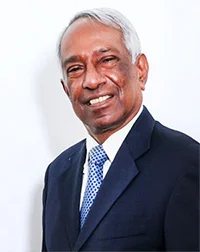 Dr B. J. C. Perera
MBBS(Cey), DCH(Cey), DCH(Eng), MD(Paediatrics), MRCP(UK), FRCP(Edin), FRCP(Lond), FRCPCH(UK), FSLCPaed, FCCP, Hony. FRCPCH(UK), Hony. FCGP(SL)
Specialist Consultant Paediatrician and Honorary Senior Fellow, Postgraduate Institute of Medicine, University of Colombo, Sri Lanka.

 Tourism is very much in the news these days and it’s certainly a good sign to see lots of foreigners checking out Sri Lanka.
With this in mind, Ruki’s Model Academy & Agency recently had a spectacular event to select Mrs. Tourism Sri Lanka in order to promote Sri Lanka in the international scene.
Nimesha Premachandra was crowned Mrs. Tourism Sri Lanka 2026.
She says she owes her success to Ruki (Rukmal Senanayake), the National Director and model trainer, and personality and advocacy trainer Tharaka Gurukanda.
Nimesha is a school teacher by profession, an actress and TV presenter by passion, and an entrepreneur by spirit.
She believes in balancing grace with purpose, and using her platform to inspire women, while promoting the beauty and culture of Sri Lanka to the world. And this is how our Chit-Chat went:
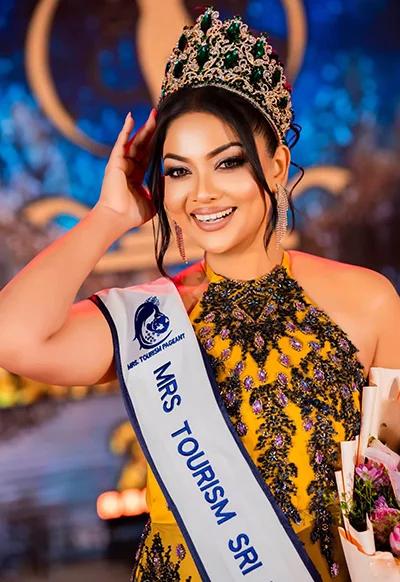
Nimesha Premachandra: Mrs. Tourism Sri Lanka 2026
01. How would you describe yourself?
I am a passionate, disciplined, and people-oriented person. I love learning, performing, and guiding others, especially young minds, through education.
02. If you could change one thing about yourself, what would it be?
I would probably try to be less self-critical and allow myself to celebrate achievements more often.
03. If you could change one thing about your family, what would it be?
Nothing major. I am grateful for my family’s love and support, which has shaped who I am today.
04. Is Mrs. Tourism Sri Lanka your very first pageant?
No. I have been part of pageants before, but Mrs. Tourism Sri Lanka is very special because it represents purpose, culture, and global representation.
05. What made you take part in this contest?
I wanted to represent Sri Lanka internationally and use this platform to promote tourism, culture, and women’s empowerment.
06. Obviously, you must be excited about participating in the grand finale, in Vietnam; any special plans for this big event?
Yes, I am extremely excited. My focus is to showcase Sri Lankan elegance, hospitality, and authenticity, while building meaningful connections with participants from around the world.
07. How do you intend promoting tourism, in Sri Lanka, during your rein?
I plan to highlight Sri Lanka’s diverse experiences in culture, heritage, wellness, nature, and local hospitality through media appearances, digital storytelling, and tourism collaborations.
08. School?
Kaluthara Balika. School life played a big role in shaping me. I actively participated in sports and performing arts, which later helped me build confidence as an actress and presenter.
09. Happiest moment?
Being crowned Mrs. Tourism Sri Lanka 2026 and seeing the pride in my family’s eyes – definitely one of my happiest moments.
10. What is your idea of perfect happiness?
Peace of mind, good health, and being surrounded by the people I love while doing work that has meaning.
11. Which living person do you most admire?
I most admire Angelina Jolie because she beautifully balances her work as an actress with meaningful humanitarian efforts. She uses her global platform to support refugees, advocate for human rights, and inspire women to be strong, compassionate, and independent.
12. Which is your most treasured possession?
My memories and experiences because they remind me how far I’ve come, and keep me grounded.
13. Your most embarrassing moment?
Like everyone, I’ve had small on-stage mishaps, but they always taught me to laugh at myself and move forward confidently.
14. Done anything daring?
Participating in pageants while balancing teaching, media work, and family life has been one of the boldest and most rewarding decisions I’ve made.

Keen to use her title to promote Sri Lanka globally
15. Your ideal vacation?
A peaceful destination surrounded by nature; somewhere I can relax, reconnect, and experience local culture.
16. What kind of music are you into?
I enjoy soft, soulful music because it helps me relax and stay inspired.
17. Favourite radio station:
I enjoy stations that blend good music with meaningful conversation and positive energy.
18. Favourite TV station:
Sri Lanka Rupavahini Corporation. It’s where it all began for me. It played a significant role in my journey as a TV presenter and helped shape my confidence and passion for media.
19 What would you like to be born as in your next life?
Someone who continues to inspire others because making a positive impact is what matters most.
20. Any major plans for the future?
I hope to expand my work in media and entrepreneurship while continuing my role as an educator and using my title to promote Sri Lanka globally.

Afternoon showers expected in the Uva and Sabaragamuwa provinces and in Hambantota, Nuwara-Eliya and Ampara districts

Trump administration launches US military operation in Ecuador

US sinks Iranian warship off Galle returning from Indian naval exercise

Justice Kumudini complains of male domination at senior levels, absence of a woman head of BASL

No qualified printer to head Government Printing Department

Wildlife Dept. fails on elephant fence management: Withanage

‘Dates have the highest sugar content to fight Coronavirus’

Sunday Island 27 December – Headlines

#SundayIsland 17th December – Headlines

Sunday Island – 28th March

Sunday Island Headlines – 21 March

Sunday Island – 21st February – Headlines
-

 Features3 days ago
Brilliant Navy officer no more
-

 Opinion6 days ago
Jamming and re-setting the world: What is the role of Donald Trump?
-
 Features6 days ago
An innocent bystander or a passive onlooker?
-

 Opinion3 days ago
Sri Lanka – world’s worst facilities for cricket fans
-

 Business6 days ago
An efficacious strategy to boost exports of Sri Lanka in medium term
-
 Features4 days ago
Overseas visits to drum up foreign assistance for Sri Lanka
-
 Features4 days ago
Sri Lanka to Host First-Ever World Congress on Snakes in Landmark Scientific Milestone
-

 Features3 days ago
A life in colour and song: Rajika Gamage’s new bird guide captures Sri Lanka’s avian soul