
News
The revised Data Protection Bill now out


by Randima Attygalle
The Data Protection Bill which was presented to the Legal Draftsman’s Department for further amendments to some of the provisions in the original Draft Bill has been released.
The Information and Technology Agency of Sri Lanka (ICTA) has announced that several changes have been made to the substantive provisions of the original Draft Bill including re-arrangement of key provisions. The changes were based on the feedback of a number of stakeholders including the Central Bank of Sri Lanka, Attorney General’s Department and the Ministry of Justice.
The Chair of the Data Protection Drafting Committee and the Legal Advisor to ICTA, Jayantha Fernando notes that, further amendments to the Bill are, however, possible once the Draft Bill is presented to the Cabinet and published as a Bill.
The original Draft Bill was reviewed by the Attorney General (AG) for compliance with Article 77 of the Constitution and the preliminary observations of AG received by the Drafting Committee in July last year. The Drafting Committee’s responses to AG’s observations were also reviewed by the Independent Review Panel, Chaired by Justice K. T. Chitrasiri and this response was sent to the AG and the Legal Draftsman in October. This was followed by several consultations between the Legal Draftsman’s Department and the Drafting Committee, through November and December last year.
The draft legislation defines ‘data’ as ‘any data by which an individual is identifiable and this includes name, an identification number, location data and also factors specific to the physical, physiological, genetic, psychological, economic, cultural or social identify of an individual’. Data protection is the right of a person to ensure that their personal data is not used, exchanged or even maintained without their knowledge.
The draft legislation Fernando told the Sunday Island imposes several obligations on those who collect and process personal data (‘Controllers’ and ‘Processors’). A new set of rights is also given to citizens under this new legislation, which are known as ‘Rights of data subjects’.
“For instance, personal data could be collected only for a specified purpose and not for any other purpose that is incompatible with the said purposes. However, processing data in public interest, scientific or historical research will not be considered incompatible. Personal Data has to be processed in a manner to ensure appropriate security, including protection against accidental loss, destruction or damage,” explains Fernando.
Data Subject (individuals) will also have the right to withdraw his or her consent given to Controllers and will also have the right to rectify the data without undue delay. Further, the Data Subjects have been given the right to object to processing of their data. These rights of Data Subjects can be exercised directly by the individuals with the Controller.
In the modern digital era where data is often at risk, both at individual and organizational level, this legislation becomes very relevant in view of certain measures introduced in the latest version of the Bill, points out the senior legal expert.
“Accountability measures for processing of personal data are required by the law to be implemented by government departments, banks, telco’s, companies etc. as forming a self-regulatory mechanism, referred to as ‘Data Protection Management Programme in the Law. There is also the right of appeal by citizens to the Data Protection Authority against the decisions made by entities which refuse their requests under the Law.”
Requirement for ‘Data Protection Impact Assessments’ (DPIA) by those entities doing high risk processing, becomes relevant in the context of digital adoptions in different organizations where individual data is collected. The Bill also defines criteria for cloud hosting of data under the provisions governing cross-border data flows and includes safeguards when data is hosted out of the country. Furthermore, the Data Protection Authority is vested with powers to give directives to the government and the private sector entities processing personal data and impose penalties in the event of non-compliance. There is a right of appeal from these decisions to the Court of Appeal.
Although laws on data protection have been in force in many parts of the world for several years, data protection is still a new concept to us. The drafting Committee, as it Chair explains, has taken into account international best practices, such as the OECD Privacy Guidelines, APEC Privacy Framework, Council of Europe Data Protection Convention, EU General Data Protection Regulation and laws enacted in other jurisdictions such as the UK, Singapore, Australia and Mauritius. “We have also studied the laws enacted in the State of California as well as the Indian Bill, when formulating the draft legislation,” Fernando remarked.

Business
Prime Minister Holds Bilateral Meetings with ADB Leadership and Participates in education policy dialogue in Manila


Prime Minister Dr. Harini Amarasuriya held a series of bilateral meetings with senior officials of the Asian Development Bank (ADB) on 10 March at the ADB Headquarters in Manila, during her official visit to the Philippines. The discussions focused on strengthening development cooperation between Sri Lanka and the ADB, reviewing ongoing projects, and exploring opportunities for future collaboration.
The Prime Minister first met with ADB President Masato Kanda. During the meeting, both sides reaffirmed the strong partnership between Sri Lanka and the Asian Development Bank. President Kanda welcomed the Prime Minister’s visit and commended Sri Lanka’s efforts to stabilise the economy and advance recovery following the recent economic crisis.
Prime Minister Amarasuriya expressed Sri Lanka’s appreciation for the continued support extended by ADB, including assistance provided in response to the impacts of Cyclone Ditwah and the Bank’s broader development cooperation with the country. She highlighted the importance of ADB-supported initiatives across key sectors that contribute to Sri Lanka’s ongoing recovery and long-term development.
The Prime Minister also held discussions with Yingming Yang, Vice President (South, Central and West Asia) of ADB, where both sides reviewed the progress of ongoing ADB-funded projects in Sri Lanka and explored opportunities to further strengthen collaboration in areas such as health, education, and social development.
In a separate meeting with Christine Engstrom, Director General of Sectors Department 3, discussions focused on sector-specific initiatives supported by ADB, particularly in human and social development, public sector management, and financial sector reforms. The Prime Minister noted that future investments in the education sector should place greater emphasis on human resource development and improving the quality of teaching and learning, alongside infrastructure development.
Following these meetings, the Prime Minister participated in a Policy Dialogue on Education and Skills Development, which brought together representatives from ASEAN institutions, Philippine education authorities, and ADB officials. The dialogue focused on regional education systems, policy collaboration, and initiatives aimed at strengthening education and skills development frameworks.
During the discussion, the Prime Minister highlighted the importance of expanding education cooperation between Sri Lanka and the Philippines, particularly in areas of policy exchange and institutional collaboration. Participants also discussed the development of the Technical and Vocational Education and Training (TVET) sector and explored opportunities to strengthen skills development frameworks to better align with emerging economic demands.
The engagements in Manila reaffirmed the shared commitment between Sri Lanka, the Asian Development Bank, and regional partners to deepen cooperation in advancing sustainable development, strengthening education systems, and promoting inclusive economic growth.

(Prime Minister’s Media Division)
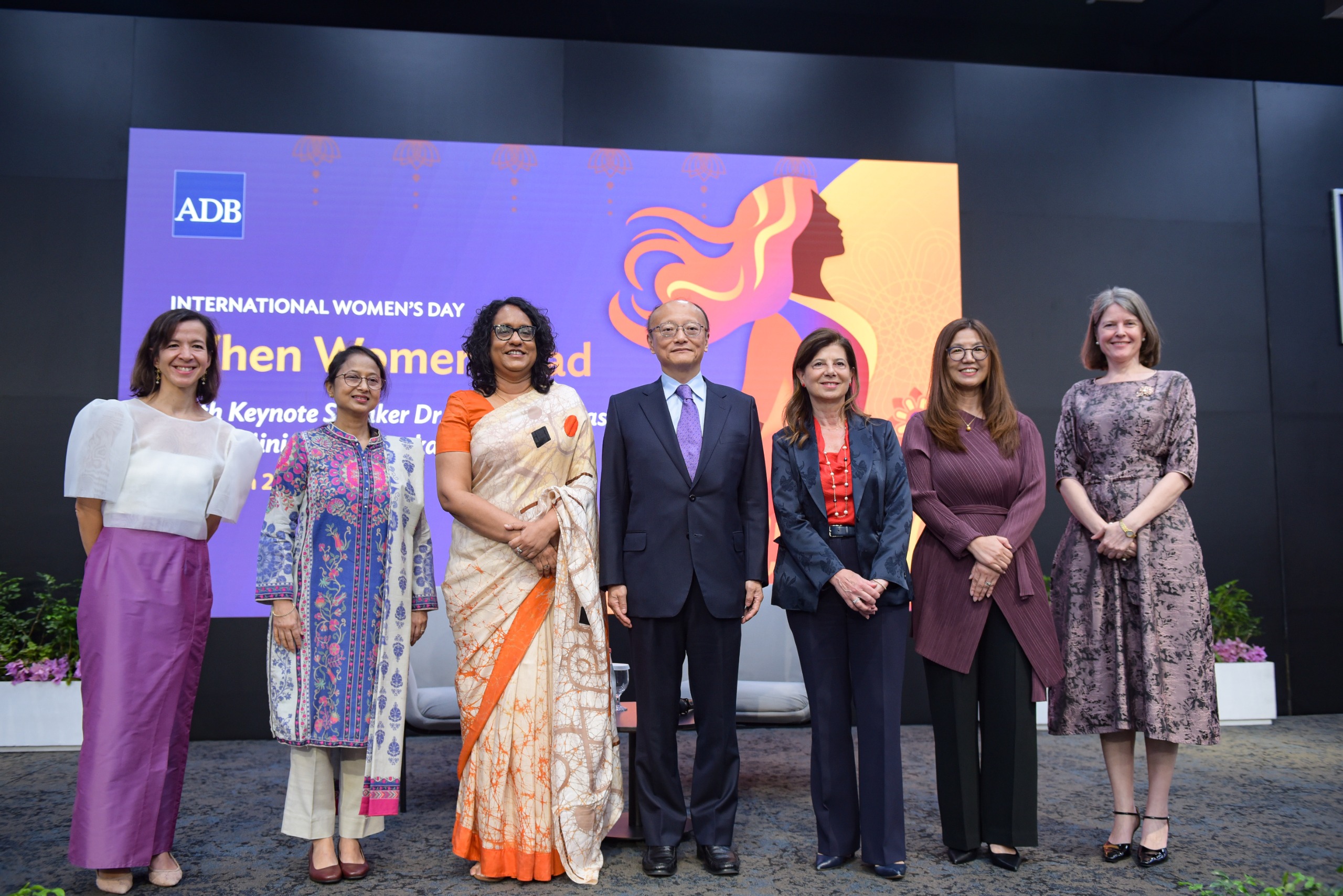
Prime Minister Dr Harini Amarasuriya participated in the International Women’s Day Flagship Event hosted by the Asian Development Bank (ADB) on 10 March at the ADB Headquarters in Manila, Philippines. The event brought together senior ADB leadership, representatives of the diplomatic community, and development partners to mark International Women’s Day and to reaffirm global commitments to gender equality.
Delivering the keynote address, the Prime Minister highlighted the critical role of education in empowering women and girls, emphasising that equitable access to quality education remains one of the most powerful tools for achieving social and economic transformation. She underscored Sri Lanka’s longstanding commitment to education and noted the importance of strengthening inclusive learning systems that enable women to fully participate in national development.
The Prime Minister also drew attention to the significant contribution of women’s unpaid care work, noting that it remains largely unrecognised despite its vital role in sustaining families, communities, and national economies. She emphasised the need for policies and social protection mechanisms that acknowledge and support care work, thereby enabling women to participate more fully in economic life.
Addressing broader structural challenges, the Prime Minister stressed the importance of increasing women’s participation in political decision-making and the labour force, noting that inclusive governance and economic participation are essential for sustainable and equitable development.
She highlighted the need for continued collaboration between governments, international institutions, and development partners to remove barriers that limit women’s opportunities.
During the event, Prime Minister was honoured with the Shireen Lateef Women’s Leadership Award in recognition of her commitment to advancing women’s leadership and empowerment.
The event was opened by the President of the Asian Development Bank and senior ADB leadership, followed by a high-level discussion on advancing gender equality across the region. The Prime Minister’s participation reaffirmed Sri Lanka’s commitment to strengthening partnerships with international institutions to promote women’s empowerment and gender-responsive development policies.
(Prime Minister’s Media Division)

The Ceylon Electricity Board Engineers’ Union (CEBEU) yesterday warned that uncertainty surrounding the ongoing restructuring of the Ceylon Electricity Board (CEB) had forced many employees to refrain from performing their regular duties, raising concerns about potential disruptions to electricity sector operations.
The engineers’ union said the current situation had arisen due to what it described as either deliberate actions or extreme negligence in implementing the restructuring process, which has created significant confusion among staff who previously served under the CEB.
According to the union, although the state power utility has been formally restructured and new companies established, a large majority of former CEB employees have yet to receive official appointment letters, confirming their positions in the newly formed entities.
“The reality is that the institution, previously known as the Ceylon Electricity Board, no longer exists in its earlier form, yet most employees, who served under it, have not been issued proper appointment letters, or related documentation, assigning them to the newly established companies,” the CEBEU said.
The union said that while some workers had been issued “assignation letters”, those documents merely indicate the institution to which an employee has been attached and do not clearly define employment conditions, responsibilities, authority, or reporting structures.
“As a result, employees currently lack the necessary legal framework confirming their employment status, their duties, the authority under which they operate, and who they are accountable to within the new institutions,” the CEBEU said.
The engineers’ union emphasised that the current crisis was not created by employees but was the direct result of, what it called, shortsighted and questionable actions taken by those responsible for implementing the reforms.
It also expressed concern that the relevant Minister, appointed through the National List, had failed to hold meaningful discussions with employees, despite having previously advocated strongly for workers’ rights.
The union said trade union action had been launched only after months of unsuccessful attempts to resolve the issues through verbal requests and written communication with the authorities.
“Despite repeated appeals made over several months, there has been no satisfactory response. Decisions appear to have been taken under the assumption that a government with a strong mandate can proceed without proper consultation,” the union said.
However, the CEBEU stressed that employees engaged in essential operations—including power generation, transmission, and distribution—continue to work in order to ensure electricity supply to the public.
“These staff members are continuing their duties under considerable risk to prevent major disruptions to the electricity supply,” the union noted.
Nevertheless, the union warned that the prevailing uncertainty could affect certain operational activities, and restoration work following breakdowns may take longer than usual.
The CEBEU appealed to the public to understand the situation and expressed regret for any inconvenience that may arise.
“We request the public to understand the situation and cooperate with us during this difficult period. We sincerely regret any inconvenience that may be caused,” the union added.
By Ifham Nizam

EU-approved sterile pharma facility launched

Prime Minister Holds Bilateral Meetings with ADB Leadership and Participates in education policy dialogue in Manila

Nahid Rana and Tanzid Hasan complete Pakistan’s demolition in opening ODI

Prime Minister highlights the importance of recognising Women’s Unpaid Care Work

Australia grants asylum to 2 more members of Iranian women’s football team

Showers are likely in the Northern, Eastern, Sabaragamuwa, Southern and Uva provinces and in Kandy and Nuwara-Eliya districts

‘Dates have the highest sugar content to fight Coronavirus’

Sunday Island 27 December – Headlines

#SundayIsland 17th December – Headlines

Sunday Island – 28th March

Sunday Island Headlines – 21 March

Sunday Island – 21st February – Headlines
-

 News6 days ago
University of Wolverhampton confirms Ranil was officially invited
-

 News7 days ago
Legal experts decry move to demolish STC dining hall
-

 News5 days ago
Peradeniya Uni issues alert over leopards in its premises
-

 News6 days ago
Female lawyer given 12 years RI for preparing forged deeds for Borella land
-

 News3 days ago
Repatriation of Iranian naval personnel Sri Lanka’s call: Washington
-

 News6 days ago
Library crisis hits Pera university
-

 News5 days ago
Wife raises alarm over Sallay’s detention under PTA
-

 News6 days ago
‘IRIS Dena was Indian Navy guest, hit without warning’, Iran warns US of bitter regret