
Features
The Rajapaksa Brothers’ Return is Not a Victory for All

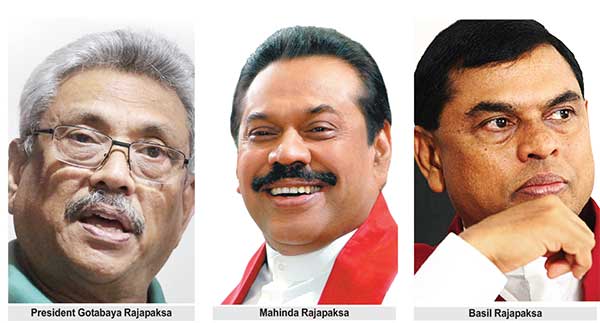
President Gotabaya Rajapaksa however decided that he could still meet the challenges with the powers vested in him. True to his word, the infected clusters were quickly contained. Sri Lanka is yet to face the dreaded second wave that had engulfed most other countries. Though imports were severely controlled, his Administration ensured that there were no shortages of any essentials
by Shivanthi Ranasinghe
Sri Lanka is the first country to defeat “Regime Change”. The fact that this whole operation was reversed by the ballot makes this accomplishment irrefutable. It is after all in the guise of strengthening democracy that this “Regime Change” Operation was launched. Critics have tried to downplay this turn of events by claiming that the voter turnout was the lowest in the decade. With a voter turnout of over 71 percent however, the recently concluded general elections can hardly be considered to have been apathetic.
This election was held at a time that is trying for the whole world. There was an attempt within the country to postpone elections indefinitely and instead for the dissolved Parliament to be recalled. This would have allowed those politicians whose popularity that had nosedived to remain as decision-makers without a people’s mandate.
It is interesting that advocates of democracy found fault with President Gotabaya. They accused him of running the country without a Parliament. However, instead of taking the ground situation into account or exploring ways of safely conducting elections, their expectations were also for the dissolved parliament to be recalled and elections to be postponed. Surprisingly, it did not bother them that such an act would violate the people’s franchise.
President Gotabaya Rajapaksa however decided that he could still meet the challenges with the powers vested in him. True to his word, the infected clusters were quickly contained. Sri Lanka is yet to face the dreaded second wave that had engulfed most other countries. Though imports were severely controlled, his Administration ensured that there were no shortages of any essentials.
The Supreme Courts agreed with the President that he had taken the right steps in dissolving Parliament and calling for general elections. Therefore, the onus of holding elections were with the Elections Commission.
The EC that had already postponed elections twice had no other choice but to proceed. By this time, since the Kandakadu cluster, not a single new patient had been identified from within the Island.
It is also noteworthy that independent observers have declared this election to have been both fair and peaceful. Therefore, no one can interpret the two third majority that the Gotabaya Rajapaksa Administration received as anything but a clear mandate from the people.
A healthy voter turnout, elections conducted in a peaceful environment despite the trying circumstances and a clear message from the people attests to the strength of the democracy in Sri Lanka. Yet, the silence from the so-called proponents of democracy is deafening.
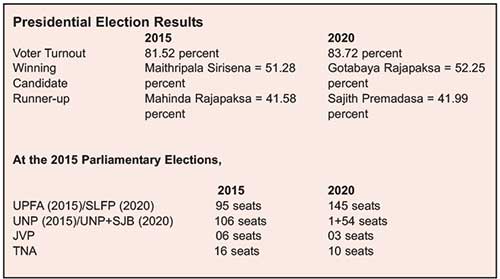
Mandate Received in
2015n & in 2020
After the 2015 presidential and parliamentary elections, many international players as well as independent bodies applauded Sri Lanka for reestablishing democracy. Some even took credit for it. The then US State Secretary John Kerry revealed that nearly USD 800 million of American taxpayers’ money was invested to change the governments of four countries. Sri Lanka was one of them.
 Yet, none of the countries that propelled the Yahapalana Government into power enthusiastically extended its support for the 2019 presidential elections. India’s lackluster approach is understandable. As far as India is concerned, the betrayal of leasing of the Hambantota Port to China for 99 years, which can be extended for another 99 years is equivalent to LTTE assassinating Rajiv Gandhi.
During the Mahinda Rajapaksa Administration, the ambitious Chinese-funded projects made India uneasy. The occasional visits from Chinese nuclear subs hardly compares though to the permanent residency Yahapalana Government granted to China with th leasing of the Port.
Absurd amounts of money were spent on the elections by all parties, especially on social media. However, it is not clear if the Yahapalana candidate, Sajith Premadasa received the same or similar support that Maithripala Sirisena did from external bodies.
In 2015, the Yahapalana Government came to power after receiving much support and assistance, especially in social media, from external sources. This was somewhat reminiscent to the LTTE days when the Government troops struggled without weapons comparable to those of the enemy. Likewise, the Mahinda Rajapaksa Administration too could not counter the social media onslaught.
Yet, the mandate the Yahapalana Government received in 2015 was not as clear as that received by the Gotabaya Administration in 2019-2020. By this time, the playing field in social media had leveled out. This allowed the Rajapaksa camp to effectively counter disinformation as well as carry out their own campaigns. Therefore, it is possible to surmise that the voters’ decision was less manipulated in 2019.
Manipulations for a
Democratic Majority
After Maithripala Sirisena won the 2015 Presidential Elections, he took control of the SLFP. This was a bizarre situation as the SLFP was the main party of the United People’s Freedom Alliance (UPFA). As such, backed by the UNP, Maithripala Sirisena contested against the UPFA. Thus, when he took over the SLFP, he effectively became the Head of the Government as well as that of the legitimate Opposition.
Sirisena came to power on the UNP vote base on an “apolitical” platform. Hence, the UNP voter was rather taken aback when he become the leader of their arch rival. They however calmed as Sirisena was then able to exert influence over the UPFA, enabling Ranil Wickremesinghe’s minority government to plough ahead unhindered. This allowed the minority government to even tinker with the Constitution.
Except for Rear Admiral Sarath Weerasekara, the new Opposition was in a confused daze and somewhat cowered by Mahinda Rajapaksa’s defeat. Therefore, they offered zero resistance. Their failure resulted in the 19th Amendment which they too supported. In the course of the next four years, the country was to suffer immensely because of an amendment without due democratic process.
To overcome the failure of obtaining a majority at the 2015 General Elections, Ranil Wickremesinghe formed a National Government. Maithripala Sirisena too helped in this manipulation by convincing about 40 UPFA MPs to join this union. He even replaced the names of those on the list placed before the electorate as National List nominees with defeated candidates who were loyal to him.
This violated the people’s mandate. Candidates rejected by the people do not have the moral right to represent them. Moreover, the National List is a means to bolster the intellectual capacity of the Parliament by inviting highly respected personalities and subject experts with a proven track record. It is most definitely not for candidates scorned by voters. The voters were in effect cuckolded twice because the promised National List was not the one that eventually materialized.
Maithrpala Sirisena’s actual motive was self preservation. Had he not got his own team, he would have been a mere puppet of the UNP. Yahapalana Government supporters argued that this as a progressive move that would end the era of divisive politics with both main parties on the same side.
In reality however, Maithripala Sirisena fortified with a team of his own began to assert his own independence. As a result, the two factions – one led by Sirisena and the other by Wickremesinghe – could not agree on many issues. This indecisiveness led to nine different economic policies within three years. By the fourth year, a Cold War of sorts had set in between the two camps, which led to the catastrophic Easter Sunday massacres.
Before this fission became apparent, the extraordinary lengths the Yahapalana Government went to ensure its dominance in Parliament were heralded as democratic. The various western agents who “dropped in” heaved a sigh of relief “that the era of Mahinda Rajapaksa authoritarianism is over”. It was only after Donald Trump became the US President that ended these visits, which in reality were a trespassing of our sovereignty.
These agents who “oohed” and “ahhed” over the “democratic reforms” ushered in with the Regime Change Operation, refused to see just how much the democratic norms were been violated. Maithripala Sirisena was able to lure only about half of the UPFA MPs. The corruption charges against these MPs miraculously disappeared. Despite the lure of power and perks, 55 MPs refused to be part of the Yahapalana Government. They continued to be persecuted by a special criminal investigation division directed by the then Prime Minister Ranil Wickremesinghe.
This group presented themselves as the Joint Opposition (JO) as they contested against the Yahapalana Government. As such, the mandate JO received from their voters was to oppose the Yahapalana Government. Therefore, none of the UPFA MPs had a right to sit with the Yahapalana Government.
JO was the largest group in Parliament as an opposition. Together, this group represented eight of the nine provinces. Yet, Maithripala Sirisena as the President and Karu Jayasuriya as the Speaker refused to acknowledge the JO as the Opposition. Instead, the TNA with its meager presence in the Parliament, representing only two of the provinces was appointed as the Opposition Leader.
While Karu Jayasuriya agreed to treat the ostracized group as a separate entity, he refused to acknowledge the large number in the group. As such, he refused to allocate a reasonable time for the JO to speak in Parliament.
An Opposition Protective of Its Government
The TNA, while accepting the prestige of the position of the Leader of the Opposition, never spoke on any of the National issues. In fact, they barely disguised their complicit partnership with the Government. They never raised an issue over the Central Bank bond scams, even as the interests rates began to rise as a direct rippled effect of these scams. The economic repercussions were enormous as businesses collapsed and cost of living soared. As imports increased while the export markets struggled, the rupee came under intense pressure. The sudden devaluation of the rupee by 31 percent was unprecedented. This in turn increased our debt burden, causing our interest rates to rise even more.
During the tenure of the Yahapalana Government, Sri Lanka experienced a number of tragedies. Droughts and floods are common phenomenon in Sri Lanka. Apart from these, the Salawa explosion, the Meetotamulla garbage disaster and the massive Aranayaka landslide took place while the TNA sat as the Opposition. Not a single TNA MP visited any of these disaster sites, nor raised in Parliament the delay in compensating the victims. They did not even raise the issue faced by the Northern fishermen due to poaching by the South Indian fishing trawlers.
The TNA’s focus was holding the Sri Lankan Military accountable for alleged war crimes and gaining more autonomy. These were also the very objectives of the Yahapalana Government. As such, both the Yahapalana Government and the TNA were working in partnership.
While the Yahapalana Government co-sponsored the UNHRC Resolution 30/1, the TNA was formulating a new constitution with irreversible conditions to strengthen the provinces at the cost of the central government. They were thus working on the same project.
Even as the TNA were pushing for more autonomy, they failed to protect the powers they already have at hand. One by one the Provincial Councils became defunct as the PC elections were postponed indefinitely. The very reasons Provincial Councils were created was as a step to redress the grievances of the Tamils in the North and East. Yet, to date they have not expressed any distress over the fact that these councils are no longer functioning. It is ironic indeed that since the expiration of these councils, the provinces are being run by the Government.
It was indeed eyebrow raising when the TNA tried to protect the Yahapalana Government. As the popularity of the Yahapalana Government plummeted, a petrified TNA beseeched India to protect the government. By doing so, TNA must have become the first Opposition to want to protect the sitting government.
Democracy Advocators Break their Silence
Not a single West mentored entity was bothered by these vulgarities that shammed democracy. They continued to be relieved that the Rajapaksas were not at the helm. However, the people have voted with an overwhelming majority the Rajapaksa brothers back to power.
This is very alarming to the West-led foreign media as well as civil groups. They refuse to acknowledge any positive stride taken by the new Rajapaksa headed Administration. Even Sri Lanka’s superb management of the COVID-19 pandemic is met with countless criticism and without a single word of praise or acknowledgment of its remarkable successes. They worry that the “democratic reforms” introduced by the previous government will be rolled back.
Sri Lanka can be assured that the next four years will be a never ending complaint from these entities as they nitpick over isolated incidents and make mountains out of molehills. They may moan and groan, but it is the people in Sri Lanka who has to live with the situation. Therefore, it is the Sri Lankan citizen who must decide what is right and not for Sri Lanka.
(ranasingheshivanthi@gmail.com)



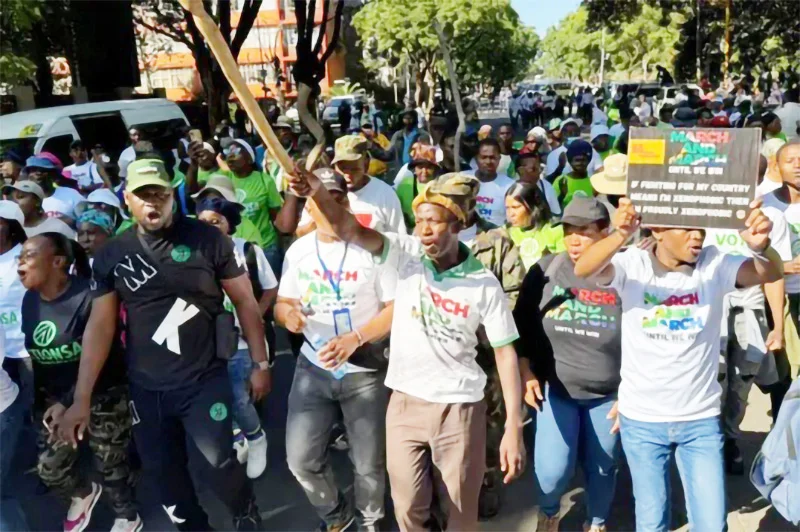
 The current outbreak of anti-immigrant protests in Durban, South Africa is bound to have taken many a subscriber to value-based politics or political idealism quite by surprise. After all, this is evidence that despite the historic accomplishments of nation-builders of the stature of the late President Nelson Mandela it cannot be taken for granted that identity politics, including racism in its worst forms, is no more in South Africa.
At the time of this writing details are scarce on the substantive root causes of the protests but it could very well be that economic grievances, particularly on the part of the majority community in South Africa, are contributing considerably to the disaffection. Shrinking employment and material prospects are likely to figure majorly among the factors igniting the unrest.
Fortunately, the local authorities in Durban are losing no time in calling for peaceful co-existence among the relevant communities and are pointing to the vital importance of stepping-up national integration processes. Apparently, immigrants in sizable numbers from neighbouring countries are present in Durban. However, international TV footage of the protests quoted some local authorities as saying that the majority of the immigrants in some centres that housed them were not illegal migrants and had the documents that entitle them to be in Durban.
In the Durban protests the world has fresh proof of the socially divisive consequences of the gathering globe-wide economic disaffection, touched off particularly by the continuing crisis in West Asia. Going ahead, the world would need to brace for increasing identity-based unrest of the kind it is just witnessing in South Africa.
Considering that the material lot of ordinary people everywhere could only aggravate progressively, with the US and Iran showing no signs of negotiating an end to their confrontation any time soon, it will be left to the more democratic and progressive sections of the world community to initiate positive measures collectively to bring a measure of relief to the discontented.
The swiftness with which such relief will be provided would depend crucially on the importance those sections taking up these undertakings attach to value-based politics as opposed to Realpolitik of power politics.
Going by these yardsticks, Italy could be considered to be moving in the right direction. Recently Italy came to the fore in initiating the collective named, ‘Rome Coalition for Food Security and Access to Fertilizer’, which has as one of its aims the swift provision of fertilizer to economically weak African countries.
In a recent statement Italian Minister of Foreign Affairs and International Cooperation, Antonio Tajani, said that a principal aim of the project was to ensure that the farmers of Africa gained easy access to fertilizer, considering that food security is a growing concern among some of Africa’s economically vulnerable countries.
The statement went on to mention that some 30 countries hailing from the Mediterranean region, the Middle East, the Balkans as well as the FAO had been invited to join the coalition. The venture is far-seeing in that food security is main among the reasons for social discontent which in turn could degenerate into endemic political turmoil and bloodshed. Separatist violence and geographical fragmentation of countries wouldn’t be too far behind these developments, as Africa itself has often proved.
It is hoped that more G7 countries would take the cue from Italy and do what they could to ease the hardships of economically distressed countries, particularly of the global South. In these efforts they would need to break rank with the US, which is today brutally indifferent to the consequences of its policy of making ‘America First’, come what may.
Going by current developments, the Trump administration seems to be blithely oblivious to the wider, deleterious effects of its policy course in West Asia. Besides rendering Iran militarily and otherwise impotent nothing else seems to matter to Washington, as regards West Asia. This is policy short-sightedness of an extreme kind. After all, right now West Asia could be said to be sitting on the proverbial powder keg.
On the other hand, Iran is not giving the world the impression that it is doing anything constructive to get out of the policy straitjacket that it wove for itself decades ago. Rather than enter into a policy of ‘live and let live’ in relation to Israel in particular and initiate a process of reconciliation with the latter, it has chosen to operate within policy parameters that continue to damn Israel. This has put Israel always on the ‘defensive’ so to speak and prevented the opening up of space for meaningful dialogue.
That said, Israel is obliged to explore the possibilities of entering into a negotiatory process with the Arab-Islamic world that could lead to a de-escalation of tensions and bloodshed. It cannot continue to look at its neighbours through lenses that distort them as archetypal enemies who should be ‘wiped off completely from the face of the earth.’
In other words, the need is urgent for Realpolitik to give way to value-based politicks. Italy is beginning to prove that the latter approach could be pursued with some success. May be the EU and the UK could throw their weight behind these initiatives as well and establish that international politics could be refashioned on the basis of humane, civilized norms. The UN would need to be fully supportive of these moves and prove an organizational nucleus of the operations that follow.
In fact the time is ripe for people of conscience to collectively stand up on the side of peace and say ‘No’ to war and violence. Organizations such as the ICRC, the WHO and Medicines Sans Frontiers have already taken up this call. Referring to the widespread destruction of health facilities and their dehumanizing results these organizations have said, among other things, that ‘This is not a failure of the law. It is a failure of political will.’
True, ‘failure of political will’ among those powers that matter accounts for the runaway, uncontrollable nature of war and destruction in contemporary times, but more fundamentally it is a failure of the human conscience. It could very well be that the phenomenal levels to which violence and war have been unleashed today have had the effect of deadening consciences. This is a matter for urgent study and wide discussion.

 I would describe Indunil Kaushalya Dissanayaka as innovative and creative, and she operates under the name of Cuteefly.
Indunil always comes up with something novel to celebrate special occasions, and she does it with candles … and that’s her profession.
She was in the spotlight when she created a happening scene, with candles, for Christmas, Sinhala and Tamil New Year, and Valentine’s Day.
As lanterns light up Sri Lanka for Vesak, the Colombo-based candle maker is quietly turning wax and wick into little pieces of the festival.
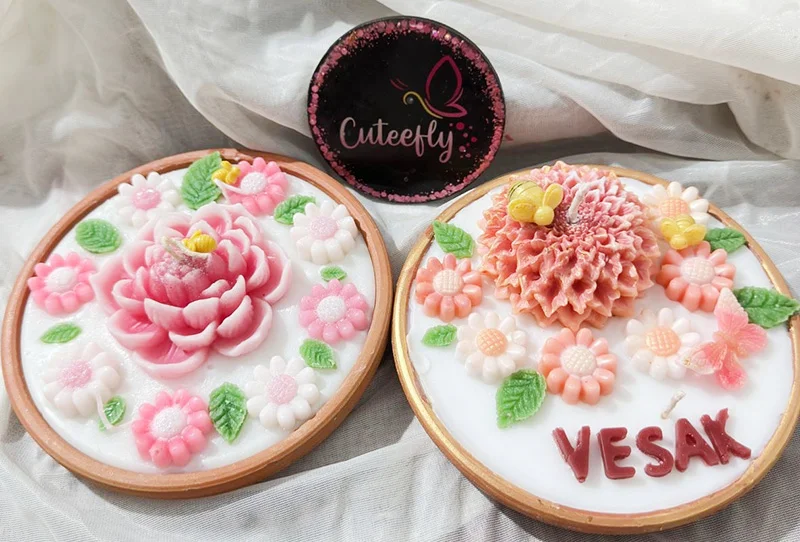
Candles reflecting Vesak themes
Her candles reflect Vesak themes – light, peace, remembrance, giving, etc., to enable you to fill your Vesak celebration with devotion and beauty.
Among her Vesak creations is a lotus-shaped soy candle, scented with sandalwood, lavender, etc., meant to burn during this Vesak Poya Day.

Indunil Kaushalya Dissanayaka: Customers
praise her for her creativity
These handcrafted Vesak candles are perfect for offering at the temple, she says.
What makes her creations so novel is that they come in different shapes, scents, themes, and all are handmade.
What’s more, her customers have heaped praise on her for her creativity.
According to Indunil, her creations are perfect as a thoughtful gift … to bring beauty, unity, and light into every moment.
Says Indunil: “Our beautifully handcrafted Unity candles are designed with premium detail and love, making them perfect for celebrations, gifts, and meaningful occasions.”
Cuteefly, says Indunil, is available online.
Readers could contact Indunil on 0778506066 for more details.
He Facebook Page is: Cuteefly.

Handmade with love

 Yes, dark spots do crop up on the skin, especially with sun exposure and, of course, as the skin ages.
However, these tips should be of immense benefit to those who are faced with dark spots.
* Lemon and Honey Glow Mask:
You will need 01 teaspoon lemon juice and 01 teaspoon honey.
Mix the lemon juice and honey well and then apply this mixture, only on the dark spots.
Leave for 10–15 minutes and then rinse with cool water.
Benefits:
Lemon helps brighten pigmentation.
Honey moisturises and heals skin.
Gives a natural glow.
* Aloe Vera Gel Treatment:
All you need is fresh aloe vera gel.
Apply the gel apply on dark spots, before going to bed.
Leave overnight and wash in the morning.
Benefits:
Reduces acne marks and pigmentation.
Soothes irritated skin.
Helps skin repair naturally.
* Turmeric and Yoghurt Paste:
You will need 01 teaspoon yoghurt and a pinch of turmeric
Mix the yoghurt and turmeric into a smooth paste and apply on affected areas.
Leave for 15 minutes and then wash gently with lukewarm water.
Benefits:
Turmeric brightens skin naturally.
Yoghurt removes dead skin cells.
Helps fade dark spots gradually.
Use these packs 02-03 times a week as results are generally seen over time.
You can also try this out: Mix a ripe papaya into a smooth paste and apply to the face, or directly on to the dark spots. Leave for 15-20 minutes and then wash with lukewarm water.

Let us all build a society valued with peace and harmony, guided by unity and solidarity beyond all differences – PM

Showers will occur at times in the Western, Sabaragamuwa and North-western provinces and in Galle, Matara, Kandy and Nuwara-Eliya districts

Rajitha calls for combined lists, denounces those unwilling to join as traitors

20 lawmakers, four officials visiting China

More Japanese funds for demining operations in the north

Clingendael Institute delegation visits Pathfinder Foundation

‘Dates have the highest sugar content to fight Coronavirus’

Sunday Island 27 December – Headlines

#SundayIsland 17th December – Headlines

Sunday Island – 28th March

Sunday Island Headlines – 21 March

Sunday Island – 21st February – Headlines
-

 Business6 days ago
Historic launch of CCWE Fashion Week & International Summit 2026
-

 News4 days ago
All-New GRAVITE launches at LKR 6.99 Mn
-
 Features4 days ago
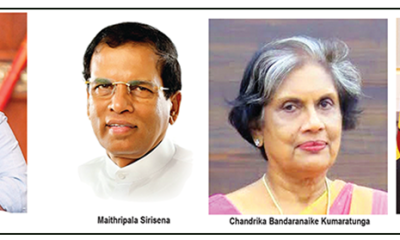
The NPP’s pivot to the past
-
 News3 days ago
Police probe underway to ascertain links between criminals deported from UAE and local politicians
-
 News2 days ago
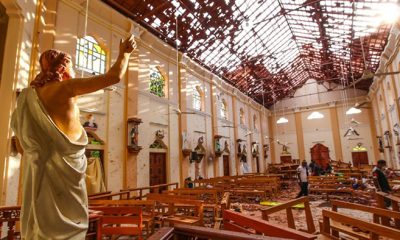
Easter Sunday carnage: Court told Maulana’s statement cannot be accepted without cross-examination
-

 Opinion6 days ago
The need to reform Buddhist ecclesiastical order
-
 Features4 days ago
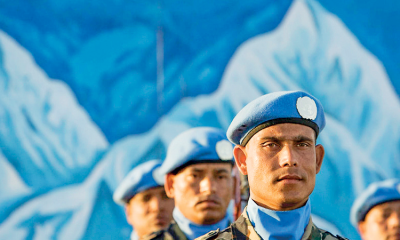
End of Peacekeeping
-
 News3 days ago
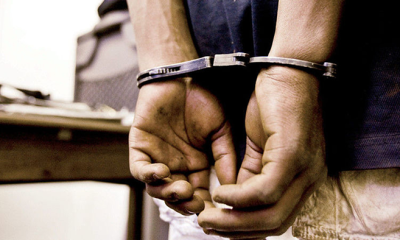
Dickoya double murder suspect arrested