
Features
The Opposable Thumb and the Big Toe: Of The Thinker In Auguste Rodin and Sarath Chandrajeewa

by Laleen Jayamanne
What do the prehensile hand and the big toe have to do with the unique and exalted human ability to think? These two vital anatomical features of our body, the thumb and the big toe, don’t draw attention that much (we take them for granted), but a canonical French sculpture and a small Lankan painting have brought them to my attention recently.
I was predisposed to notice the function of the big toe in Rodin’s modern sculpture, The Thinker (1904) and in Sarath Chandrajeewa’s painting, Thinker in front of the empty doorway (2023), because of a photo of a big toe in the book, Gesture and Speech by the palaeo-anthropologist Andre Leroi-Gourhan. In extreme close-up, it is not a pretty picture, though what Leroi-Gourhan has to say about its function in human evolution is startling, certainly food for thought. He says that the evolution of the human foot with its big toe created the bipedal ability to stand up firmly, and walk upright, without losing balance.
Try walking with the big toe lifted up! Similarly, without the freed prehensile hand, humans could not have evolved to create tools and language, with a big, highly differentiated brain and nervous system of precise sensitivity. He demonstrates the unique refinement of the human hand and foot by providing diagrams of the gradual differentiation of these two drivers of evolution in contrast with some primates. Here’s Leroi-Gourhan:
“The human hand is not fundamentally different from that of other primates. Its ability to grasp, like theirs, is due to an opposable thumb. The foot, however, is radically different from a monkey’s. A primary stage with an opposable big toe is conceivable, but the two paths must have diverged very early, before the earliest known anthropoid stage”.
The Thinker as Archetypal MAN Just imagine placing a woman in the posture of The Thinker. Would it be credible? Sumathy Sivmohan asked this rhetorical question in our recent piece on ‘Abstraction & Empathy’ (Island 19/4/24):
“We already have the figure of the Thinker in Rodin. Do we immediately know to make those connections, and therefore think of the Thinker? Or is it a MAN holding himself in a ‘thoughtful’ pose which kindles the idea?”
So, I did a search and found that there is at least one such example, but its parodic register makes the point. In singer Ariana Grande’s “God Is a Woman” music video, she sits in The Thinker pose while being attacked by small angry men. Rodin’s thinker, though celebrated as a rare modern bronze sculpture, has been parodied in mass culture from as early as 1940. Charly Chaplin parodied The Thinker by placing multiple plaster copies of the statue to decorate the road on which Hinkel’s motorcade travelled in The Great Dictator. He adjusted a detail by making The Thinker stretch out one arm in a ‘Heil Hitler’ salute. Jean Luc Godard parodied The Thinker in his 1968 anti-Vietnam war essay-film, A Letter to Jane. It seemed that the solemnity of this perennial European male posture was unsalvageable.
The Archaic Thinker
But the prototype for the Thinker goes back to ancient times with clay figurines striking the same pose of a seated male figure holding his head in his hand. This iconic gesture (gestus in Brecht, Abhinaya in Mirror of Gesture (Abihnaya Darpan), of resting or holding the weight of the head in his hand with down cast eyes is what makes it an archetypal image of introspective, thinking man, self-aware man. The organ of thought, the brain appears to be weary and heavy, needing support of its ally, the hand. Wikipedia says the following about The Thinker’s archaic lineage:
“The Thinker from Yehud, also known as the Thinker of Palestine,[1] is an archaeological figurine discovered during salvage excavations in the Israeli city of Yehud. The figurine, which sits atop a ceramic jug in a posture resembling Rodin’s famous sculpture “The Thinker,” dates back to the Middle Bronze Age II Palestine (c. 1800–1600 B.C.E.). It was found in a tomb accompanied by various items, including daggers, spearheads, an axe head, a knife, two male sheep, and a donkey, all likely buried as offerings. After its discovery, the broken jug had to be stabilised and restored before being displayed in the Canaanite Galleries of the Israel Museum in Jerusalem.”
“The “Thinker of Cernavodă”, Romania, a terracotta sculpture, and its female counterpart, “The Sitting Woman”, are works of art from the Chalcolithic era. The Hamangia culture produced these remarkable sculptures, with The Thinker believed to be the earliest prehistoric sculpture that conveys human self-reflection instead of the more common artistic themes of hunting or fertility. About 5,000 BC.”
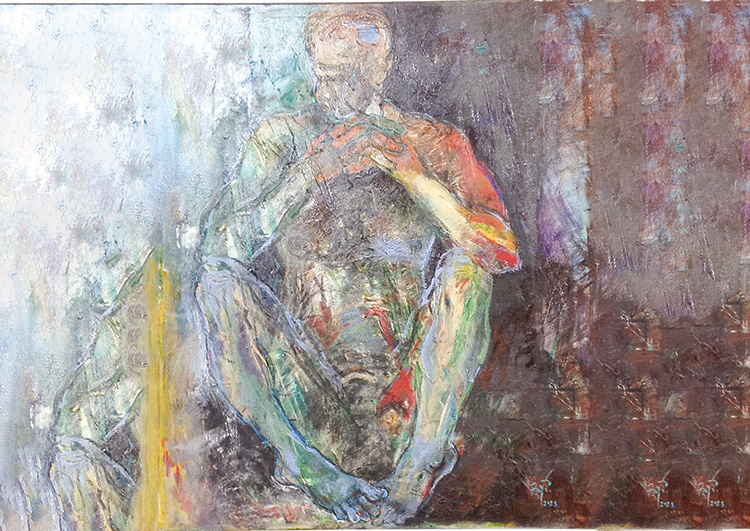
And then Sarath Chandrajeewa does a small painting in 2023 and gives it a discursive title; Thinker in front of the empty doorway, which recollects Rodin’s work respectfully, in that it is not an ‘appropriation,’ neither a copy nor a pastiche of an old master, both tired gestures. But here, the exchange is between two bronze sculptors, one of whom also paints and makes pottery. There is a complex exchange of thought encoded in craft praxis (a theory-practice exchange) going on here, in this act of naming. A rare Lankan practitioner of bronze casting of monumental statues, (trained in the European tradition in Britain and post-Soviet Russia), and of abstract work in bronze, from the global South, salutes a modern European master in an oblique manner, fully cognisant of the vast aesthetic, historical and political differences that separate them. The gesture is quiet, measured, very modest indeed.
The sheer monumental form of Rodin’s Thinker (6 feet), is emphasised by the fact of its placement at a height emphasising the weight of thought bearing down. Besides, seated on a rocky surface he leans forward, twisting his body by placing his right elbow on his left knee, with his hand supporting his head lost in thought. Thinking appears to strain the body to an extreme. The feet rest on an uneven slope creating a sense of a somewhat precarious balance, emphasised by the big toe of his right leg which grips the rocky ground as though to steady himself from slipping.
The Asian Squatting Posture
In contrast, Sarath’s thinker is squatting on the ground and therefore has a stable stance working comfortably with gravity, as all Asian dancers and martial artists also do in their bent-knee stance, while standing. However, the thinker’s right big toe is separated from the little toes and appears to have a life of its own. which is why it stuck out like a sore thumb, as we say in English. The mimetic correspondence between the two thinkers helps to differentiate them on the basis of this similarity. Their big toes sharpen our perception and readies the mind to perceive differences and diverge. This power of divergence, while working within a tradition, is what the late Kumar Shahani called creativity, within Indian Modernism. A contribution to the richness of Indian Modernism which engaged with tradition without reproducing clones and neo-traditionalist kitsch.
‘All that is Solid Melts into Air’ Marx
The high seriousness of Rodin’s The Thinker easily lent itself to parody partly because it is a highly abstract work, free of context, universal. It is in the great lineage of nude sculpture from classical Greece of idealised male figures such as Apollo, to the perfect anatomy of David by Michelangelo. These lessons have been internalised by Rodin who comes at the tail end of this European tradition, after the famous Laocoon of the twisted bodies entangled in a serpentine struggle with a large snake. Rodin’s The Thinker appears belated, an anachronism in the midst of the dematerialisation of space and time in impressionism and other Modernist work of the late 19th Century capitalist, industrial modernity.
Rodin’s model for his The Thinker, ironically, was a boxer who often suffers from brain damage as an occupational hazard! But by then the division between the body (manual labour with the hand) and mind (intellectual labour with the brain) had had a long history in Europe from the Florentine Renaissance on, where the abstract brain work produced Linear Perspective and mapped the globe, as well as the factory system with its division of labour, to produce wool for the market, which required workers with manual skills.
The European Thinker as a Melancholic
It was in this 16th Century tradition that the pathology of Melancholia was written about in Italy, as the signature malady of men who lived by exercising their intellect, that is men of genius, artists, poets and philosophers. In contrast, in classical Greece the thinker was a man who walked and talked, a peripatetic figure as in Plato’s Academy, seen in paintings. Socrates and his students appear to have had a wide repertoire of gestures for picturing thinking as a collective, active process. But it is in the Renaissance that the iconography of the head resting on a hand was revived from prehistoric times to represent a unique male individual as the thinker. Is this because of the immense archive of Classical Greek knowledge that opened up to be mastered, creating the Italian Renaissance?
Thereby in the Renaissance, the thinker as a sedentary, isolated figure of genius became a well-recognised archetype in both the philosophical and medical discourse on Melancholia and also in painting. The German Albrecht Durer, who is the major figure of the Northern Renaissance made the most iconic image of the pathology in his copper engraving, Melancholia 1, (1514). Here the allegorical figure of melancholy is an angel with wings, but in the form of a large woman sitting with her head resting on her hand, in a workshop with craft tools and a geometric form all scattered on the floor unused. His St Jerome in his Study shows the scholar alone in his study at his desk, with a dog, associated with the ‘black dog’ of melancholia. This tradition presents male artists and scholars as being prone to melancholia. They are thought to suffer from a manic-depressive polarity, where creativity of genius flowers when experiencing inspiration or enthusiasm (meaning possessed by divinity), and that very exertion creates the depressive melancholia as well.
The Melancholy Prince of Denmark; ‘To be or not to be …’
With Hamlet as the melancholy prince, the iconography gets theatricalised and dramatic in the sense of being subject to conflicting emotions and moods which give rise to the soring poetry of existential agony and incomparable scenes such as his address to the skull of ‘poor Yorick’ (the Court Jester), at his grave site. The young prince thinks on his feet unlike the older men weighed down by abstract thought.
There is a vast European archive devoted to the pathology of Melancholia. In entering it one risks never returning from it intact. Such are its seductions. So, it’s best to have a brief peek into it and salvage Freud’s essay on ‘Mourning and Melancholia’ which is a very accessible text worth reading. He makes a distinction between mourning and melancholia by saying we mourn the death of a beloved person but the sadness of melancholy is a more generalised, defused feeling of profound emptiness and we are unaware of what it is that we have lost; its unconscious.
Feminists have done some very important work on this pathology of depression (an epidemic in the global North), and have asked why the category of genius has been coded as male. One of the reasons being that gifted women have only rarely had access to the symbolic means to express their profound experiences of loss, sadness and melancholy, unlike men who have had the full range of cultural expression at hand through access to deep education and training.
Ophelia or Portia?
In this force field of Male Melancholia and attendant exceptional classical erudition and creativity of highly gifted men of genius, the figure of Ophelia cuts a sorry picture, no doubt a depressive, given how she is treated by Hamlet, but without the corresponding eloquence of speech, she simply drowns herself in her sadness. In contrast, the clever Portia was a favourite among school girls of my era when there were inter-school Shakespearean competitions where her verbal eloquence, quick wittedness and stirring speech were always on display; ‘The quality of mercy is not strained…’.
Melancholia (Kalpanacari-Thanikam dose hewath Kalakireema?)
Sarath’s ‘Thinker in front of the empty doorway’ is one of the few paintings I was drawn to in his Visual Paraphrases exhibition of 2023 at Barefoot Gallery. And that it was placed next to The Ascetic, (in the catalogue), created a montage, where one noticed the counter-intuitive vibrancy of colour of the Ascetic with primary colours and the disturbingly unruly manner in which the mostly light colours and lines formed the semi-abstract Thinker.
The Ascetic was inviting while the Thinker was sort of disturbing to look at, though I found both compelling in their own way. While the brush strokes abstract the body of the thinker, he is very firmly situated in front of ‘the empty doorway’, a void. The figure is also firmly grounded in his striking squatting position. It’s a class specific posture, though not gender specific, and perhaps it’s also very South Asian, which is easily performed by manual workers, both urban and rural. People of upper classes who do not sit on the ground do not have the muscle strength and flexibility to sit in this manner.
A Void
It’s the incongruity between the title, Thinker…, with its European art history lineage, and the Asiatic squatting posture which struck me at first. The empty doorway is haunting with its yawning void, marked in black, fading to a grey white background with a barely delineated doorpost with the missing door, recalling ‘The’ looted doors and windows of Jaffna during the civil war. Here’s how Sumathy Sivamohan formulates Sarath’s mode of abstraction:
“Sarath’s art is abstract – but they build on the ideas of palpable forms of the real – images of the war that have come to be both tactile and material, like the wood, and have come to stand for the dislocation of war”.
Unlike Rodin’s context free thinker, the melancholy thoughtfulness (kalpanakari-thanikam-dose?) has a social/historical referent presented as a fragment, ‘…the empty doorway’, but abstracted from realist coordinates of place and time. Sumathy identifies a similar dynamic in the abstraction in Fallen Monument where she recognised immediately the scattered fragments of the Jaffna peninsula as her home.
But it’s the rough brush strokes, scrapings and scratching perhaps and the variety of patches of pastel shades of colour mixed with patches of black that emit energy which makes Thinker in front of the empty doorway as alive as The Ascetic but in a more troubling, agitated way, which I guess is what thinking feels like when it does not repeat the same thing over and over, but plunges into a void to find a foot hold, to grip onto something or hang onto something to orient oneself.
The Limits of Realism & Empathy
Had this figure been painted in a realist more empathetic mode, with a sad facial expression say and solid anatomy, its power to create meaning would have been quite different, more limited, I think. What is definitely solid in the painting, though lightly sketched, is ‘The empty doorway’, a fading trace of a violent civil war history, marked with the definite article for emphasis.
In the absence of a realist anatomy to identify with empathetically, one feels a pulsing of the nervous system, suggested by the jostling markings, scribbles, incisions even and colours that don’t ‘complement’ each other. The texture is imperceptible on paper and barely registered on the computer screen, my only forms of access to this painting. The thinker’s bowed, slightly turned head with downcast eyes, rests lightly on his hands with clasped fingers held in front symmetrically, as in a gesture of prayer, elbows resting on the knees, a figure of introspection.
Celestial Blue
A light, radiant, soft, celestial blue patch of colour on the thinker’s head echoes the same colour at the top left-hand corner of the frame and elsewhere on the body including the right big toe, suggesting an outside, out of frame. These qualities of blue appear to lighten the existential gravity of the ‘Thinker in front of the empty doorway’. Here, there is no weighty realist musculature of Rodin’s Thinker to weigh us down with sorrow.
Instead, one feels an energetic, intensive body (expressed with movement-colour somewhat muddied and a variety of markings, abrasions), that makes the beholders minds’ eye restless; perhaps an image of thought under duress. The blue big toe fires a neural connection in the brain of a thinker (an old woman) who thereby dodges the blues.

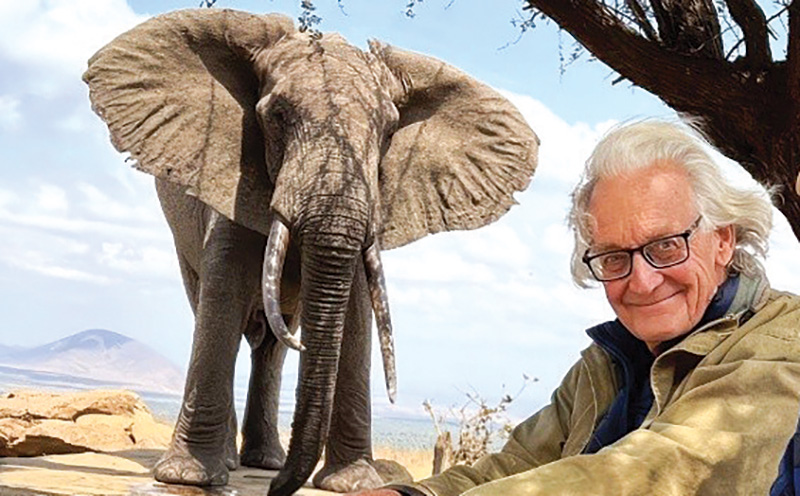
Passing of Iain Douglas-Hamilton, a man who dedicated his life to conservation and whose life’s work leaves a lasting impact on our appreciation for, and understanding of, elephants.
– Prince William
In Africa on 08 December, 2025, when the sun slipped below the horizon, it did not only give an end for that day, but it also marked the end of a man whose knowledge and courage saved Africa’s elephants. This gentleman was none other than Iain Douglas-Hamilton! There is a beautiful African proverb that says, “When an old man dies, a library burns to the ground,” and it resonates well with Iain’s demise.
Iain pioneered behaviour research on elephants, and he was the first to highlight the elephant poaching crisis in Africa. Also, the adventures he went through to save the elephants will inspire generations.
From Oxford to Africa
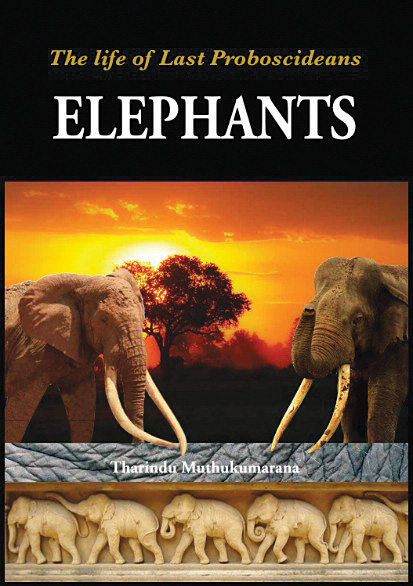
The Life of the Last Proboscideans: Elephants”, authored by Muthukumarana, stands as an awardwinning, comprehensive study that integrates elephant evolution, anthropology, biology, behaviour, and conservation science.
Iain was born on 16 August, 1942, into an aristocratic family, the son of Lord David Douglas-Hamilton and Ann Prunella Stack. His parents were a distinguished couple in Britain: his father, a Scottish nobleman, served as a squadron leader in the Royal Air Force, while his mother was a pioneering figure in physical fitness and a prominent advocate for women’s rights. After finishing his school, Iain was admitted to Oxford University to study zoology. At the age of 23, for his PhD, Iain travelled to Tanzania to study the behaviour of elephants at Lake Manyara National Park. This was a daring and humble beginning that would change how the world understood elephants. He learnt to recognise individual animals based on their tusks and ears. He observed their family bonds, their grief, and their intelligence. These findings made the scientific community identify elephants as sentimental beings. During this period, he married Oria Rocco, and together they had two children, Saba and Mara.
Battle for the elephants
When ivory poaching swept across Africa and devastated elephant populations, Iain did not withdraw in despair. He confronted the crisis head-on, guided by science, rigorous data, and unwavering resolve. Through extensive aerial counts and field studies, he laid bare the scale of the tragedy—revealing that Africa’s elephant numbers had collapsed from an estimated 1.3 million to just about 600,000 in little more than 10 years.
It was largely thanks to his work that the global community saw—perhaps for the first time—the full scope of the crisis. His efforts played a pivotal role in pushing forward the 1989 international ban on ivory trade, a landmark moment for wildlife conservation.
In 1993, Iain founded Save the Elephants (STE), an organisation that would become the heart of elephant conservation efforts in Kenya and across Africa.
At STE, he pioneered the use of GPS-tracking and aerial survey techniques to monitor elephant movements, protect them from poaching, and plan safe corridors for them in increasingly human-dominated landscapes. These methods have since become standard tools in wildlife conservation worldwide.
Beyond technology and science, Iain was a mentor. He inspired — and continues to inspire — generations of conservationists, researchers, and everyday people who care deeply about wildlife. Through his books (such as Among the Elephants and Battle for the Elephants), documentaries, lectures, and personal example, he invited the world to see elephants not as trophies or commodities, but as sentient beings — worthy of awe, study, and protection.
Iain and Sri Lanka
In 2003 Iain came to Sri Lanka for the first time to attend the “Symposium on Human-Elephant Relationships and Conflict” as the keynote speaker. On that day he concluded his address by saying, “When I hear the talk of Problem Animal Control, I always wonder whether our species has the capacity for its own self-regulation or Problem Human Control in a humane and wise manner. HEC stands for Human Elephant Conflict, one of our focuses of this conference. How I wish it could come to stand for Human Elephant Coexistence, based on a recognition that other beings also need their space to live in. We are a long way from that, but I am sure that many of the findings of the talented body of researchers in this room will begin a stepwise progress in answering some of these fundamental problems.”
A few years ago Iain’s organisation STE collaborated with the Sri Lankan Wildlife Conservation Society for research activities aimed at reducing human-elephant conflict. In 2016 when the Sri Lankan government was going to destroy the confiscated illegal African elephant ivory, I made a request for Iain to write a congratulatory message to Sri Lanka’s President and Prime Minister for the wise decision they had taken. Iain sent me a four-page meaningful letter written by him, and he was joined by 18 other conservation organisations. In his letter he mentioned, “I want to offer my congratulations to the government of Sri Lanka for the laudable decision to destroy ivory stocks…” Sri Lanka is sending a message to the world that ivory should be without worth; elephants have value when alive. This is a critical message to send, particularly to the religious world, as they are sensitised about the threat religious ivory poses to elephant populations in Africa.”
Fortunately, Iain’s conservation is taken up by his children, especially his eldest daughter, Saba. In 2016 and 2024 she came to Sri Lanka for a lecture hosted by the Galle Literary Festival. Also in 2019, for the Wildlife and Nature Protection Society’s 125th Anniversary, Saba and her husband visited a gala dinner that was held to fundraise for conservation projects.
A difficult path
Iain’s path was never easy. He endured personal peril many times: from hostile terrain and unpredictable wild animals to being shot at by poachers while conducting aerial patrols over war-torn national parks.
Yet despite the danger, despite setbacks — flooded camps, lost data, shifting political tides — his conviction never wavered. His was a life marked by resilience. He refused complacency. He refused to surrender. And through every hardship, he remembered why he began: to give elephants a future.
Iain was also a pilot, and as the old English saying goes, “Pilots don’t die; they simply fly higher.” In that spirit, I wish the same peaceful ascent for Iain. My heartfelt condolences are with Iain’s family.
by Tharindu Muthukumarana ✍️
tharinduele@gmail.com
(Author of the award-winning book “The Life of Last Proboscideans: Elephants”)
When you hear the word gratitude the first impression you get is a tail-wagging dog. If you feed a dog one day, it will wag its tail even if you meet it after a few years. That is gratitude. In addition, dogs are great teachers. They are at home in the world. They live in the moment and they force us to stay with them. Dogs love us and remain grateful unconditionally not for our bodies or bank accounts.
Small children are taught to say ‘Thank you’ for any favour they receive from others. They do not know that the two words can have positive effects on your health and the well-being of others.
Some time ago I had to call emergency services as I found one of my family members was unconscious. Within minutes an ambulance arrived and the paramedics whisked the patient away to the nearest hospital. He was in intensive care for a few days and returned home. We were marvelled at the impact of a handful of strangers who took charge of the patient at a critical time. I immediately wrote thank you notes to those who saved the patient’s life. I knew that it was a small gesture on my part. However, it was the only way I could express my gratitude to a dedicated team.
Selfless people
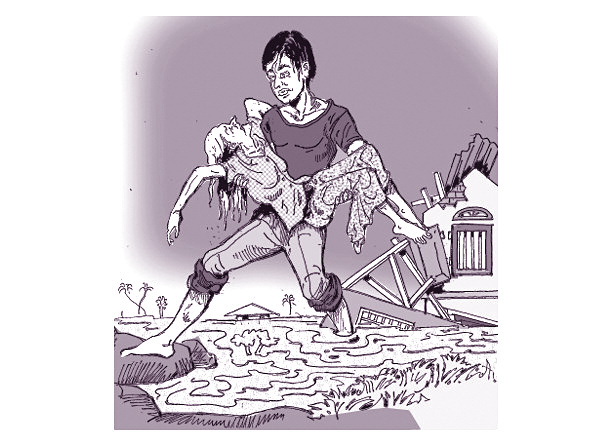
Later I realized that there are a large number of selfless people who do life-saving work, but they never expect anything in return. How volunteers saved a large number of flood victims is a case in point. The flood victims may not have expressed their gratitude in so many words. However, they would have felt a deep sense of gratitude to the volunteers who saved them.
Why do people come forward to help those facing natural disasters and other dangerous situations? A recent research in the United States shows that sharing thoughts of gratitude and performing acts of kindness can boost your mood and have other positive effects on your health. Almost all religions teach that gratitude does have a good impact on your happiness. Professor of Psychology Willibald Ruch says that gratitude is among the top five predictors of happiness.
By showing gratitude you can make positive changes in your own life. If you feel a sense of gratitude whenever you receive something that is good for you, it will be a healthy sign. You cannot get such a feeling in a vacuum because others have to play their roles. They can be your loved ones, friends, strangers or even people in authority. Gratitude is how you relate to them when you see yourself in connection with things larger than yourself.
Gratification lifestyle
Strangely, many people do not pause to appreciate what others are doing for them. For this you have to blame your gratification lifestyle. With the popularity of social media the young people feel that they are the centre of the universe. They seem to think there is no necessity to thank those who help them.
Why should we thank others even for minor favours? Recent studies show that those who express gratitude increase their own happiness levels. They also lower their blood pressure levels to a great extent. On the other hand, they will be able to sleep well and improve their relationships. They are also less affected by pain because of the positive impact on their depression.
They may not know that positive effects of gratitude are long lasting. Research shows that those who write thank you notes improve their mental health. There was also a decrease in their bodily pains. What is more, they feel more energetic in completing their daily activities. Unfortunately, schools and universities do not teach the value of gratitude since it is fairly a new field of study. Researchers are still trying to find out its cause and effect relationship. We know that those who perform acts of gratitude can sleep well. However, we do not know the reason for it. Researchers are wondering whether gratitude leads to better sleep or sleep leads to more gratitude. They also probe whether there is another variable that leads to gratitude and improved sleep.
Children
Despite such controversies, we know for certain that gratitude can benefit people at any stage of life. Most elderly people remain grateful for their children and grandchildren who support them. Elderly people cannot regain their physical strength or mental agility. Therefore they focus on gratitude. They are thankful to their children and grandchildren for their present situation.
How do gratitude recipients react? Research shows that those who receive thank you notes or acts of kindness experience positive emotions. You feel happy when someone holds a door open for you. Similarly, you are happy if you receive some unexpected help. Recently I was pleasantly surprised to see that someone has credited a big sum of money to my bank account in appreciation of a small favour I had done.
When you thank someone they are more likely to return the favour or pay kindness forward. Psychologically, people feel very happy when you thank them. However, some people hesitate to say thank you. The give-and-take of gratitude deepens relationships. In a close relationship husbands and wives do not thank each other. However, there are other ways of showing gratitude. A wife can make her husband feel appreciated. Such a feeling of appreciation will go a long way to strengthen their relationship.
Some people are ungrateful by nature. However, they can learn the art of being grateful. Such people will do well to maintain a gratitude journal. It is something similar to Pinpotha maintained by Buddhists in the past. They can record positive events in the journal. At the beginning this may not be easy. With practice, however, you can do it well. I knew of a man who kept a gratitude journal. Although his family members laughed at him, he did not give up the habit. When he was diagnosed with a terminal disease he used to read his gratitude journal very happily.
By R.S. Karunaratne ✍️

The 2004 Asian Tsunami erupted the day after Christmas. Like the Boxing Day Test Match in Brisbane, it was a boxing day bolt for Indonesia, Thailand, Sri Lanka, India and Maldives. Twenty one years later, in 2025, multiple Asian cyclones hit almost all the old victims and added a few more, including Malayasia, Vietnam and Cambodia. Indonesia and Sri Lanka were hit hard both times. Unlike the 2004 Tsunami, the 2025 cyclones made landfalls weeks before Christmas, during the Christian Season of Advent, the four-week period before Christmas preparing for the arrival of the Messiah. An ominously adventus manifestation of the nature’s fury.
Yet it was not the “day of wrath and doom impending … heaven and earth in ashes ending” – heavenly punishment for government lying, as an opposition politician ignorantly asserted. By that token, the gods must have opted to punish half a dozen other Asian countries for the NPP government’s lying in Sri Lanka. Or all those governments have been caught lying. Everyone is caught and punished for lying, except the world’s Commander in Chief for lying – Donald J. Trump. But as of late and none too sooner, President Trump is getting his punishment in spades. Who would have thought?
In fairness, even the Catholic Church has banished its old hymn of wrath (Dies irae, dies illa) that used to be sung at funerals from its current Missals; and it has on offer, many other hymns of peace and joy, especially befitting the Christmas season. Although this year’s Christmas comes after weeks of havoc caused by cyclonic storms and torrential rains, the spirit of the season, both in its religious and secular senses, will hopefully provide some solace for those still suffering and some optimism to everyone who is trying to uplift the country from its overflowing waterways and sliding slopes.
As the scale of devastation goes, no natural disaster likely will surpass the human fatalities that the 2004 Tsunami caused. But the spread and scale of this year’s cyclone destruction, especially the destruction of the island’s land-forms and its infrastructure assets, are, in my view, quite unprecedented. The scale of the disaster would finally seem to have sunk into the nation’s political skulls after a few weeks of cacophonic howlers – asking who knew and did what and when. The quest for instant solutions and the insistence that the government should somehow find them immediately are no longer as vehement and voluble as they were when they first emerged.
NBRO and Landslides
But there is understandable frustration and even fear all around, including among government ministers. To wit, the reported frustration of Agriculture Minister K.D. Lalkantha at the alleged inability of the National Building Research Organization (NBRO) to provide more specific directions in landslide warnings instead of issuing blanket ‘Level 3 Red Alerts’ covering whole administrative divisions in the Central Province, especially in the Kandy District. “We can’t relocate all 20 divisional secretariats” in the Kandy District, the Minister told the media a few weeks ago. His frustration is understandable, but expecting NBRO to provide political leaders with precise locations and certainty of landslides or no landslides is a tall ask and the task is fraught with many challenges.
In fairness to NBRO and its Engineers, their competence and their responses to the current calamity have been very impressive. It is not the fault of the NBRO that local disasters could not be prevented, and people could not be warned sufficiently in advance to evacuate and avoid being at the epicentre of landslides. The intensity of landslides this year is really a function of the intensity and persistence of rainfall this season, for the occurrence of landslides in Sri Lanka is very directly co-related to the amount of rainfall. The rainfall during this disaster season has been simply relentless.
Evacuation, the ready remedy, is easier said than socially and politically done. Minister Lal Kantha was exasperated at the prospect of evacuating whole divisional secretariats. This was after multiple landslides and the tragedies and disasters they caused. Imagine anybody seriously listening to NBRO’s pleas or warnings to evacuate before any drop of rainwater has fallen, not to mention a single landslide. Ignoring weather warnings is not peculiar to Sri Lanka, but a universal trait of social inertia.
I just lauded NBRO’s competence and expertise. That is because of the excellent database the NBRO professionals have compiled, delineating landslide zones and demarcating them based on their vulnerability for slope failure. They have also identified the main factors causing landslides, undertaken slope stabilization measures where feasible, and developed preventative and mitigative measures to deal with landslide occurrences.
The NBRO has been around since the 1980s, when its pioneers supplemented the work of Prof. Thurairajah at Peradeniya E’Fac in studying the Hantana hill slopes where the NHDA was undertaking a large housing scheme. As someone who was involved in the Hantana project, I have often thought that the initiation of the NBRO could be deemed one of the positive legacies of then Housing Ministry Secretary R. Paskaralingam.
Be that as it may, the NBRO it has been tracking and analyzing landslides in Sri Lanka for nearly three decades, and would seem to have come of age in landslides expertise with its work following 2016 Aranayake Landslide Disaster in the Kegalle District. Technically, the Aranayake disaster is a remarkable phenomenon and it is known as a “rain-induced rapid long-travelling landslide” (RRLL). In Kegalle the 2016 RRLL carried “a fluidized landslide mass over a distance of 2 km” and caused the death of 125 people. International technical collaboration following the disaster produced significant research work and the start of a five-year research project (from 2020) in partnership with the International Consortium on Landslides (ICL). The main purpose of the project is to improve on the early warning systems that NBRO has been developing and using since 2007.
Sri Lankan landslides are rain induced and occur in hilly and mountainous areas where there is rapid weathering of rock into surface soil deposits. Landslide locations are invariably in the wet zone of the country, in 13 districts, in six provinces (viz., the Central, Sabaragamuwa, Uva, Northwestern, Western and Southern, provinces). The Figure below (from NBRO’s literature) shows the number of landslides and fatalities every year between 2003 and 2021.
Based on the graphics shown, there would have been about 5,000 landslides and slope failures with nearly 1,000 deaths over 19 years between 2003 and 2021. Every year there was some landslide or slope failure activity. One notable feature is that there have been more deaths with fewer landslides and vice-versa in particular years. In 2018, there were no deaths when the highest number (1,250) of landslides and slope failures occurred that year. Although the largest number in an year, the landslides in 2018 could have been minor and occurred in unpopulated areas. The reasons for more deaths in, say, 2016 (150) or 2017 (250+), could be their location, population density and the severity of specific landslides.
NBRO’s landslide early warning system is based on three components: (1) Predicting rainfall intensity and monitoring water pressure build up in landslide areas; (2) Monitoring and observing signs of soil movement and slope instability in vulnerable areas; and (3) Communicating landslide risk level and appropriate warning to civil authorities and the local public. The general warnings to Watch (Yellow), be Alert (Brown), or Evacuate (Red) are respectively based on the anticipated rainfall intensities, viz., 75 mm/day, 100 mm/day; and 150 mm/day or 100 mm/hr. My understanding is that over the years, NBRO has established its local presence in vulnerable areas to better communicate with the local population the risk levels and timely action.
Besides Landslides
This year, the rain has been relentless with short-term intensities often exceeding the once per 100-year rainfall. This is now a fact of life in the era of climate change. Added to this was cyclone Ditwah and its unique meteorology and trajectory – from south to north rather than northeast to southwest. The cyclone started with a disturbance southwest of Sri Lanka in the Arabian Sea, traversed around the southern coast from west to east to southeast in the Bay of Bengal, and then cut a wide swath from south to north through the entire easterly half of the island. The origin and the trajectory of the cyclone are also attributed to climate change and changes in the Arabian Sea. The upshot again is unpredictability.
Besides landslides, the rainfall this season has inundated and impacted practically every watershed in the country, literally sweeping away roads, bridges, tanks, canals, and small dams in their hundreds or several hundreds. The longitudinal sinking of the Colombo-Kandy Road in the Kadugannawa area seems quite unparalleled and this may not be the only location that such a shearing may have occurred. The damages are so extensive and it is beyond Sri Lanka’s capacity, and the single-term capacity of any government, to undertake systematic rebuilding of the damaged and washed-off infrastructure.
The government has its work cutout at least in three areas of immediate restoration and long term prevention. On landslides warning, it would seem NBRO has the technical capacity to do what it needs to do, and what seems to be missing is a system of multi-pronged and continuous engagement between the technical experts, on the one hand, and the political and administrative powers as well as local population and institutions, on the other. Such an arrangement is warranted because the landslide problem is severe, significant and it not going to go away now or ever.
Such an engagement will also provide for the technical awareness of the problem, its mitigation and the prevention of serious fallouts. A restructuring could start from the assignment of ministerial responsibilities, and giving NBRO experts constant presence at the highest level of decision making. The engagement should extend down the pyramid to involve every level of administration, including schools and civil society organizations at the local level.
As for external resources, several Asian countries, with India being the closest, are already engaged in multiple ways. It is up to the government to co-ordinate and deploy these friendly resources for maximum results. Sri Lanka is already teamed with India for meteorological monitoring and forecasting, and with Japan for landslide research and studies. These collaborations will obviously continue but they should be focused to fill gaps in climate predictions, and to enhance local level monitoring and prevention of landslides.
To deal with the restoration of the damaged infrastructure in multiple watershed areas, the government may want to revisit the Accelerated Mahaweli Scheme for an approach to deal with the current crisis. The genesis and implementation of that scheme involved as many flaws as it produced benefits, but what might be relevant here is to approach the different countries who were involved in funding and building the different Mahaweli headworks and downstream projects. Australia, Britain, Canada, China, Italy, Japan, Sweden and Germany are some of the countries that were involved in the old Mahaweli projects. They could be approached for technical and financial assistance to restore the damaged infrastructure pieces in the respective watershed areas where these countries were involved.
by Rajan Philips ✍️

Duffy, Ajaz rip through West Indies as New Zealand seal series 2-0

Financial contributions received for ‘Rebuilding Sri Lanka’ Fund

UNICEF representatives and PM discuss rebuilding schools affected by the Disaster

A few showers may occur in the Uva province and in Ampara, Batticaloa, Matale, Nuwara-Eliya, and Hambantota districts

NMRA laboratory lacks SLAB accreditation

Air quality deteriorating in Sri Lanka

‘Dates have the highest sugar content to fight Coronavirus’

Sunday Island 27 December – Headlines

#SundayIsland 17th December – Headlines

Sunday Island – 28th March

Sunday Island Headlines – 21 March

Sunday Island – 21st February – Headlines
-

 Midweek Review6 days ago
How massive Akuregoda defence complex was built with proceeds from sale of Galle Face land to Shangri-La
-
 News5 days ago
Pope fires broadside: ‘The Holy See won’t be a silent bystander to the grave disparities, injustices, and fundamental human rights violations’
-

 News5 days ago
Pakistan hands over 200 tonnes of humanitarian aid to Lanka
-
 News6 days ago
Burnt elephant dies after delayed rescue; activists demand arrests
-

 Business4 days ago
Unlocking Sri Lanka’s hidden wealth: A $2 billion mineral opportunity awaits
-

 Editorial6 days ago
Colombo Port facing strategic neglect
-

 News4 days ago
Army engineers set up new Nayaru emergency bridge
-

 News6 days ago
Sri Lanka, Romania discuss illegal recruitment, etc.