
Features
THE NEED FOR INCREASED FUEL PRICES AND DIVESTITURE OF CEYLON PETROLEUM CORPORATION

by Sanjeewa Jayaweera
In a recent TV talk show “Face the Nation”, a panel of economists mostly with experience in the private sector delivered an insightful and no holds barred discussion on the recent hike in petroland diesel prices. The participants were Murtaza Jafferjee (Chair of Advocata Institute), Nishan De Mel (Executive Director Verite Research), Dr Anila Dias Bandaranaike (Former Assistant Governor of Central Bank) and Shiran Fernando (Chief Economist of the Chamber ofCommerce).
It was good to listen to a discussion where no attempt was made to cotton wool the perilous position of the Sri Lankan economy. It was pleasing that all panelists felt that the price increase was inevitable even if taken rather late in the day. Some of the key points they made were:
Murtaza Jafferjee said, “market forces are not allowed to operate due to government interference, which prolongs the issues at hand despite creating an illusion that everything is fine. The government is trying to solve a foreign currency solvency issue by using toolsintended to manage a liquidity crisis. We spend a net amount of US $ 3.5 billion in a year on fuel imports (when the average price is US $ 70 per barrel) which is the single largest import, and that it is vital to price it correctly.
“The revised pricing, unfortunately, does not still cover the cost of diesel. The government should have done price increases in stages. In New Delhi, the price of a Liter of petrol is Rs. 250/- (SEE TABLE 1). According to a World Bank study, the fuel subsidy benefits the richest 30% of households (here) with 70% of the benefit. He proposed that to ease the burden of higher fuel cost on the poorest segment of the population, there needs to be a cash transfer, like Samurdhi benefits to that segment instead of subsidizing all and sundry.”
 His message was not to play politics with fuel prices, causing a huge hole in the economy. He was astounded that the single person income tax-free threshold of Rs.three million for a year introduced by the government in 2019 is 400 per cent of the country’s per capita income. This contrasts with countries like Singapore and Australia, both of whom have a much higher per capita income than Sri Lanka, but the tax-free threshold is only around 20% of per capita income.
Dr Anila Dias Bandaranaike said, “leadership need to make tough decisions and convince the public to undergo certain hardships to work towards a better future.” Those presently overseeing the management of the economy are out of their depth and drowning. Post-2015, when attending parliamentary oversight committees, she observed that most MP’s were absent and that many of the few who attended did not understand what was going on! She was critical of the private sector and referred to them as the NATO = No Action Talk Only! But unfortunately, she declined to comment about the role of the utterly inefficient and subservient public service of which she was part for several years!
Nishan de Mel said, “The present government reduced a plethora of taxes when it came to power, thereby significantly reducing government revenue—estimated to be around Rs. 600 billion. These measures were to act as an economic stimulus leading to economic growth. Unfortunately, no analysis has been done to determine whether these measures achieved the desired result.”
He lamented that there is a lack of economic data readily available in our country. This prevents proper monitoring and analysis of various actions resorted to by the government and hinders future planning. He cited an example of how the Central Bank has filed a court case to prevent access to certain data relating to the bond scam. They retained expensive lawyers from private practice as opposed to those from the Attorney Generals Department. The government is resorting to local borrowing to bridge the budget deficit, and by keeping the lending rates below inflation, the government is borrowing at zero cost. Our economy is in a precarious position.
The Need for a Formula for Pricing Fuel
Those who have some knowledge and understanding of how the government should manage the economy have been of the view for several decades that the government needs to price the supply of fuel, electricity, gas, and many other commodities and services based on a formula ofcost-plus profit. In 2018, the Yahapalana government did introduce a price formula. They were subjected to both criticism and ridicule. With an impending election, the practice was hastily withdrawn. A document prepared as far back 2003 proposed that the fuel price formula should be based on:
CIF price (FOB + freight + insurance + evaporation losses) to which the following costs be added (port + jetty charges + customs and excise duty + financial charges + storage and terminal charges + marketing and distribution charges) to arrive at the wholesale cost.
The retail price was to be arrived at by adding the following to the wholesale cost (profit margin of 5% + retailer and dealer margin of 2.5% of the wholesale price + VAT).Fuel prices should be revised monthly to reflect changes in Singapore Platts average FOB price and exchange rates.
It was a simple enough formula to have been implemented. No doubt there would have been periods when world oil prices spiked well above US 100 per barrel, the retail price would have been high. However, we all know that no commodity or service can be provided below costother than for a short period. Unfortunately, this type of logic has escaped those who have governed our country for so many decades.
 Actually, it is a case of not being able to take tough decisions at the correct time. Short-term political popularity has overridden the compelling need for sound economic management. That our country has lacked visionary leaders since Independence is evident. However, we, the masses, are equally culpable for our predicament. The quotation “people get the government they deserve” is quite apt.
In addition, high fuel prices hopefully should also act as a catalyst for car owners to adopt practices such as car-pooling. The benefits extend beyond just financial to also reducing traffic jams on our roads, pollution etc.
The Losses incurred by Ceylon Petroleum Corporation (CPC)
At the outset, I must express my disappointment that the latest CPC Annual Report available is for the year ended December 31, 2018. This reflects the overall inefficiency that pervades state institutions where the work ethic is deplorable. Many companies listed on the Colombo Stock Exchange releases their Annual Reports within 90 days of the end of the financial year. An examination of the financial statements of CPC for 2018 reveals the following.
CPC posted a loss of Rs. 105 billion, of which Rs. 82.7 billion was on account of foreign exchange rate variation and a further Rs. 12.9 billion due to interest costs. Unfortunately, even at a Gross Profit Level (Revenue less direct costs), there was a loss of Rs 3 billion. TheBalance Sheet as of December 31, 2018, reflects that CPC has accumulated losses of Rs. 325.6 billion. The net assets are a negative of Rs. 281.7 billion. Borrowings were Rs. 296 billion,although there was Rs. 110.6 billion of bank deposits, investments in treasury bonds and bank balances. Other liabilities of Rs. 313 billion included foreign bills payable for imports of Rs. 245.5 billion.
CPC is insolvent, and the Auditor General has qualified his report by stating, ” The Corporation’s ability to continue as a going concern without the financial assistance from the Government is doubtful.”
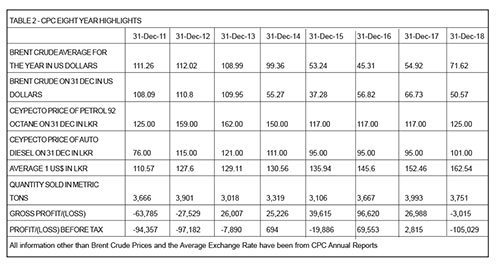
I have included a table (2) detailing the eight-year history of the performance of CPC and some essential information. The absence of the financials for 2019 and 2020 prevents me from doing a 10-year analysis. As can be observed in 2011, 2012, and 2018, CPC made a loss even at Gross Profit Level and posted a loss before tax in five out of eight years. In 2011 and 2012, the average price for a barrel of Brent crude was in the region of US $ 112, and the consequences of not adjusting the fuel price are apparent. On the other hand, in 2013, despite the average cost of a barrel of Brent being US $ 109, CPC was able to post a Gross Profit of Rs. 26 billion as fuel prices were adjusted to reflect the cost.
Poor Management of CPC
Given the pivotal role that CPC plays in our economy, there is a need to ensure that people of skill, proven competence, and experience be appointed to both the Board of Directors and the key management positions. I have noted from perusing the corporation’s Annual Reports that the Executive Chairman post is like a merry go round. In the year 2017, there were three different Chairmen, whilst in 2018, there were two separate Chairmen. No organization, let alone one as large as CPC, can function effectively without continuity. In addition, the calibre of people appointed to the post of Chairman is a cause for concern.
In 2017, the Minister of Petroleum appointed his brother as the Chairman. Under any circumstances, this appointment can only be deemed as nepotism. In addition, the Chairman being a former cricketer, had no relevant experience nor proven competence and maybe the skill sets required to hold this position. The infamous hedging deal that cost the country’s taxpayers a sum over Rs. 14 billion between 2007 and 2008 occurred when another former national cricketer was the Chairman of CPC.
Do we ever learn? Another who served as Chairman in 2018 is a person whose career was in the Sri Lanka Administrative Service. With all respect, having dealt with various senior public servants in our country during my career in the private sector, I have grave reservations about their capability to hold a position that requires proven commercial acumen and expertise. A question that needs to be posed and answered by the Chairman and the Board who served the CPC in 2020 is whether they took advantage of rock bottom prices in the world market to secure our future supplies.
Auditor General’s Report On CPC
The Auditor General’s (AG) Report for 2017 and 2018 of CPC and subsidiary run into 29 and 18 pages, respectively. They are a damning indictment of maintaining poor accounting records, lax internal controls, non-adherence to Sri Lanka Accounting standards, lack of evidence for audit, non-compliance with laws, rules, regulations, poor management decisions, operating inefficiencies, and transactions of contentious nature.
Due to the constraint of space, I shall only list a few of them, although any reader interested can access the annual reports of CPC on their website www.ceypecto.gov.lk
Differences in balances payable/receivable as reflected in the accounting recordsof CPC and other parties:
A difference of Rs. 670.93 million in the inter-company balance between CPC and the Subsidiary – Ceylon Petroleum Storage Terminal Ltd., as of December 31, 2017, increased to Rs. 2.47 billion by December 31, 2018.
A balance difference of Rs. 436.78 million observed between CPC and the Department of Inland Revenue (IRD) regarding Income Tax, Economic Service Charge, and Value Added Tax payable/recoverable.
There is a balance difference of Rs. 778.3 million between CPC and the CEB as of December 31, 2018
An amount of Rs. 2.7 billion is reflected in excess as payable to Sri Lanka Customs compared with Sri Lanka Customs’ records.
No basis disclosed or audit evidence provided for the provision of Rs. 142.92 million made on inventory items to be written off.
An amount of Rs. 4.59 billion payable to the People’s Bank on account of hedging transactions between 2007 and 2009 has been excluded from the financial statements of CPC. In addition, Commercial Bank of Ceylon Plc has filed a case at the Commercial High Court, Colombo, claiming US $ 8.65 million from CPC. The total estimated loss due to the hedging transactions between 2007 and 2009 is estimated to be Rs. 14 billion.
An estimated loss of Rs. 1.5 billion because of non-implementation of collecting a monthly utility fee from CPC- owned dealer operated filling stations and Treasury owned dealer operated filling stations from January 01, 2014, onwards.
CPC has borne Rs. 53.57 million and Rs. 259.9 million during 2017 and 2018 respectively as PAYE Tax of its employees without deducting it from their personal emoluments.
A sum of Rs. 307.8 million incurred in purchasing seven motor vehicles in 2017 without the approval of the Ministry, General Treasury and the Department of Public Enterprise.
An agreement has been entered into with Hyrax Oil SDN BHD to build a Lubricant Blending Plant on a BOT basis in May 2016. No comparable proposal has been obtained, which is the acceptable procedure. The AG’s report also mentions that they could not ensure that a properfeasibility study had been conducted for the project.
The list is much longer. The Auditor-General and his staff need to be commended for their work. In most countries, an audit report of this nature would result in action against officers responsible. I believe most audit reports compiled by the Auditor General on state enterprises would be equally bad or even worse.
The Impact of fuel Prices and politicization
The Minister, in justifying the price increase said, CPC has borrowed around Rs. 600 billion from People’s Bank and Bank of Ceylon, and any further borrowing might destabilize the entire banking system.
There is no doubt that an increase in fuel prices has a ripple effect that runs across from the cost of transport to goods, resulting in hardship to some population segments. It mainly impacts the poorer segment struggling to make ends meet. The popular euphonism in Sinhalese that most opposition politicians say “gahen watuna minihata gona anna” which is equivalent to the English “from the frying pan to the fire.”
In the 2018 Annual Report, it is disclosed that CPC lost Rs. 14.7 billion due to selling kerosene below cost. The loss per litre is Rs. 56.86. The annual report states, “The subsidy on kerosene is largely misused by the transport sector when the price gap between the diesel and kerosene is more.” However, as Jafferjee said, the solution to avoid this pain is to make a cash transfer to those in the poverty net and not benefit the rest of the population.
I came across a Sri Lanka review done by the World Bank in 1996 where they say “Sri Lanka’s large array of safety nets are both costly and poorly targeted. They typically have transferred resources, albeit modest, to a large fraction of the population above the poverty line and inadequate sums to the very poor.” Unfortunately, 25 years on this statement is still applicable.
It is deplorable that politicians of both the main parties try to politicize fuel prices despite being aware of the massive negative economic impact of not pricing fuel based on the cost-plus profitformula. Their job is also to educate the public and stop childish symbolic acts of riding bullock carts, cycles and three-wheelers. The decision to import expensive vehicles for MP’s needs our unreserved condemnation. One must live hoping that action will be taken against the members of the CPC Board who in 2017 ordered seven vehicles for Rs. 307 million with no covering approval.
Conclusion
In my view, the need to privatize the Ceylon Petroleum Corporation is compelling. The government can maybe hold a majority stake of 51%. However, the management of CPC by an independent professional team outside government interference is a must. This is equally applicable to many other state corporations like the CEB, the National Water Board and Litro Gas.
I can imagine the howls of protest this will draw from the JVP, other left-wing parties, and trade unions. The opposition by the trade unions is understandable given that the staff cost at CPC for the year was Rs. 6 billion, which increased to Rs. 12.7 billion inclusive of the subsidiary company. As to whether the Rs. 259.9 million borne by CPC as PAYE tax on behalf of its employees is included or on top of this is anybody’s guess. The cost to company (CTC) of anan employee at CPC (excluding the subsidiary company) is approximately Rs. 180,000 per month.
The government must draw upon the success of the part divestiture and independent management of Sri Lanka Telecom and Sri Lankan Airlines under Emirates to restructure all loss-making institutions. These changes should have been implemented long ago, but as the panel of experts said in the Face the Nation talk show, it is better late than never.


On 17 February, the Indian Navy posted a cheerful message on X.
“Welcome!” it wrote, greeting the Iranian warship Iris Dena as it steamed into the port of Visakhapatnam to join an international naval gathering.
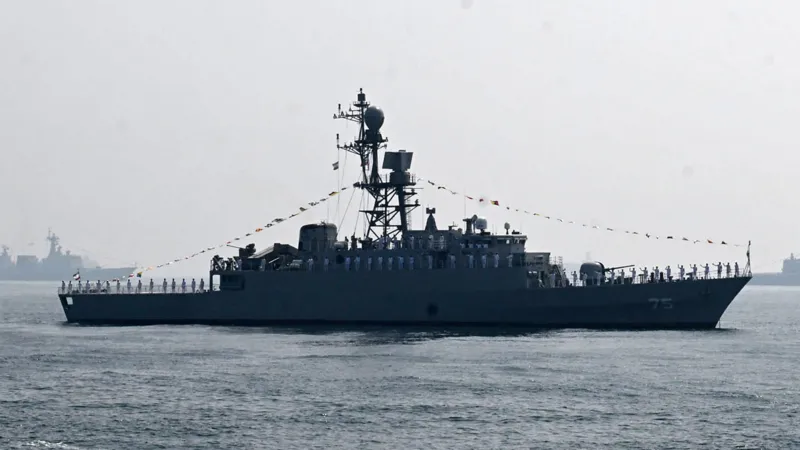
Photographs showed sailors in crisp whites and a grey frigate gliding in the sea harbour on a clear day. The hashtags spoke of “Bridges of Friendship” and “United Through Oceans”.
Two weeks later the ship, carrying 130 sailors, lay at the bottom of the Indian Ocean. It had been torpedoed by a US submarine off Sri Lanka’s southern coast on 4 March.
Commissioned in 2021, the Dena was a relatively new vessel – a Moudge-class frigate of Iran’s Southern Fleet, which patrols the Strait of Hormuz and the Gulf of Oman.
According to US Defence Secretary Pete Hegseth, the vessel “thought it was safe in international waters” but instead “died a quiet death”. Rescue teams from Sri Lanka have recovered at least 87 bodies. Only 32 sailors survived.
The sinking marks a dramatic widening of the war between America, Israel and Iran. And, though it occurred in international waters of the Indian Ocean and outside India’s jurisdiction, it is an awkward moment for Delhi.
“The war has come to our doorsteps. That is not a good thing,” says retired Vice Admiral Arun Kumar Singh.
For some strategists, the episode carries broader implications for India’s regional standing.
Indian strategic affairs expert Brahma Chellaney wrote on X that the US torpedoing of the Iranian warship in India’s “maritime neighbourhood” was “more than a battlefield episode” – calling it a “strategic embarrassment” for Delhi.
“By sinking a vessel returning from an Indian-hosted multilateral exercise, Washington effectively turned India’s maritime neighbourhood into a war zone, raising uncomfortable questions about India’s authority in its own backyard,” Chellaney wrote.
Just days before its destruction, the Dena had been a diplomatic guest of the Indian Navy.
The ship had travelled to Visakhapatnam, a sun-washed port city on India’s east coast, to participate in the International Fleet Review 2026 and Exercise Milan, a large multilateral naval exercise meant to showcase India’s growing maritime leadership.
Seventy-four countries and 18 warships took part in the events, which Delhi described as a demonstration of its ambition to become the Indian Ocean’s “preferedsecurity partner”.
Visiting ships at such multilateral exercises usually do not carry a full combat load of live munitions, unless scheduled for a live-fire drill, according to Chellaney. Even during the sea phase, when drills and live firing take place, ships carry only tightly controlled ammunition limited to the specific exercises.
Singh, an invitee to the event, recalls seeing the warship and its Iranian sailors in Visakhapatnam just days before its fate changed.
“I saw the boys marching in front of me,” he says of the Iranian naval contingent during the parade along the seafront, just 10m away. “All young people. I feel very sad.”
He says on 21 February, the assembled ships – including the Iranian vessel – sailed out for the sea phase of Exercise Milan, scheduled to run until 25 February.
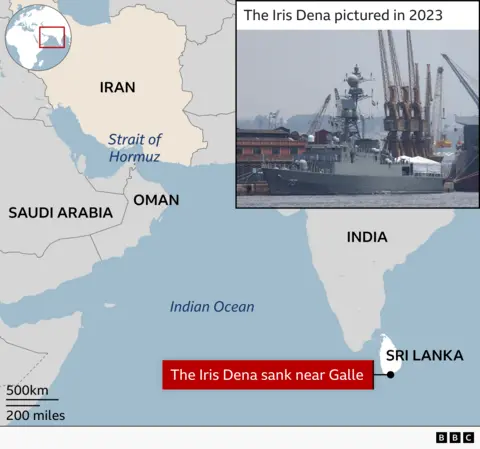
“What happened next is less clear: the ship may have returned to port or peeled away after exercises. Either way, the waters where it was later sunk – off Galle in Sri Lanka – lie only two to three days’ sailing from India’s east coast,” Singh says. What the ship was doing in the 10-12 days in between is not clear.
Singh, who has commanded submarines, believes the sequence leading up to the attack was probably straightforward.
The US, he notes, tracks vessels across the world’s oceans. “They would have known exactly when the ship left and where it was heading,” he says. A fourth of America’s submarine fleet of 65-70 is at sea at any given time, according to analysts.
According to the Indian Navy, the Iranian warship had been operating about 20 nautical miles west of Galle – roughly 23 miles (37km) – in waters that fall under Sri Lanka’s designated search-and-rescue zone.
The attack, Singh says, appears to have involved a single Mark-48 torpedo, a heavyweight weapon carrying about 650 pounds of high explosive, capable of snapping a ship in two. Video footage suggests the submarine may have fired from 3-4km away, around 05:30 local time.
The aftermath was grim and swift.
The warship reportedly sank within two to three minutes, leaving little time for rescue. “It’s a miracle they managed to send an SOS,” Singh says, which was picked up by the Sri Lanka Maritime Rescue Coordination Centre in Colombo.
According to the Indian Navy, a distress call from the Iranian warship was picked up by Colombo in the early hours of 4 March, triggering a regional search-and-rescue effort.
The navy said in a statement that Sri Lanka’s navy began rescue operations first, while India moved to assist later.
The Indian Navy deployed a long-range maritime patrol aircraft to support the search and kept another aircraft with air-droppable life rafts on standby.
A naval vessel already operating nearby reached the area by late afternoon. Another ship, which sailed from the southern Indian port city of Kochi to join the effort, continues to comb the waters for survivors and debris.
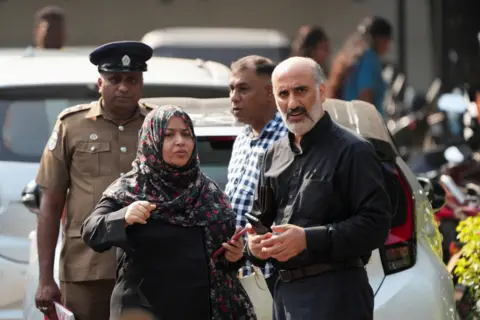
Under the Second Geneva Convention, countries at war are required to take “all possible measures” to rescue wounded or shipwrecked sailors after a naval attack. In practice, however, this duty applies only if a rescue can be attempted without putting the attacking vessel in serious danger.
Singh says submarines are rarely able to help.
“Submarines don’t surface,” he says. “If you surface and give up your position, someone else can sink you.”
Singh suspects the speed of the sinking – and possibly sparse shipping in the area at the time – meant few nearby vessels could respond. “A ship breaking up that fast leaves almost no chance,” he says.
In a shooting war, Singh says, the legal position is blunt.
Fighting between the United States and Iran had been under way since 28 February, with claims that 17 Iranian naval vessels had already been destroyed.
“When a shooting war is on, any ship of a belligerent country becomes fair game,” he says.
Many questions remain. Why was the Iranian warship still in waters near Sri Lanka nearly two weeks after leaving India’s naval exercise? Was it heading home, or on another mission? And how long had the US submarine been tracking it before firing?
For Delhi, the episode is diplomatically awkward.
India has drawn closer to Washington on defence while maintaining long-standing political and economic ties with Tehran – a balancing act the war has made harder.
Indian Prime Minister Narendra Modi has called broadly for “dialogue and diplomacy” to resolve conflicts, but has neither addressed the sinking of the Iranian vessel directly nor criticised the American strike.
Iran’s Foreign Minister Abbas Araghchi described the attack as “an atrocity at sea” and stressed that the frigate had been “a guest of India’s Navy”. Meanwhile Sri Lanka has taken control of another Iranian naval vessel off its coast after an engine failure forced it to seek port, a day after the US attack.
The episode has nonetheless sparked debate within India’s strategic community.
Kanwal Sibal, a veteran diplomat, argued that India’s responsibility may not be legal, but it is moral.
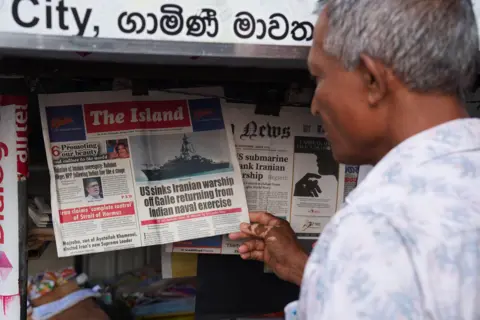
“The Iranian ship would not have been where it was had India not invited it to the Milan exercise,” he wrote on X. “A word of condolence at the loss of lives of those who were our invitees would be in order.”
Others like Chellaney have framed the issue in more strategic terms.
He described the strike as a blow to India’s maritime diplomacy. The torpedoing of the frigate in “India’s maritime backyard”, he argued, punctured Delhi’s carefully cultivated image as a “preferred security partner” in the Indian Ocean.
“In one torpedo strike, American hard power has punctured India’s carefully cultivated soft power,” says Chellaney.
As the debate gathered pace in strategic circles, India’s official response remained cautious.
External Affairs Minister S Jaishankar said on X that he had held a telephone conversation with Araghchi, and also posted a photograph of a meeting with Iran’s Deputy Foreign Minister Saeed Khatibzadeh at a foreign policy summit in Delhi.
For military historian Srinath Raghavan, the legal position is clear: once the Iranian vessel left India’s shores, Delhi had no formal responsibility.
The strategic message, however, is harder to ignore.
“First, the spreading geography of this war. Second, India’s limited ability to manage its fallout,” says Raghavan.
“Indeed, the US Navy has fired a shot across the bow aimed at all regional players, including India.”
[BBC]


“All animals are equal, but some animals are more equal than others” ––George Orwell, Animal Farm
 When I wrote in this column an essay on 4th February 2026 titled, the ‘Beginning of Another ‘White Supremacist’ World Order?’, my focus was on the hypocrisy of Canadian Prime Minister Mark Carney’s Davos address on 20 January 2026 to the World Economic Forum. It was embraced like the gospel by liberal types and the naïve international relations ‘experts’ in our country and elsewhere. My suspicion of Carney’s words stemmed from the consistent role played by countries like Canada and others which he called ‘middle powers’ or ‘intermediate powers’ in the world order he critiqued in Davos. He wanted such countries, particularly Canada, “to live the truth?” which meant “naming reality” as it exists; “acting consistently” towards all in the world; “applying the same standards to allies and rivals” and “building what we claim to believe in, rather than waiting for the old order to be restored.” These are some memorable pieces of Carney’s mantra.
Yet unsurprisingly, it only took the Trump-Netanyahu illegal war against Iran to prove the hollowness in Carney’s words. If he placed any premium on his own words, he should have at least voiced his concern against the continuing atrocities in the Middle East unilaterally initiated by the US and Israel. But his concern is only about Iran’s seemingly indiscriminate attacks across the region targeting US and Israeli installations and even civilian locations in countries allied with the Us-Israel coalition.
Issuing a statement on 3 March 2026 from Sydney he noted, “Canada has long seen Iran as the principal source of instability and terror in the Middle East” and “despite more than two decades of negotiations and diplomatic efforts, Iran has not dismantled its nuclear programme, nor halted its enrichment activities.” A sensible observer would note how the same statement would also apply to Israel. In fact, Israel has been the bigger force of instability in the Middle East surpassing Iran. After all, it has exiled an entire population of people — the Palestinians — from their country to absolute statelessness has not halted its genocide of the same people unfortunate enough to find themselves in Gaza after their homeland was taken over to create Israel in 1948 and their properties to build illegal Jewish settlements in more recent times. And then there is the matter of nuclear weapons. Israel has never been hounded to stop its nuclear programme unlike Iran. There is, in the world order Carney criticixed and the one in his fantasy, a fundamental difference between a ‘Jewish bomb’ and a ‘Muslim bomb’ in the ‘clash of civilisations’ as imagined by Samuel P. Huntington and put into practice by the likes of Messers Trump, Netanyahu, and Carney. That is, the Jewish bomb is legitimate, and the Muslim one is not, which to me evokes the commandments in the dystopian novella Animal Farm.
But Carney, in his new rhetoric closely echoing those of the leaders of Germany, UK and France, did not completely forget his Davos words too. He noted, in the same statement, “we take this position with regret, because the current conflict is another example of the failure of the international order.” But in reality, it is not the failure of the current international order, but its reinforcement by the likes of Mr Carney, reiterating why it will not change.
Coming back to the US-Israel attack on Iran, anyone even remotely versatile in the craft of warfare should have known, sooner or later, the rapidly expanding theatre of devastation in the Middle East was likely to happen for two obvious reasons. One, Iran had warned of this outcome if attacked as it considered those countries hosting US and Israeli bases or facilities as enemies. This is military common sense. Two, this was also likely because it is the only option available for a country under attack when faced with superior technology, firepower and the silence of much of the world. I cannot but feel deep shame about the lukewarm and generic statements urging restraint issued by our political leaders notwithstanding the support of Iran to our country in many times of difficulty at the hands of this very same world order.
When I say this, I am not naïvely embracing Iran as a shining example of democracy. I am cognizant of the Iranian regime’s maltreatment of some of its own citizens, stifling of dissent within the country and its proxy support for armed groups in the region. But in real terms, this is no different from similar actions of Israel and the US. The difference is, the actions of these countries, particularly of the US, have been far more devastating for the world than anything Iran has done or could do. US’s misadventures in Vietnam, Iraq, Syria, and Afghanistan come to mind — to take only a handful of examples.
But it is no longer about Carney and the hollowness of his liberal verbal diarrhoea in Davos. What is of concern now is twofold. One is the unravelling fiction of what he called the ‘new world order’ in which he located countries like Canada at the helm. And the second is the reality of continuing to live in the same old world order where countries like Canada and other middle and intermediate powers will continue to do the bidding of powerful aggressors like the US and Israel as they have done since the 20th century.
Yet, one must certainly thank Trump and Mr Natenyahu for one thing. That is, they have effectively exposed the myth of what used to be euphemistically called the ‘western civilisation.’ Despite its euphemism, the notion and its reality were omnipresent and omnipotent, because of the devastating long term and lingering consequences of its tools of operation, which were initially colonialism and later postcolonial and neocolonial forms of control to which all of us continue to be subjected.
One thing that was clearly lacking in the long and devastating history of the ‘western civilisation’ in so far as it affected the lives of people like us is its lack of ‘civilisation’ and civility at all times. Therefore, Trump and Mr Netanyahu must be credited for exposing this reality in no uncertain terms.
But what does illegal and unprovoked military action and the absence so far of accountability mean in real terms? It simply means that rules no longer matter. If Israel and the US can bomb and murder heads of state of a sovereign country, its citizens including children, cause massive destruction claiming a non-existent imminent threat violating both domestic and international law, it opens a wide playing field for the powerful and the greedy. Hypothetically, in this free-for-all, China can invade India through Arunachal Pradesh and occupy that Indian state which it calls Zangnan simply because it has been claiming the territory of itself for a very long time and also simply because it can. India can invade and occupy Sri Lanka, if it so wishes because this can so easily be done and also because it is part of the extended neighbourhood of the Ramayana and India’s ‘Akhand Bharat’ political logic. Sri Lanka can perhaps invade and occupy the Maldives if it wants a free and perennial supply of Maldive Fish. Incidentally, the Sri Lankan Tamil guerrilla group, People’s Liberation Organization of Tamil Eelam nearly succeeded in doing so 1988.
Sarcasm aside, even more dangerous is the very real possibility of this situation opening the doors for small, violent and mobile militant groups to target citizens of these aggressor countries and their allies as we saw in the late 1960s and 1970s. This will occur because in this kind of situation, many people would likely believe this form of asymmetric warfare is the only avenue of resistance open to them. It is precisely under similar conditions that the many Palestinian armed factions and Lebanese militia groups emerged in the first place. If this happens, the victims will not be the fathers and the vociferous supporters of the present aggression but all of us including those who had nothing to do with the atrocities or even opposed it in their weak and inaudible voices.
If I may go back to Carney’s Davos words, what would “to live the truth?”, “naming reality”, “acting consistently” and “applying the same standards to allies and rivals” mean in the emerging situation in the Middle East? Would this kind of hypocrisy, hyperbole, choreographed silence and selective accusations only end if a US invasion of Greenland, an integral part of the ‘White Supremacist’ World Order’ takes place? By then, however, all of us would have been well-trained in the art of feeling numb. By that time, we too would have forgotten yet another important line in Animal Farm: “No animal shall kill any other animal without cause.”

Sexual education is a vital component of holistic education, contributing to physical health, emotional well-being, gender equality, and social responsibility. Despite its importance, sexual education remains a sensitive and often controversial subject in many societies, particularly in culturally conservative contexts. In Sri Lanka, discussions around sexuality are frequently avoided in formal and informal settings, leaving young people to rely on peers, social media, or misinformation. This silence creates serious social, health, and psychological consequences. By examining the Sri Lankan context alongside international examples, the importance of comprehensive and age-appropriate sexual education becomes clear.
Understanding Sexual Education
Sexual education goes beyond biological explanations of reproduction. Comprehensive sexual education includes knowledge about human anatomy, puberty, consent, relationships, emotional health, gender identity, sexual orientation, reproductive rights, contraception, prevention of sexually transmitted infections (STIs), and personal safety. Importantly, it also promotes values such as respect, responsibility, dignity, and mutual understanding. When delivered appropriately, sexual education empowers individuals to make informed decisions rather than encouraging early or risky sexual behavior.
The Sri Lankan Context: Silence and Its Consequences
In Sri Lanka, sexual education is included in school curricula mainly through subjects such as Health Science and Life Competencies, however the content is often limited and taught with hesitation. Many teachers feel uncomfortable discussing sexual topics openly due to cultural norms, religious sensitivities, and fear of parental backlash. As a result, lessons are rushed, skipped, or delivered in a purely biological manner without addressing emotional, social, or ethical dimensions.
This lack of open education has led to several social challenges. Teenage pregnancies, although less visible, remain a significant issue, particularly in rural and estate sectors. Young girls who become pregnant often face school dropouts, social stigma, and limited future opportunities. Many of these pregnancies occur due to lack of knowledge about contraception, consent, and bodily autonomy.
Another serious concern in Sri Lanka is child sexual abuse. Numerous reports indicate that many children do not recognize abusive behaviour or lack the confidence and language to report it. Proper sexual education, especially lessons on body boundaries and consent, can help children identify inappropriate behavior and seek help early. In the Sri Lankan context, where respect for elders often discourages questioning authority, this knowledge is especially crucial.
Furthermore, misinformation about menstruation, nocturnal emissions, and bodily changes during puberty causes anxiety and shame among adolescents. Many Sri Lankan girls experience menarche without prior knowledge, leading to fear and confusion. Similarly, boys often receive no guidance about emotional or physical changes, reinforcing unhealthy notions of masculinity and silence around mental health.
Cultural Resistance and Misconceptions
Opposition to sexual education in Sri Lanka often stems from the belief that it promotes immoral behaviour or encourages premarital sex. However, international research consistently shows the opposite: young people who receive comprehensive sexual education tend to delay sexual initiation and engage in safer behaviours. The resistance is therefore rooted more in cultural fear than empirical evidence.
Religious and cultural values are important, but they need not conflict with sexual education. In fact, sexual education can be framed within moral discussions about responsibility, respect, family values, and care for others principles shared across Sri Lanka’s major religious traditions. Ignoring sexuality does not protect cultural values; rather, it leaves young people vulnerable.
International Evidence: Lessons from Other Countries
Several countries demonstrate how effective sexual education contributes to positive social outcomes.
In the Netherlands, sexual education begins at an early age and is age-appropriate, focusing on respect, relationships, and communication rather than explicit sexual activity. As a result, the Netherlands has one of the lowest rates of teenage pregnancy and STIs in the world. Young people are encouraged to discuss feelings, boundaries, and consent openly, both in schools and at home.
Similarly, Sweden introduced compulsory sexual education as early as the 1950s. Swedish programs emphasise gender equality, reproductive rights, and sexual health. This long-term commitment has contributed to high levels of sexual health awareness, low maternal mortality among young mothers, and strong societal acceptance of gender diversity. Sexual education in Sweden is also closely linked to public health services, ensuring access to counseling and contraception.
In many developing contexts, international organisations have supported sexual education as a tool for social development. UNESCO promotes Comprehensive Sexuality Education (CSE) globally, emphasising that it equips young people with knowledge, skills, attitudes, and values that enable them to protect their health and dignity. Studies supported by UNESCO show that CSE reduces risky behaviours, improves academic outcomes, and supports gender equality.
In countries such as Rwanda and South Africa, sexual education has been integrated with HIV/AIDS prevention programs. These initiatives demonstrate that sexual education is not a luxury of developed nations but a necessity for public health and social stability.
Comparing Sri Lanka with International Models
When compared with international examples, Sri Lanka’s challenges are not due to lack of capacity but lack of open dialogue and political will. Sri Lanka has a strong education system, high literacy rates, and an extensive public health network. These strengths provide an excellent foundation for implementing comprehensive sexual education that is culturally sensitive yet scientifically accurate.
Unlike the Netherlands or Sweden, Sri Lanka may not adopt early-age sexuality discussions in the same manner, but age-appropriate education during late primary and secondary school is both feasible and necessary. Topics such as puberty, menstruation, consent, online safety, and respectful relationships can be introduced gradually without violating cultural norms.
Sexual Education in the Digital Era
The urgency of sexual education has increased in the digital age. Sri Lankan adolescents are exposed to sexual content through social media, films, and online platforms, often without guidance. Pornography frequently becomes a primary source of sexual knowledge, leading to unrealistic expectations, objectification, and distorted ideas about consent and relationships.
Sexual education can counter these influences by developing critical thinking, media literacy, and ethical understanding. Teaching young people how to navigate digital relationships, cyber harassment, and online exploitation is now an essential component of sexual education.
Gender Equality and Social Change
Sexual education also plays a crucial role in promoting gender equality. In Sri Lanka, traditional gender roles often limit open discussion about female sexuality while excusing male dominance. Comprehensive sexual education challenges these norms by emphasizing mutual respect, shared responsibility, and equality in relationships.
Educating boys about consent and emotional expression helps reduce gender-based violence, while educating girls about bodily autonomy strengthens empowerment. In the long term, this contributes to healthier families and more equitable social structures.
The Way Forward for Sri Lanka
For sexual education to be effective in Sri Lanka, several steps are necessary. Teachers must receive proper training to handle the subject confidently and sensitively. Parents should be engaged through awareness programs to reduce fear and misconceptions. Curriculum developers must ensure that content is age-appropriate, culturally grounded, and scientifically accurate.
Importantly, sexual education should not be treated as a one-time lesson but as a continuous process integrated into broader life skills education. Collaboration between schools, healthcare providers, religious leaders, and community organisations can help normalise discussions around sexual health while respecting cultural values.
Finally , sexual education is not merely about sex; it is about health, dignity, safety, and responsible citizenship. The Sri Lankan experience demonstrates how silence and taboo can lead to misinformation, vulnerability, and social harm. International examples from the Netherlands, Sweden, and global initiatives supported by UNESCO clearly show that comprehensive sexual education leads to positive individual and societal outcomes.
For Sri Lanka, embracing sexual education does not mean abandoning cultural values. Rather, it means equipping young people with knowledge and ethical understanding to navigate modern social realities responsibly. In an era of rapid social and technological change, sexual education is not optional it is essential for building a healthy, informed, and compassionate society.
by Milinda Mayadunna ✍️

The final voyage of the Iranian warship sunk by the US

AI-generated Iran war videos surge as creators use new tech to cash in

Huge explosions rock major Tehran airport as Israel strikes ‘regime infrastructure’

India hit back but Sutherland, Hamilton impress to give Australia the edge

Heat Index at ‘Caution Level’ in the Sabaragamuwa province and, Colombo, Gampaha, Kurunegala, Anuradhapura, Vavuniya, Hambanthota and Monaragala districts

Dry weather will prevail over the island.

‘Dates have the highest sugar content to fight Coronavirus’

Sunday Island 27 December – Headlines

#SundayIsland 17th December – Headlines

Sunday Island – 28th March

Sunday Island Headlines – 21 March

Sunday Island – 21st February – Headlines
-

 Features5 days ago
Brilliant Navy officer no more
-

 Opinion5 days ago
Sri Lanka – world’s worst facilities for cricket fans
-

 News2 days ago
Legal experts decry move to demolish STC dining hall
-

 Features5 days ago
A life in colour and song: Rajika Gamage’s new bird guide captures Sri Lanka’s avian soul
-

 Business3 days ago
Cabinet nod for the removal of Cess tax imposed on imported good
-

 News1 day ago
University of Wolverhampton confirms Ranil was officially invited
-

 Features6 days ago
Overseas visits to drum up foreign assistance for Sri Lanka
-
 Features6 days ago
Sri Lanka to Host First-Ever World Congress on Snakes in Landmark Scientific Milestone