
Features
The making of The Island


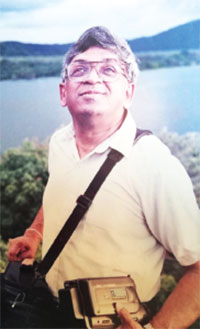
by Vijitha Yapa, Founder Editor, Sunday Island
The person at the other end of the phone calling from Nallur was very angry. “Mr Editor, you have killed me in your paper today”. I did not ask him where he was speaking from, as he may treat it as an insult. I did not know what he was speaking about and asked what story he was referring to and after listening to him, told him to call me back in half an hour. There were no ubiquitous mobile phones at that time nor easy access to telephones in the eighties.
The story revolved around the Coroner of Nallur, Mr Francis, committing suicide and Dr Watson performing the autopsy. The call was from Mr Francis who said it was the other way round. I asked the sub editor for the original story submitted by the Nallur correspondent and what the sub editor had edited and compared it with what had been printed in the Island that morning.
 Mr Francis was correct. The Nallur correspondent had said that Dr Watson committed suicide and Coroner Francis performed the autopsy. I screamed angrily at the sub editor and asked him, “What the hell have you done? Why did you do this and what can I tell this Coroner?” The sub editor submitted his lame excuse. “I tried to contact the correspondent and could not get through to Nallur. This seemed a ridiculous story and I felt the Nallur correspondent had got it all wrong. Why should a medical doctor who makes pots of money commit suicide? I felt it is the coroner, a poorly paid public servant, who had every reason to commit suicide and changed the story to reflect that”.
It was the most incredible explanation and he was a senior sub editor. What could I do? I apologized to Mr Francis when he phoned and said I am carrying an apology to him in the next day’s newspaper. This is the only time I ever apologized to anybody because I am a strong believer that facts printed must be correct and the editorial staff should be fully responsible to see that the true facts should be followed to the letter. The story is recollected on the 40th anniversary of the Sunday Island and it is an indication of the trials we faced and the difficulties we encountered.
Upali Wijewardene asked me to be the Editor of the Sunday Island in March 1981 when I submitted my resignation as the Media Officer at the GCEC (Greater Colombo Economic Commission) he chaired. From April 1981 I had accepted an offer from Dow Jones and Co of USA to look after their interests by procuring advertisements for the Wall Street Journal and also to import and distribute the Asian Wall Street Journal in Sri Lanka.
But even by August he had not found anyone and he sent his Mercedes Benz to my residence and asked me to come immediately to his home. There he said, ” I want you to be the Founder editor of the Sunday Island which will be born on October 4, because I have confidence in you”. I felt very sorry because here was a man who had wealth and power but was frustrated because he could not find an editor.
I told him I will accept the offer for six months until he found another person but as I have started my own business it was difficult for me to devote full time to the newspaper. I asked for a virtually impossible five figure salary, the highest for any journalist , a car with a driver to take my children to school and since I had some commitments with some foreign newspapers for journalistic assignments I requested leave whenever the need arose. He said okay and “You can start tomorrow”. I told him that to start the newspaper I will need to recruit immediately and cannot waste time on red tape. He gave me permission to approach any journalist and where necessary to double their salaries on the condition that they start work immediately from the next day.
I contacted many of the well known journalists and asked them to come for an interview and basically within a week we had the staff. It was a bold move because we were asking people in secure jobs to give up their positions in other newspapers and commence work with us within 24 hours. Ours was an establishment which was not publishing any newspapers except a weekly cartoon paper. The majority of those approached had the faith to take the plunge and we began work immediately.
Because of the problems we faced there was not even a dummy copy which we could produce before the date of publication, October 4. But somehow the birth took place that day though the first issues did not reach the public in the morning but late in the evening. I had returned home about 1 o’clock in the morning having finished the editorial work and was shocked to find that even by the afternoon it had not even been printed!. I rushed to the press and found that the plates were never sent to the printing press in Homagama because the technical staff were found wanting. There were blank pages and I ordered that some ads should be repeated and also some articles and sent the pages.
Though late the paper was received very well. It was in colour and we were the first to do computer printing of a newspaper in Sri Lanka. The pages were clean and people appreciated the pictures and layout. Gamini Weerakoon was the deputy editor, Rienzie Wijeratne was the pictures editor and Ajith Samaranayaka was the editorial writer responsible for features.
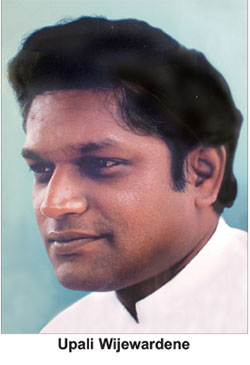 Gamini Weerakoon’s wife Rajitha was working for the Sunday Observer and I had to tell Gamini to make sure he does not talk in his sleep.
We also got some people from the Times group.Some of them were the first females to be recruited to the Upali Group head office, an all male domain. The ladies who came from the Times newspaper sought permission everyday to go to Fort about midday. They never explained why and I had to finally ask them the reason for this as our transport was limited to one vehicle at that time. They all appeared as a delegation in my office and said sheepishly,” We have to go to Fort because there is no toilet for women at Upali’s!”. It is an area which we had neglected and I immediately phoned Mr Upali Wijewardene and within 24 hours a special toilet with locks in the male domain was made available to the ladies.
Within one month of our publication Mr Wijewardene came to the office and said, ” I want to start the daily newspaper from November 16″. I was lucky not to have suffered a heart attack as we still had teething problems. The technical office once came and asked me why I could not give Page one and the sports page two days earlier like the feature pages so that he could give the paper on time.
Mr Wijewardene would not change his mind to postpone the commencement of the daily. We gathered the staff together and told them the news, recruited more journalists and the newspaper began as scheduled on November 16, 1981. Mr Peter Harland from UK assisted us in those early days and veteran planter Leslie Dharmaratne was the CEO of Upali Newspapers. He had no experience in journalism and there were practical issues with regard to the staff. The staff wanted a festival advance but the CEO was quite adamant that it could not be done because there were very heavy expenses with the starting of the newspaper and no funds were available. This virtually led to a strike but luckily it was averted though one or two Sinhala journalists decided to leave or were asked to leave.
It is the exposures of corrupt practices in The Island which caught the interest of the readers and the circulation soared . Mr Upali Wijewardene was the ideal publisher as he did not interfere in running the newspaper. He thought that President J.R. Jayewardene will support him in his endeavour to become the MP for Kamburupitiya but unfortunately Prime Minister Ranasinghe Premadasa opposed it. This led to practical problems and Mr Wijewardene certainly did not help himself when replying to a query by Mervyn de Silva, editor of the Guardian and said his hero was SWRD Bandaranaike. J.R. Jayewardene was very annoyed and because of various difficulties, Upali Wijewardene decided to resign as the Director General of the GCEC.
When Hector Kobbekaduwa was chosen as the SLFP candidate for the presidential election in 1982 Mr Wijewardene felt that since Mrs Sirimavo Bandaranaike had been disqualified from running, the one person who should be contesting the elections from the SLFP was her son Anura Bandaranaike. Anura opposed this and said he could not go against the SLFP. Mr Wijewardene then suggested that Anura should form his own party and that the necessary finances for that operation could be found. But Anura did not take up the offer though it reached the ears of JR, who was visibly annoyed.
Perhaps one of the most sensational stories that the Sunday Island exposed was how foreign minister ACS Hameed had used funds from South Korea through the Sri Lanka High Commission in London. It was used to procure bagpipes for schools in Akurana in Mr Hameed’s electorate. JR and Mr Hameed were on an official visit to China at that time. Mr Hameed told me later it was an embarrassment to Mr Jayewardene who queried it and ordered Mr Hameed to credit all the money that he had in the special account to the President’s Fund.
Another important story was how cricketer Bandula Warnapura decided to take a rebel Sri Lanka team to South Africa. Officially Upali newspapers opposed that visit editorially but carried news of it. Minister Gamini Dissanayake was very annoyed by this and phoned me and told me to stop carrying news of these rebels and said the other newspapers had agreed to his request. I refused and said editorially we condemned the rebel tour but felt we could not ignore the need to inform our readers of what was happening in South Africa.
Mr Dissanayake was very annoyed and said, “If that is your attitude I am going to speak to you publisher”. I knew Mr Upali Wijewardene was not in Colombo that morning but that evening he phoned me and asked whether Gamini Dissanayake had asked me to stop publicity for the rebels and wanted to know my reactions to it. I told him the facts and what he said about contacting the publisher. Mr Wijewardene said he had told Gamini Dissanayake that he does not tell the minister what to do in Cabinet or how to run his ministry. He said he wanted Mr Dissanayake not to interfere in the running of his independent newspaper.
Mr Wijewardene then asked me what news we had of the Sri Lanka rebels in South Africa. I said that there was a picture by Reuters of Bandula Warnapura and colleagues emerging out of the airport in South Africa with their luggage loaded on trolleys. He asked me where I was placing the picture and I replied that it will be on page 14, the Sports page. He laughed and then said, “Why don’t you put it on page 1” . That was Upali Wijewardene, the man who feared no one.
Many of the journalists achieved fame through the pages of the newspaper. The paper was a beacon of hope to the minorities, specially the Tamils, who felt they were being hounded. One of the boldest decisions I made was to ask DBS Jeyaraj to begin a column in the Sunday Island and to call it “Behind the Cadjan Curtain,’ an adaptation of China’s bamboo curtain .The column was well read and well received.
Ajith Samaranayake was another great asset. The editorial he wrote in the newspaper soon after the 1983 July riots and the appeal to people for sanity and to think afresh was read out in full by Mr Maithripala Senanayake in Parliament. It was Ajith who asked Jeyraj who was working at Veerakesari, the Tamil newspaper, to apply for a job at the Sunday Island. I was impressed by the clean shaven Jeyaraj’s performance in the test I gave him and recruited him. Later DBS said that impish Ajith had advised him to shave off his moustache and beard as I did not like such growth on the faces of journalists, which he realised later was a complete lie.
Ajith had his flings through words and once got into an argument with Gamini Fonseka. Initially the articles from Gamini and from Ajith created interest but Gamini’s replies became a bit boring in the latter stages. I told Ajith the time has come to end the series. He agreed and I allowed him to do the final column. His final comment was brief but rich with content. He said he was stopping these arguments with Mr Gamini Fonseka because trying to convince him was like playing a Veena to a deaf elephant. Gamini never replied to that because to those who knew his history, knew there was a rich meaning in that one sentence pregnant with opportunities.
There are many more stories to tell but space and time are precious and tributes to the individual journalists who made the Sunday Island a paper the readers looked forward to read is difficult to put down on paper. But the rich history of the Sunday Island which began 40 years ago has to be recorded and I wish the Editor and journalists of the newspaper all the best for the future.

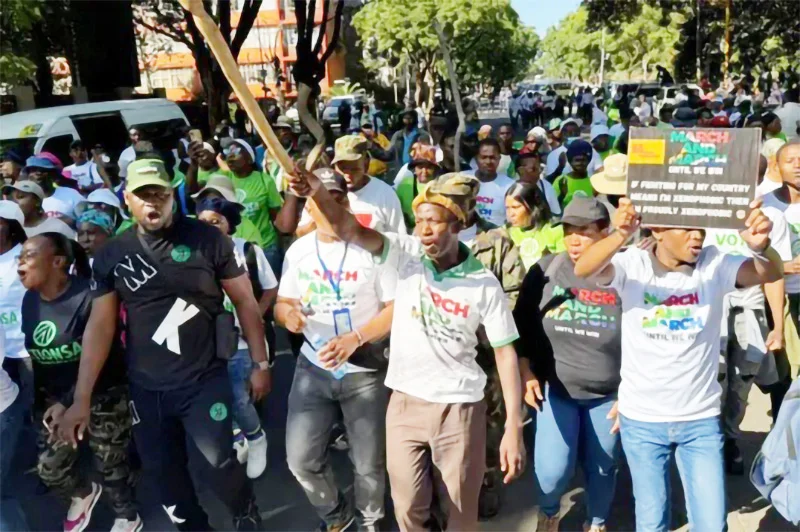
 The current outbreak of anti-immigrant protests in Durban, South Africa is bound to have taken many a subscriber to value-based politics or political idealism quite by surprise. After all, this is evidence that despite the historic accomplishments of nation-builders of the stature of the late President Nelson Mandela it cannot be taken for granted that identity politics, including racism in its worst forms, is no more in South Africa.
At the time of this writing details are scarce on the substantive root causes of the protests but it could very well be that economic grievances, particularly on the part of the majority community in South Africa, are contributing considerably to the disaffection. Shrinking employment and material prospects are likely to figure majorly among the factors igniting the unrest.
Fortunately, the local authorities in Durban are losing no time in calling for peaceful co-existence among the relevant communities and are pointing to the vital importance of stepping-up national integration processes. Apparently, immigrants in sizable numbers from neighbouring countries are present in Durban. However, international TV footage of the protests quoted some local authorities as saying that the majority of the immigrants in some centres that housed them were not illegal migrants and had the documents that entitle them to be in Durban.
In the Durban protests the world has fresh proof of the socially divisive consequences of the gathering globe-wide economic disaffection, touched off particularly by the continuing crisis in West Asia. Going ahead, the world would need to brace for increasing identity-based unrest of the kind it is just witnessing in South Africa.
Considering that the material lot of ordinary people everywhere could only aggravate progressively, with the US and Iran showing no signs of negotiating an end to their confrontation any time soon, it will be left to the more democratic and progressive sections of the world community to initiate positive measures collectively to bring a measure of relief to the discontented.
The swiftness with which such relief will be provided would depend crucially on the importance those sections taking up these undertakings attach to value-based politics as opposed to Realpolitik of power politics.
Going by these yardsticks, Italy could be considered to be moving in the right direction. Recently Italy came to the fore in initiating the collective named, ‘Rome Coalition for Food Security and Access to Fertilizer’, which has as one of its aims the swift provision of fertilizer to economically weak African countries.
In a recent statement Italian Minister of Foreign Affairs and International Cooperation, Antonio Tajani, said that a principal aim of the project was to ensure that the farmers of Africa gained easy access to fertilizer, considering that food security is a growing concern among some of Africa’s economically vulnerable countries.
The statement went on to mention that some 30 countries hailing from the Mediterranean region, the Middle East, the Balkans as well as the FAO had been invited to join the coalition. The venture is far-seeing in that food security is main among the reasons for social discontent which in turn could degenerate into endemic political turmoil and bloodshed. Separatist violence and geographical fragmentation of countries wouldn’t be too far behind these developments, as Africa itself has often proved.
It is hoped that more G7 countries would take the cue from Italy and do what they could to ease the hardships of economically distressed countries, particularly of the global South. In these efforts they would need to break rank with the US, which is today brutally indifferent to the consequences of its policy of making ‘America First’, come what may.
Going by current developments, the Trump administration seems to be blithely oblivious to the wider, deleterious effects of its policy course in West Asia. Besides rendering Iran militarily and otherwise impotent nothing else seems to matter to Washington, as regards West Asia. This is policy short-sightedness of an extreme kind. After all, right now West Asia could be said to be sitting on the proverbial powder keg.
On the other hand, Iran is not giving the world the impression that it is doing anything constructive to get out of the policy straitjacket that it wove for itself decades ago. Rather than enter into a policy of ‘live and let live’ in relation to Israel in particular and initiate a process of reconciliation with the latter, it has chosen to operate within policy parameters that continue to damn Israel. This has put Israel always on the ‘defensive’ so to speak and prevented the opening up of space for meaningful dialogue.
That said, Israel is obliged to explore the possibilities of entering into a negotiatory process with the Arab-Islamic world that could lead to a de-escalation of tensions and bloodshed. It cannot continue to look at its neighbours through lenses that distort them as archetypal enemies who should be ‘wiped off completely from the face of the earth.’
In other words, the need is urgent for Realpolitik to give way to value-based politicks. Italy is beginning to prove that the latter approach could be pursued with some success. May be the EU and the UK could throw their weight behind these initiatives as well and establish that international politics could be refashioned on the basis of humane, civilized norms. The UN would need to be fully supportive of these moves and prove an organizational nucleus of the operations that follow.
In fact the time is ripe for people of conscience to collectively stand up on the side of peace and say ‘No’ to war and violence. Organizations such as the ICRC, the WHO and Medicines Sans Frontiers have already taken up this call. Referring to the widespread destruction of health facilities and their dehumanizing results these organizations have said, among other things, that ‘This is not a failure of the law. It is a failure of political will.’
True, ‘failure of political will’ among those powers that matter accounts for the runaway, uncontrollable nature of war and destruction in contemporary times, but more fundamentally it is a failure of the human conscience. It could very well be that the phenomenal levels to which violence and war have been unleashed today have had the effect of deadening consciences. This is a matter for urgent study and wide discussion.

 I would describe Indunil Kaushalya Dissanayaka as innovative and creative, and she operates under the name of Cuteefly.
Indunil always comes up with something novel to celebrate special occasions, and she does it with candles … and that’s her profession.
She was in the spotlight when she created a happening scene, with candles, for Christmas, Sinhala and Tamil New Year, and Valentine’s Day.
As lanterns light up Sri Lanka for Vesak, the Colombo-based candle maker is quietly turning wax and wick into little pieces of the festival.
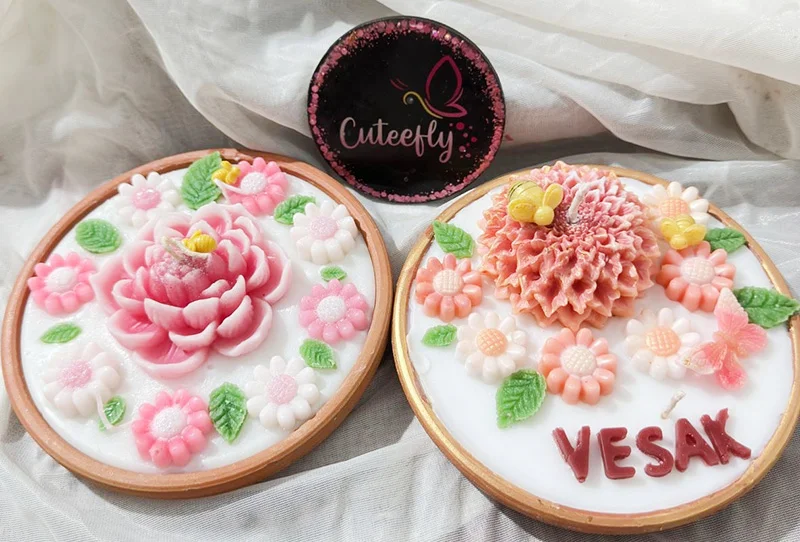
Candles reflecting Vesak themes
Her candles reflect Vesak themes – light, peace, remembrance, giving, etc., to enable you to fill your Vesak celebration with devotion and beauty.
Among her Vesak creations is a lotus-shaped soy candle, scented with sandalwood, lavender, etc., meant to burn during this Vesak Poya Day.

Indunil Kaushalya Dissanayaka: Customers
praise her for her creativity
These handcrafted Vesak candles are perfect for offering at the temple, she says.
What makes her creations so novel is that they come in different shapes, scents, themes, and all are handmade.
What’s more, her customers have heaped praise on her for her creativity.
According to Indunil, her creations are perfect as a thoughtful gift … to bring beauty, unity, and light into every moment.
Says Indunil: “Our beautifully handcrafted Unity candles are designed with premium detail and love, making them perfect for celebrations, gifts, and meaningful occasions.”
Cuteefly, says Indunil, is available online.
Readers could contact Indunil on 0778506066 for more details.
He Facebook Page is: Cuteefly.

Handmade with love

 Yes, dark spots do crop up on the skin, especially with sun exposure and, of course, as the skin ages.
However, these tips should be of immense benefit to those who are faced with dark spots.
* Lemon and Honey Glow Mask:
You will need 01 teaspoon lemon juice and 01 teaspoon honey.
Mix the lemon juice and honey well and then apply this mixture, only on the dark spots.
Leave for 10–15 minutes and then rinse with cool water.
Benefits:
Lemon helps brighten pigmentation.
Honey moisturises and heals skin.
Gives a natural glow.
* Aloe Vera Gel Treatment:
All you need is fresh aloe vera gel.
Apply the gel apply on dark spots, before going to bed.
Leave overnight and wash in the morning.
Benefits:
Reduces acne marks and pigmentation.
Soothes irritated skin.
Helps skin repair naturally.
* Turmeric and Yoghurt Paste:
You will need 01 teaspoon yoghurt and a pinch of turmeric
Mix the yoghurt and turmeric into a smooth paste and apply on affected areas.
Leave for 15 minutes and then wash gently with lukewarm water.
Benefits:
Turmeric brightens skin naturally.
Yoghurt removes dead skin cells.
Helps fade dark spots gradually.
Use these packs 02-03 times a week as results are generally seen over time.
You can also try this out: Mix a ripe papaya into a smooth paste and apply to the face, or directly on to the dark spots. Leave for 15-20 minutes and then wash with lukewarm water.

Let us all build a society valued with peace and harmony, guided by unity and solidarity beyond all differences – PM

Showers will occur at times in the Western, Sabaragamuwa and North-western provinces and in Galle, Matara, Kandy and Nuwara-Eliya districts

Rajitha calls for combined lists, denounces those unwilling to join as traitors

20 lawmakers, four officials visiting China

More Japanese funds for demining operations in the north

Clingendael Institute delegation visits Pathfinder Foundation

‘Dates have the highest sugar content to fight Coronavirus’

Sunday Island 27 December – Headlines

#SundayIsland 17th December – Headlines

Sunday Island – 28th March

Sunday Island Headlines – 21 March

Sunday Island – 21st February – Headlines
-

 Business6 days ago
Historic launch of CCWE Fashion Week & International Summit 2026
-

 News4 days ago
All-New GRAVITE launches at LKR 6.99 Mn
-
 Features4 days ago
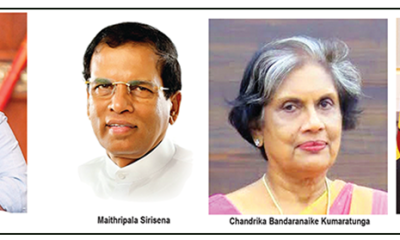
The NPP’s pivot to the past
-
 News3 days ago
Police probe underway to ascertain links between criminals deported from UAE and local politicians
-
 News2 days ago
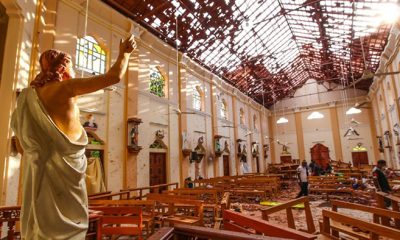
Easter Sunday carnage: Court told Maulana’s statement cannot be accepted without cross-examination
-

 Opinion6 days ago
The need to reform Buddhist ecclesiastical order
-
 Features4 days ago
End of Peacekeeping
-
 Opinion2 days ago
Undermining the democratic political framework