
News
The Jungle and the Sea: Lankan civil war drama lifts joy above trauma

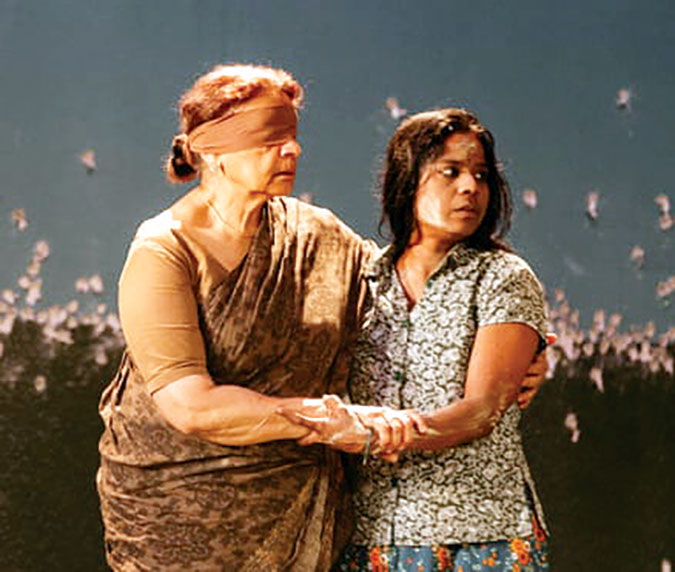
A new play that combines two great pillars of literature – the Mah?bh?ratha and Antigone – with the untold histories of the Sri Lankan civil war to forge a new story about surviving loss, discovering love and building a path to justice, by Lankan origin Australian writer and director S. Shakthidharan and Eamon Flack is a soaring achievement, says The Guardian.
The play staged at Belvoir St theatre, Sydney shows people living and loving despite danger, says a report by TG.It says: Ablindfolded woman, wearing a sari, places a conch shell on the ground. It might serve as a ritualistic trumpet or a reminder of a Sri Lankan beach towards the end of the country’s 26-year civil war – when tens of thousands of bodies lay scattered on its sand as though they had fallen from the sky.
She then dances slowly, sorrowfully, with precise mime and hand gestures to signal her pain. We soon learn this matriarch, Gowrie, had taken a vow many years earlier to wear the blindfold until her four children could be reunited, after her only son was swept away with the Tamil Tigers – a group the Sinhalese-controlled government branded terrorists.
In this silent, impactful opening scene of The Jungle and the Sea, Anandavalli – in her first acting role – brings to Gowrie her own experience: first, as artistic director of the Lingalayam Dance Company, notably in the classical Indian dance form bharata natyam; and also as a survivor of trauma herself.
Co-written and co-directed by Anandavalli’s playwright son S Shakthidharan with Belvoir’s artistic director Eamon Flack, the play is a companion piece to 2019 epic Counting and Cracking, which aimed to fill the silences between first- and second-generation Sri Lankan-Australian refugees about their shared history. It went on to win seven Helpmann awards, and recently toured to Edinburgh and Birmingham.
During the long development process for Counting and Cracking, Anandavalli gradually opened up to her son about fleeing Sri Lanka for Australia, and agreed to act in this latest work. It features seven other actors plus two musicians playing carnatic instruments including the lute-like saraswati veena, and percussion such as a mridangam and a ghatam clay pot.
Like its predecessor, The Jungle and the Sea is another achievement of sustained feeling and empathy, of insight into chaos, power and the human instinct for joy and survival. This is all the more remarkable given the simplicity of the production, with a revolving stage used at different speeds to indicate travel between eras and locations, and little reliance on props. There is no scenery apart from bullet holes running the width of the theatre walls.
While Shakthidharan and Flack’s earlier play charted the origins of the conflict and was set mainly in the capital of Colombo on the west coast, The Jungle and the Sea shifts the focus to northern Sri Lanka, where the violence was concentrated. It is focused on 1995, the war’s final year of 2009, and the present day in 2022.
Shakthidharan shows people living and loving despite danger and death – but this new material carries risk. While Counting and Cracking aimed to help Sri Lankans heal and feel a part of the Australian story, and endeavoured to provide a space for many truths across religious and ethnic lines, there is potential for retraumatisation from the violent events recounted in The Jungle and the Sea.
Perhaps this is why that violence is portrayed stylistically, with characters smearing their faces with blood to denote death and then walking away – a too-subtle strategy which dramatically undersells a couple of moments. A wedding across religious lines during bombing and shelling also risks minimising the horrors of war, although Shakthidharan succeeds in his clear intent to “drive an arrow” through media images of “helpless brown people”, and instead show Sri Lankans “surviving and loving and living”. There are also a couple of repetitive spots in the second act that could do with a trim, particularly around the family’s journey to find the brother, Ahilan (Biman Wimalaratne).
But performances are finely honed. Bollywood actor Prakash Belawadi, who played the patriarch in Counting and Cracking, returns to play the father, Siva, who is poignantly convincing when blinded in the war, and amusing in his reaction when his youngest daughter Lakshmi (Emma Harvie) comes out as a “lesbian atheist” during a well-calibrated comic scene at an expensive Sydney restaurant.
Nadie Kammallaweera, who was also in Counting and Cracking, segues neatly between the widely varying ages of her two characters, daughter Madlu and eccentric but wise Devla. And Kalieaswari Srinivasan plays firebrand daughter Abi with gusto, marrying across sides a Sinhalese groom, Himal (Rajan Velu), then trying to light a funeral pyre for her sibling, risking the wrath of the state in a denouement reminiscent of Antigone’s defiance.
The play will prompt important conversations about the Sri Lankan government killing its own citizens during the war, turning heavy machinery upon them or encouraging them to take shelter at church or hospital before bombing such gathering places.
Wise words translated to English from devotional Tamil poetry ultimately take centre stage with appeals to our better selves, even as war sloganeering twists language and we are reminded love itself can be “abused, betrayed, sensationalised”. The final dance is saved for the matriarch Gowrie, whom poetic licence gifts the sight of her children once again, as fretted strings and double-barreled drums play out.The Jungle and the Sea is at Belvoir Street theatre until 18 December.



More than 1,600 students sat this year’s Russian Classical Ballet Examination, the largest number ever to take part in the examination in Sri Lanka. Exams were held in Colombo from 5, to 18, October and in Galle on 10 October.
Students aged four and above came from across the island, including Colombo, Galle, Gampaha, Negombo, Matara, Kelaniya, Panadura, Wattala, Kiribathgoda, Ratnapura, Kandy, Kurunegala, Bandarawela and Badulla. They are taught by 15 dedicated teachers trained in the Vaganova method, the renowned Russian system of classical ballet training.
They were examined by Dr. Oxana Karnovich of the Moscow State Academy of Choreography, a distinguished academic and curator.
The Russian School of Ballet and Dancing was established in 2001 by Michael Ustinov, Buddhapriya Ramanayake and Mrs Chandi Aluvihare, with Mrs Galina Pleshakova as its founding instructor. Today the School is led by Director Madam Maria Popova, Counsellor of the Embassy of the Russian Federation in Sri Lanka.

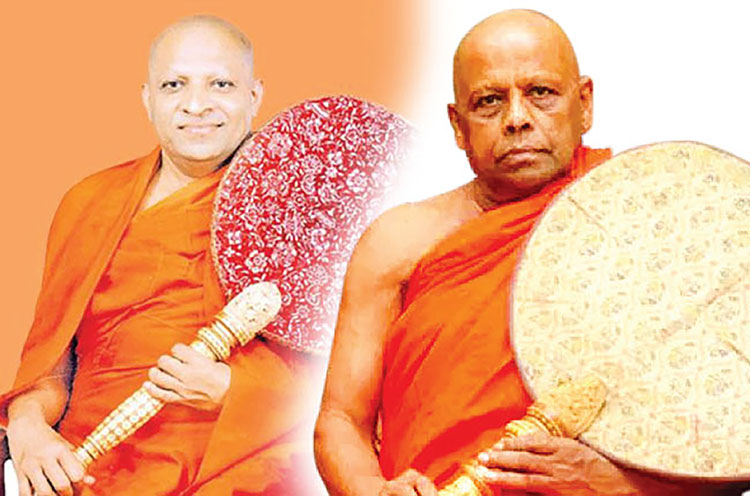
MONETABRIEF– Sri Lanka’s two most senior Buddhist chapters, Malwatte and Asgiriya, demanded special concessions for monks serving prison sentences, following the disrobing of convicted monk Ven. Galagodaatte Gnanasara in line with established procedures.
The chief prelate of the Asgiriya chapter, Most Venerable Warakagoda Sri Gnanarathana, told Prisons Commissioner Senaka Palletenna that Ven. Gnanasara, who is serving a six-year sentence for contempt of court, must be released immediately.
Prison authorities have no power to release or pardon convicts, but Palletenna told the monk in Kandy on Friday that he would convey his request to the relevant government authorities.
“There is no point in talking about this and that… The entire country has been shaken (??????? ) . He must be released,” the Asgiriya chief prelate said.
The Malwatte chief prelate, Most Venerable Thibbatuwawe Sri Siddhartha Sumangala, appeared to accept the court verdict against Ven. Gnanasara, but asked the prisons chief whether a separate section could be established for convicted monks.
Palletenna noted that a special ward for the clergy already existed at Welikada Prison.
At least 63 convicted Buddhist monks are currently incarcerated within Sri Lanka’s criminal justice system.
Meanwhile, a group of 34 Buddhist monks named in a Colombo Fort Magistrate’s Court order to vacate the vicinity of the Presidential Secretariat ended their protest and dispersed after lunch on Friday.The monks are demanding an unconditional pardon for Ven. Gnanasara, who has previously been imprisoned, making him a reconvicted prisoner.
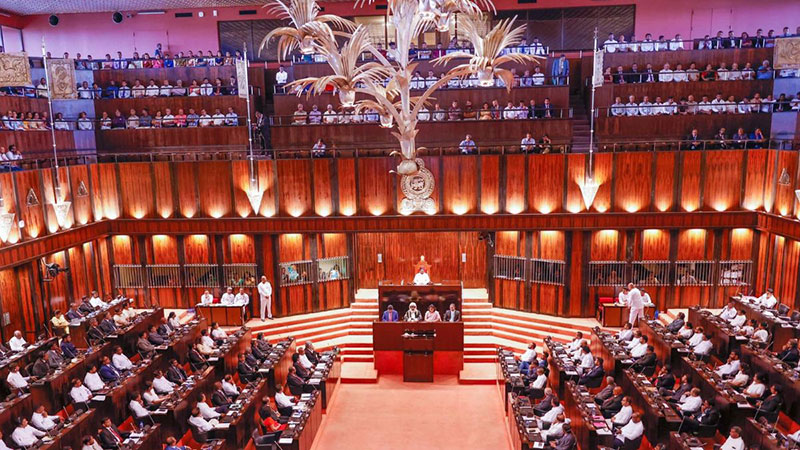
The debate on the no-confidence motion against Speaker Dr. Jagath Wickramaratne, submitted by the Samagi Jana Balawegaya (SJB), has been postponed indefinitely pending the Attorney General’s opinion on certain technical issues in the motion.
Government representatives raised the matter at a meeting of the Committee on Parliamentary Business, pointing out that several provisions of the motion required clarification and that the Attorney General’s advice should be obtained.
As obtaining the opinion would take time, the debate could not be scheduled for the next parliamentary week, parliamentary sources said.
Chief Opposition Whip Gayantha Karunatilaka said a date for the debate would be decided after the Attorney General’s advice was received.
Meanwhile, Parliament is scheduled to meet from October 20 to 23, Secretary General of Parliament Kushani Rohanadeera announced.
The parliamentary business for the week was finalised at a meeting of the Committee on Parliamentary Business held on Friday (16) under the chairmanship of Deputy Speaker Dr. Rizvie Salih.
On each sitting day, the period from 9.30 a.m. to 10 a.m. will be allocated for parliamentary business under Items 1 to 6 of Standing Order 22. Questions for Oral Answers will be taken up from 10 a.m. to 11 a.m., followed by questions under Standing Order 27(2) from 11 a.m. to 11.30 a.m.
On Tuesday, October 20, an Opposition-sponsored Adjournment Motion will be debated from 11.30 a.m. to 5.30 p.m.
On Wednesday, October 21, a resolution under the Public Debt Management Act and a Supplementary Estimate will be taken up for debate and approval from 11.30 a.m. to 5 p.m. The annual reports of five statutory institutions will subsequently be presented for approval without debate, while questions at the Adjournment Time will be taken up from 5 p.m. to 5.30 p.m.
On Thursday, October 22, the Second Reading debates on two Bills to amend the Poisons, Opium and Dangerous Drugs Ordinance (Bills Nos. 79 and 80) will be held from 11.30 a.m. to 5 p.m.
The annual reports of five statutory institutions will then be taken up for approval without debate, followed by an Opposition-sponsored Adjournment Motion from 5 p.m. to 5.30 p.m.
On Friday, October 23, the Second Reading debate on the Elimination of Rabies and Registration of Dogs Bill will be held from 11.30 a.m. to 5 p.m. A Government-sponsored Adjournment Motion will be debated during the final half-hour of the sitting.

Record 1,600 students take Russian Classical Ballet examination in Sri Lanka

Half a million people join protests in France, but some turn violent

Deadly fire breaks out at Canada military base

Showers or thundershowers will occur in most parts of the island after 1.00 p.m.

Buddhist hierarchy demands prison perks for monk convicts

Debate on NCM against Speaker postponed indefinitely

‘Dates have the highest sugar content to fight Coronavirus’

Sunday Island 27 December – Headlines

#SundayIsland 17th December – Headlines

Sunday Island – 28th March

Sunday Island Headlines – 21 March

Sunday Island – 21st February – Headlines
-

 Latest News5 days ago
Nissanka’s return headlines Sri Lanka’s Test squad against Pakistan
-

 Latest News6 days ago
Farhan and Sadaqat help Pakistan seal series in style
-

 Features6 days ago
Intake 16: 45 years of duty and honour
-

 News6 days ago
Malwathu Chapter issues statement on talks with President over Gnanasara Thera’s robes
-

 News6 days ago
CP alleges NPP has taken the blame for illegal US sanctions on Iranian vessels
-

 Opinion6 days ago
How long can Sri Lanka remain silent on its demographic crisis?
-

 News4 days ago
Sri Lanka, India caught in US-Iran ship crisis
-

 Latest News4 days ago
Kusal Mendis’ unbeaten 87 hands Sri Lanka consolation win