
Features
The intellectual retreat


Science has advanced but has philosophy retreated to the ivory tower? Economists and historians are taking an ever more visible role in public life but why not philosophers? One of the profound questions that philosophy raises is the question of how one ought to live. Have philosophers and thinkers abandoned their traditional role as critics of our beliefs and practices? If yes, why?
By ASH NARAIN ROY
We are living in intensely paradoxical times. While the 21st century is experiencing an explosion of scientific advances, there is a sense that intellectuals are no longer playing a major role as protagonists of change. The world seems to be moving towards the atomisation of life of the mind. Technology grows and thinking shrinks!
The Bill Gates of the world marvel at the 21st century’s major advances in the fields like gene editing, machine learning, driverless cars, robotic surgery, and artificial intelligence among others. Mr Gates predicts that some of the breakthrough technologies will include custom cancer treatments tailored to a person’s genome, sanitation without sewers and carbon dioxide catchers.Science has advanced but has philosophy retreated to the ivory tower? Economists and historians are taking an ever more visible role in public life but why not philosophers?
One of the profound questions that philosophy raises is the question of how one ought to live. Have philosophers and thinkers abandoned their traditional role as critics of our beliefs and practices? If yes, why?
Is it because of the rise of ‘corporatocracy’ or the exhaustion of the modern mind? Is it because of the sclerosis of institutions? Is it the internet which is leading to a certain kind of illiteracy? Is it too much to expect philosophy to continue answering Emmanuel Kant’s questions: what can I know? What should I know?Even French philosophy which made a lasting impact on rationalism, republicanism, feminism, positivism, existentialism and structuralism seems to be in the doldrums. Today rational discourse is in terribly short supply.
Thinkers and public intellectuals are quietly disappearing as influential factors on the public scene. In ancient times, intellectuals and philosophers added character to society. When intellectuals shine a light on a public sphere, only then does a society flourish. Plato served as an advisor to the ruler of Syracuse. He travelled to the strife-torn court of Syracuse three times risking his life to create a philosopher king. John Stuart Mill served a term in parliament. Bertrand Russell got involved in nearly every public policy debate of his time.
Philosopher David Blitz considers Russell like “few others before him and even fewer after him” bringing his intellectual acumen to bear on public issues. Public intellectuals often fight a war on the plane of ideas. But the industrial society, considered by some as a “suicide machine,” has squeezed the space for philosophy. Didn’t Arnold Toynbee warn us that civilisations are not murdered, they commit suicide? How do we explain the greatest minds walking the earth over two millennia ago – Confucianism in China, the Upanishads and Buddhism in India, Homer’s Greece and Hebrew prophets?
It was around 500-300 BCE that saw the advent of the greatest religious, spiritual and philosophical traditions in Eurasian societies. German-Swiss philosopher Karl Jaspers explains that these societies independently embraced moral universalism, prompted by the teachings of Plato, the Hebrew prophets, Zarathustra, Buddha and Confucius. Does one assume that there are extraordinary times in history when the world throws up a torrent of genius?
But why was it possible then and not before? There are others who argue that these societies were not necessarily “islands of light”. Plato’s writings aren’t really conceivable without Zoroastrianism and Egyptian moral ideals. Jonny Thompson who teaches philosophy at Oxford, explains that “when cultures, ideologies and peoples come together, great steps forward happen.”
The advent of great cities allowed great thinkers and intellectuals to debate and collaborate. Great cities nurtured great thinkers and philosophers. Cities thus spurred intellectual ferment. American diplomat and academic Nick Burns pose a rather provocative question: “Who among today’s literary figures has any chance of being recognised as a thinker on par with Dostoevsky or Marx?” We still do have great minds amid us. New York Times columnist Ross Douthat’s list of most influential intellectuals today includes Ibram X Kendi, Robin Di Angelo, Steven Pinker, Peter Singer, Peter Thiel, and Yuval Noah Harari among others.
Given the breadth of human genius, any intellectual hit parade would be an act of folly. One can at best talk of how scores of top minds are still shaping the future. Britain’s influential Prospect Magazine published a list of 50 thinkers in 2021.
It shortlisted the world’s top 10 thinkers: Palestinian biologist Jacob Hana, physicist Carlo Rovelli, political theorist Mahmood Mamdani, historian of philosophy Peter Adamson, vaccine developers Ozlem Turecci and Ugur Sahin, English professor Priyambada Gopal, theologian Mustafa Akyol, public health expert Devi Sreedhar, environmentalist Frans Schepers and essayist Rebecca Solnit. Prospect magazines 2005 top five were Noam Chomsky, Umberto Eco, Richard Dawkins, Václav Havel and Christopher Hitchens. Have intellectuals become what J S Mill called “the powerless people”? In the age of junk science and moral relativism, while some intellectuals have been reduced to instruments of manipulation, others have retreated, working alone, often engaged in esoteric theorising.
With our stress on techno-solutionism, many intellectuals have been forced to live in hermetic bubbles. Intellectuals also align today with corporate and institutional thinking. And uncompromising intellectuals like Noam Chomsky have become marginal as they are excluded from the mainstream media. Is smart technology dumbing down the human race? Nicolas Carr in his book ‘Is Google Making Us Stupid?’ says that the daily use of the internet is “rewriting our brains for skimming rather than the sustained concentration required by books.”
Susan Jacoby in ‘Age of American Unreason’ argues that technology has damaged our ability to think. She further maintains that the rise of religious fundamentalism, the failure of public education to create an informed citizenry and the triumph of video over print culture account for anti-intellectualism in the US. This story is no different in India. Globally, the disconnect between the people and the intellectuals is widening. Intellectuals in India are often ridiculed by the ruling class. Today parties prefer cheerleaders, rather than intellectuals. Those who have fallen from the great height of moral values are making the biggest splash.
Media, the gatekeepers, have long given up gatekeeping. Instead of public intellectuals, we now have pundits on TV channels. They denounce, mock, vituperate and lash out at their opponents in the strongest possible language. Their reasoning generates more heat than light. Social media is a poison tree. We need intellectuals and philosophers as they are the world’s eyes. As Einstein said, “intellectuals solve problems, geniuses prevent them.”
(The Statesman/ANN)






The long standing foreign policy of Sri Lanka was Non-Alignment. However, in the context of emerging geopolitical rivalries, there was a need to question the adequacy of Non-Alignment as a policy to meet developing challenges. Neutrality as being a more effective Policy was first presented in an article titled “Independence: its meaning and a direction for the future” (The Island, February 14, 2019). The switch over from Non-Alignment to Neutrality was first adopted by former President Gotabaya Rajapaksa and followed through by successive Governments. However, it was the current Government that did not miss an opportunity to announce that its Foreign Policy was Neutral.
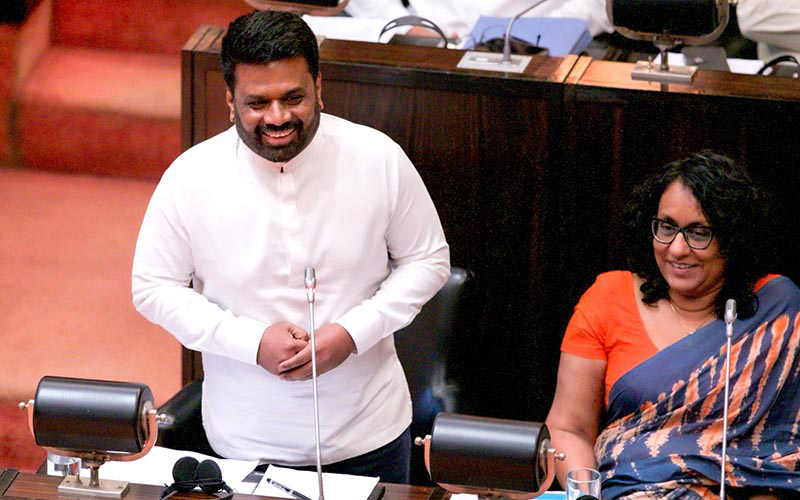
The policy of Neutrality has served the interests of Sri Lanka by the principled stand taken in respect of the requests made by two belligerents associated with the Middle East War. The justification for the position adopted was conveyed by President Anura Kumara Dissanayake to Parliament that Iran had made a formal request on February 26 for three Iranian naval ships to visit Sri Lanka, and on the same evening, the United States also requested permission for two war planes to land at Mattala International Airport. Both requests were denied on grounds of maintaining “our policy of neutrality”.
WHY NEUTRALITY
Excerpts from the article cited above that recommended Neutrality as the best option for Sri Lanka considering the vulnerability to its security presented by its geographic location in the context of emerging rivalries arising from “Pivot to Asia” are presented below:
“Traditional thinking as to how small States could cope with external pressures are supposed to be: (1) Non-alignment with any of the major centers of power; (2) Alignment with one of the major powers thus making a choice and facing the consequences of which power block prevails; (3) Bandwagoning which involves unequal exchange where the small State makes asymmetric concessions to the dominant power and accepts a subordinate role of a vassal State; (4) Hedging, which attempts to secure economic and security benefits of engagement with each power center: (5) Balancing pressures individually, or by forming alliances with other small States; (6) Neutrality”.
Of the six strategies cited above, the only strategy that permits a sovereign independent nation to charter its own destiny is neutrality, as it is with Switzerland and some Nordic countries. The independence to self-determine the destiny of a nation requires security in respect of Inviolability of Territory, Food Security, Energy Security etc. Of these, the most critical of securities is the Inviolability of Territory. Consequently, Neutrality has more relevance to protect Territorial Security because it is based on International Law, as opposed to Non-Alignment which is based on principles applicable to specific countries that pledged to abide by them
“The sources of the international law of neutrality are customary international law and, for certain questions, international treaties, in particular the Paris Declaration of 1856, the 1907 Hague Convention No. V respecting the Rights and Duties of Neutral Powers and Persons in Case of War on Land, the 1907 Hague Convention No. XIII concerning the Rights and Duties of Neutral Powers in Naval War, the four 1949 Geneva Conventions and Additional Protocol I of 1977” (ICRC Publication on Neutrality, 2022).
As part of its Duties a Neutral State “must ensure respect for its neutrality, if necessary, using force to repel any violation of its territory. Violations include failure to respect the prohibitions placed on belligerent parties with regard to certain activities in neutral territory, described above. The fact that a neutral State uses force to repel attempts to violate its neutrality cannot be regarded as a hostile act. If the neutral State defends its neutrality, it must however respect the limits which international law imposes on the use of force. The neutral State must treat the opposing belligerent States impartially. However, impartiality does not mean that a State is bound to treat the belligerents in exactly the same way. It entails a prohibition on discrimination” (Ibid).
“It forbids only differential treatment of the belligerents which in view of the specific problem of armed conflict is not justified. Therefore, a neutral State is not obliged to eliminate differences in commercial relations between itself and each of the parties to the conflict at the time of the outbreak of the armed conflict. It is entitled to continue existing commercial relations. A change in these commercial relationships could, however, constitute taking sides inconsistent with the status of neutrality” (Ibid).
THE POTENTIAL of NEUTRALITY
It is apparent from the foregoing that Neutrality as a Policy is not “Passive” as some misguided claim Neutrality to be. On the other hand, it could be dynamic to the extent a country chooses to be as demonstrated by the actions taken recently to address the challenges presented during the ongoing Middle East War. Furthermore, Neutrality does not prevent Sri Lanka from engaging in Commercial activities with other States to ensuring Food and Energy security.
If such arrangements are undertaken on the basis of unsolicited offers as it was, for instance, with Japan’s Light Rail Project or Sinopec’s 200,000 Barrels a Day Refinery, principles of Neutrality would be violated because it violates the cardinal principle of Neutrality, namely, impartiality. The proposal to set up an Energy Complex in Trincomalee with India and UAE would be no different because it restricts the opportunity to one defined Party, thus defying impartiality. On the other hand, if Sri Lanka defines the scope of the Project and calls for Expressions of Interest and impartially chooses the most favourable with transparency, principles of Neutrality would be intact. More importantly, such conduct would attract the confidence of Investors to engage in ventures impartial in a principled manner. Such an approach would amount to continue the momentum of the professional approach adopted to meet the challenges of the Middle East War.
CONCLUSION
The manner in which Sri Lanka acted, first to deny access to the territory of Sri Lanka followed up by the humanitarian measures adopted to save the survivors of the torpedoed ship, earned honour and respect for the principled approach adopted to protect territorial inviolability based on International provisions of Neutrality.
If Sri Lanka continues with the momentum gained and adopts impartial and principled measures recommended above to develop the country and the wellbeing of its Peoples, based on self-reliance, this Government would be giving Sri Lanka a new direction and a fresh meaning to Neutrality that is not passive but dynamic.
by Neville Ladduwahetty

The interference into affairs of other nations by the USA’s Central Intelligence Agency (CIA) started in 1953, six years after it was established. The Anglo-Iranian Oil Company supplied Britain with most of its oil during World War I. In fact, Winston Churchill once declared: “Fortune brought us a prize from fairyland beyond our wildest dreams.”
When in 1951 Dr. Mohammad Mosaddegh was reluctantly appointed as Prime Minister by the Shah of Iran, whose role was mostly ceremonial, he convinced Parliament that the oil company should be nationalised.
Mohammed Mosaddegh
Mosaddegh said: “Our long years of negotiations with foreign companies have yielded no result thus far. With the oil revenues we could meet our entire budget and combat poverty, disease and backwardness of our people.”
It was then that British Intelligence requested help from the CIA to bring down the Iranian regime by infiltrating their communist mobs and the army, thus creating disorder. An Iranian oil embargo by the western countries was imposed, making Iranians poorer by the day. Meanwhile, the CIA’s strings were being pulled by Kermit Roosevelt (a grandson of former President Theodore Roosevelt), according to declassified intelligence information.
Although a first coup failed, the second attempt was successful. General Fazlollah Zahedi, an Army officer, took over as Prime Minister. Mosaddegh was tried and imprisoned for three years and kept under house arrest until his death. Playing an important role in the 1953 coup was a Shia cleric named Ayatollah Abol-Ghasem Mostafavi-Kashani. He was previously loyal to Mosaddegh, but later supported the coup. One of his successors was Ayatollah Ruhollah Mostafavi Musavi Khomeini, who engineered the Islamic Revolution in 1979. Meanwhile, in 1954 the Anglo-Iranian Oil Company had been rebranded as British Petroleum (BP).
Map of the Middle East
When the Iran-Iraq war broke out (September 1980 to August 1988), the Persian/Arabian Gulf became a hive of activity for American warships, which were there to ensure security of the Gulf and supertankers passing through it.

CIA-instigated coup in Iran in 1953 Dr. Mohammad Mosaddegh
The Strait of Hormuz, the only way in and out of the Gulf, is administered by Oman and Iran. While there may have been British and French warships in the region, radio ‘chatter’ heard by aircraft pilots overhead was always from the US ships. In those days, flying in and out of the Gulf was a nerve-wracking experience for airline pilots, as one may suddenly hear a radio call on the common frequency: “Aircraft approaching US warship [name], identify yourself.” One thing in the pilots’ favour was that they didn’t know what ships they were flying over, so they obeyed only the designated air traffic controller. Sometimes though, with unnecessarily distracting American chatter, there was complete chaos, resulting in mistaken identities.
Air Lanka Tri Star
Once, Air Lanka pilots monitored an aircraft approaching Bahrain being given a heading to turn on to by a ship’s radio operator. Promptly the air traffic controller, who was on the same frequency, butted in and said: “Disregard! Ship USS Navy [name], do you realise what you have just done? You have turned him on to another aircraft!” It was obvious that there was a struggle to maintain air traffic control in the Gulf, with operators having to contend with American arrogance.
On the night of May 17, 1987, USS Stark was cruising in Gulf waters when it was attacked by a Dassault Mirage F1 jet fighter/attack aircraft of the Iraqi Air Force. Without identifying itself, the aircraft fired two Exocet missiles, one of which exploded, killing 37 sailors on board the American frigate. Iraq apologised, saying it was a mistake. The USA graciously accepted the apology.
Then on July 3, 1988 the high-tech, billion-dollar guided missile cruiser USS Vincennes, equipped with advanced Aegis weapons systems and commanded by Capt. Will Rogers III, was chasing two small Iranian gun boats back to their own waters when an aircraft was observed on radar approaching the US warship. It was misidentified as a Mirage F1 fighter, so the Americans, in Iranian territorial waters, fired two surface-to-air Missiles (SAMs) at the target, which was summarily destroyed.
The Vincennes had issued numerous warnings to the approaching aircraft on the military distress frequency. But the aircraft never heard them as it was listening out on a different (civil) radio frequency. The airplane broke in three. It was soon discovered, however, that the airplane was in fact an Iran Air Airbus A300 airliner with 290 civilian passengers on board, en route from Bandar Abbas to Dubai. Unfortunately, because it was a clear day, the Iranian-born, US-educated captain of Iran Air Flight 655 had switched off the weather radar. If it was on, perhaps it would have confirmed to the American ship that the ‘incoming’ was in fact a civil aircraft. At the time, Capt. Will Rogers’ surface commander, Capt. McKenna, went on record saying that USS Vincennes was “looking for action”, and that is why they “got into trouble”.
Although USS Vincennes was given a grand homecoming upon returning to the USA, and its Captain Will Rogers III decorated with the Legion of Merrit, in February 1996 the American government agreed to pay Iran US$131.8 million in settlement of a case lodged by the Iranians in the International Court of Justice against the USA for its role in that incident. However, no apology was tendered to the families of the innocent victims.
These two incidents forced Air Lanka pilots, who operated regularly in those perilous skies, to adopt extra precautionary measures. For example, they never switched off the weather radar system, even in clear skies. While there were potentially hostile ships on ground, layers of altitude were blocked off for the exclusive use of US Air Force AWACS (Airborne Warning and Control System) aircraft flying in Bahraini and southern Saudi Arabian airspace. The precautions were even more important because Air Lanka’s westbound, ‘heavy’ Lockheed TriStars were poor climbers above 29,000 ft. When departing Oman or the UAE in high ambient temperatures, it was a struggle to reach cruising level by the time the airplane was overhead Bahrain, as per the requirement.
In the aftermath of the Iran Air 655 incident, Newsweek magazine called it a case of ‘mistaken identity’. Yet, when summing up the tragic incident that occurred on September 1, 1983, when Korean Air Flight KE/KAL 007 was shot down by a Russian fighter jet, close to Sakhalin Island in the Pacific Ocean during a flight from New York to Seoul, the same magazine labelled it ‘murder in the air’.
After the Iranian coup, which was not coincidentally during the time of the ‘Cold War’, the CIA involved itself in the internal affairs of numerous countries and regions around the world: Guatemala (1953-1990s); Costa Rica (1955, 1970-1971); Middle East (1956-1958); Haiti (1959); Western Europe (1950s to 1960s); British Guiana/Guyana (1953-1964); Iraq (1958-1963); Soviet Union, Vietnam, Cambodia (1955-1973); Laos, Thailand, Ecuador (1960-1963); The Congo (1960-1965, 1977-1978); French Algeria (1960s); Brazil (1961-1964); Peru (1965); Dominican Republic (1963-1965); Cuba (1959 to present); Indonesia (1965); Ghana (1966); Uruguay (1969-1972); Chile (1964-1973); Greece (1967-1974); South Africa (1960s to 1980s); Bolivia (1964-1975); Australia (1972-1975); Iraq (1972-1975); Portugal (1974-1976); East Timor (1975-1999); Angola (1975-1980); Jamaica (1976); Honduras (1980s); Nicaragua (1979-1990); Philippines (1970s to 1990s); Seychelles (1979-1981); Diego Garcia (late 1960s to present); South Yemen (1979-1984); South Korea (1980); Chad (1981-1982); Grenada (1979-1983); Suriname (1982-1984); Libya (1981-1989); Fiji (1987); Panama (1989); Afghanistan (1979-1992); El Salvador (1980-1992); Haiti (1987-1994, 2004); Bulgaria (1990-1991); Albania (1991-1992); Somalia (1993); Iraq (1991-2003; 2003 to present), Colombia (1990s to present); Yugoslavia (1995-1995, and to 1999); Ecuador (2000); Afghanistan (2001 to present); Venezuela (2001-2004; and 2025).
If one searches the internet for information on American involvement in foreign countries during the periods listed above, it will be seen how ‘black’ funds were/are used by the CIA to destabilise those governments for the benefit of a few with vested interests, while poor citizens must live in the chaos and uncertainty thus created.
A popular saying goes: “Each man has his price”. Sad, isn’t it? Arguably the world’s only superpower that professes to be a ‘paragon of virtue’ often goes ‘rogue’.
God Bless America – and no one else!
BY GUWAN SEEYA
Features
Mannar’s silent skies: Migratory Flamingos fall victim to power lines amid Wind Farm dispute

By Ifham Nizam
A fresh wave of concern has gripped conservationists following the reported deaths of migratory flamingos within the Vankalai Sanctuary—a globally recognised bird habitat—raising urgent questions about the ecological cost of large-scale renewable energy projects in the region.
The incident comes at a time when a fundamental rights petition, challenging the proposed wind power project, linked to India’s Adani Group, remains under examination before the Supreme Court, with environmental groups warning that the very risks they highlighted are now materialising.
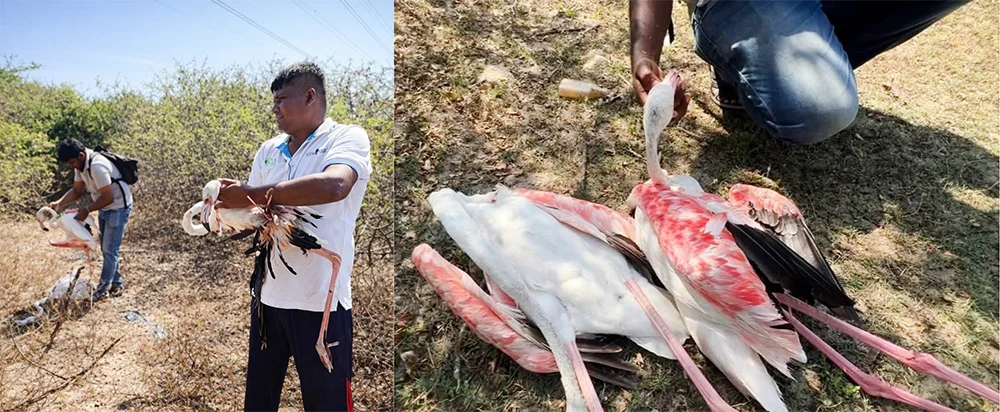
At least two flamingos—believed to be part of the iconic migratory flocks that travel thousands of kilometres to reach Sri Lanka—were found dead after entanglement with high-tension transmission lines running across the sanctuary. Another bird was reportedly struggling for survival.
Professor Sampath Seneviratne, a leading ornithologist, expressed deep concern over the development, noting that such incidents are not isolated but indicative of a broader and predictable threat.
“These migratory birds depend on specific flyways that have remained unchanged for centuries. When high-risk infrastructure, like poorly planned power lines, intersect these routes, collisions become inevitable,” he said. “What we are witnessing now could be just the beginning if proper mitigation measures are not urgently implemented.”
Environmentalists argue that the Mannar region—particularly the Vankalai wetland complex—is one of the most critical stopover sites in South Asia for migratory waterbirds, including flamingos, pelicans, and various species of waders. The sanctuary’s ecological value has also supported a niche with growing eco-tourism sector, drawing birdwatchers from around the world.
Executive Director of the Centre for Environmental Justice, Dilena Pathragoda, said the incident underscores the urgency of judicial intervention and stricter environmental oversight.
“This tragedy is a direct consequence of ignoring scientifically established environmental safeguards. We have already raised these concerns before court, particularly regarding the location of transmission infrastructure within sensitive bird habitats,” Pathragoda said.
“Renewable energy cannot be pursued in isolation from ecological responsibility. If due process and proper environmental impact assessments are bypassed or diluted, then such losses are inevitable.”
Conservation groups have long cautioned that the installation of wind turbines and associated grid infrastructure—especially overhead transmission lines—within or near sensitive habitats could transform these landscapes into lethal zones for avifauna.
An environmental activist involved in the ongoing legal challenge said the latest deaths validate earlier warnings.
“This is exactly what we feared. Development is necessary, but not at the cost of biodiversity. When projects of this scale proceed without adequate ecological assessments and safeguards, the consequences are irreversible,” the activist stressed.
The debate has once again brought into focus the delicate balance between renewable energy expansion and biodiversity conservation. While wind energy is widely promoted as a clean alternative to fossil fuels, experts caution that “green” does not automatically mean “harmless.”
Professor Seneviratne emphasised that solutions do exist, including rerouting transmission lines, installing bird diverters, and conducting comprehensive migratory pathway studies prior to project approval.
“Globally, there are well-established mitigation strategies. The issue here is not the absence of knowledge, but the failure to apply it effectively,” he noted.
The timing of the incident is particularly worrying. Migratory flamingos typically remain in Sri Lanka until late April or May before embarking on their return journeys. Conservationists warn that if hazards remain unaddressed, larger flocks could face similar risks in the coming weeks.
Beyond ecological implications, experts also highlight potential economic fallout. Wildlife tourism—especially birdwatching—contributes significantly to local livelihoods in Mannar.
Repeated reports of bird deaths could deter eco-conscious travellers and damage the region’s reputation as a safe haven for migratory species.
Environmentalists are now calling for immediate intervention by authorities, including a temporary halt to high-risk operations in sensitive zones, pending a thorough environmental review.
They stress that protecting animal movement corridors—whether elephant migration routes or avian flyways—is a fundamental pillar of modern conservation.
As the controversy unfolds, one question looms large: can Sri Lanka pursue sustainable energy without sacrificing the very natural heritage that defines it?
Pathragoda added that for now, the sight of fallen flamingos in Mannar stands as a stark reminder that development, if not carefully planned, can carry a heavy and irreversible cost.

Presidential Suite at Sri Jayewardenepura General Hospital opened to the public

Cabinet Sub-Committee appointed to streamline the Public Service meets for the second time

PSL 2026: Teams allowed to submit two XIs and pick one after toss

Japan Premier League [JPL], building cricket from the ground up

Showers may occur at a few places in the Sabaragamuwa province and in Galle, Matara, Kalutara and Nuwara-Eliya districts in the evening

Energy Minister indicted on corruption charges ahead of no-faith motion against him

‘Dates have the highest sugar content to fight Coronavirus’

Sunday Island 27 December – Headlines

#SundayIsland 17th December – Headlines

Sunday Island – 28th March

Sunday Island Headlines – 21 March

Sunday Island – 21st February – Headlines
-

 News3 days ago
Senior citizens above 70 years to receive March allowances on Thursday (26)
-

 Features5 days ago
Trincomalee oil tank farm: An engineering marvel
-
 News20 hours ago
Energy Minister indicted on corruption charges ahead of no-faith motion against him
-

 News2 days ago
US dodges question on AKD’s claim SL denied permission for military aircraft to land
-

 Features5 days ago
The scientist who was finally heard
-

 Business2 days ago
Dialog Unveils Dialog Play Mini with Netflix and Apple TV
-

 News3 days ago
CEB Engineers warn public to be prepared for power cuts after New Year
-
 News3 days ago
Japanese boost to Sri J’pura Hospital, an outright gift from Tokyo during JRJ rule