
Features
“The Herd Mentality: Why We Follow the Crowd—And How to Think for Yourself” – Part I

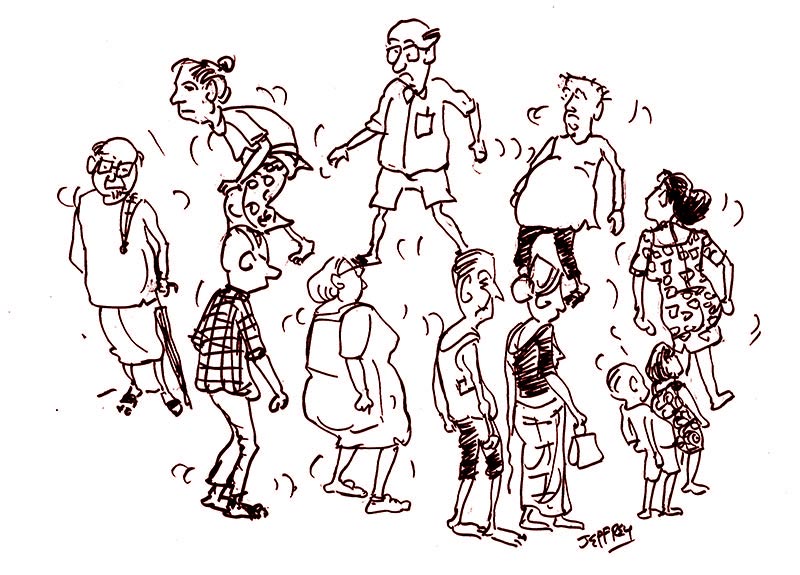
From politics to campus ragging, understanding group psychology can help Sri Lankans break free from dangerous conformity
The Paradox of Group Behaviour
“It was the first week of university. The seniors called him to the common room. He didn’t want to go—something felt off. But everyone else did. He stayed silent. By the end of the night, what began as ‘tradition’ turned into humiliation.”
We often see ourselves as rational beings, yet in group settings, our actions frequently contradict our personal judgment. Whether it’s students silently enduring ragging, voters swept up in political frenzy, or ordinary people following unethical commands, our behaviour in crowds can appear irrational. This isn’t due to weakness, but rather to the hidden wiring of the human brain. While we like to believe that logic governs our choices, group dynamics often awaken deep emotional instincts that override reason. When we become part of a group—be it a crowd, community, or institution—we risk losing the very thing that defines us: our individual judgment. This paradox stems from evolutionary survival mechanisms that once helped us thrive in tribes but now, in modern society, can lead us astray.
The Emotional Brain and Evolutionary Psychology
The truth is, our brains are still evolving. Neuroscience shows that the prefrontal cortex—the part responsible for logic, planning, and self-control—is one of the last regions to fully develop, often not maturing until a person’s mid-20s. In contrast, the more primitive brain structures, like the amygdala and limbic system, which govern emotions, fear, and survival instincts, are far more active and influential, especially in high-stress or emotionally charged situations.
These emotional centres evolved millions of years ago and are shared with many animals. While a disciplined and educated mind can help regulate these impulses through conscious awareness and learned behaviour, emotional reactions often override rational thinking—particularly in group settings, or under pressure. Numerous psychological studies, including those on emotional hijacking (as described by Daniel Goleman in Emotional Intelligence), confirm that even highly intelligent individuals can act irrationally when emotions take control. No matter how advanced our intellect, we are emotional beings first—and rational thinkers second. Nowhere is this more apparent than when we become part of a group.
The Need to Belong: A Biological Imperative
Humans are deeply social beings. From birth, our brains are wired to seek connection, approval, and a sense of belonging. This isn’t just a matter of psychology—it’s rooted in biology. Studies in neuroscience show that social interaction activates the same reward centres in the brain as food and physical pleasure. The hormone oxytocin, often called the “bonding hormone,” plays a critical role in forming trust and attachment, especially in group settings. Evolutionarily, belonging to a group significantly enhanced our ancestors’ chances of survival—offering protection, shared resources, and social learning.
How Conformity Becomes a Survival Instinct
Ancient survival instincts continue to shape modern behaviour by driving conformity, loyalty, and groupthink. People often align with group opinions, as shown in Solomon Asch’s conformity experiments, to avoid social rejection. The brain reinforces group attachment by releasing dopamine when we feel accepted, strengthening loyalty even when a group’s actions defy logic or ethics. This can lead to groupthink, a phenomenon identified by Irving Janis, where the desire for harmony suppresses dissent and critical thinking, often resulting in flawed or unethical decisions.
The Psychology of Habit Loops in Groups
These social impulses are strong because they’ve been essential to our species’ survival—but they can sometimes override individual reason and ethics in today’s complex world. Group behaviour often reinforces itself through what James Clear calls a habit loop: social cues trigger emotional responses, which are reinforced by approval, status, or a sense of belonging. Group behaviour can serve as a cue (e.g., laughter, anger, fear), leading to imitation (response), and social acceptance (reward).
Us vs. Them: How Groups Create Division
Groups naturally form boundaries between “us” and “them,” a tendency that fuels tribalism, stereotyping, and exclusion. This division is vividly illustrated in William Golding’s Lord of the Flies, where a group of boys, on a deserted island, descend into savagery, splitting into rival factions and dehumanising outsiders. Emotional energy dominates in such environments—fear, excitement, and anger spread rapidly, creating, what psychologists call, emotional contagion. In Arthur Miller’s The Crucible, the Salem witch trials dramatise how mass hysteria and fear escalate into collective violence, as neighbours turn against one another to protect themselves or gain social standing.
Emotional Contagion and Crowd Behaviour
“Think of how quickly outrage spreads during political rallies, or how a single comment online can ignite a storm of reactions.” This kind of collective emotion—whether euphoric or dangerous—often leads to irrational decisions or destructive behaviour. Political rallies, riots, and even online mobs can exhibit this pattern, much like in George Orwell’s 1984, where state-controlled rallies, like the “Two Minutes Hate,” whip the public into frenzied emotional consensus. Literature reminds us that under the right conditions, the crowd can overpower the individual, often with tragic consequences.
Obedience, Hierarchy, and Role Conformity
Every group, whether formal or informal, eventually forms a hierarchy. Humans are instinctively wired to seek leadership and to organise themselves into roles within social structures.
This dynamic creates two powerful forces that shape behaviour. First, obedience to authority—a phenomenon famously demonstrated in Stanley Milgram’s experiments—shows that people will follow orders from perceived leaders, even when those commands conflict with their moral compass. Second, individuals begin to unconsciously conform to the roles assigned to them within the group. These roles, whether leader, follower, enforcer, or outcast, come with behavioural expectations that people internalise over time. Once internalised, these roles can override personal values, leading individuals to act in ways they might never consider outside the group context. This helps explain how ordinary individuals can commit extraordinary acts—both heroic and horrific—under group influence.
The ‘Group Mask’: Losing the Individual Self
When individuals become immersed in a group, they often feel compelled to hide their true thoughts, values, or instincts in order to fit in—a psychological phenomenon sometimes referred to as wearing a “group mask.” This mask can suppress personal judgment, silence internal dissent, and even lead individuals to participate in actions they would normally find unacceptable on their own. In the safety—or pressure—of the collective, people may go along with harmful, reckless, or unethical behaviours simply to avoid standing out.
The desire for acceptance becomes so strong that the individual self is often pushed aside in favour of maintaining group harmony or avoiding exclusion. For example, imagine a group decides to take a sea bath in rough seas. One person may feel it’s dangerous but says nothing for fear of being seen as weak or difficult. Tragedies often occur when no one steps forward to break this silent agreement. History shows us that groups have committed some of the worst crimes—from violent riots, gang rape to war crimes—under the illusion of shared responsibility. The individual dissolves into the group, and so does moral accountability.
Social Pressure and the Fear of Ostracism
As a university professor, I’ve seen how students hesitate to speak out—not because they don’t know what’s right, but because they fear being left alone. Social pressure, though often subtle, can be a profoundly powerful force in shaping human behaviour. The need to belong and be accepted drives many to conform outwardly, even when they privately disagree. Most people would rather align with the group than risk ridicule, judgment, or conflict. Even more deeply rooted is the fear of ostracism—the emotional pain of being excluded or isolated can lead individuals to suppress their true beliefs, silence their opinions, and compromise their values.
This fear is not just social but neurological; studies have shown that social exclusion activates the same areas of the brain as physical pain, underscoring just how compelling the urge to fit in can be. This is especially visible in subcultures like hazing or ragging, where non-conformity leads to public shaming. Even parents, fearing for their children’s safety, may reluctantly tolerate harmful group dynamics, internalising stress that damages them over time.
Ragging is such a deeply rooted menace that it becomes difficult to eradicate—not merely because of the act itself, but because it is perpetuated by powerful group dynamics that reward conformity and punish resistance. Its persistence is fuelled by silence, tradition, and the psychological need to belong, making it a systemic issue that demands both cultural awareness and courageous intervention. (To be concluded)
by Senior Professor E. P. S. Chandana ✍️
Department of Biosystems Technology
Faculty of Technology
University of Ruhuna



 The abduction of Venezuelan President Nicolas Maduro by US special forces on January 3rd and his coercive conveying to the US to stand trial over a number of allegations leveled against him by the Trump administration marks a dangerous degeneration of prevailing ‘world disorder’. While some cardinal principles in International Law have been blatantly violated by the US in the course of the operation the fallout for the world from the exceptionally sensational VVIP abduction could be grave.
Although controversial US military interventions the world over are not ‘news’ any longer, the abduction and hustling away of a head of government, seen as an enemy of the US, to stand trial on the latter soil amounts to a heavy-handed and arrogant rejection of the foundational principles of international law and order. It would seem, for instance, that the concept of national sovereignty is no longer applicable to the way in which the world’s foremost powers relate to the rest of the international community. Might is indeed right for the likes of the US and the Trump administration in particular is adamant in driving this point home to the world.
Chief spokesmen for the Trump administration have been at pains to point out that the abduction is not at variance with national security related provisions of the US Constitution. These provisions apparently bestow on the US President wide powers to protect US security and stability through courses of action that are seen as essential to further these ends but the fact is that International Law has been brazenly violated in the process in the Venezuelan case.
To be sure, this is not the first occasion on which a head of government has been abducted by US special forces in post-World War Two times and made to stand trial in the US, since such a development occurred in Panama in 1989, but the consequences for the world could be doubly grave as a result of such actions, considering the mounting ‘disorder’ confronting the world community.
Those sections opposed to the Maduro abduction in the US would do well to from now on seek ways of reconciling national security-related provisions in the US Constitution with the country’s wider international commitment to uphold international peace and law and order. No ambiguities could be permitted on this score.
While the arbitrary military action undertaken by the US to further its narrow interests at whatever cost calls for criticism, it would be only fair to point out that the US is not the only big power which has thus dangerously eroded the authority of International Law in recent times. Russia, for example, did just that when it violated the sovereignty of Ukraine by invading it two or more years ago on some nebulous, unconvincing grounds. Consequently, the Ukraine crisis too poses a grave threat to international peace.
It is relevant to mention in this connection that authoritarian rulers who hope to rule their countries in perpetuity as it were, usually end up, sooner rather than later, being a blight on their people. This is on account of the fact that they prove a major obstacle to the implementation of the democratic process which alone holds out the promise of the progressive empowerment of the people, whereas authoritarian rulers prefer to rule with an iron fist with a fixation about self-empowerment.
Nevertheless, regime-change, wherever it may occur, is a matter for the public concerned. In a functional democracy, it is the people, and the people only, who ‘make or break’ governments. From this viewpoint, Russia and Venezuela are most lacking. But externally induced, militarily mediated change is a gross abnormality in the world of democracy, which deserves decrying.
By way of damage control, the US could take the initiative to ensure that the democratic process, read as the full empowerment of ordinary people, takes hold in Venezuela. In this manner the US could help in stemming some of the destructive fallout from its abduction operation. Any attempts by the US to take possession of the national wealth of Venezuela at this juncture are bound to earn for it the condemnation of democratic opinion the world over.
Likewise, the US needs to exert all its influence to ensure that the rights of ordinary Ukrainians are protected. It will need to ensure this while exploring ways of stopping further incursions into Ukrainian territory by Russia’s invading forces. It will need to do this in collaboration with the EU which is putting its best foot forward to end the Ukraine blood-letting.
Meanwhile, the repercussions that the Maduro abduction could have on the global South would need to be watched with some concern by the international community. Here too the EU could prove a positive influence since it is doubtful whether the UN would be enabled by the big powers to carry out the responsibilities that devolve on it with the required effectiveness.
What needs to be specifically watched is the ‘copycat effect’ that could manifest among those less democratically inclined Southern rulers who would be inspired by the Trump administration to take the law into their hands, so to speak, and act with callous disregard for the sovereign rights of their smaller and more vulnerable neighbours.
Democratic opinion the world over would need to think of systems of checks and balances that could contain such power abuse by Southern autocratic rulers in particular. The UN and democracy-supportive organizations, such as the EU, could prove suitable partners in these efforts.
All in all it is international lawlessness that needs managing effectively from now on. If President Trump carries out his threat to over-run other countries as well in the manner in which he ran rough-shod over Venezuela, there is unlikely to remain even a semblance of international order, considering that anarchy would be receiving a strong fillip from the US, ‘The World’s Mightiest Democracy’.
What is also of note is that identity politics in particularly the South would be unprecedentedly energized. The narrative that ‘the Great Satan’ is running amok would win considerable validity among the theocracies of the Middle East and set the stage for a resurgence of religious fanaticism and invigorated armed resistance to the US. The Trump administration needs to stop in its tracks and weigh the pros and cons of its current foreign policy initiatives.

 The British School in Colombo (BSC) hosted its Annual Christmas Carnival 2025, ‘Gingerbread Wonderland’, which was a huge success, with the students themseles in the spotlight, managing stalls and volunteering.
The event, organised by the Parent-Teacher Association (PTA), featured a variety of activities, including: Games and rides for all ages, Food stalls offering delicious treats, Drinks and refreshments, Trade booths showcasing local products, and Live music and entertainment.

The carnival was held at the school premises, providing a fun and festive atmosphere for students, parents, and the community to enjoy.
The halls of the BSC were filled with pure Christmas magic and joy with the students and the staff putting on a tremendous display.
Among the highlights was the dazzling fashion show with the students doing the needful, and they were very impressive.

The students themselves were eagerly looking forward to displaying their modelling technique and, I’m told, they enjoyed the moment they had to step on the ramp.
The event supported communities affected by the recent floods, with surplus proceeds going to flood-relief efforts.

 Hi! This week I’m giving you some beauty tips so that you could look forward to enjoying 2026 with a glowing younger looking skin.
Face wash for natural beauty
* Avocado:
Take the pulp, make a paste of it and apply on your face. Leave it on for five minutes and then wash it with normal water.
* Cucumber:
Just rub some cucumber slices on your face for 02-03 minutes to cleanse the oil naturally. Wash off with plain water.
* Buttermilk:
Apply all over your face and leave it to dry, then wash it with normal water (works for mixed to oily skin).
Face scrub for natural beauty
Take 01-02 strawberries, 02 pieces of kiwis or 02 cubes of watermelons. Mash any single fruit and apply on your face. Then massage or scrub it slowly for at least 3-5 minutes in circular motions. Then wash it thoroughly with normal or cold water. You can make use of different fruits during different seasons, and see what suits you best! Follow with a natural face mask.
Face Masks
* Papaya and Honey:
Take two pieces of papaya (peeled) and mash them to make a paste. Apply evenly on your face and leave it for 30 minutes and then wash it with cold water.
Papaya is just not a fruit but one of the best natural remedies for good health and glowing younger looking skin. It also helps in reducing pimples and scars. You can also add honey (optional) to the mixture which helps massage and makes your skin glow.
* Banana:
Put a few slices of banana, 01 teaspoon of honey (optional), in a bowl, and mash them nicely. Apply on your face, and massage it gently all over the face for at least 05 minutes. Then wash it off with normal water. For an instant glow on your face, this facemask is a great idea to try!
* Carrot:
Make a paste using 01 carrot (steamed) by mixing it with milk or honey and apply on your face and neck evenly. Let it dry for 15-20 minutes and then wash it with cold water. Carrots work really well for your skin as they have many vitamins and minerals, which give instant shine and younger-looking skin.

Greenland allies vow action if Trump moves to seize world’s largest island

Landslide early warnings issued to the Districts of Badulla, Kandy, Matale and Nuwara Eliya

Coe commits World Athletics support to Jamaica

Rare mountain gorilla twins born in Africa’s oldest national park

ECB launch ‘thorough review’ in wake of 4-1 Ashes defeat

Warning for deep depression over South-east Bay of Bengal Sea area

‘Dates have the highest sugar content to fight Coronavirus’

Sunday Island 27 December – Headlines

#SundayIsland 17th December – Headlines

Sunday Island – 28th March

Sunday Island Headlines – 21 March

Sunday Island – 21st February – Headlines
-

 News3 days ago
Interception of SL fishing craft by Seychelles: Trawler owners demand international investigation
-

 News3 days ago
Broad support emerges for Faiszer’s sweeping proposals on long- delayed divorce and personal law reforms
-
 News4 days ago
Private airline crew member nabbed with contraband gold
-

 News2 days ago
Prez seeks Harsha’s help to address CC’s concerns over appointment of AG
-

 News2 days ago
Govt. exploring possibility of converting EPF benefits into private sector pensions
-

 Features3 days ago
Educational reforms under the NPP government
-

 News6 days ago
Health Minister sends letter of demand for one billion rupees in damages
-

 Features4 days ago
Pharmaceuticals, deaths, and work ethics