
Opinion
The Gift of Music: Sons and Fathers

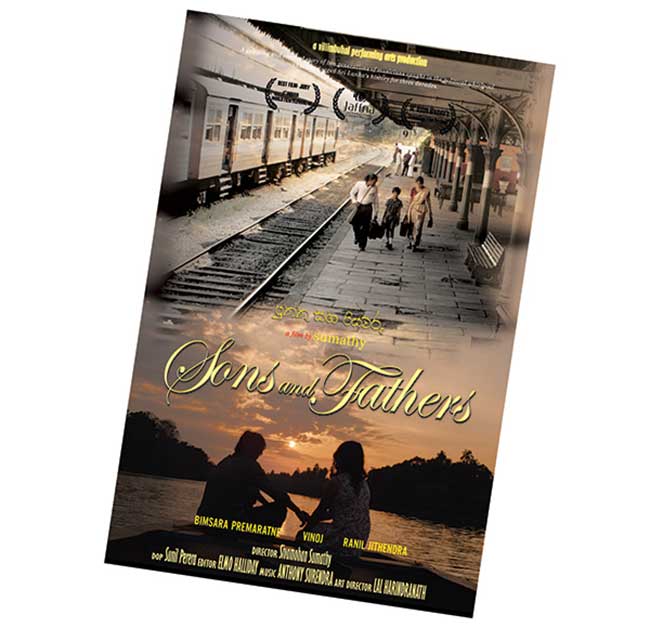
a film by Sumathy – Part III
Continued from Wednesday
The Mother’s Song and its Loss
Towards the very end of the film we see Rex, Kanthi and their daughter absorbed in something on their TV. For the first time we see them in large close-ups (rare in this film), while the camera tracks between them, bringing each of them very close to us. A cut to the TV reveals Champa singing Lucky’s ‘mother’s song’ with orchestration, in a polished, well trained, sweet voice, dressed tastefully in a matching sari and blouse, producing the requisite well-rehearsed gestures and artfully-wistful smiles for the camera. What we have heard and seen so far is of this song’s unusual circulation from a mother to a son whose childhood was nourished by his mother singing it often.
We see its social circulation when Kanthi is invited to sing a song by her guests who appreciate her voice and the song. She sings with ease and grace, dressed now in an Indian sari, wearing a pottu and her knee length hair in a single braid.
But we also hear the song at intense moments of fear and sadness, as when Kanthi sings it to herself after having looked at a photo album. But on the television it appears as a song ‘stolen’ from the family by Champa, without a thought for royalties, having violated something above and beyond the provenance of a song.
As the threesome watch Champa’s polished performance of their own song, Kanthi begins to mouth it silently, while Rex looks on utterly bereft but still beating time to the song he composed for his beloved wife, while the camera rests on Mala who looks straight at us for the first time, as the shot ends. Was she angry I wondered, trying to read her contained intense expression.
The careless, cool ease with which Champa becomes a professional singer and sings the song publicly contrasts starkly with a singular rendition of it by Lucky. While in his bedroom (with a blurred poster of John Lennon on his wall), Lucky spits out a snatch of Rock music, but in the club, he sings his mother’s song almost to himself, in a caressing whisper, before the band has to strike a ‘Happy Birthday’ with the sound of breaking glass in the distance; a complex sequence in montage.
Lucky is presented as a tender, generous and most vulnerable young man, and through his allegorisation as The Terrorist, at the movie theatre, we might be able to see how even such a person may become a ‘terrorist,’ cornered, crushed, with avenues for professional movement all blocked for him and his family.
In doing this the director makes an exemplary figure of a Lankan artiste whose cultural heritage is mixed, hybrid, not monoculturally pure. It’s nothing to do with his ‘pure blood’ (Sinha-ley,) but rather a matter of access to learning, fair opportunity and a shared understanding of a rich multi-cultural world (including India), open to the outside world.
That it is a Sinhala actor who is personified as a Tamil Terrorist (who in his actual life sings in Tamil), is significant, because some of that brutalising process is ‘demonstrated’ through the political device of allegory. There is no ‘conversion’ of Lucky into a Terrorist because we see both Lucky and the persona of the Terrorist in his gesture of shooting at an image, with an invisible gun. In the movie theatre, he is not a symbol or a metaphor, but functions as an allegorical body. Allegory makes us see double, and stays with the unresolved duality, and lets it trouble us, as it did Malin and me. That splattered red on white appears as both blood and some red paint, and the white background both a movie screen and a pure white surface, both at once. Such a mode of allegorical viewing goes against our habitual and ingrained ways of consuming films.
Some of us, who have spent all our working lives teaching film and have also grown-up watching lots of all kinds of films (in a long-ago vanished Ceylon in my case) believe that when it’s time to take leave, the Angel of Death will arrive and give us a chance to see just two film clips one last time. Now, I will unhesitatingly choose Dharmasena Pathiraja’s film Ponmani, made with his Tamil friends, while he was teaching Sinhala literature and Media Studies at the Jaffna University in the ‘70.
It’s the haunting funeral procession of Ponmani, with her coffin in a horse-drawn glass carriage, led by a slender man in shorts, filmed in a formal long-shot against a lagoon and an expanse of sky, with her father walking alone some distance away from the mourners, as his Vellala family was estranged from her. For having violated caste taboos, she was shot dead by a killer hired by her betrothed, as she came out of a church with her new kin group.
The Karnataka song we had heard sung repeatedly, by a group of seated female singers (about longing for Krishna to appear), plays across this desolate shot one last time.
The other clip is of the seemingly every-day banal high-angle-shot of the family of three walking towards us on a railway platform. In long to medium shots from Sons and Fathers, we see Rex, Kanthi and Lucky as a boy, walking between them carrying small suitcases of their possessions. The couple has just got married at a registry (with minimal formality, with just four smiling in-laws) and are coming home to live with Rex. Kanthi is dressed in a Kandyan sari and Rex has long curly hair tied at the back. Seeing that shot of the threesome, who are being observed by an adult Lucky leaning on a railway bridge (a pensive ‘recollection image’), it becomes an iconic shot for Sinhala cinema, suggestive in its promise of rich potential for our art and much else.
Variations of this shot, of them climbing the long steps of the station, are repeated several times like the refrain of Lucky’s beloved mother’s song.
sumathy wrote the lyrics for two of the four songs in the film. Vantharu Vanthachu (‘He is coming’ with apocalyptic events of bombs destroying the earth, elephants in trees, wrapped in a love song), is sung in Tamil.
The Mother’s Song, written in English, is translated for the film by Amarakeerthi Liyanage, a Professor of Sinhala and a specialist in Comparative Literature. Anthony Surendra, the Tamil music director of the film, wrote, composed and sang My Heart (Ma Hade) in the film at a recording studio and is the song Kanthi hums to Rex’s accompaniment at the keyboard (and also to an infant Kamala), in a most unusual romantic scene. When asked, sumathy said that she was thinking of Desdemona’s Willow Song while writing what she calls ‘The Mother’s Song’ for the film. The Shakespearean ballad was given to Desdemona by her mother who had received it from her maid.
She makes a significant change in her song, the ‘betrayal’ there is no longer sexual as in the original folk ballad sung by Desdemona before Othello kills her in a fit of jealousy. But in the film, it becomes Champa’s thoughtless, cunning betrayal of Lucky and his mother.
The way Sumathy presents Rex Periyasami, Mudiyanselage Kanthilatha, Lakshman and Mala as a multi-ethnic family, makes one feel that they will survive the fire that set Lanka ablaze then, stronger in the essential values that bind them together, but no doubt at great cost to their livelihoods and futures, in creating the hybrid music, their very life-blood, which Kanthi says emphatically, ‘saved them’. Sumathy’s Sons and Fathers is her poetic tribute to those values that bind that family and the ethnically diverse Lankan popular film and music industry where those values also flourished, once.
However, Malin’s singular question to his mother, and Mala’s last look to the camera, perhaps of anger, make an old critic like me imagine that they must be big by now. And in so doing, I hear faintly Rukmani Devi singing, ‘mavila penevi rupe hade …swapneya chaya …’ (in my heart emerges a dream-image … of life) as I fall asleep, perchance to dream.
(Concluded)



APPRECIATION
On Friday, the 20th of March, Vijitha Senevirathna would have celebrated his 85th birthday if not for his sad passing away nearly a year ago.
The passing of Vijitha was a moment of great sorrow to all who knew him.
He was my classmate from Montessori to pre-university at Maris Stella College, Negombo. As a Maristonian, Vijitha excelled in his academic studies.
Eventually, he entered the Law College and practised as an Attorney-at-Law and Notary Public for over 50 years.
As an Attorney-at-Law, Vijitha earned the respect of the judiciary and a wide circle of clients. He upheld the highest and most cherished values of the legal profession and earned the trust of all who knew him. His 50th anniversary in the noble profession of law was celebrated with much pageantry, amidst a distinguished gathering of friends, relations, clerics, and the rich and famous of Sri Lanka.
Vijitha dearly loved his proud wife Nirmali and his six children, who are in the highest professions in Sri Lanka. He inculcated among his children professional efficiency, diligence, and honesty.
We who associated closely with Vijitha miss his warm friendship, sense of humor, and animated conversation. He was a raconteur, and people gathered around him and listened to his narrations and tales of yore, especially at the many celebrations at his residence in Dehiwala, where the waters of Scotland flowed generously.
I have personally admired Vijitha’s patience, grit, and lifetime achievements, despite a physical dysfunctionality he suffered over his lifetime.
For Vijitha, the song has ended, but the melody lingers on, in the words of the popular composer Irving Berlin.
Merrick Gooneratne

China has invested more than USD 60 Billion in Venezuela and plans to invest further in that country. This is happening despite the abduction by the US of Venezuela’s president Maduro and his wife and US President Donald Trump’s boastful claim that he will be selling Venezuela’s oil. And what is even more surprising is that the Venezuelan Ambassador to China says nobody but Venezuela will decide the price of its oil and to whom it sells. He has assured that Chinese investments in his country will be safe and secure.
According to media reports, Venezuelan Ambassador to China, Remigio Ceballos, has stated that Venezuela will determine the price of its oil exports to China independently, asserting that prices will follow international market trends rather than dictates by the United States. Ceballos has stated that Caracas “will not heed the arrangements of the US or other countries” on oil pricing. The remarks followed reports that the U.S. is planning to exercise control over Venezuela’s state-run oil company, PDVSA, and potentially push prices down to $50 per barrel. Ceballos sought to reassure China that its investments in the South American country remained secure, emphasising that China and Venezuela are “trusted partners”. The ambassador clarified that despite geopolitical tensions, Venezuela would not follow Washington-led pricing structures, ensuring its oil remains competitive. These statements came in response to intense geopolitical maneuvering in early 2026 regarding Venezuela’s oil sector and its ongoing energy relationship with China (CNBC, 4th Feb. 2026).
Failure of agression
These developments reveal the failure of aggression in the face of support and cooperation. The US imposed crippling sanctions on Venezuela while China helped it to survive. Finally, true to form, the US did what it does best, take out the leader, like it did in Iraq, Libya and several other countries. Nowhere has this strategy succeeded, whereas the Chinese Belt and Road Initiative has been welcomed in most countries in Asia, Africa and the Middle East. China provides leadership in several key international associations and organisations designed to foster, or in some cases offer alternatives to, the existing global order. Key groupings include the Shanghai Cooperation Organization (SCO), BRICS, and the Asian Infrastructure Investment Bank (AIIB), alongside specialised UN agencies and regional forums like the Forum on China-Africa Cooperation (FOCAC). In contrast most of the US led organizations such as NATO, QUAD, AUKUS, are military alliances. Further, the US has defence agreements with several countries which are strategically vital for its interests, in the Middle East, Africa, Americas and Asia. China does not have a formal alliance requiring it to fight for another country. China adopts an anti-alliance policy and officially opposes NATO-like military alliances, arguing they create “small cliques” that cause confrontations in the region. China focuses on strategic partnerships rather than formal blocs, treating various countries as partners to avoid the confrontational nature of alliances.
With regards to aid, while the US focuses on capacity building China seems to believe that infrastructure development is more beneficial and would help the recipient country to develop its economy and be independent. Sri Lanka has experience with these US capacity building programmes and know that they are more often aimed at influencing the participants to change their political orientation and to be aligned with Western socio-political ideology. It is said that these programmes may have helped the US to bring about a regime change in the country. In Cambodia, too, the US has conducted capacity building programmes which the discerning Cambodians are suspicious of. China is the largest source of Foreign Direct Investment and top trading partner for Cambodia, with investment totaling over $23 billion by mid-2024, heavily focused on manufacturing, infrastructure, and real estate. Key projects under the Belt and Road Initiative include highways, hydroelectric dams, special economic zones, and the $1.7 billion Funan Techo Canal.
Bid to counter Chinese influence
The US attempts to counter the burgeoning advances of China by use of force. The abduction of President Maduro of Venezuela, the country with the largest oil deposits and increasingly coming under the influence of China, was its diabolical response. This criminal act shows the poverty of the US strategy. What it could do instead is develop cordial relations and respect the rights these countries must have in deciding on their socio-political structures and help them to come out of poverty without bullying and exploiting their resources. If that had been their policy no other country would have an opportunity to get a foothold in their backyard.
Iran joined the BRICS and was in the process of mending its fences with Saudi Arabia, a staunch ally of the US, with Chinese mediation. Saudi Arabia was also joining the BRICS, which is not well-disposed towards the US. China was planing to invest heavily in Iran. China and Iran signed a 25-year, $400 billion strategic cooperation agreement in 2021, aiming to boost energy and infrastructure.. The US and its ally in the Middle East, Israel, could not silently watch those developments that they saw as a threat to their hegemony and dominance in the region. The US felt the need to thwart the Chinese advance and also the growth of BRICS while Israel saw it as an opportunity to wipe out the opposition to its master plan of total genocide of Palestinians and grabbing their ancestral land in whole.
After killing Iranian supreme leader and bombarding the country into what they thought was submission, Trump said he must have a say in the appointment of the next leader and also that Ayatollah’s son was not acceptable to him. He demanded unconditional surrender of Iran and said there probably would not be anybody in Iran even to declare a surrender. Iran has not only said it will never surrender but also gone ahead and appointed the murdered supreme leader’s son as his successor. Trump said the Iranian navy was gone, its air force was gone, missile stockpiles were gone and it was already defeated. But Iran miraculously continues to fire missiles at Israel and US bases in the neighbouring countries.
Iran probably will be defeated in the war, but whether the US and Israel will achieve their goals is most unlikely. The underlying reason for this conflict is the problem of Palestine. The two-state solution adopted by the UN could be the basis for peace. The US knows this but it does not want peace in the Middle East. It can exploit the oil resources in the region by keeping it under eternal turmoil. This policy perfectly suits Israel as well and it exploits the situation to commit genocide of the Palestinians and grab their land.
In this era of multipolarity with several countries possessing long range missiles and nuclear capability and several of those countries being not in friendly terms with either US or Israel, re-arming, re-grouping and re-emerging of forces that will continue the anti-imperialist, anti-expansionist struggle cannot be prevented.
If only US, Europe emulate China
If the US and also the influential Europe could see how beneficial the policy adopted by China could be to everybody living on this planet, there would be peace in the world. This is what the Chinese have been telling the West while it engages in confrontation and aggression against those who do not fall in line and abide by their dictate. Chinese have shown their readiness to help everybody without discrimination, whether foe or friend of the US. China has significantly increased its investment in Saudi Arabia and other US allies in the Middle East, with 2024 seeing a record high in BRI (Belt and Road Initiative) engagement—reaching $39 billion in construction contracts and investments in the region. Saudi Arabia has emerged as the top recipient of Chinese investment, with over 93 projects initiated since 2021 despite it being one of the staunchest allies of the US in the Middle East with a large US military presence. The US has its largest military base in the Middle East in Qatar. Yet China has heavily invested in Qatar, primarily focusing on energy, infrastructure, and financial sectors. Major investments include Sinopec and CNPC securing stakes in Qatar’s North Field East LNG expansion projects, as well as significant participation in infrastructure projects like the Hamad Port and Lusail Stadium.
Vietnam, a victim of US aggression, has recently signed a defence cooperation agreement with it. Yet China has invested heavily in Vietnam, becoming a top source of foreign direct investment and leading in new projects as of 2025–2026. Chinese firms are investing billions in high-tech, electronics, and manufacturing in Vietnam, with over $6.7 billion pledged between January and November 2025.
Based on reports from international human rights organisations, the U.S. Department of State, and various news analyses, Saudi Arabia is widely considered a highly repressive, authoritarian country with intensified crackdown on political dissent, freedom of expression, and human rights activists. In 2016, the kingdom executed 146 people, including a mass execution of 47 men on January 2. The US says it’s attacking Iran because it is repressive, but in truth it is doing so because Iran does not toe its line, Saudi Arabia does and goes scot-free.
All in all, in this imperfect world what everybody must do is help each other disregarding their imperfections. If the US and also Europe try to emulate China, the world, in the least, would be safer.
(Some information contained in this article is from Wikipedia.)
by N. A. de S. Amaratunga

My father was an ardent believer of astrology. It was his hobby. As a result, not only my family, friends, and neighbours had horoscopes, but our pets also had their own. No need to say, my early life was choreographed according to celestial movements. When I sat for my ordinary level exam, father came up with an auspicious time to leave for the exam. This posed a huge logistical and psychological challenge. I was at Ananda hostel at that time, and he suggested that I leave at the auspicious time, which was more than an hour ahead of start time, sat in the basketball court until the doors open to the examination hall.
I told him no way. Not only that I would be laughingstock, but it would also disrupt the daily routine of study hall, breakfast, and arriving on time without wasting precious time, and disturbing the important mental harmony. By this time, I also had developed enough courage not to accept tradition without justification, mainly thanks to Ven. Kotagama Wachissara thero, our Dhamma teacher. It must have hurt his feelings, but my father backed out. I did well in the exam, and that was the last time I had anything to do with astrology.
Not exactly, when we got married, our parents came up with an auspicious time for the traditional ceremony, but due to a logistical hitch, we missed it. Not to worry, after five decades, the spark has not left and things are going smoothly. Since then, we have moved across continents, taken up jobs, moved into houses, and brought up kids without the assistance of astrology. Similarly, I know countless people who lead successful, happy, and prosperous lives without ever having heard of astrology.
Vedic Astrology, also called Jyotish, originated over 5,000 years ago in India. It is deeply rooted in the Vedas, ancient Hindu scriptures. Western Astrology began around 2,000 years ago in Mesopotamia and developed further in Greece and Rome. For millennia, humanity has tried to correlate celestial movements with terrestrial events, especially seasonal changes, for the benefit of agriculture, maritime navigation, and trade over long distances. This “mundane astrology” was a practical effort to bring order to a chaotic world. Naturally, the ancients extended this study to interpret the effect of celestial events on the individual. Vedic Astrology emphasises spiritual growth, while Western Astrology focuses on personality and psychological traits.
Until the 17th century, astrology and astronomy were virtually indistinguishable. Great scientists like Johannes Kepler and Isaac Newton practised astrology or lived in a world where it was considered a legitimate academic discipline. However, Enlightenment, or the Age of Reason in the 17th–18th century, which emphasises reason, individualism, and skepticism toward tradition introduced a rigorous scientific method that astrology could not satisfy. From a physical standpoint, the gravitational or electromagnetic influence of distant planets on a newborn human is negligible compared to the influence of the immediate environment. Parenting, education, and social background, for example.
Consequently, the scientific community classifies astrology as a pseudoscience, noting that its predictions rely on the tendency for people to find personal meaning in vague, generalized statements. Once a person starts believing this system, they tend to seek out and remember information that confirms their beliefs while ignoring or rationalising the many times the predictions were wrong. Phrases like “You will go through a difficult time during such a period” feel personal, but who would not go through challenging times in their lives. This is called the Barnum Effect. In times of high stress or uncertainty, astrology provides a sense of structure and predictability, making a chaotic world feel more manageable.
Vedic Astrology uses the sidereal zodiac, which aligns with the actual positions of stars and constellations. In contrast, Western Astrology relies on the tropical zodiac, based on the Earth’s seasons. The sidereal zodiac reflects fixed star positions, while the tropical zodiac shifts due to the Earth’s axial precession. Unlike my father, I know nothing about astrological calculations, but I wonder if the current disagreement on the New Year auspicious times is a result of following such different methods.
There is some validity in having a unified timetable for major events as it can coordinate and bring together a community, or an entire nation in this case. It is a good thing. However, it cannot be denied that astrology is a belief system that the individual must decide to accept or reject depending on their own wishes. Expecting the government to take any part in endorsing a belief system that has absolutely no empirical evidence goes beyond lunacy. Where would it stop? Do we expect the government to decide the auspicious time to get married, indula katagema, or akuru kiyaweema of children? Instead, we must demand our government get out of pandering to belief systems of any nature and focus on the business of governance based on facts and figures.
In our household, we celebrate New Year to suit our lifestyle: we cook a special meal, but on the same old stove, at our convenience so that it does not disrupt the regular mealtimes and share it with family and friends. It is a social event for sharing fun and goodwill. We tell the children about the traditions, how they started, and the food, but we do not expect them to subscribe to any belief systems and engage in meaningless activities that waste their time and resources. We expect them to grow up to be realistic, yathabutha, not bahubutha, as my grandfather would have said.
by Geewananda Gunawardana

SriLankan Airlines Alerts Customers to Social Media Scams

Four dead 32 injured in head on collision at Weerawila

JMSDF ship OONAMI concludes goodwill visit

Cabinet nod to amend Central Cultural Fund Act No. 57 of 1980
’National Namal Uyana’ declared as a National Heritage
Establishment of Supervisory Committees for restoring economic activities.

‘Dates have the highest sugar content to fight Coronavirus’

Sunday Island 27 December – Headlines

#SundayIsland 17th December – Headlines

Sunday Island – 28th March

Sunday Island Headlines – 21 March

Sunday Island – 21st February – Headlines
-

 News7 days ago
Historic address by BASL President at the Supreme Court of India
-

 Sports7 days ago
The 147th Royal–Thomian and 175 Years of the School by the Sea
-

 Business3 days ago
Browns EV launches fast-charging BAW E7 Pro at Rs. 5.8 million
-
 Life style4 days ago
From culture to empowerment: Indonesia’s vision for Sri Lanka
-
 News7 days ago
Power sector reforms jolted by 40% pay hike demand
-

 Latest News3 days ago
QR code system will be implemented for fuel with effect from 06.00 a.m. today (15th)
-
 Opinion6 days ago
M. D. Banda: Memories of Appachchi – II
-
 News5 days ago
Crypto loopholes funnel Lankan funds abroad